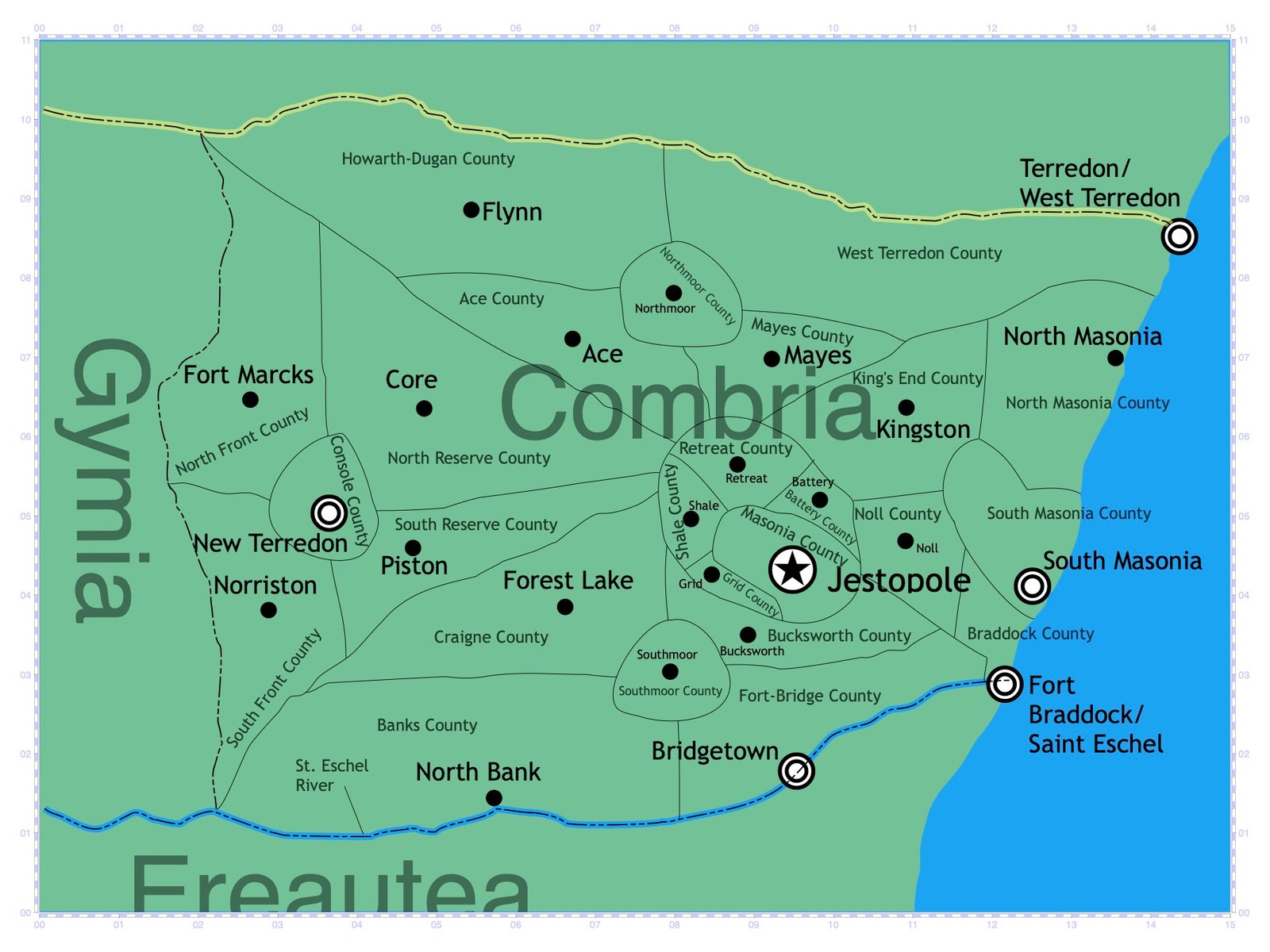
*The content of this entry remains largely unaltered from the previous version; although some minor changes have been made.*
Preface:
Combria is the Northeastern-most province of the Independent Commonwealth State of Return (the ICSR), and borders the Kingdom of the Great North. Jestopole, the provincial capital of Combria, is home to the University of Combria and the House of Masons.
Establishment and Progress:
Founded by William Jeson in 1086, Combria was initially its own nation, over which the House of Masons governed, serving as both the incumbent-appointed presidential council of the nation and the leadership of the hubstone industry. Throughout history, leadership within the ranks of the House of Masons would be volleyed over by two rival families: the Leons and the Kontacets.
Aside from the political contests, the nation of Combria led the Circlarian Realm through a period of technological progress over the next fifty years, as the House of Masons pioneered the invention of automobiles, aircraft, and electricity. By the 1130s, other societies in Remikra, Canticula, and the remainder of the Circlarian Realm began developing their own hubstone infrastructures; and so Combria preserved its brand began to settle into a culture of Combrian tradition in order to shut out foreign competition. Between 1161 and 1162, a series of measures of compromise between the House of Masons establishment and the working classes converted the industrial sector of the House of Masons into a semi-democratically-run organization, with the caveat being that incumbent leadership figures set the rules on candidate qualifications (only Leon and Kontacet family members qualified). In 1165, the national government of Combria re-established itself in the newly-founded city of Hasphitat and separated itself from the House of Masons, which remained in Jestopole; thus, the House of Masons was no longer an actual government entity. However, the House of Masons continued to serve the growing hubstone industry.
The Early Republic:
Throughout the 1240s, the House of Masons survived a civil war and a succession of transitional governments. Following the establishment of the Federal Estates of Retun (the Early Republic), the area encompassing the Five Original Districts of Combria became the Province of Combria, with its provincial capital in Jestopole and government seat a separate entity from the House of Masons. Twenty years later, then-Prime-Minister Edward Jackson enacted policies expanding on free enterprise and economic growth by initially taxing large business firms. The House of Masons responded to this by establishing itself, on paper, as a non-profit organization and placed investments in lending banks, which loaned capital to entrepreneurs, most of whom happened to be Leons and Kontacets. These entrepreneurs signed contracts calling for shares of profit to go toward "retirement trust funds" for the House of Masons, which would pay out to retiree business executives. Meanwhile, "necessity funds" would be paid out to other business figures within this network. Furthermore, to reduce the possibility of lawsuits and negative publicity, the House of Masons made special business contracts with media outlets.
The 1276 Resolution, which eliminated restrictions on banks and large businesses, helped to simplify the economic structure surrounding the House of Masons, which relinquished its status as a non-profit organization and acquired the businesses with which it previously signed contracts. Also beginning in the 1270s arose the henshale industry, which provided serious competition against the hubstone industry. The House of Masons paid lobbyists to convince county governments throughout the provinces of Combria, Ereautea, and Gymia to pass laws banning henshale cars and machines. This had "patchy" success, with some counties banning henshale technologies and other counties, having encountered lobbyists from the henshale industry itself, banning hubstone technologies. However, in the late 1290s, then-Prime-Minister John Waltman signed the National Transportation Act, which overrode the county-wide bans and allowed for the freedom of choice for car owners between the two competing industries. The henshale industry remained a competitive industry until 1311, when henshale reserves ran dry.
The Commonwealth:
Following the 1309 Revolution and the establishment of the Independent Commonwealth State of Retun (the ICSR), sweeping national legislation required every business, including the House of Masons, to become truly democratically-run; and for about five years, the House of Masons was governed by third-party leaders (neither Leons nor Kontacets). In 1317, however, the Kontacet family launched an agenda to arrange contracts with foreign media outlets to endorse Leon and Kontacet candidates to House-of-Mason employees within House-of-Mason property limits. This technically did not violate any legal terms since the previously-mentioned legislative changes still paid respect to the concept of private property. And thus, the Leons and Kontacets effectively regained control over the House of Masons in the years that followed.
In the 1380s, the Leons and Kontacets merged to form a collaborative organization: the Leon-Kontacet Trust, which existed separately from the House of Masons. And through numerous company elections, the Leon-Kontacet Trust legally acquired dymensional-fire businesses throughout the province of Combria, and eventually the entire Commonwealth. In 1399, James Lawrence Kontacet became Prime Minister of the ICSR and passed budget reconciliation measures to further the ability of the Leon-Kontacet Trust to lead an effort to "commercialize" the national platform of the dymensional-fire industry: the Library of Circlaria. Kontacet's agenda had a profound influence on the Library, and would continue until the economic shake-up enveloping Remikra between 1399 and 1400. The Library was still in its early stages of development, and investor confidence partially diverged toward the scriptfire industry while the Leon-Kontacet Trust would eventually cease to exist. Nevertheless, the commercial aspects and consistent standards originating from Kontacet's short-lived term as Prime Minister are still present in the Library today. Furthermore, investor confidence has long-since recovered.
Presently, dymensional-fire and scriptfire sub-forums are integrated, following negotiated mutual agendas formed in parallel to the RAD Party Reunification Movement. This newly-solidified platform dominates the Combrian market while the House of Masons continues to meet the supply-and-demand quotas for the Circlarian hubstone industry.