
Image by Leslie Faye
Many scholars believe that wysps are some of the earliest life forms to have ever come into being. In fact, many believe that wysps may have existed on the super-earth planet before its split into Juno Minor (this world) and Nephina.
Wysps are lifeforms each containing a semi-stone-like body the size of a grain of sand. However, every wysp navigates its environment through its extensive spellfire-charged-particle energy field.
The fusion of DNA into the small semi-stone-like body gives immediate birth to a wysp. This clump of DNA grows and expands until the wysp's death. Wysps metabolize nutrients through their pseudo-magnetic fields, which pull in matter particles and spellfire particles, the combination of which synthesize a certain type of energy that nourishes the sand-grain-like body of the wysp.

Image by Leslie Faye
Wysps survive through the metabolism of nutrients, but also through defense. In discussing how wysps defend themselves, it is important to note the two types of wysps: formed and formless. Formed wysps take on certain shapes, most often serpent-like ones. They also take the shape of other animals based off the matter they consume or interact with. Wysps are conscious of their surroundings; and formed wysps will imitate certain shapes with the intent to scare off perceived threats. In fact, they have even been known to take the shape of humans, evoking fear and superstition in early societies.

Image by Leslie Faye
It is the formless wysps, however, that present real dangers to humans and animals. Formless wysps seem harmless, being shaped like flames or little stars. However, they defend themselves by directly attacking perceived enemies. They do this by either striking their target with spellfire discharges which cause blunt force injury, or by infecting their target with spellfire-infused viruses. In fact, it is believed that such a virus was ultimately what led to the Neurovirus pandemic in Middle Remikra in the 1320s.
And although most of both types are nomadic in nature, there are a few species of wysp, primarily in the Chokian Mountain region in Canticula, that are territorial.
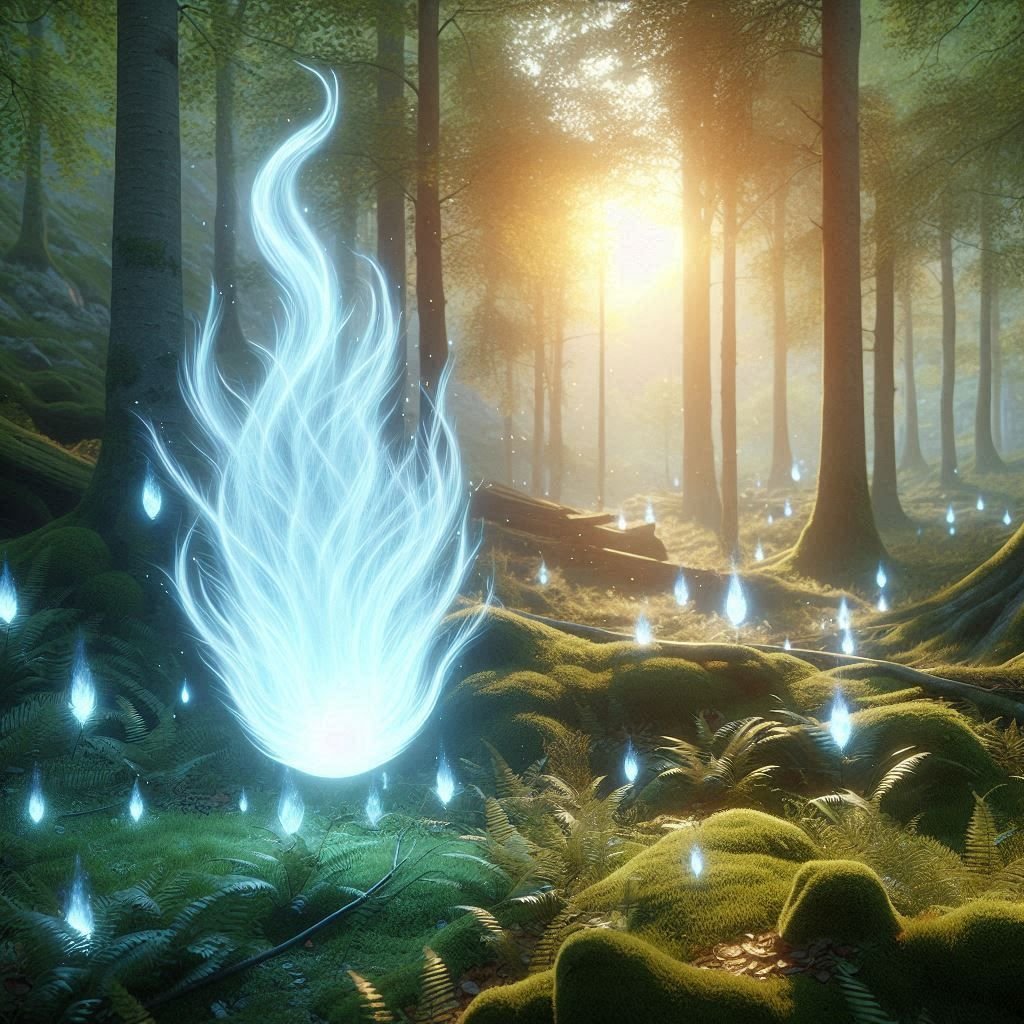
Image by Leslie Faye
Every twelve years, a given wysp will shed strands of its DNA, which float around its energy field. When enough of these are present, the next shedding will cause numerous strands to fuse and spawn new wysps, an event known as a spawning. Early on in its life span, the amount of DNA shed by the parent wysp is less than the amount it produces. However, over time, the amount of DNA the wysp produces decreases. Eventually, there will come a threshold where the DNA shed becomes more than the DNA produced, with such a threshold being known as a said wysp's prime.
The lifespan of a typical wysp is about 1200 years. At the end of this lifespan, the wysp will shed enough DNA that its body can no longer hold itself together. When this happens, the parent wysp will split into a plethora of new wysps, thus marking the parent wysp's death.
This, of course, leaves an important question: Why is the planet of Juno Minor not overrun by thousands of millions of wysps? The reason is because of the plethora spawned, many end up unable to maintain their energy fields and fall to the ground, immobilized as duds. The reason why this is the case is a complete mystery.