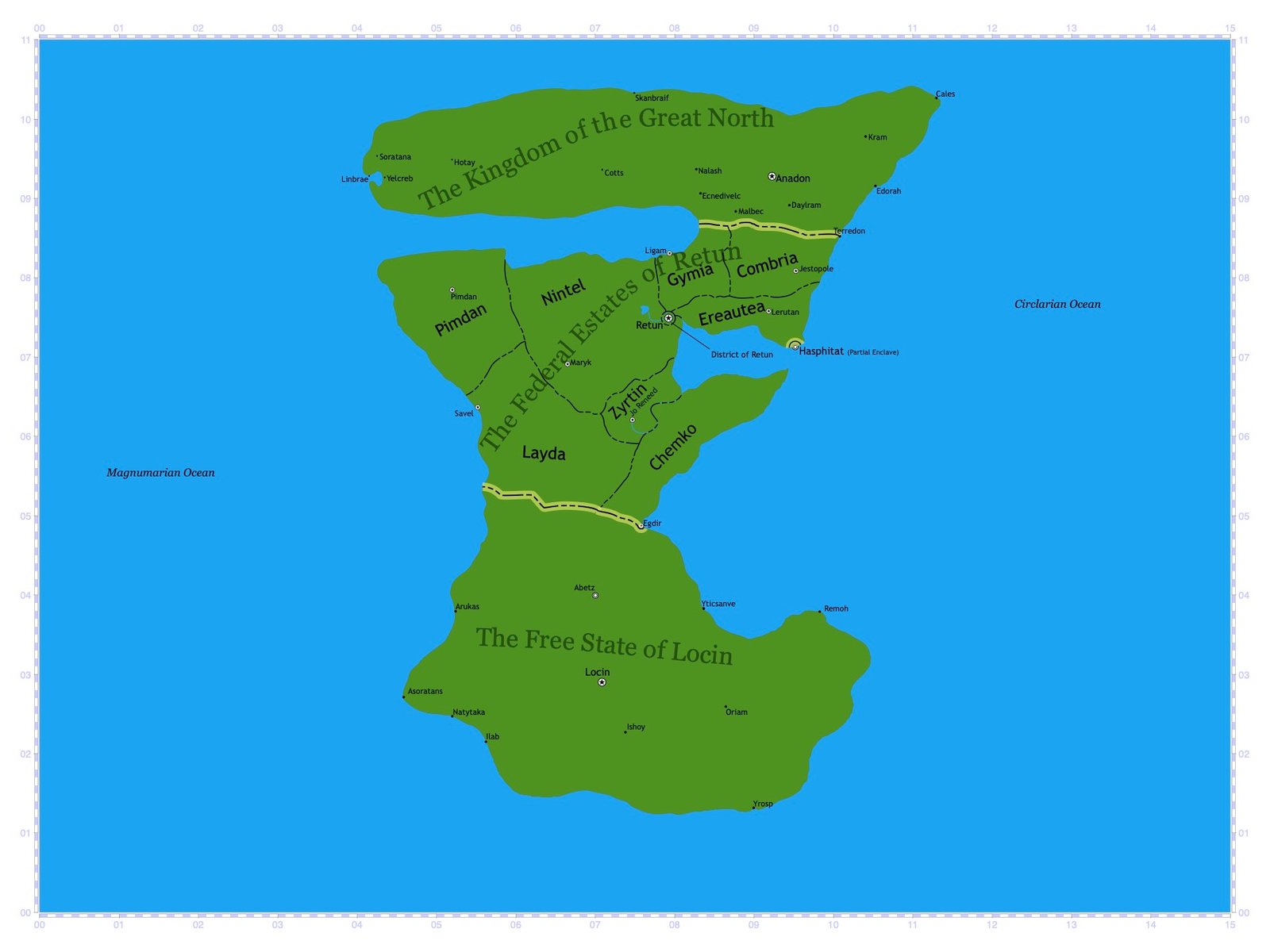
Remikra, 1264-1308
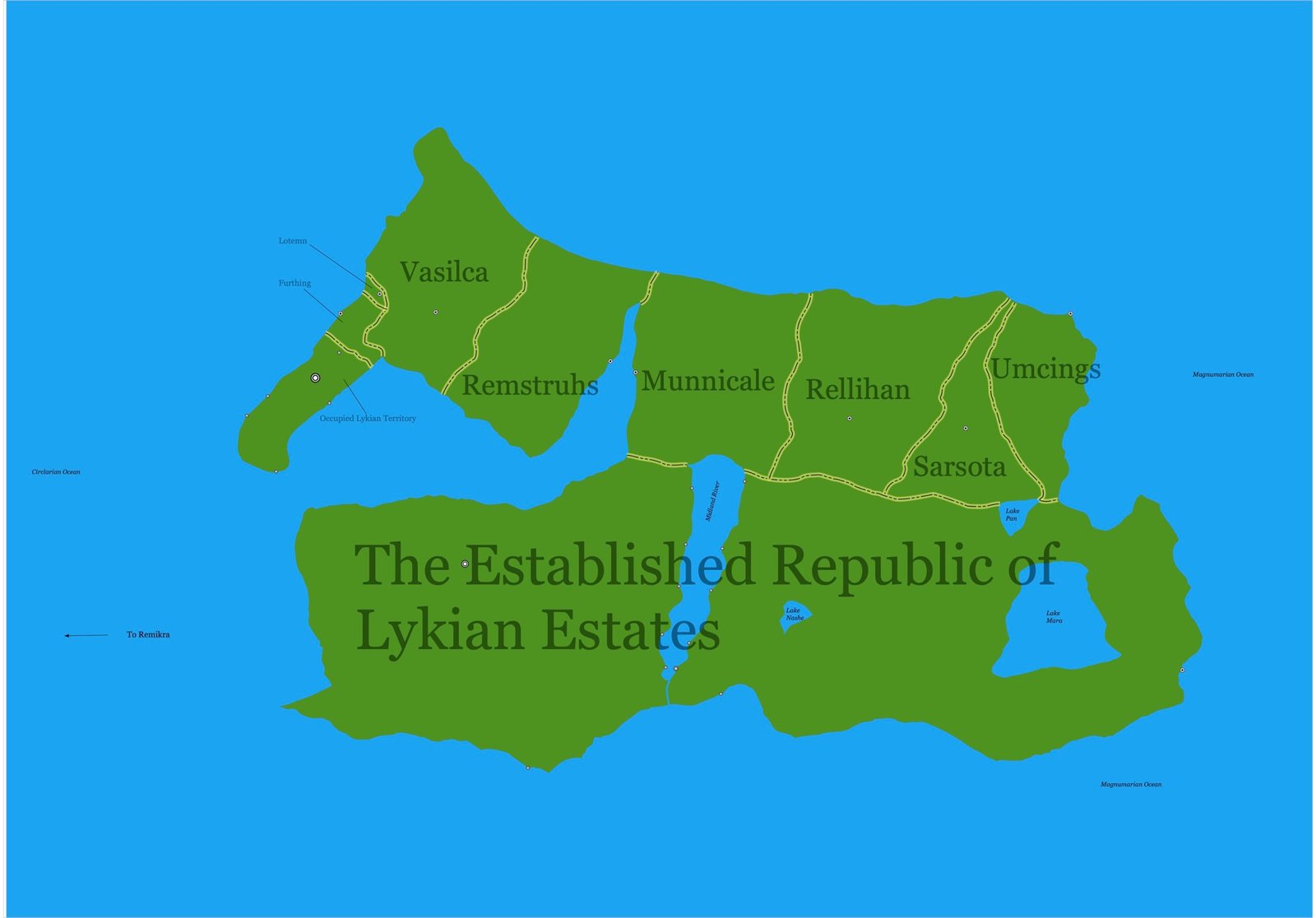
Canticula, 1267-1287
Deep-Trade: Definition
Deep-trade is the spellfire practice of assigning special tradestones to represent certain shares of certain assets of value for a particular business. Licensed spellcrafters can "explode" deep-trade stones in order to produce currency or items of value equal to the value the said stones represent. However, since this is an end-use and there are far more tradestones than licensed spellcrafters available to engage them in a timely fashion, it is a more economic practice for a stoneholder to purchase a tradestone at a particular value, then sell it whenever it increases in value, in order to make a profit.
Retun and Prove: Established Relations
In 1285, a trade arrangement signed between the Lykian and Retunian Republics split the Meredythian Island of Vantacula between the two nations and allowed private businesses to establish themselves here. Legally, all of Vantacula was under Lykian jurisdiction, but the Lykians had decided through the trade deal to lease the Western half of the Isle to the Retunians. Thus, Retunian businesses, primarily deep-trade firms, were allowed to open alongside similar Lykian businesses. Furthermore, a mutual agreement in the trade deal exempted deep-trade transactions between Lykian and Retunian businesses from tariffs or taxation. There was no deep-trade arrangement yet between the two nations, politically speaking, although there was the potential for such an arrangement to materialize in the future, sparking excitement among investors across both nations. In the meantime, deep-trade transactions were facilitated as John Waysworth, a prominent representative of the Bucksworth Financial Institute, headquartered in Hasphitat, established a branch office in Vantacula.
In November 1285, the National Bank for the Lykian Trust, or NBLT, extended an invitation to John Waysworth to establish a Provan chapter for the Bucksworth Institute Tradestone Commission in a high-value office space in the city of Prove proper.
John Waysworth in Prove
John Waysworth accepted the invitation and established the Provan chapter in January 1286. Before long, he began selling valuable deep-trade stones to Lykian banks and businesses, and using the proceeds from this to purchase Lykian deep-trade stones to sell to Retunian tradestone markets. Net proceeds from all of this paid into lucrative dividends, particularly for Waysworth as well as Bucksworth shareholders back in Remikra.
On November 10, 1286, John Waysworth's office in Prove was sacked by Lykian officials, who conducted a thorough search of the premise and arrested John Waysworth, himself. Waysworth was charged with fraud and espionage, and faced a possible death sentence. Retunian Prime Minister Arthur Cummings had just returned from a Summit in Vantacula with Lykian President Restara Unjoy when he was informed of this. Immediately, Prime Minister Cummings sent his best known lawyers to defend John Waysworth in the Lykian court proceedings, an approach that succeeded in convincing the Lykian Justice System to reduce Waysworth's sentence to deportation. On November 14, John Waysworth was taken to a holding cell at a border crossing between the Lykian Republic and the nation of Umcings, where he would wait until a Retunian air reconnaissance unit came to pick him up.
John Waysworth was not informed on when the reconnaissance unit would come. So he decided to escape custody and flee into the surrounding countryside. The issue here was that the border crossing was located in the highlands of the Chokian Mountains, where the climate was cold, snowy, and harsh. Furthermore, the landscape was filled with dangerous wildlife animals such as bears, wolves, and predatory wysps. Supposedly, John Waysworth escaped a close encounter with a bear on the first night, and a close encounter with a wysp on the second night. Finally though, on November 16, an air rescue reinforcement team launched by Cummings upon news of Waysworth's escape assisted the original reconnaissance unit, and spotted John Waysworth. They rescued him and flew him back to Remikra.
The Lykian War
Lykian President Restara Unjoy condemned the so-called Waysworth Scandal, holding the Retunian government responsible. As it turned out, Lykian authorities received a tip that John Waysworth had been selling stagmarcated tradestones, or tradestones worth almost no value being sold to unknowing clients for a falsely high value, hence the reason for the sacking of John Waysworth's office in Prove on November 10. And when they searched the premise, Lykian officials had spellcrafters "explode" three of John Waysworth's tradestones, which turned out to be duds.
How did the Lykian authorities find out about John Waysworth's scandal in the first place? During the Summit between Prime Minister Cummings and President Unjoy, which took place on November 6, Prime Minister Cummings sent a letter to President Unjoy asking for her and her family to join in on the Scandal. The issue with this approach was that the NBLT, the primary bank victimized by the Waysworth Scandal, was the very institute in which the Unjoy family had deep stakes. The Retunian public in years to come would condemn Prime Minister Cummings not only for taking part in the Waysworth Scandal, but also for his daft judgement behind writing the letter to President Unjoy. Needless to say, the Retunian Prime Minister's decision at the Summit made absolutely no strategic sense.
Regardless, President Unjoy, on December 24, 1286, issued executive orders freezing all trade relations with the Retunian Republic and revoking the lease in Vantacula. Subsequently, she ordered Retunian authorities to evacuate all Retunian civilians and businesses off the Isle. However, Retunian authorities refused such orders and called on Prime Minister Cummings, who more than obliged to send in Retunian Marine and Army forces to defend the Retunian settlers from local pro-Lykian partisans consisting mostly of Vantaculan natives. While doing this, Prime Minister Cummings news of the hostility from Lykian leadership be withheld from the Retunian public, as well as informed the Retunian Department of Defense of a "possible local partisan terrorist threat."
In short, Cummings aimed to preserve the newly-gained status quo by defying orders from the Lykian government while trying to prevent the Retunian public from becoming aware of possible Lykian hostility.
Between January 2 and January 23, 1287, Retunian and partisan forces engaged in numerous skirmishes. On January 24, the Lykian Navy arrived, engaging with Retunian forces in a heavy battle across the Isle, another development that Prime Minister Cummings prevented from being disclosed to the Retunian public. Between February 4 and 5, Cummings sent the Retunian Navy, which succeeded in driving all Lykian forces off of Vantacula. Cummings then summoned the Lykians to an "emergency counsel" in order to negotiate peace and territorial concessions, an invitation to which the Lykians responded with cold silence.
On February 6, 1287, President Unjoy ordered high-flying Lykian aircraft to drop Red Desert bombs upon South Masonia, Hasphitat, and the Basin District of Retun proper. Each of those targeted cities was devastated by the attack as the entire Retunian population went into panic. President Unjoy gave a second order for Prime Minister Cummings to surrender all of Vantacula.
Prime Minister Cummings refused to comply to this. Between February 7 and 16, 1287, the Lykian Navy renewed its assault upon Vantacula and attempted to take it by force. The Retunians held their ground; and on February 15, Prime Minister Cummings ordered an airstrike on the Lykian base in Gyrosak responsible for the Vantacula initiative.
On February 16, 1287, President Unjoy responded with Red Desert bomb attacks on Egdir and Retun. Later that evening, in the wake of these events, particularly with the city of Retun proper being struck by two Red Desert bomb attacks, Prime Minister Cummings signed a mutual cease-fire with the Lykian Republic. On February 17, the island-nation of Rakara, allied to the Lykian Republic, facilitated the signing of a Treaty by the Retunians to surrender not just Vantacula, but most of the Meredythian Isles to the Lykian Republic. The consolation here was that the Retunian Republic was allowed to keep the five Westernmost Isles.
Thus, the war was over.
Fallout
Retunian businesses lost many of their trade posts. Roughly seventy-five percent of the Retunian trade network around the Circlarian Ocean would eventually be recovered; although the apex of Retunian trade achieved in the early-to-mid-1280s would never be achieved again.
The Retunian population would lose trust not only in Prime Minister Cummings and his Administration, but also the Retunian establishment as a whole. The public was outraged at the John Waysworth Scandal and the gag orders given by Cummings to hide from the public the truth about the Lykian War. A group of Representatives in Retunian Council filed a motion to have Prime Minister Cummings impeached.
In the midst of all this, however, emerged a significant question: Why did Prime Minister Cummings explicitly tell President Unjoy about the John Waysworth Scandal? Speculation arose from this, because in 1285, Cummings and Waysworth had become involved in a conflict of interest over a revised tax code. During that brief exchange of civil hostility, Waysworth vowed to have his firm reduce funding to Prime Minister Cummings' prospective 1290 re-election campaign. This led to speculation over whether or not Cummings' reveal of John Waysworth to President Unjoy was, in fact, a form of retaliation. However, there was no hard evidence to back up this theory.
A major revelation came in the year 1359 with the discovery of a letter to Arthur Cummings from his mother, who lived until the year 1302. It was dated March 10, 1286, months before the Summit in Vantacula. And that letter contained advice from his mother for Cummings to invite President Unjoy to partake in the "lucrative business arrangement" involving John Waysworth.
Scholars initially rejected the so-called "ridiculous and completely ludicrous notion that an elected public official would act on the whimsical advice of a personal family member in this way." However, there are quite a few factors now known about Arthur Cummings. First was that he was known to take advice from his mother without question, even in matters where his mother, though undoubtedly well-intentioned, was not well-versed. Also, Cummings was raised in a very affluent socioeconomic environment; and though he was good at the practice of business, particularly in banking, he did not ace his college courses in history and political science. All of these factors in combination led Arthur Cummings to become extremely, and even dangerously, complacent when it came to making serious decisions like those in a public office.
The impeachment motion against Arthur Cummings in 1287 never made it past a vote in the Retunian House of Representatives. Cummings would encounter another impeachment motion against him in 1295, but that failed as well. However, Cummings would lose the 1296 election against the Progressive candidate, John "Red" Waltmann.
John Waysworth, meanwhile, announced an early retirement in December 1286 and moved to the Mid-Westerlies, where he would remain until his death in 1310.