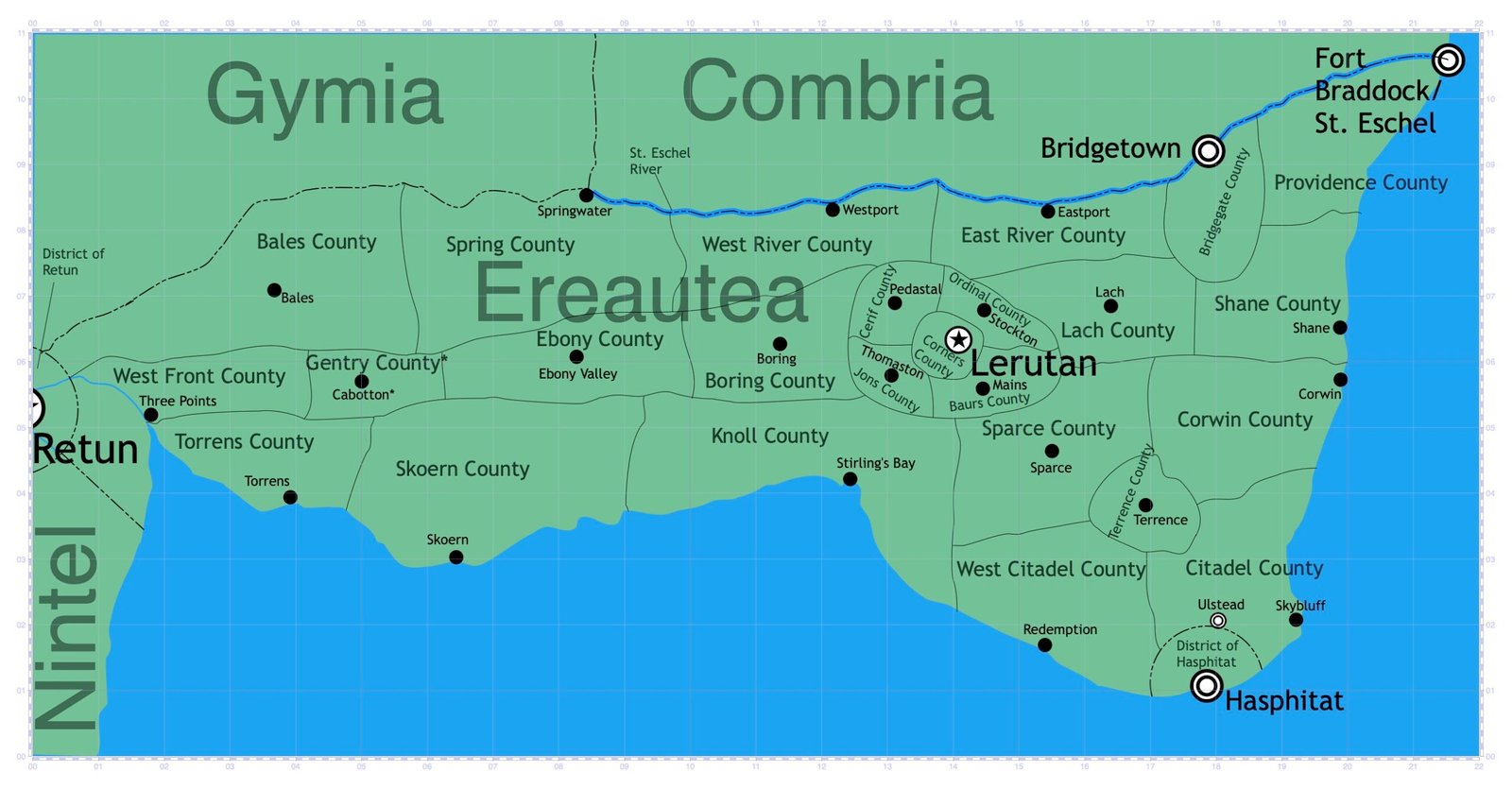
Map of Ereautea, Present
Article Written: 8 November 1456
Even today, it is a matter of speculation whether or not Cixela Esary, herself, was directly behind the event. But what is known, however, is that in 1187, Michael Fvenn led a group of militants, seemingly under the oathcrafting influence, in an attempt to topple the government of the then-District of Ereautea in Lerutan.
SCPC: Trade with Remikra
The latter half of the 1100s saw a period of trade between the Remikran Union and House Esary seated in Notulfa. The Sororal Council of the Primeron Class, led by Cixela Esary as one of the Esarian House Councils, traded directly with the Remikran Union nation of Combria, which was politically unstable at the time. In 1167, the SCPC appointed a directory government to preside over Combria for three days, during which they paid off some debts, sorted out logistical issues, and propagated a "set of virtues." Trade between Combria and the SCPC continued afterward and peaked between 1172 and 1182. And it was during this time that the "set of virtues" introduced by the SCPC began to be propagated by Combrians naming themselves "stewards of virtue." There is conflicting evidence on the direct sources of their influence and how they were able to spread such influence to other Combrians, leading scholars over the past twenty years to begin speculating the possibility of oathcrafting.
Regardless, there emerged a most avowed "steward" by the name of Jon Codon, who began assembling a large band of followers across Combria.
Jon Codon: Takeover Attempt
As factional violence put the balance of power in jeopardy in Combria's new national capital, Hasphitat, the most prominent figure of the Jameson Faction, Jacob Thomas Henry, appointed Jon Codon to the commander position of one of the Faction's militant groups. In doing so, Henry and Codon agreed to a mutual pledge that Codon would offer support for the Jameson Faction both in terms of recruitment and paramilitary defense, and that Henry would, after becoming the next President of Combria, promise to recruit associates of the SCPC to positions of power in his new Administration. In 1184, Henry became the next President of Combria, establishing the Hasphitat National Watch and appointing Jon Codon as its Head. Codon then presented a list of SCPC associates for Henry to appoint, but President Henry stiffly rejected the proposal. Henry's reason was that he had, since the forming of the mutual pledge, researched into House Esary and grew uncomfortable with its far-reaching influence into the land and sea trading guilds across large swaths of Circlaria. He was also uncomfortable with Jon Codon and his followers, citing that there was "more of a force at play on behalf of the seemingly shady individuals in minor but powerful positions of the Sororal Council and the other Councils within House Esary." As an act of safe measure from his perspective, President Henry demoted Jon Codon to the Lieutenant Chief position of National Watch Division Fourteen. Henry's consolation thereafter was to establish a contract of fair trade with the SCPC but vowed that "cross-administrative influence shall remain separate."
Citing that President Henry breached the mutual pledge, Codon expressed contempt and stated that President Henry had betrayed him. He denounced President Henry as "the Head of the Corrupt State," and then rallied his followers to a new resolution: "to subdue Henry's regime and, in its place, established a Combrian State eternally and unquestionably loyal to the virtues of Cixela Esary."
Codon's following grew to include a large number of Division Fourteen Officers. On 6 February 1185, Codon and 112 of these Officers staged an armed attack against the Chadwick Building. They managed to capture the First and Second Levels, but on the Third Level, they were confronted by the Hasphitat National Watch Chadwick Building Security Division, who overwhelmed Codon's forces and brought them to surrender.
Jon Codon was arrested and put on trial, where, on 12 September 1185, he was convicted of sedition and sentenced to death. Codon was executed by firing squad on 6 February 1186.
Michael Fvenn
Michael Fvenn was a lawyer for a family charter business in Lerutan. He was also initially a member of the Leon Faction, rival to the Jameson Faction, but was converted by Jon Codon, who thoroughly indoctrinated him with Cixela Esary's "set of virtues," and had him become a "junior steward" under Jon Codon's close mentorship. Fvenn was deeply saddened by Jon Codon's execution and condemned President Henry's "Corrupt State." With quite a following of his own, Fvenn established the Order of the Esarian Fellowship, an underground organization dedicated to Jon Codon's principles, and began recruiting followers. The aim of the Order was to establish Jon Codon's vision of a "New Combrian State," as Fvenn even named himself the "First Combrian Speaker" to Cixela Esary.
Fvenn's recruitment strategy proved quite effective and successful, consisting of pious individuals dressed in robes as well as armed defenders, the latter of which included body guards and assassins. He started by converting as many followers as possible until a majority of the street on which he lived consisted of them. He swayed the surrounding residential block in a similar fashion, and then continued to other residential blocks across Lerutan. Each converted household displayed nothing conveying loyalty to the SCPC externally, but drapes and symbols lined the walls inside. Fvenn moved on to the surrounding rural townships and found even less resistance to his recruitment efforts.
Moris Perton, the appointed Governor of the District of Ereautea, began growing concerned with this rapidly-spreading movement, citing its "potentially dangerous fervor." On 13 June 1186, Governor Perton acted upon his suspicion by issuing an ordinance banning the Esarian Order in all of the District of Ereautea, and enforced this by conducting home searches, material confiscations, and even arrests. Perton called upon the other Districts and even President Henry to do the same.
On 1 September 1186, under Fvenn's command, members of the Esarian Order blocked important streets and shut down basic functions of infrastructure in the city of Lerutan. In the rural areas, Order members blocked roadways and overran local Council Chambers. This led Perton to partially rescind his ordinance in order to only prohibit public displays of pro-Esarian sentiment. Fvenn made a bargain to President Henry to have the Order peacefully co-exist with him if Henry began appoint SCPC associates to his Administrative positions. President Henry declined the proposition but gave concession by allowing Esarian traders to engage with local Combrian businesses.
However, Combrian laborers not associated with the Esarian Order grew suspicious of possible shady business involving President Henry and the House of Esary, primarily with the SCPC. They united and attempted to negotiate with President Henry for a rollback of the Esarian trade bargain and other similar trade deals, arguing that tariff breaks recently enacted with the SCPC would ultimately lead to higher rent and taxes for the workers. However, the talks failed with President Henry maintaining that revenue expecting to result from trade with the SCPC would eventually balance out and eliminate the financial hardships of the working class if there were any. Henry also asserted that he already had negotiated exhaustively with Michael Fvenn and that any further compromises were not possible.
On 2 March 1187, labor unions across all of Combria collaborated and staged a general strike, which lasted until 22 March when President Henry signed a contract with the laborers rescinding all compromises agreed upon with Michael Fvenn and issued a decree freezing trade indefinitely with the SCPC.
Michael Fvenn condemned the events of March 1187 as being the result of a conspiracy to "employ the mob mentality in order to cement the power of President Henry as the Head of the Corrupt Combrian State." The Esarian Order carried out regular public demonstrations across Ereautea as they trained and armed a large body of new recruits. Fvenn then called for Governor Perton to step down and allow for the "establishment of Ereautea as a State dedicated to the SCPC and independent from the corruption of President Henry." Perton responded with crackdown measures against the Esarian Order street demonstrations. Meanwhile, Fvenn ordered the construction of underground armament camps to train the armed recruits and build "mortar wheel-cannons."
On 3 November 1187, Michael Fvenn launched an onslaught of armed infantry, artillery, and spellcasters against the Governor's House in Lerutan. Governor Perton and his Administration fled the premise to an underground bunker as Fvenn led his forces to storm the Governor's Office. It was here that Michael Fvenn proclaimed himself "Head of the Esarian State of Ereautea," and demanded that President Henry formally recognize Ereautea as an independent nation, giving Henry seventy-two hours to withdraw all national Combrian forces from Ereautea in order to avoid a declaration of war. On 4 November, President dispatched National Guard forces into Ereautea, overcoming the rural regions with little to no resistance and violently clashing with Esarian Order fighters in the streets of Lerutan. On 5 November, being easily outflanked and out-equipped, Esarian Order fighters were overcome as National Guard forces, armed with tanks and proper cannons, surrounded the Governor's House. They gave Michael Fvenn twenty-four hours to surrender and vacate the premise or come under intense artillery fire. Within one hour of the end of that time limit, Michael Fvenn finally surrendered.
Like his mentor, Jon Codon, Michael Fvenn was convicted of sedition but would ultimately be spared from a death sentence. Instead, he was sent to the District of West Combria where he would remain, for the rest of his life, under house arrest in one of his family estates.