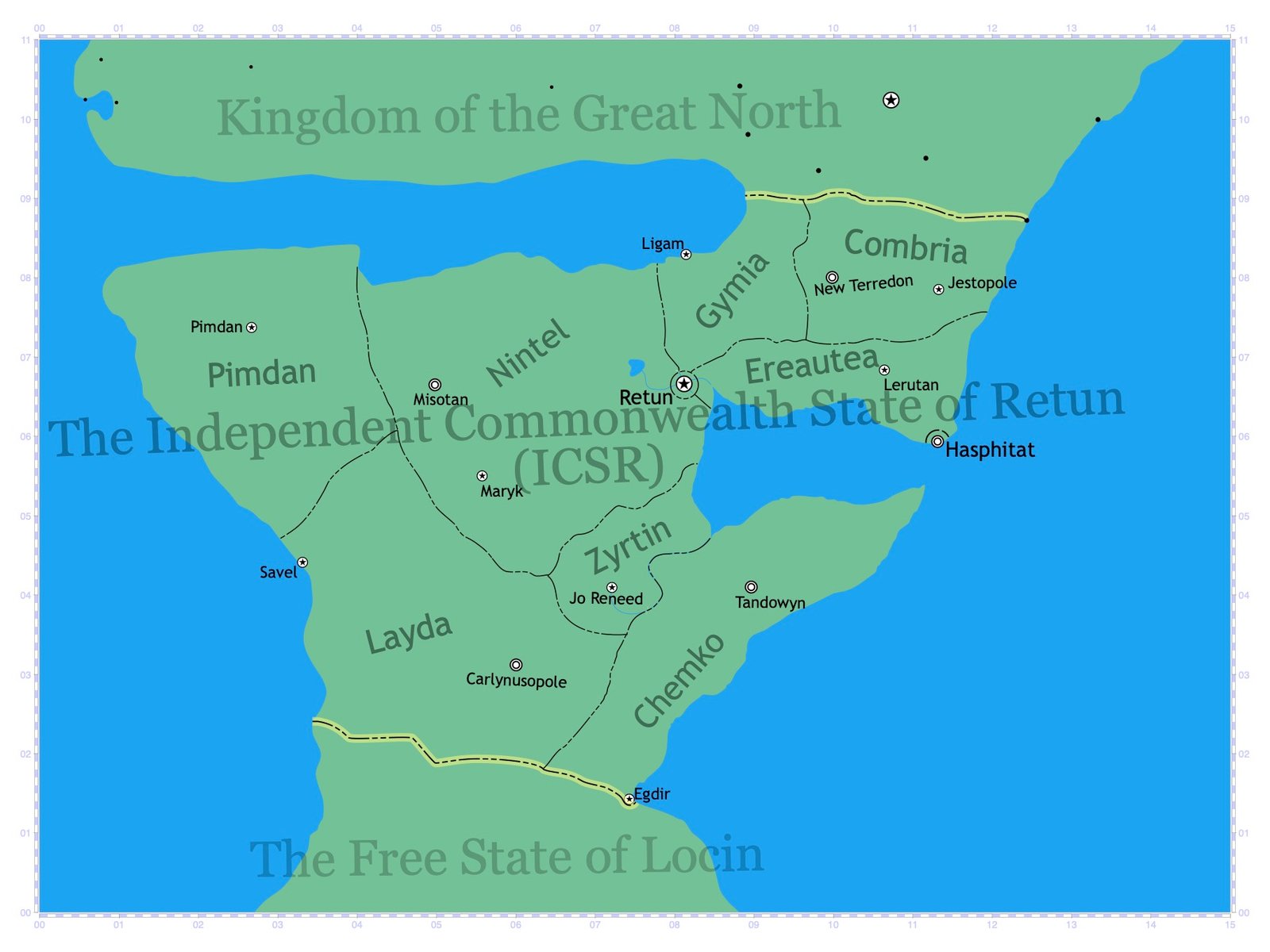
Map of Middle Remikra, Present
Article Written: 16 April 1456
For the past one-hundred years, Middle Remikra has grown more integrated and interconnected in every aspect of life owing to great leaps in advancement in technology, communication, and transit. For example, one can now take a gyroplane from Egdir and arrive in Pimdan within two hours. However, despite such progress, there still remain elements giving distinction to various regions of Middle Remikra; and a few of those elements include regional dialects. For example, what is referred to as the game of "scrall" in Ereautea is referred to as the game of "scrum" in Pimdan.
Combrian Edoran
The first dialect of interest is Combrian Edoran, the official mode of communication used by the government of the Independent Commonwealth State of Retun. It is most commonly spoken in the Basin District, the province of Combria, and most of Ereautea. The dialect originated in Combria in the late eleventh and early twelfth centuries as the nation-state of Combria came into being as a separate entity from the Great North. Combrian Edoran utilizes proper terms such as "scrall," "table," "chair," "hammer," and "house."
Trade Edoran
Having originated in the mid-twelfth century, Trade Edoran is hardly distinguishable from Combrian Edoran, except that the vowel accents are different. Trade Edoran is spoken mostly in the District of Hasphitat, but is also occasionally spoken in other places along the East Coast such as Fort Braddock and South Masonia, and is also somewhat prevalent in Bridgetown as well. Trade Edoran emerged in these areas as the result of coastal trade with the Great Northern traders of Terredon. And thus the influence is there. For example, "scrall" is pronounced more like "scrohll," "table" like "tyeble," "chair" like "cheh," and "hammer" like "hahmmer." However, pronounciations for some words like "house" do not change.
Wannonian Influx
It is with the Wannonian Influx that we begin to see significant deviations. Wannonian Influx is still the Edoran language, except that it includes vocabulary words derived from the ancient Wannonian language of Aerdn. Such a dialect is predominant in the provinces of Gymia and Nintel; and that is because those two provinces were territories of the former nation of Wannonia, which fell in 1176. With this dialect, "scrall" is referred to as "bellagry"; "table" as "mensa" or "mensi"; "chair" as "sill," "sell," or "sol"; "hammer" as "mallet"; and "house" as "doman."
Linbraean Influx
Although bearing more similarity to Combrian Edoran than to Wannonian Influx, the Linbraean Influx is still a distinct dialect of its own. Linbraean Influx is most frequently spoken in Pimdan and Northern Layda, due to the fact that Pimdan and Layda were once territories of the Great North. Furthermore, Pimdan was under Great Northern jurisdiction for a second time between 1309 and 1321. With Linbraean Influx, "scrall" is referred to as "scrum," "table" as "top," "chair" as "seat," "hammer" as "pounder," and "house" as "squat."
Kitalan Influx
Kitalan Influx is a dialect of Edoran with vocabulary words derived from the official Locinian language: Chemkan-Mikanian Vernacular, also known as Modern Mikanian Vernacular. Kitalan Influx is primarily spoken in Zyrtin and Southern Layda, both of which were part of the former nation-state of Mikant, which later shifted its territorial claims to Southern Remikra and became the Free State of Locin. Speakers of Kitalan Influx refer to "scrall" as "reddy," "table" as "tabla," "chair" as "cadera," "hammer" as "mardel," and "house" as "casa."
Chemkan Vernacular Influx
Homogenous Chemkan Vernacular has been seldom spoken since the fall of the Chemkan Republic in 1108. However, its influence is still apparent in the Edoran dialect of Chemkan Vernacular Influx, which is Edoran containing vocabulary from the Chemkan Vernacular. Chemkan Vernacular Influx is spoken primarily in the province of Chemko, and refers to "scrall" as "quadric," "table" as "mesa," "chair" as "sill," "hammer" as "martyl," and "house" as "casa."