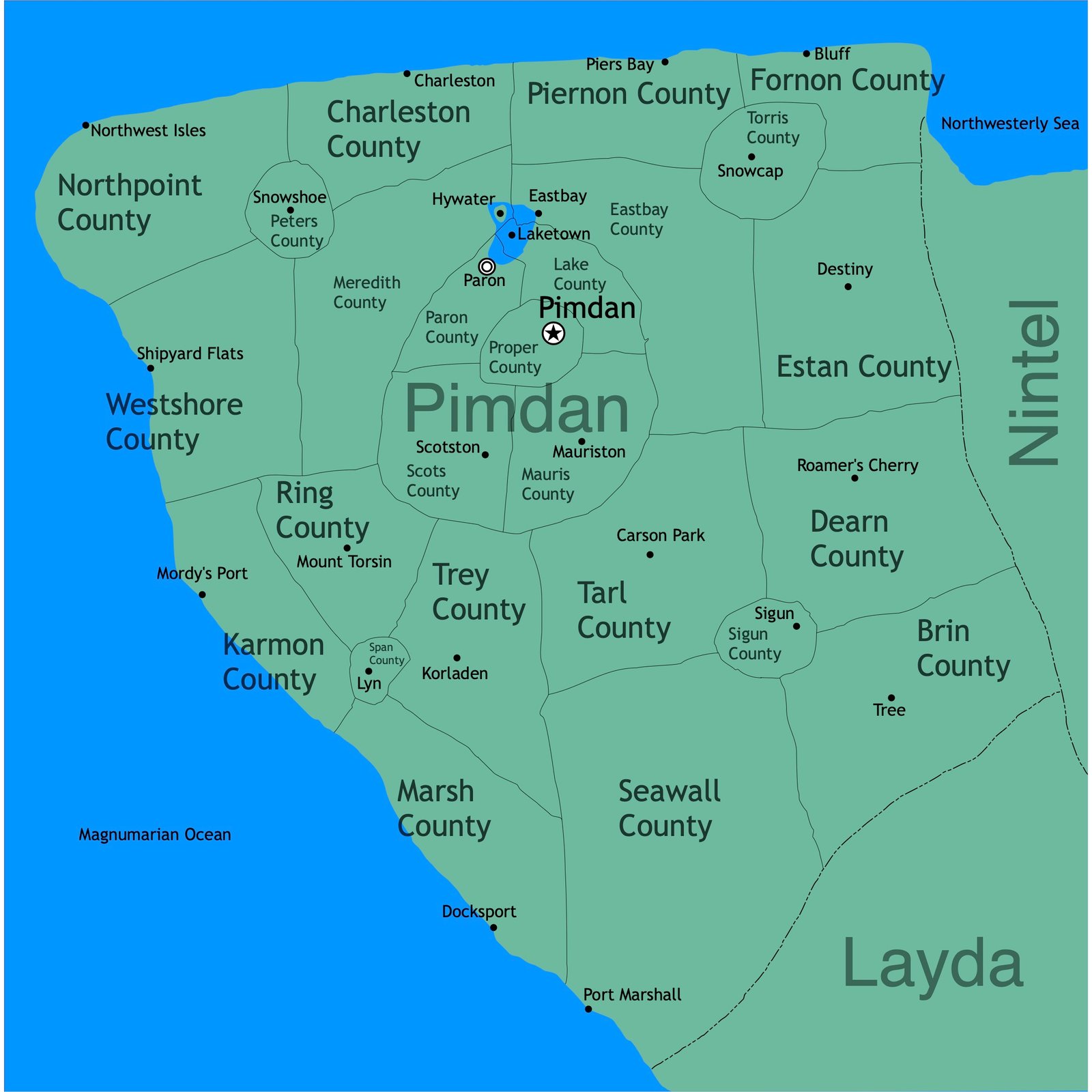
Map of the Province of Pimdan of the ICSR, Present-day
Article Written: 15 May 1451
Situated in the North-Central region of the Province of Pimdan and North-Northwest of the Provincial Capital, the community of Lake Paron boasts a unique history.
Early Days
The Lake and its skymountain, Meredyth, was a site consecrated by the local indigenous population until about the 1050s, when they were driven out while the land was re-settled by Great Northern forces under the command of General William Paron. Over the course of 200 years, various villages sprung up around the Lake and were dedicated to either mining, fishing, or logging. In the 1150s, Great Northerners constructed airships that enabled the settlement of Meredyth, upon which was established the town of Hywater in 1164. In 1167, villages on the East side of the Lake gathered and established the town of Eastbay while those in the Southwest established the town of Paron in 1169. Between 1171 and 1172, engineers constructed a man-made island of piers and docks in the middle of the Lake; and upon this isle was established Laketown in 1173.
And so the economy between the communities thrived under Great Northern leadership until 1231, when, as part of a territorial agreement signed in Cotts, the Great North withdrew its jurisdiction from Pimdan, leaving it unclaimed. The logging, fishing, and mining companies that had emerged in the Lake Paron region were left to function independently; and soon, in the absence of government regulation, these employers began raising prices and keeping wages depressed. That had been an issue during the days of the Great North, but now it began to worsen.
The Early Republic
In the late 1240s, the Federal Estates of Retun extended its influence to incorporate Pimdan as a territory and eventually a Province by January of 1249. In 1250, workers began forming collective-bargaining organizations with their business owners, who refused to compromise toward agreeable terms during contract negotiations. Calls were made to then-Prime-Minister James Black and the Federal Estates Council to pass legislation to increase starting wages and to improve working conditions, but this was met with stiff resistance from Council members who held business asset growth as a higher priority. Tension broke in March 1251 when all the workers across the Lake Paron region united and carried out a general strike. James Black responded to this by sending in federal marshal troops which conducted mass arrests. The strike ended by that summer as most of the workers there in the beginning of the year were replaced by new workers imported from other regions in the new Republic. However, these workers, whose promises for better pay and working conditions were not met, united and, again, carried out a general strike in November of 1251. Again, federal marshals were called in to quell the uprising, and this time, employers attempted to stave off future collective sentiment by implementing a rigorous schedule of "cross-assignment," in which laborers would be re-assigned to a new worksite with a new schedule once every three to six weeks.
However, collective sentiment remained in the region and had taken a permanent root, as outspoken figures formed the Labor Party of Lake Paron, and began running for public offices. In the 1252 local elections, these candidates won public seats in a widespread victory, capturing the mayoral seat and the majority of city council each of all four towns. And in 1253, all four communities signed a conjoined agreement, known as the Joint Agreement of 1253, to standardize prices, starting wages, and working conditions. Meanwhile, the Labor Party of Lake Paron gained momentum throughout the Province of Pimdan, and then throughout the entire Republic. In 1254, they officially renamed themselves the National Labor Party.
And so the economy thrived in the Lake Paron region over the two decades that followed, with the community gaining a national reputation for exceptional worker pay, working conditions, and living standards. In 1262, the Bank of Hywater was established to lend money and capital to up-and-coming businesses, with such lending practices being regulated by the 1253 Joint Agreement in order to preserve economic stability. Over the course of the 1260s, numerous Lake Paron businesses signed agreements with trading partners in the city of North Kempton, Nintel, which had a demand for building material made of the clay extracted from the bottom of the Lake. This arrangement created a steady income for the Lake Paron region.
However, between 1273 and 1274, the economy of North Kempton, Nintel collapsed, leading to a sudden loss in revenue and business for the Lake Paron region. Lake Paron businesses suddenly found themselves in financial distress and turned to the Bank of Hywater for emergency credit. Before long, the Bank of Hywater, with its funds drying up, suspended its credit lines, forcing Lake Paron businesses to turn elsewhere for emergency funding. After being rejected by Bucksworth and the Big Banks in Hasphitat, these businesses turned to the Linbraean Royal Treasury, who promised to lend even larger sums of money on a monthly basis over the next ten years. A joint arrangement of this was signed by the Royal Treasury and a large group of Lake Paron businesses in 1275.
Between 1275 and 1276, it became apparent that the businesses and Royal Treasury noticed a loophole in the 1253 Joint Agreement which allowed the money lent to not be passed down to employee wages in a fair and proportional fashion. This drew contempt from employees who called on their mayors and council members to pass legislation regulating such lend-outs. However, the Linbraean Royal Treasury anticipated this and lobbied Labor Party politicians to vote against such regulations, with the promise that the Treasury would help fund Labor Party campaign platforms in the future, as the Labor Party establishment had been struggling nationwide since the 1260 elections. Incumbent mayors and council members caved to such lobbying and voted down the regulations. And in the years that followed, emerging Diplomatic Party candidates called them out on this. In the 1279 council seat elections, the Diplomatic Party captured the majority of councils in Hywater and Eastbay, while reducing the Labor Party to razor-thin majorities in Paron and Laketown. In addition to this issue, the Diplomatic Party, in 1282, ran a smear campaign against Labor Party leaders and union leaders with regard to the ongoing academy strikes. As a result, the Diplomatic Party captured the mayor seats and majority of council in all four communities.
Starting in 1283, the new Diplomatic Party in power repealed the Joint Agreement of 1253, which repealed wage requirements, working condition regulations, price regulations, borrowing and lending regulations, and a rule previously put in place that prohibited publicly-owned estates from voting and selling their assets to private banks, among numerous other protections.
Despite the ensuing inflation and the worsening working and living conditions, the Diplomatic Party held the Lake Paron voter base in its sway with its "competition-and-reward" dogma, the idea that success came not only from hard work, but also from being the best in one's craft, and that societies that do not follow this dogma are doomed to fail. This led the Lake Paron region population to vote against John "Red" Waltmann in the 1296 and 1302 elections in favor of the Diplomatic Party. However, loyalty to the Diplomatic Party was suddenly broken in 1308, when the population turned against the Diplomatic Party Prime Minister candidate, Walter Scott Mason, who had been preaching ultra-nationalism and hatred against the darkfire community. Although they, themselves, were not supportive of the darkfire community at the time, Lake Paron voters viewed Mason's agenda as fascist and morally corrupt; so they and the majority of the province of Pimdan voted for the Libertarian Party candidate, Carl Rens.
Rens and Mason, however, lost to Waltmann, who won re-election for a third term. Waltmann's victory bolstered the momentum of a proposition, first made public in 1303, for the province of Pimdan to secede from the Republic; and the Lake Paron community was in full support. Pimdan followed through with this move in 1309, in the wake of the 1309 Revolution in the Basin District, but then voted to be annexed by the Great North. This was the result of an amendment proposed by numerous provincial legislators on behalf of lobbying from the Linbraean Royal Treasury.
The Great North
Life seemed to improve in the Lake Paron region under the Great North, as the Linbraean Regiondom ruled with a libertarian dogma. However, it soon became apparent that the Linbraean Royal Treasury had too much of an overreach over every aspect of Lake Paron life. Businesses and local councils began running large debts from the Treasury. Furthermore, no effort was made to improve workers wages and living conditions as promised before; and the Treasury had ownership over the estates and had intricate rules governing rent and evictions. Many of these workers turned to support from Finzi in the Republic, now the Commonwealth. While the Royal Treasury spread propaganda attempting to demonize them, many workers united and, in February 1321, staged another general strike.
The Linbraean Regiondom sent military forces attempting to break the strike. This was countered, however, by Peacekeepers sent by Finzi, who was, at this point, obligated to protect them. Armed confrontation arose between the Peacekeepers and the Linbraean troops, sparking the day-long Battle of Lake Paron on 15 February 1321, which resulted in 150 dead in 600 injured. This Battle resulted in the Peacekeepers and their allies succeeding in driving out the Linbraeans. That May, the Province of Pimdan, after a successful motion to secede from the Great North, rejoined the Commonwealth.
The Commonwealth: Early 1300s
Afterward, division ensued. Incumbent mayors and council members joined the ranks of the National Establishment Party, a conservative bloc relative to Commonwealth politics, and ran re-election platforms based upon the notion that Finzi's principles went against free market principles and granted too much favor to the darkfire community. The voting base was split nearly evenly in each town, and all of them yielded NEP majorities and mayorships in the 1324 elections, both of which having been captivated by razor-thin margins. Nevertheless, Finzi's laws governing pay, living, and workplace standards improved life in Lake Paron for the first time since 1282. The area was spared mostly from the Knights of the Common Good insurrections and Neurovirus pandemic of 1329. However, Realist Party candidates, promising good compromises between the principles of Finzi and the NEP, captured the local government seats in the 1330 elections, and would hold onto them until 1342.
It was the Hywater Bank Scandal of 1340, which involved the stagmarcation of trade stones, which finally began to undermine support for the Realists and their allied parties. The 1342 mayoral and city council elections saw all four council majorities and mayorships be handed over to the RAD Party. In the 1344 Prime Minister elections, the Lake Paron community supported Raol Robinson of the RAD Party, in contrast to the rest of Pimdan, who supported John DeMajj of the National Establishment Party.
During this time period, the Lake Paron region established yet another Joint Agreement, known as the Joint Agreement of 1343. This restored most of the policies and regulations of the one from 1253. The only exception here was that wage standards were adjusted for inflation, and that the other regulations were adjusted for conformity with Commonwealth law.
The Commonwealth: Late 1300s
The Lake Paron community continued to thrive just as it did during the first Joint Agreement. However, in 1359, the Esurchians arrived and began infiltrating businesses, estates, and local governments. The people of the Lake Paron region banded together and pushed out the Esurchians in early 1360. However, the Esurchian infiltration broke their trust in the RAD Party. That same year, they formed the Local Coalition of Lake Paron, who elected write-in candidates who defeated RAD Party incumbents in the 1360 mayoral elections.
In the 1370s, the clay deposits ran dry. Furthermore, in 1375, then-Prime-Minister Megan Wen enacted environmental protection policies which put a stop to commercial fishing and logging. And so during the 1380s, the Lake Paron region turned to scriptfire science, tourism, and gyroplane manufacturing.
In 1396, voters in the Lake Paron region gravitated toward the newly-formed Reformed RAD Party, a conservative bloc dedicated to the revitalization of the Commonwealth economy through dymensionalism, which had begun to take root in the region since the 1380s. Reformed RAD Party candidates took mayoral seats and council majorities in the 1396 elections and held these until 1426. During this time, they established Library of Circlaria branches in all four towns.
The Commonwealth: 1400 to Present
From 1400 to 1426, the Lake Paron economy was largely dominated by the scriptfire industry and Library of Circlaria, as the region drew in experts and scholars from all over the province and all over the nation. In the 1420s a generation emerged of workers and scholars who believed in equal opportunities for those wishing to live and work in the region, regardless of interest. The issue at the time was that there was an unequal distribution of resources for different career vocations. For example, Library of Circlaria and scriptfire had more capital and educational opportunities than other vocations. In 1424, the Commonwealth experienced the beginnings of the Solidarity Movement, which would ultimately propel Mary Ann Heits to winning the Commonwealth Prime Minister nomination in the 1428 national elections. And the youth of Lake Paron joined the Movement by putting forward candidates of the Proculturalist Party, which secured mayorships and council majorities in the 1426 Lake Paron elections. In 1433, the Proculturalist Party would merge with the Trader Party to bring back the RAD Party, and the new incumbents of Lake Paron would follow through.
Upon taking office in 1427, the new incumbents passed and enacted an amendment to the 1353 Joint Agreement to establish an institution to provide equal funding to the numerous industries and vocations in the area, very similar to the OPEN Forum that would be re-established in the Commonwealth in 1429. This is the economic model that exists in the Lake Paron region to this day.