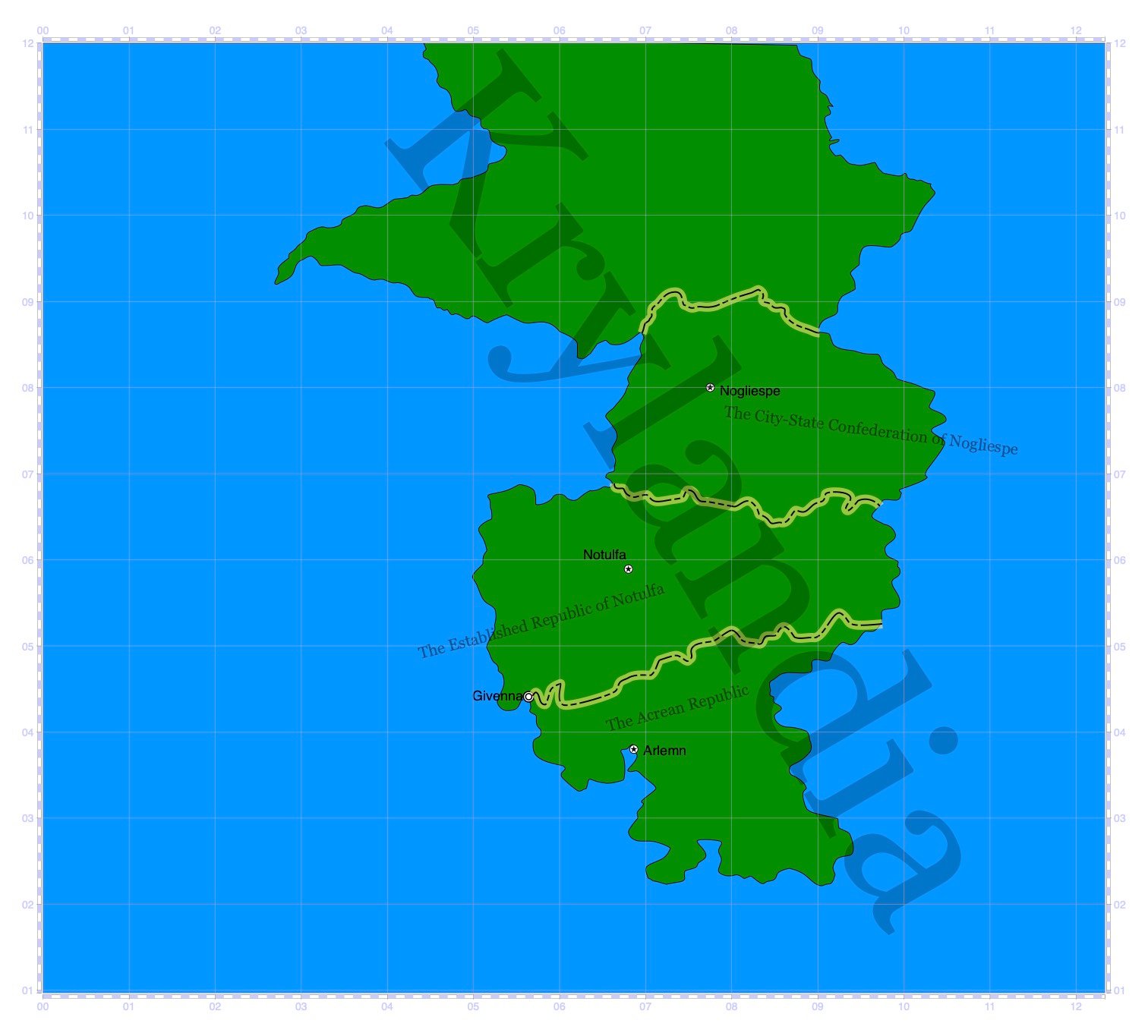
Map of East Hobland, 1400-Present
Until the twelfth century, the region in East Hobland encompassing present-day Nogliespe (Nully-es-pah) was comprised of freely-migrating clans led by warlords. Beginning in the 1000s, many of these clans took root in permanent settlements and began establishing city-states. And in the late 1090s, three commanding warlords merged and formed the city-state of Nogliespe, the largest city state, and governed over it as a triumvirate. In the years that followed, two neighboring city-states, Draveya and Esthera, would join Nogliespe as part of its hierarchy, governing themselves each under a single war-lordship loyal to the Nogliespan Triumvirate.
In the 1130s, the people under both the greater city-state of Nogliespe and the two satellite city-states carried a revolution for democracy, which succeeded in replacing each of the three Triumvirate war-lordships and the two subsidiary war-lordships in the satellite states with elected consuls. And thus, the super-entity of Nogliespe and its satellite states became a democracy with its established Statutes of Principle. Eight other city-states in the region would follow in reforming into democracies while the remaining seven did not. By the 1200s, half of the city-states outside the Nogliespe super-entity were democracies while the others remained authoritarian regimes.
Rise of Authoritarianism
Change came around in the 1170s when two business figures from Combria and Furthing established heavy industrial companies in Greater Nogliespe, sparking an industrial revolution. As the cityscape transformed from that of an agrarian one to that of a metal urban landscape, industrial development began taking shape in the two satellite states and the other democratic states. Meanwhile, the authoritarian states remained underdeveloped. In the 1180s, the workers in the industrial complexes united and demanded higher wages, creating collective pressure to which the emerging leaders yielded. This led to a rise in living and working standards, giving incentive for those living in the military states to emigrate over into Nogliespe and the democratic ones. Soon, democratic governments began passing ordinances to bar entry for the incoming immigrants. In the 1190s, the businesses began outsourcing jobs to the military states, employing its inhabitants for a fraction of the pay. This led to a loss in jobs in Nogliespe and the democratic states, which in turn led to economic hardship and even civil unrest. And in Nogliespe, such hardship led to the rise to power of a charismatic figure named Mathusen, who won the election to one of the Nogliespe Consul positions in 1202.
Upon officially taking office in 1203, Mathusen enacted a program that constructed mass housing for all Nogliespan inhabitants while providing all of them with jobs in an emerging military industrial complex. However, such housing was lacking in standards (i.e. no heating or running water); and employment was far sub-standard to jobs in the past as Mathusen nullified labor standards. Soon, Yean, the second of the Three Nogliespan Consuls rose in opposition to Mathusen over such living and working conditions, receiving support of the majority of Nogliespan inhabitants. However, Mathusen acted swiftly and had Yean assassinated. To cover up this act, he spawned a riot that gave cause for him to suspend the remaining Consul Offices, including the ones in the satellite states, as well as the remaining democratic institutions of the government. The satellite state of Draveya resisted Mathusen's actions by declaring a new government and threatening to declare independence from the Nogliespe super-entity. Mathusen responded by sending military tanks and infantry into the city-state, which successfully crushed the resistance and subverted the satellite state. Esthera, the second of the two satellite-states staged a similar resistance. Mathusen attempted to overrun the state of Esther in a similar fashion, but the state had formed alliances with the surrounding democratic states, who sent in reinforcements. During that time, these neighboring democratic states united and formed the Western Confederacy of Hobland and formally declared war on Nogliespe.
However, this Confederacy had no formal capital city or even a central government; and its forces were disorganized and lacking in important resources. Furthermore, some states within the Confederacy signed enlisted some of the military states to assist in the conflict against Nogliespe, a move that was adamantly opposed by other states within the Confederacy. Such opposition was to the point that the opposing states began blockading supply lines between military states and their friendly Confederate counter-parts. And this led to the outbreak of a civil war within the Confederacy in the year 1209.
In December 1210, Mathusen took advantage of the ensuing civil conflict and launched an organized frontal offensive against both the Confederacy and the military states. Needless to say, both of the satellite states of Draveya and Esther were defeated; and Mathusen succeeded in felling the remaining Confederate and military states. By the end of the month, the entire region fell under Nogliespan jurisdiction, with Mathusen in direct control.
Life under Mathusen was brutal and oppressive. Acts and speeches of opposition were outlawed and met with capital punishment. Working and living standards were low and continued to worsen over the years, as Mathusen embarked on massive industrial projects. Meanwhile, an opposing faction within the Mathusen Movement left the nation and landed in the Southern neighbor of Notulfa, where they carried out a similar movement that took advantage of existing political tensions and drove the House of Esary from power in 1213. In its place was established a similar authoritarian regime.
Fall of Authoritarianism
It was when Mathusen signed charters to sell tanks and artillery to Northern Canticulan nations at the beginning of the First Continental War in 1221 that opposition against him began to take a firm stand. That year, an underground movement known as the Pan-Democratic Movement formed and infiltrated nearly every rank of Nogliespan society to a certain degree, especially the military. On 3 March 1221, two months after the beginning of the Continental War, Mathusen was assassinated; and over the six weeks that followed, the nation of Nogliespe was embroiled in a civil war. The Pan-Democratic Movement prevailed in that conflict and enacted government motions for the abolition of the Consul offices and establishment of an elected Council led by a Prime Minister. This Council called for elections and referendums to be held in September of 1221, during which the electorate voted to establish every Nogliespan state as a democratically-run entity, and for each of these states to be considered provinces.
And thus, the City-State Confederation of Nogliespe was established.
Merger into Krylandia
The new Confederation ushered in revised Statutes of Principle which firmly grounded its democratic institutions and would enact policies to establish a robust economy of free trade and improved living/working standards. In 1273, the Acrean Kingdom fell and gave rise to the Acrean Republic; and in 1275, the totalitarian regime in Notulfa fell and gave rise to the Notulfan Republic. In the wake of this, Nogliespe entered into various trade agreements with the two nations and, along with them, entered into a unbroken period of modernization and peak prosperity that would last for more than a century.
Gyrosakian mega-conglamerates began acquiring East Hoblandish businesses in the 1370s, having taken interest in their value, and began to outsource jobs to other regions while freezing pay raises and making overall working conditions worse for the East Hoblanders. In 1381, workers in the Greater Nogliespe municipality across multiple industries formed a collective organization and succeeded in forming contracts of fair employment. Such a movement became widespread throughout Nogliespe and spread to Notulfa and the Acrean Republic. However, beginning in 1393, the Congress of Circlaria, the majority of which shifted toward Gyrosakian businesses two years previously, enacted measures to nullify such contracts by strengthening a complicated and technical constraint governing the presence of such collective organizations.
This triggered tension between the social classes, which reached a breaking point in 1398, when Notulfan workers staged a nationwide general strike. This spawned a labor movement that spread to Nogliespe, where general strikes led to economic freezes in a growing number of Nogliespan city-states. Nogliespan leaders called a Conference in the city of Boken, located Northwest of Nogliespe in uncharted territory. There, Hoblandish government representatives met with Remikran representatives, Canticulan representatives, and labor movement representatives and began long talks for compromise. In 1399, they reached an agreement to merge all Hoblandish nations into a single nation while preserving the political structure of each Hoblandish nation. In 1400, this took effect, and the new nation was named Krylandia.
And so Nogliespe continues to thrive as a modern economy and society, and has done well to withstand the devastating impacts of the long-running Coughing Affliction pandemic in the last fifteen years. Its democratic government remains the same, being led by an elected Council and Prime Minister; however, every five years, an additional election is held to nominate representatives to the Krylandian Council in Boken.