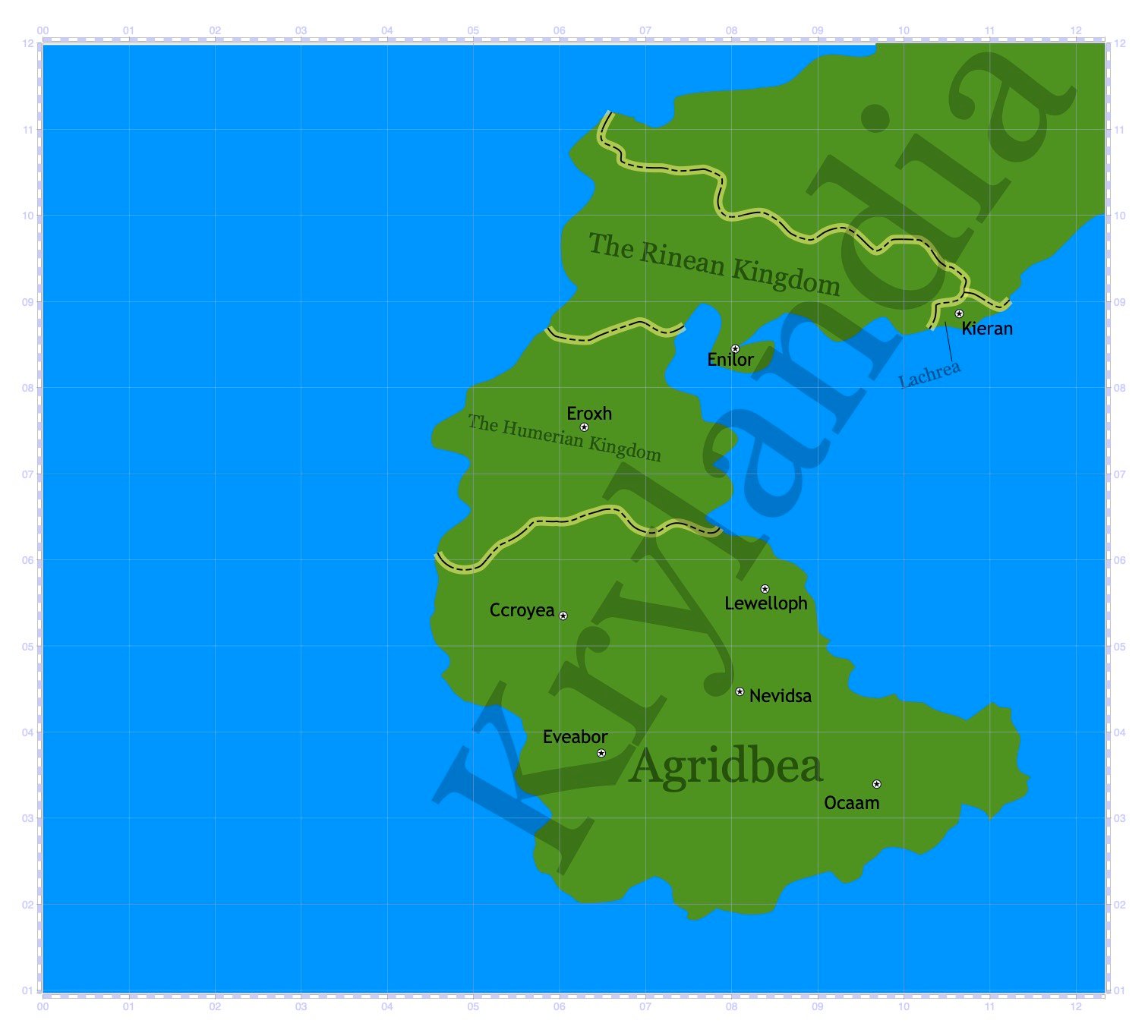
Map of West Hobland, 1400-Present
*It is important to note that before the establishment of the Circlarian School, those engaged in spellfire-crafting were known by titles of rank such as Conjurers and Chancellors.
Grandchancellor Tiernonomous settled the lands of Agridbea around 2100 BCE with the intent to establish a pure society dedicated to the task of promoting universal peace and discovering the key to immortality. Not long after, Tiernonomous died and, in his will, left the land to be governed mutually by his five Arch-Chancellors: Ccroyea, Nevidsa, Ocaam, Eveabor, and Lewelloph. They were to have equal shares of the land from which to govern from established Houses in their name; and they were to meet yearly to discuss the solutions leading to the hope of achieving immortality.
They convened as commanded for their annual discussion for only two times. During the second meeting, debates arose that diminished into sparring of insults. Rivalries soon erupted and before long, the Houses were at war against one another for dominance over the land as each Arch-Chancellor volleyed to become the next Grandchancellor.
A Nation at War
The Houses fought continuously for thirty centuries as no one House seemed to gain long-term advantage over the others. Under each House arose Lesser Houses who were loyal to the former. And under these Lesser Houses arose Factions and Clans. During times of imminent conflict, a particular House would commission their Lesser Houses to enlist warriors and spellcasters from the Factions and Clans to attack those of the enemy House. Villages would be captured or destroyed, or recaptured by the original jurisdiction. Occasionally, a Lesser House would be captured but the supreme House of that jurisdiction would usually send reinforcements to take back the said Lesser House. On occasion, a major House would come under threat as well, but no records seem to indicate any one of the Five Houses being captured before the 1070s CE.
Meanwhile, when an Arch-Chancellor died, the title would be passed down to the next legitimate candidate. Eligibility was subject to rules that varied from House to House and, within each House, such rules changed numerous times throughout history. Such was the case for the Lesser Houses and their Chancellors as well. Appointment to the Chancellor or Arch-Chancellor role was a lifetime one, and each of those who ascended to such a position governed over their jurisdiction with absolute authority.
Settlement and the Great North
Around the 1050s, the Great North arrived in West Hobland and began building settlements in the region to extract the recently-discovered blue diamond coalsand deposits. Their largest settlement was named Estry, which became an industrial hub in the region. And the Great North expanded Southward with the construction of mines, drilling sites, and rail lines. Such an expansion crossed into Agridbea, where they were attacked by armed spellcasters of the House of Lewelloph in 1058. In response to this attack, the Great North sent armed reinforcements as the region became gridlocked in an ongoing conflict. Meanwhile, Lewelloph allied with Nevidsa while the Great North allied with the Houses of Ocaam, Eveabor, and Ccroyea. Bitter conflict ensued; however the Great North was able to maintain its claimed territories North of Agridbea while giving refuge to three Lesser Houses: Eroxh, Enilor, and Kieran, who had fled North and re-established themselves in the Great Northern territories.
Blue diamond coalsand reserves ran out in West Hobland in 1061; however, with the growing threat of the alliance of Lewelloph and Nevidsa, the Great North continued to assert its military presence in the region. Nevertheless, it was costly in both finances and resources, not to mention in human lives as well. Such a situation worsened in 1068 when a Great Northern colony in East Hobland gained independence and declared war. Opposition there was fierce to the Great North, which began to lose that conflict. The Lewelloph-Nevidsa alliance took advantage of this and launched a full frontal assault on the Great Northern territories in West Hobland in 1075. In 1076, the Great North decided to surrender its front in East Hobland and convened with the Houses of Ocaam, Eveabor, and Ccroyea to launch a full-frontal counteroffensive against the Lewelloph-Nevidsa alliance. This counteroffensive succeeded as both the Houses of Lewelloph and Nevidsa were overrun by the Great North and its allies. In 1078, the Great North summoned a Conference between itself and all five Houses of Agridbea to craft the Peaceful West Hobland Non-Aggression Pact. This document was signed in October of that year, and gave equal shares of the territory of Agridbea to each of the five Houses and equal shares of territory to the three Lesser Houses in the Great Northern territory. The Great North officially withdrew from West Hobland in 1079 and amended the Pact to reduce the territory of the House of Kieran and redistribute the remaining territory equally between the other two Lesser Houses of Enilor and Eroxh, in exchange for Kieran (now renamed from Estry) becoming the capital of the newly-established independent protectorate of Lachrea, which would be governed by an incumbent-appointed presidential council.
In 1080, the local population in the territory of the House of Eroxh staged a coup against the presiding government and drove the House of Eroxh from power. In its place was established a royal ruling class, as the region became established as the Humerian Kingdom. Clauses in the Pact of 1078 prevented the Great North and the five Houses of Agridbea from intervening in this political happening; and so such nationalist sentiment spread Northward. In 1087, a similar coup happened in Enilor and led to the establishment of the Rinean Kingdom. The House of Kieran, still presiding over the remaining territory of Lachrea, called a Conference with the two Kingdoms in 1091 and signed the West Hobland Peace-and-Trade Agreement, which helped to preserve and protect the House of Kieran from a similar coup, as well as obligated the two Kingdoms to keep peace with them.
Krylandia and the Present
Relative peace ensued in the region of West Hobland until the late 1390s, when working class uprisings initiated by a political movement originating in East Hobland prompted West Hoblandish leaders to join East Hobland, Remikra, and Canticula in the Arctic city of Boken for a Conference with labor movement leaders. In 1399, compromises and agreements were signed which established a new government in Boken over a new nation covering all of Hobland, both East and West, with such a new nation to be named Krylandia (officially taken effect in 1400).
To this day, Lachrea still exists as an incumbent-appointed presidential council, while both the Humerian and Rinean Kingdoms still stand ruled by their monarchy governments and Agridbea ruled by its Five Houses. However, these countries are now part of the nation of Krylandia, and carry out elections directly by the people to appoint representatives to Boken. Meanwhile, Agridbea is the most peaceful it has been in its 3000 years of existence; however, armed clans and independent spellcasters loyal to Houses and Lesser Houses still occasionally carry out attacks in towns and marketplaces along the inter-House borders, prompting regular peacekeeping measures from the Five Houses and the Krylandian government.