Preface
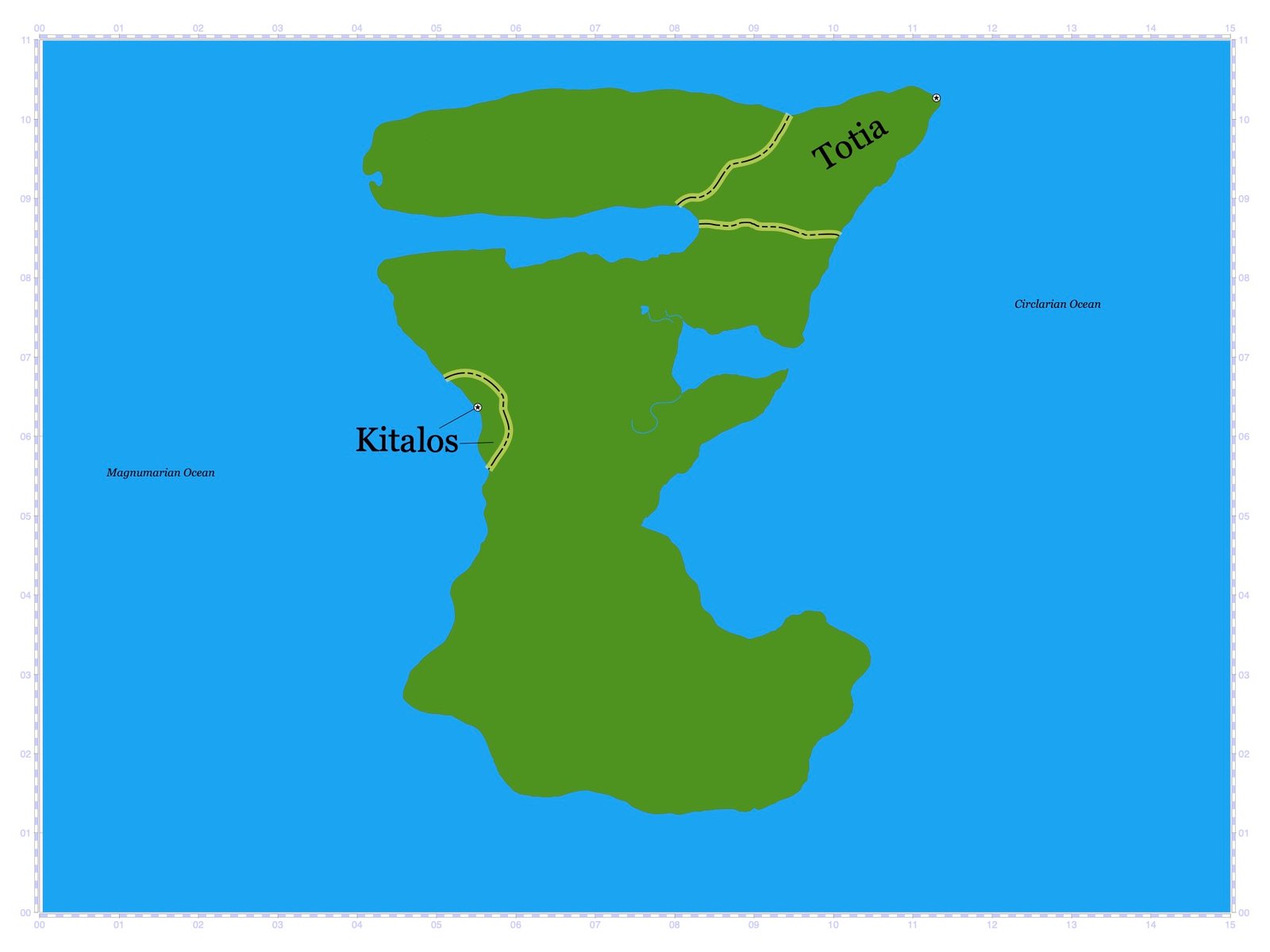
Nearly two centuries later, new generations of people from each of the two city-states, Totia and Kitalos, were keen to explore the other Remikran lands outside their bounds. Pushing such explorations was the notion that the population was growing, increasing demand for food, which could not be met with the limited space in the underground crops. It was the Kitalans, between the 840's and 830's BCE, who first began exploring, noting that the ash that had fallen in the years before had replenished the soils with nutrients, making them suitable, once again, for farming (soil depletion had been an issue before the 1025 BCE eruption). It was the Totians, however, who first began claiming land.
Totia
Totia was established during the reign of the ancient Circlarian Empire as a military outpost, and was thus a government functioning under the authoritarian rule of Circlarian Imperial Generals. Such a system was kept in place during and after the 1025 BCE catastrophe. When an unnamed scout came to him during the summertime, bringing news of pleasant and fertile lands between the towering mountains to Totia's immediate West, the Chief Commander, Atairus (875-827BCE), sent groups of explorers on expeditions to charter the vast territory. While such missions confirmed the scout's report, there were also reports of certain hazards like bears and other dangerous wildlife, as well as defensive bands of nomadic groups descended from the few people who had survived the volcanic winter. So as settlements were established on the new lands, outposts were required to protect these settlements against such dangers. By 835 BCE, Totian outposts and settlements were built throughout the new territory. Both the settlements and outposts, as well as the city of Totia, itself, were governed by a hierarchy of generals and commanders, which were, ultimately, directed by the Chief Commander.
To the Totians early on, the Corren Mountains seemed heavenly; in fact, the Totians believed that this was the site of the afterlife. Their white tops seemed to make the landscape pristine in nature. However, the first wave of explorers to set foot here in the 840's BCE discovered the reality of the landscape. The summits were steep and high; so, with no one daring a dangerous journey up one of these, navigation was difficult. Before the discovery of the Southerly Pass, a narrow strip of land that connected this region to Combria, many explorers ventured through some mountain passes, many of which went high enough to meet the snow in the winter. It was here that avalanches presented a risk. Meanwhile, the coastline to the East existed in the form of a tall, jagged cliff over the hostile Circlarian Ocean. However, settlers also arrived at a coastline to the West, the Northwesterly Sea; although the water was just as frigid here, the boundary was made not of a sharp cliff but of a beach of smoothed, round stones. Fertile grasslands filled valleys between the towering Correns, while lakes, many in number, filled other low-lying areas. It was these areas that the explorers came to see. However, these areas were separated by a seemingly infinite sea of evergreens, which was broken in many places by the rising Correns. Although slightly drier than the marine environment of Totia, the weather in the inland regions was just as cold, made harsher by the strong, Corren-crafted winds that frequently blew, especially during a storm system that occasionally arrived from the Inland Sea.
The first wave of Totian explorers encountered nomad groups, who they conquered through battle. Before 1025 BCE, North Circlarians often took the land of the indigenous and, inevitably, conceived children who had both North Circlarian and indigenous traits, forming the Totian ethnicity. It was during this time period, however, that indigenous vocabulary began mixing with Aerdn, creating the ancient Totian Vernacular. Also of indigenous influence was the change in Totian beliefs. Although they still retained the idea that ancestors and late loved ones were divine, Totians began to take on the indigenous belief that there were superior divine beings, each of a certain "element" of the known world (i.e. the ocean, the forest, etc.). This bore similarity with exception to the fact that these divine beings had names, faces, and genders. The Totians adapted indigenous styles of creating stone murals, presenting them on their city walls and along underground passages. They also incorporated indigenous dance styles and stories in their theatrical presentations. Meanwhile, the indigenous population adapted the Totian string instruments and singing styles. Cross-influence was also present in education, as "classic" Totian subjects were incorporated into indigenous "learning discussion circles," while the "learning discussion circles" were seen in the Totian curriculum. Despite the cross-influence, however, Chief Commander Atairus maintained that over the claimed Totian territories, the Totians reigned supreme. Some members of the indigenous population were taken into slavery, while others were allowed to live in their communities but under Totian law. While the Commander-Watch canton system remained intact, the Head Commander appointed Generals to head fortresses, which served to protect Totian settlers throughout certain sections of the new land. In the newly conquered lands, the top-down power distribution existed in a similar fashion, where Generals appointed Watches to command over villages and indigenous communal districts drawn out by the Totians. Succession of Generals was determined by the Head Commander, while Generals determined the succession of the Watches.
Like the Kitalans, the Totians began trading with the indigenous nomads. Early on, currency was used only in the Totian city district, while mostly bartered goods served as the main model in the new territories. However, when the Totians discovered the coast of the Northwesterly Sea, they collected the rounded stones here and carved them into precious coins, converting such into another form of currency. This currency began to be used more frequently among the land settlers and indigenous groups. Similar to the city of Totia, Generals and their families were the wealthiest and most powerful, having the most currency and the most land. The second tier consisted of Watches, soldiers, and their families. Commoners and indigenous peoples existed in the bottom tier. Soldiers, Watches, and Generals carried out a service of protection for the Head Commander, collecting payment in return. Totian commoners, as opposed to the indigenous groups, were often given priority when it came to land ownership. Members of the indigenous groups were employed to carry out services like gardening and crop tending in exchange for payment. Many members of the indigenous population also integrated into Totian settler society by hunting animals and selling food or hide for a price. This, however, created a problem for some of the groups, as, in the process of integrating, they were forced to sacrifice their food sources. One of the greatest benefits of Totian settlement in the Corren region was the increased food supply, mainly from the expansive wheat and rye crops tended in the grassy lowlands between the mountains. The indigenous population also taught the Totians to hunt animals like deer and even bears for meat. These items flooded Totian markets. The spring melt from the snows and glaciers from high in the Corren summits, as well as the rivers and lakes in the lands below, provided a seemingly unlimited supply of fresh water. In the city, inspired by a method created by an indigenous group, special ducts were installed on the rooftops of some of the structures to collect rain water. Present in the land was also a seemingly infinite number of pine trees, serving as a source of heat for winter and for cooking. Supplies of these also flooded Totian streets, bringing an end to a shortage of wood that only came into being less than ten years before the first settlers arrived on the mainland. As the settlers discovered the coast of the Northwesterly Sea, they discovered that the rounded stones on the beaches could be crafted into a valuable material known as quartz-shale. Very soon, quartz-shale coins were made, replacing the coins initially made of the rounded stones as a currency for the Totians.
Spoken word and written scrolls continued to be the form of message-giving, with the latter becoming the more frequent method. As Totian territory increased in size, "runners" began spreading messages, and were later joined by mounted carriers, who learned to domesticate horses roaming Remikra. Totia also saw the emergence of pamphlets. Pamphlets became the norm of record-keeping throughout most of Totia's history. As bulletin walls continued to exist in the cantons in urban Totia, similar bulletins existed in the settlements. However, more frequently, it was the announcements given by the Generals and Watches in the "meetings," that became the norm for inhabitants out here. As Totia grew, more above-ground streets came into being, with more and more of them being paved with bricks; such growth also happened in the underground canton streets.
Every section of new claimed land was controlled by at least one regiment of infantry, each under the command of a Watch and a General. Predominantly Totians and North Circlarians populated the ranks, but beginning in the 820's BCE, the Totian Army began having members of the indigenous groups enlist, first as prisoners of war from defeated hostile tribes as a way to rehabilitate; later on, other indigenous members were allowed to join for payment. As land settlement and indigenous population interaction grew with them, the Totians encountered allies as well as enemies, who began settling around the Bay to facilitate attacking Totians. To combat this, in 835 BCE, the Totians built ships, leading to the formation of the Totian Navy. The Totian Navy proved to be critical in the preservation of Totia as both a city and a state, because, early on, the first of the nomadic groups who arrived in the immediate area surrounding Totia were hostile. Most of that hostility was due to the happenings of Sul, a Watch officer who became one of the first Totians to conquer land on mainland Remikra, doing so by violently massacring the Fundee population. This had earned Totia a bad reputation. However, as the years progressed, Totian settlers learned to practice compensation and diplomacy with other nomadic groups encountered, most of these being further West. Evidence also suggests that Totians occasionally had contact with people from present-day Combria; although not much in terms of hostility or diplomacy ever materialized, as these people only travelled North in the summer months. By the 830's BCE, Totian influence was had on the surrounding nomadic groups, as they began constructing ships and vessels of their own. In 837 BCE, a group comprised of those separated from the Fundees attempted to capture the city of Totia by sea. Although the Totians easily defeated them, the Totians, nonetheless were in fear of another attack of that nature, spawning the idea of constructing a defended causeway made of connected ships. Another inspiration for the idea was the notion that other nomadic groups who constructed boats were coming to trade with the growing city; many of these people compensated for their service of defending the city. The causeway, however, would not come to fruition for many more years.
When the enemy was defeated in the 837 assault, the Totians noted the new spellfire inscriptions on the dead soldiers, copying these onto new scrolls, and adding them to the existing spellfire inscription libraries. Other contributions came from friendly nomadic groups and Totian land settlers, who learned from them as well as invented their own inscriptions. With this, however, the Totian Head Commandership issued decrees regulating spellwork on the mainland, to prevent settlers from rising against Totia, by only allowing public access to inscriptions and scrolls within the confines of the libraries in the city, and only permitting trusted persons to access them in the new lands. Furthermore, any member of a nomadic group, or even Totians who were half-descended from members of a nomadic group were banned from practicing spellfire using works from the Totian libraries altogether.
Kitalos
Although similar dangers faced them, many Kitalan settlers dealt with nomadic groups in a more diplomatic manner. Through barter, trade, and persuasion, many of the nomads integrated into Kitalan society. Unlike the Totians, Kitalos was governed by an elected council, which exerted little to no authority over the local councils in their jurisdiction, with the exception that each council and its people be required to follow Kitalan Moral Code. Scholars in the present-day argue that this may have been the first federal system in Remikra following the 1025 BCE catastrophe. Kitalos did not impose taxes on its people, except for wealthy merchants. However, an item of commonality with the Totians was that the Kitalans began to expand into mainland Remikra.
The Bay of Kitalos was surrounded by a line of steep hills, which gave way to a flat and higher land. Atop this land, the hills were fewer and further between, while grasslands alternated with spots of desert sand, which existed in greater number to the South. To the East, the land rose higher yet, giving way to pines and freshwater lakes. However, such a trek East by prospective Kitalan settlers was slowed by the Magnumarian Shield, which immediately followed the region of pines and lakes. While the wet and dry seasons persevered around the coastline and the desert-and-grass regions, a more temperate climate existed in the lake and mountain regions, with year-around snow topping the peaks of the Shield.
With measures of openness and integration being carried out by both the Kitalan and nomadic indigenous societies, more items of indigenous vernacular entered into Kitalan vocabulary. Such groups also influenced Kitalan religion. As Kitalans began settling in the regions further away, creating the illusion, at the time, of entering other realms, Kitalans integrated nomadic teachings into their beliefs. Such teachings included the concept of animal spirits, as well as the spirits of ancestors and human demigods. Disagreement began to grow between younger and older generations, as the latter opposed the new beliefs making their way into the city of Kitalos. Nevertheless, the changes began to take root. Although arenas in Kitalos presented venues for performances involving monologue speakers accompanied by a instrumentalists, as well as performances by singers, it was a nomadic group who first introduced into Kitalos the idea of staging theatre accompanied by music. Early styles of musical theatre existed as well, involving nomadic percussion instruments, which became popular to use along with the Kitalan harps, so that orchestras began to form. Whether or not this transformation was an indirect influence of the Totians is a matter of debate among present-day scholars. Settlers further away from the city of Kitalos were at a disadvantage, as they did not have access to the libraries in the city. The Council made many attempts to address the situation by establishing various branch libraries throughout the land. But ultimately settler education was dominated by one of two methods: traveling merchants selling copies of library scrolls for a certain amount of currency; or, more frequently, locals learning important material aurally from the indigenous nomads. As stated above, an elected council governed the city of Kitalos with local councils governing the surrounding territories, outlining a federal system. These councils only abided by Kitalos by adhering to a hierarchical Moral Code. Also, the Kitalan Council did not impose taxes on its people, with exception to rich traders; and neither did the local councils, for that would have violated the Moral Code. The structure of each local council mimicked that of Kitalan Council with little variance. Nomadic communities were exempt from Kitalan jurisdictional laws except for when a nomadic group attempted to overtake a piece of Kitalan territory for their own (which did happen occasionally). Under such circumstances Kitalan law had the Moral right to prevail.
As Kitalan society expanded, there began a growing difference in economic class between those who lived in the city and those who lived in the settled lands. Those who lived in the city tended to have more wealth than those in the rural regions, as the city provided an environment of concentrated trade. However, economic distribution within the rural areas was more equal than that within the city. Initially, nomadic groups were the ones to produce agricultural goods in exchange for ships and buildings constructed by the Kitalans. However, as Kitalans settled further distances into surrounding lands, and nomadic groups made frequent visits to Kitalos, there was, by the 830's and 820's BCE, a significant shift, where those living in the rural areas began upholding farming infrastructure and those in the city began building structures and vessels, as well as providing services. By this time, olive seeds were used more frequently, leading to an inflation in this form of currency. This was addressed effectively by having the olive seeds molded into gold coins. Eventually, these were replaced by coins made of golden ore found in the Magnumarian Shield. Olive seeds were not obsolete, however. As new land was settled, olive vineyards were established to produce Kitalos' supply of olive oil, which was used as both a food source and a fuel. Along with olives, wheat, and barley, came a new crop: maize. A predecessor to modern corn, this was introduced into Kitalan society by nomadic groups from further South along the Magnumarian Coast. Those engaged in voluntary labor began demanding specific payments of currency, leading the Kitalan Council to pass some of the first laws in modern Circlarian society regarding labor compensation. Interestingly enough, the payment demanded by laborers in the rural areas was actually in the form of food, unlike the desired gold coins in the city.
With Kitalan settlers spreading over an increasing area of influence, coupled with tolerance for different cultures and languages, significantly varied dialects began to develop from region to region, leading to confusion in message delivery. To address this, in 829 BCE, the Kitalan Council passed a law establishing a "standard language" for message delivery and an Office in each region for message interpreters. Such a standard language was also established for the "flash code system." City vaults storing records such as tax records were beginning to run out of capacity, so the Kitalan Council built vaults in various locations in rural areas to store old records, reflecting on a policy to not destroy archives. These records were discovered by scholars in modern times, serving as most of the evidence used in the study of this place and time period. Most of these places were in caves and on the sides of mountains. One was even in the side of a cliff under a waterfall. Free press continued to exist, with journals being established throughout the new regions. Many of these became primary trades for nomadic groups. A notable invention in the 830's BCE was the utilization of concrete-over-sand-bricks as pavement for roads. This was first used for the inner avenues in the city of Kitalos, but then "naked bricks" became frequent in roads throughout settled Kitalan lands. By 820 BCE, nearly every main road was paved with either bricks or bricks and concrete. Horses, mules, and mountain eagles became domesticated and converted into modes of transportation, even among those of lower economic ranks.
Demand for mercenaries and Kitalan warriors grew as roadside bandits became an issue. In response to an attack on a traveling party, "flash codes" would be sent to Kitalos or a local council, who would then dispatch scouts to search the surrounding area for the source of the attackers. Usually, a camp would be spotted; and a company of Kitalan fighters would be sent to bring the bandits into submission. Another issue was that hostile nomad groups would attack villages from across the border. Friendly nomad groups would establish camps along the border as "watchers" over the Kitalan villages for protection. Hostile groups also stole mountain eagles and attack from the air, leading to the advancement of a bow-and-arrow that could shoot greater distances and hit more precise targets with the help of spellfire inscriptions. Warriors and mercenaries, when using such a device, were careful to hit the warrior flying the eagle and not the eagle itself, as mountain eagles were considered to be a precious rarity. In fact, Moral Code considered it a high crime to kill such a creature. During this time, Kitalans and their nomadic allies constructed a more pronounced system of water vessels which patrolled the Bay and sections of the coastline.
A key invention that came about in the 820's BCE was the ability to cast spells from inscriptions on stone tablets. Multiple tablets were required, however, and such inscriptions had to be interpreted in a certain order; so only the most knowledgeable were able to work the spellfire from these. Nevertheless, spellfire tablets, though eventually forgotten for a time, served as a predecessor to the invention of the talisman many centuries later.