Preface
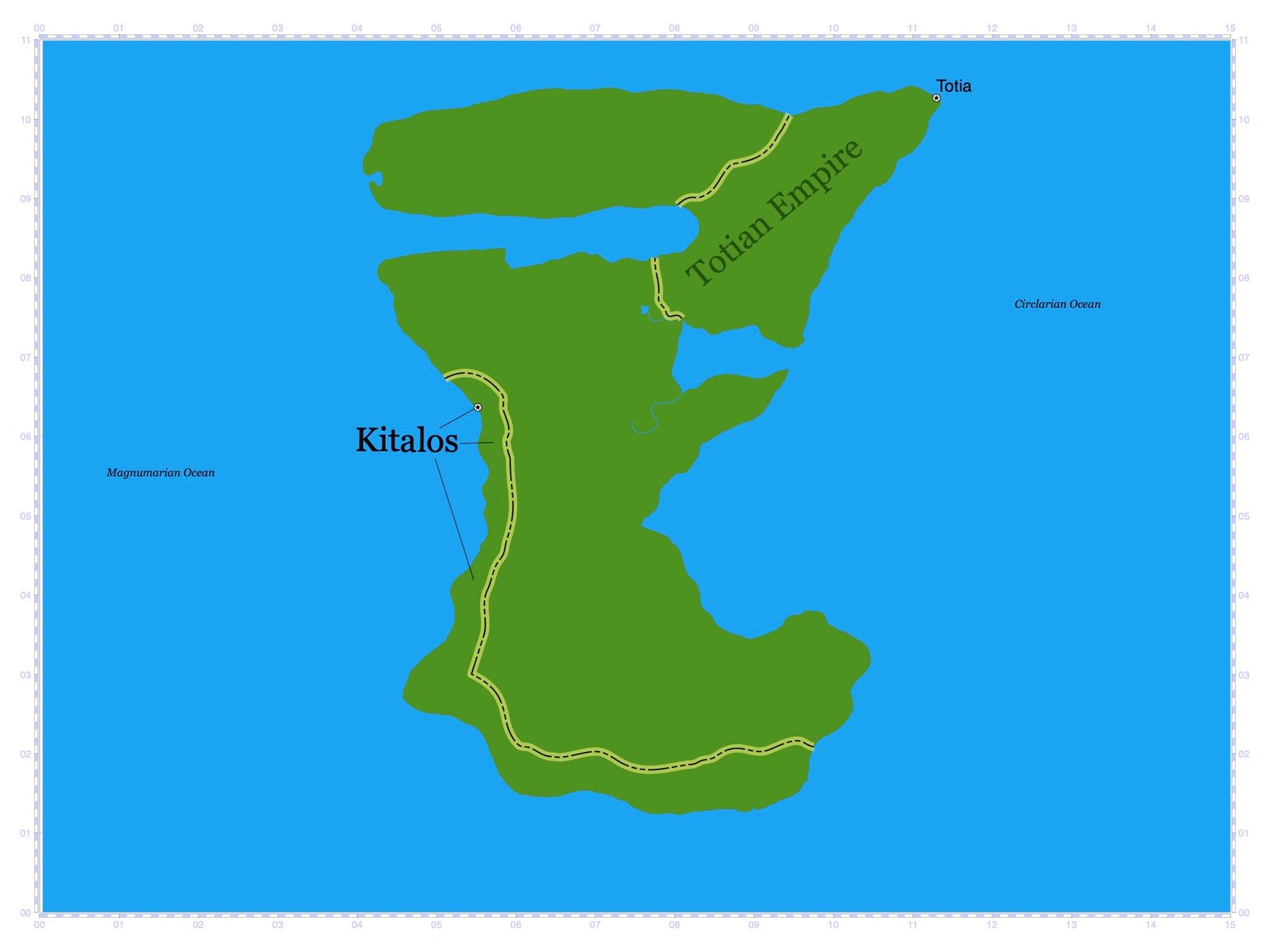
The Totians and Kitalans continued their ventures, as more land was explored and attained. And despite an indirect chain of trade formed between them by the indigenous nomads, the two states were unaware of each other, with each thinking that it was the sole civilized society in the post-Ashen world.
Totia
As present-day Combria grew ever more desirable for Totian explorers, Emperor Alec was eager to cross the St. Eschel River and reap the benefits of the territories beyond. There, the land seemed even more of a paradise with low-rolling hills instead of towering mountains. And all of this new land was covered with deciduous trees and meadow patches of fertile soil. However, two major obstacles were encountered. To the West, the towering ridges of the Wilderlands seemed impassable and riddled with aggressive wildlife. To the South, the Inland Sea seemed to stretch beyond the horizon in an infinite direction. Until the Totians advanced, it seemed as if they had reached the edge of their realm.
This newly-discovered area, or present-day Ereautea, was the flattest and lowest territory that the Totians had encountered thus far. The lakes here were less frequent in occurrence but were larger. The Northern pines were almost absent in this area. But the forests were thick here, with many of the trees bearing edible fruits that would become a valuable delicacy in the North. However, along with this land of almost heavenly paradise came extreme weather events. Although the climate here was mostly temperate and mild, storm systems would come from the Inland Sea as they do today. In the winter, Totians were treated to an oddly beautiful sight of ice-coated trees but with ice-coated paths as well, making travel difficult. In the summer, large storms and cyclones would blow ashore delivering high winds and floods. Nevertheless, the Totians continued to settle here in large numbers.
From the West along the coast of the Inland Sea came the Camarans, who spoke of trading with "desert people." Camarans were friendly to the Totians, as the Totians defeated the Kusaye and Emoran groups, the latter two of whom would also occupy this land and were enemies to the Camarans. Unknown to the Totians, the "desert people," known as the Tahns, traded with the Quitzdodals on a seasonal basis. Diplomacy was peaceful with the Camarans; and both the Camarans and Totians absorbed items of each others' native languages. For example, the words "cyclone" and "apple" are believed to have been derived from the Camaran tongue. It was Camaran mythology that began convincing Totians that the earth was, perhaps, the existence of a single divine spirit responsible for the creation of the world and the surrounding celestial bodies. Although the Totians still believed that those who died became Divine spirits who worked to bring peace and order to the world, Camaran mythology began moving Totian society closer to adapting a monotheistic belief system. Camaran mythology also manifested itself in Totian acting dramas and teaching curriculum, helped in part by Emperor Alec's agenda to gain further diplomacy with them.
The Imperial Totian social structure prevailed during this time, as Camarans living within Totian borders integrated into the Totian working class by harvesting and selling crop harvests. A chain of trade was established, as traveling Camarans brought goods from the Tahns and Quitzdodals to the Totians. Quartz from St. Eschel continued to dominate the Totian currency system, as some of this was passed from the Camarans through to the Quitzdodals, forming the fabled "Quartz Trail", which the Kitalans began to follow in the years to come. Abundant fertile soil provided opportunity for the Totians to produce even larger quantities of wheat and barley. The rains from the storms, combined with the lakes and rivers provided a seemingly infinite supply of fresh water. Also in large supply were trees, a great benefit, considering that the wood here lasted longer than the pines of the North when burnt.
Upon journeying into present-day Ereautea, Totians were fascinated by their encounters with treewalkers, an ancient animal species which lived in and navigated by treetops. This came as an additional blessing to the Totians, as their expanding road network was becoming increasingly expensive to maintain. Before long, Totians domesticated large numbers of treewalkers, harnessing travel coaches to each, and driving them with passengers and goods over long distances. However, there were two disadvantages. First, treewalkers were not accustomed to the extreme wintry environments of the Far North; so they could not travel up to Totia. Second, contempt was held by some members of the Camaran people who viewed treewalkers as sacred. Despite such circumstances, Totians continued to utilize treewalkers; and future societies would continue to do so in the centuries to come.
As Totian society began to dominate, enemies were effectively and increasingly marginalized, bringing relative peace to the region. Nevertheless, Emperor Alec continued to expand and strengthen the Totian Army, as well as its Navy. Some Navy ships during this time carried cartographers and sailed further from the coast for solely the purpose of exploring. It is believed by scholars that a Totian Navy ship re-discovered the first of the many Meredythian Islands; although, no evidence proves of any Totian settlements. However, Fundae and Mundae groups established settlements on several of these islands during this time. Some of the factions rooted here were hostile and would carry out "nuisance assaults" upon Totian ships sailing closer to the coast. The most important influence, though, was that these settlements began a new era of cross-Circlarian trade.
It is important to note that during the explorations of present-day Combria and Ereautea that Totians re-discovered spell scrolls created during the times before the Ashen Years. The most crucial discovery happened at a long-abandoned outpost near present-day Hasphitat, where a large reserve of spell scrolls, as well as a guide to the location of ancient spell scrolls all over the continent of Remikra, was unearthed. This reserve became known as the Library of the Citadel.
Kitalos
It was the spreading influence of the "Quartz Trail," now having reached the West Coast of Remikra that convinced the Kitalans to begin exploring new lands at an unprecedented speed. As the Southernmost shoreline gave way to an infinite oceanic landscape, the Kitalans decided to continue along the South coast to the East, not yet daring to climb the cliffs lining the Interior Desert. Before long, they reached the beginning of the Circlarian Ocean.
All along this coastline, the land was lower and flatter. Grasslands and palm trees, lining the wide sandy beaches, painted a heavenly tropical scene, where, unlike the West coast, the rainy season was remarkably more benign.
The ancient Kitalans at this time became acquainted with the land area and presence of the Quitzdodal population, who began integrating ever more into Kitalan society. The Quitzdodals to the East, though, were slightly different. An obvious change in dialect between the East and West Quitzdodals caused confusion back in Kitalos, who were more accustomed to the West Quitzdodalan culture. Furthermore, Quitzdodalan religious beliefs seemed to be rooted in that of a multitude of spirits, with each encompassing a particular species of plant or animal rather than one manifesting in the entirety of life.
Most of the Quitzdodals here were accustomed to their own communities and traditions; so the Kitalans respected such by not imposing local council structures. However, the local Quitzdodals accepted the notion of being under Kitalan jurisdiction, at least in writing, and abode by the Kitalan Moral Code. With trade-offs and compromises, Kitalans were allowed to establish their communities and local councils in certain places among the Quitzdodalan settlement without interference.
As previously mentioned, the local Eastern Quitzdodals were largely independent from the Kitalans and did not integrate into the Kitalan market like their Western counterparts. A large amount of trade took place between them, however, as they presented quartz, which had made its way to them via the chain of trade originating in Totia. Little did the Kitalans know that the Totians, the subject of conversation with the Quitzdodals, comprised of a civilized society like the Kitalans, themselves. The Kitalans seemed to believe that the Totians were simply nomadic people like the Quitzdodals. When the quartz eventually made its way to the city of Kitalos, it sparked a great deal of curiosity among the Kitalan people and the Head Council, and became an item of highly-valued currency among an emerging wealthy class that began to take shape.
Along with the growing number of newly-discovered exotic plants and animals, coconuts harvested from the South Coast became an item of delicacy in Kitalos. Before long, Kitalans constructed streetlights, bearing lamps burning on coconut oil. These were placed along Kitalan avenues and even main roadways.
The lengthy coastline under Kitalan jurisdiction made it inconvenient for runners to carry important messages from the capital to the new territories. To address this, the Kitalan Head Council voted to divide its territory into regions so that multiple runners could pass a message from one to another, forming a chain of travel for the messages. Also, to simplify travel, a single road made mostly of clay was constructed from Kitalos to the other end of the territory. Travel was made even more convenient with the discovery of tethros, a species of animal similar to llamas, except larger and easier to domesticate. These animals were more accustomed to tropical weather and were thus used as the mountain eagles were used in the North.
While the Western Quitzdodals were either friendly or hostile, their Eastern counterparts remained mostly neutral, dealing solely in politics involving the "Quartz Trail."
It is interesting to note that when they reached the beginnings of the Remikra coast lining the Circlarian Ocean, the Kitalans discovered ancient pre-Ashen Circlarian Imperial ruins with an area containing a library of spell scrolls. Although this library was smaller than the one discovered by the Totians to the North, it did provide large contributions to Kitalan libraries built in later years.