Quest for the North
To both Wannonia and the Edoran Kingdom, the quest for the remaining uncharted lands of Northern Remikra became an increasingly attractive prospect during the first century of the Common Era. Of the wide number of resources discovered, the four most important were metals, wolf and bear hides, spellfire quarries, and silver pines. And such existed in abundance in the North.
Migration to the East
The Moorlands were initially inhabited by the Moorlanders, or so they were named by the Edorans. The Moorlanders depended on Moorland grains as well as meat from bears, wolves, and elk for food. Beginning in 25 BCE, global climate change killed off a large amount of the grain supply, causing the elk to migrate Eastward. After them followed the bears and wolves. With such necessary for their survival, the Moorlanders followed their food sources into the Edoran Kingdom, where they encountered the Kingdom's subjects. Intent on eliminating the competition, the Moorlanders posed a threat as they regularly attacked and looted Edoran villages.
Defense Against the West
In 11 CE, the Moorlanders launched their first coordinated assault against the various counties and villages of the Western regions of the Edoran Kingdom. In response to the ensuing terror, Queen Edora ordered the building of more citadels and walls. The most significant of these was a large wall dividing the West from the Edoran Kingdom. Such a wall was completed in 19 CE; and in that same year, the Moorlanders attempted to scale the wall, almost succeeding in a location to its South. Here, Edoran soldiers pushed back the attackers and then set out to the West to find and destroy the Moorlander encampment responsible. Doing so with success, the Edoran soldiers returned with wolf and bear hides, while the spellcrafters who accompanied them returned with spellfire scripts from the quarries. This sparked interest in the lords and knights for further exploration; however, Queen Edora, indoctrinated in the unholiness of the Moorlands, refused to fund it.
Changes in Leadership
An uprising occurred in Wannonia in 22 CE, where usurpers succeeded in breaking through Imperial fortifications and ended the life of Emperor Raden III, part of a line of puppet Emperors loyal to Edora. The throne was succeeded by the opposition leader, Kamon, who cast a wary eye toward the aggressive Edoran Kingdom. In 43 CE, Queen Edora died, and was peacefully succeeded by her son, Robert, who granted permission and funds to the lords and knights wanting to venture into the Moorlands. Between 47 and 57 CE, the Edorans invaded the Moorlands, pushing the Moorlanders further West and down toward Wannonia.
Early Edoran Kingdom: Geography
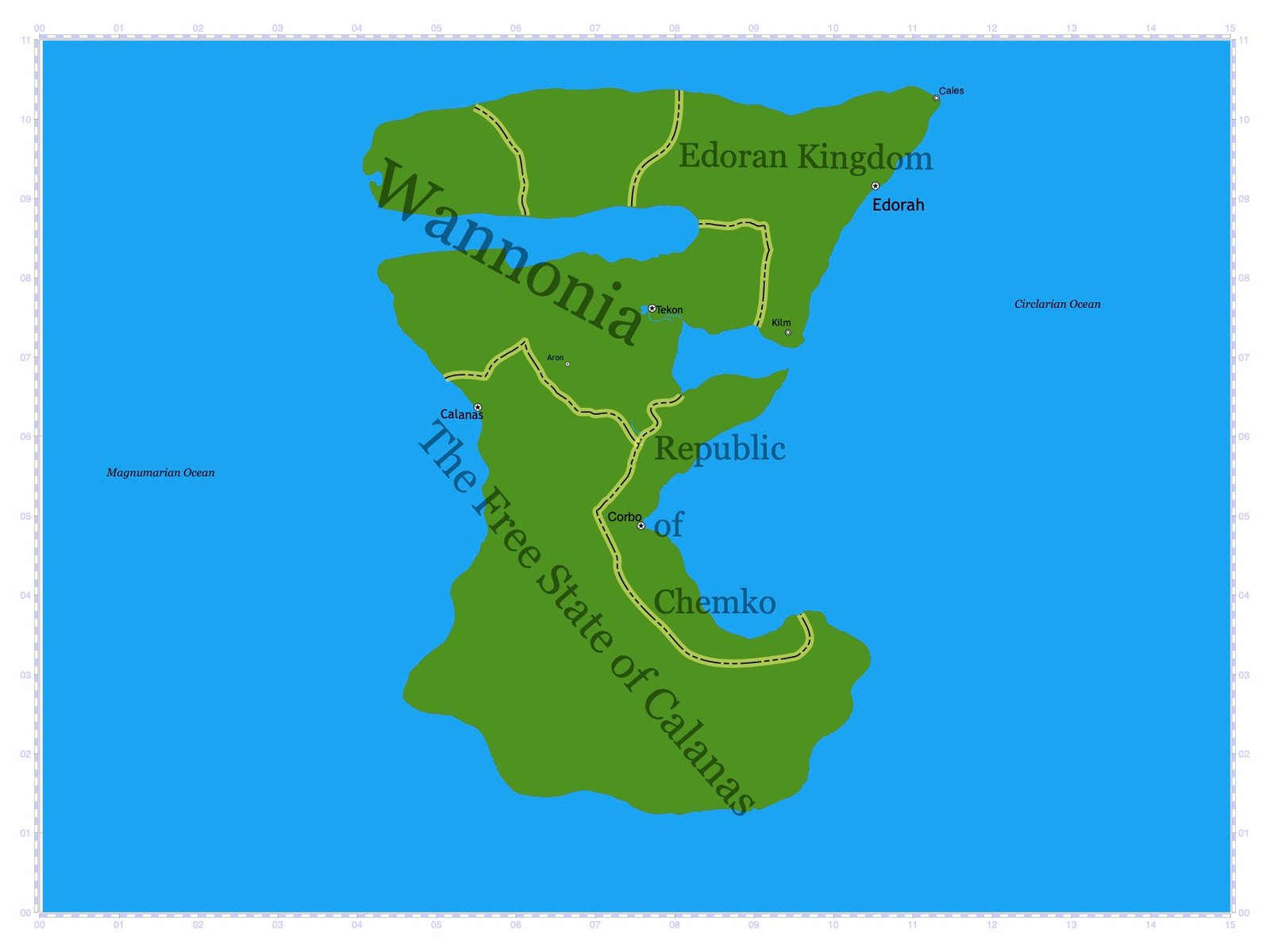
The Edoran Kingdom, by this point, covered four regions: the Northeast, the Moorlands, Combria, and Ereautea.
The territory in the Northeast consisted mainly of the towering Corren Mountains, the foothills of which were dominated by pines, grasslands, and permafrost. Owing to the climate change, the climate here was colder than ever before, where cold and stormy summers alternated with frigid and snowy winters. In the Moorlands, the territory was flat with occasional ridges, where the region consisted mainly of prairie grasses and grains, and where blustery summers alternated with frigid winters. In Combria, the Correns diminished to only steep hills and low-altitude mountains, where the pines began alternating with deciduous trees. While the weather here was cold as well, it was a little more temperate, with a slightly more pronounced difference between winter and summer. In Ereautea, the terrain became milder yet as rolling hills dominated by deciduous trees and grass valleys filled the landscape. Slightly warmer summers prevailed here, but occurred between still cold and snowy winters. Furthermore, storms from the Inland Sea, though more mild in nature, were more frequent.
Early Edoran Kingdom: People and Society
Fundaes, Mundaes, Emorans, Totians, North Circlarians, and Krids (sea merchants) blended to form the Edoran ethnicity. The language here was initially the Wannonian dialect of Aerdn with a strong influence of Kridian and genuine North Circlarian vocabularies. Such a specific tongue developed in the rural areas of Karlinian society, where was brought up Remiscus, and would, in the years to come, evolve into the Edoran Language. Although local religions were practiced in remote areas, such practices came into violation of Edoran law, which commanded only the practice of Alconism. In all Edoran villages and cities, theatre was banned, as it was seen as unholy. Writing was done only in the monasteries and within the ranks of Edoran nobility. Music was almost exclusively played in the courts of the lords and kings or queens. Only those in the monasteries and within the ranks of Edoran nobility received a formal education; all of the other Edoran subjects were given their commanded duties. And not long after taking the throne, King Robert brought back an organized system of serfdom for all Edorans except for those in knighthood and the higher social ranks.
All Edoran land was owned by a monarch, in this case, King Robert, who made all the laws while leasing sections of land, or counties, to the lords. Each lord had command over the county leased to him by the monarch while paying a land tax to the King via taxes collected from the serfs. He had command over such local taxes as well as the liberty to impose his own laws, so long as they did not violate the laws of the King. The knights were employed by the lords to protect both the respective counties and the kingdom as a whole. Each knight was charged with the duty of carrying out all laws of the King and the lord. The serfs owned basically nothing. They had almost no constitutional rights or freedoms; and permission was required from the presiding lord to make decisions such as marriage or leaving the county. Serfs traded with merchants and had incentive to do so, since they were subject to the lords' taxes. Exempt from taxation were two independent groups: the nobles and the clergy. The nobles, the King's family members and sometimes close friends, were allowed to own large pieces of land at wealth at their disposal. The clergy, ranked in descending wealth and power by bishops, priests, and monks, practiced Alconism in the monasteries that had come about in this time. They were seen by the King as holy, and were therefore given peace.
Early Edoran Kingdom: Trade and Resources
Such a hierarchy that existed between the monarchs and the serfs was the definition of the Edoran social class structure. Serfs produced crops in the rural farmlands, where the commanding lord of each county determined the amount of food allocated to the workers and their families, his own family and court, and the Edoran Crown. In the cities, only conventional guilds authorized by the King were allowed to form, while there was a limit placed on the number of regional guilds that could exist in each particular trade. In the sea ports, trade occurred mostly along the coast between the Remikran powers. Sea merchants still prospered, but there was less contact with Canticula than in the past. For trade by land and sea, the Edoran Kingdom grew grains and fruit, crafted items from the remaining flake shale, and sold animal meat and hides. The Edorans continued to use the system of copper, silver, and gold coins as the primary form of currency. However, the Edorans also extracted quartz from the St. Eschel River to make coins, each of which was worth twenty-five copper coins. As much as the grains, fruits, and animal meats were traded, they also served as food sources for the Edorans, while glaciers, lakes, and rivers provided plentiful supplies of freshwater. Wood and flake shale were used for lighting and heating, and offered a reliable supply for a number of years. In contrast, quartz began to run dry as the first century came to an end. Its value increased dramatically, making the new coins more valuable than twenty-five coppers.
Early Edoran Kingdom: Communication and Transportation
King Robert established an official Post Office in 51 CE, where all messages were carried on either horseback or by eagle. Letters, journals, and pamphlets circulated between those of the higher ranks, while town square announcements spread messages to the serfs. Nearly every castle in the Edoran Kingdom contained a library storing such items. Such a system maintained itself quite well, considering that the old road system, built by the Remikran powers of the past, fell into disrepair; and roads connecting small villages were still made of dirt. For the main roads, the unnavigable parts were filled, under King Robert's orders, by gravel made of greystone drawn from the Correns. Horses and eagles served as common transit for the knights, lords, and nobles, while all other subjects saw walking as the only affordable mean of transit.
Early Edoran Kingdom: Military and Diplomacy
Each lord was granted a division each of infantry and cavalry dedicated to protecting the Kingdom, authorized to travel great distances during times of war. The King, meanwhile, had his own division each of infantry and cavalry. He also had his own Navy fleet, while the seaside counties each had their own division. Such a system of defense, with each division containing a sufficient number of soldiers, was necessary, as the Edoran Kingdom had unstable diplomacy with Wannonia, where war was prevented only by the signing of treaties, each dedicated to a compromise of a small piece of land. Nevertheless, Wannonia and the Edoran Kingdom did not trust each other; and each side built and fortified border walls. Despite this, both powers had a common enemy: the Moorlanders.
Meanwhile, the Edorans maintained complete neutrality with the Chemkans and the Calanasians.
Early Edoran Kingdom: Spellfire
Regional spellfire guilds were approved by the King and authorized by their respective lords, and served only to satisfy deeds necessary to the Kingdom. Individual spellcrafters practiced independently, not mingling with society. Some of these taught Edoran outcasts, as they formed "shadow guilds" functioning separate from society and without the awareness of Edoran authority. Such institutions, in many ways, functioned like monasteries. Nevertheless, there were outlaws who openly resisted the Edoran Kingdom and their values of absolute government by causing deeds of trouble. While most escaped punishment, others were caught and put to death. In many cases, innocents were blamed for "witchcraft", even though the provoking misfortune in many cases was not, in fact, caused by works of spellfire.
Invasion and Exploration
Between 56 and 57 CE, the Moorlanders launched a coordinated invasion upon the land of Wannonia, where they were quickly pushed back by Emperor Kamon's Legions. Captured Moorland warriors were either slaughtered or taken into serfdom. In October 57 CE, as some of the captives spoke, word reached Kamon that King Robert was expanding the Edoran Kingdom Westward across the North. To counter such expansion and gain of power, Emperor Kamon promptly sent explorers to scout the Moorlands from the West, from which they returned with bear and wolf hides, scrolls by spellfire quarries, and metals. However, unlike the Edorans, the Wannonians had set foot in the Linbraen Mountains, where they found their most important resource: silver pines, which could generate enough spellfire to compensate for the long-squandered Wannonian quarries. To the Emperor's excitement and intrigue, this provided an opportunity to settle the territory and possibly stop the advancement of the Edorans.
Wannonian Expansion: The Pimdanian and Linbraen Mountains
The Wannonians first reached the Pimdanian Mountains, where they discovered that such peaks were taller than the Correns, with large regions of land in the snowy highlands. Along with vast, deep lakes, Wannonians were also fascinated to discover "airbourne mountains" ("skymountains" in present-day terminology). Such a landscape was dominated by pines and a large variety of temperate grasses and flowers. The summers here were mildly warm but stormy; and like in the Correns, the winters were frigid and snowy. Elk meat was a plentiful food source, while the glaciers, lakes, and rivers provided a seemingly infinite water supply. Wood from the pines provided heat and light. The local inhabitants here consisted of the Lynds who chose not to migrate to Wannonia in the past. The Wannonians were initially friendly to them, but, by Emperor Kamon's strategy, one group of them would be slaughtered while the Wannonians would convince the survivors to blame another Lyndan group. Wannonian soldiers would then gain control of each particular region here, portraying themselves as diplomats and peacemakers.
The Linbraen Mountains were equal in height to the Pimdanians, but bore the tallest land-bound peak in Remikra, Mount Teroth, with the Wannonians being the first civilized Remikran society to discover it. Here, as well, were the "airborne mountains." Like the Pimdanians, the terrain here was dominated by pines and grasses; however, the grasses were of a lesser variety, and existed between large tracks of tundra. Unlike further South, the weather here was generally wintry year-round, though less intense in the summer months than in the winter months. Elk existed here in the summers; but the Wannonians learned from the Khaps, the local inhabitants, the concept of whaling. The Wannonians' most important discovery in this region was silver pine trees, whose wood burnt longer than any other wood or even flaxweed, and had beneficial spellfire properties.
In 87 CE, Emperor Kamon of Wannonia died peacefully. He was succeeded by his son, Kamon II, who continued the agenda of Northern settlement.