Edoran Subjugation
Throughout the 60s CE, Moorlanders captured by Edorans during the conflict in the North faced a choice: die, or convert to Alconism to work as a serf in the Edoran Kingdom. With the latter choice, Moorlanders were seen as equals among the other serfs, where they were given a job and a place to live. However, those two assets were not choices of each Moorlander but assignments given by the presiding lords. Furthermore, like all other Edorans, Moorlanders were subject to taxation.
Moorlanders as Pawns Between Edora and Wannonia
Meanwhile, in the West, a section of the Moorland region was inhabited by Moorlanders who were driven from their homes in the lands now conquered by the Edoran Kingdom, having escaped death and captivity, but were not daring enough to cross into Wannonia. With these Moorlanders, it was the lack of food and resources that prompted them to strike back at the Edorans in the early 60s CE. They launched a coordinated and terrifying assault upon the newly-established Edoran settlements; but by this time, there were also established Edoran castles and fortresses, which proved too strong. Furthermore, such an assault provoked the Edorans into launching assaults of their own, which, utilizing better organization and strategy, drove the Moorlanders even further to the West than they originally were. In 65 CE, King Robert died, and was succeeded by King Ronald, married to Queen Alexandra, both of whom vowed to continue defending the Kingdom against the Moorlanders. By this point, though, the Moorlanders had learned of Edoran fortress-building methods as well as Edoran fighting tactics, and began to carry out stronger resistance by, themselves, building fortified camps and adapting combat strategies. But by the late 60s CE, the Moorlanders were attacked from the West by the Wannonians, who saw and took advantage of weaknesses in their Edoran-style defenses. With the greatest of ease, they attacked and captured the camps, forcing Moorlanders into slavery. Alarmed by this, King Ronald sent spies to gain insight on how the Wannonians managed to overcome these defenses, and used such information to rebuild genuine Edoran castles and forts. King Ronald also used caution to capture only Moorlander strongholds not occupied also by Wannonians for fear of engaging in direct conflict with Wannonia; for Wannonia, as King Ronald understood, was a more civilized society, being stronger and better-armed. In September 96 CE, King Ronald died, and was succeeded by his wife, Queen Alexandra.
The Two Walls
Moorlander slaves accustomed to farming in harsh conditions, were of high value in Wannonia, where a worsening climate increased the need for more efficient crop-tending, especially for the flaxweed fields. However, in the latter half of the first century, a sudden shortage of incoming Moorlander captives caught the attention of Emperor Kamon II, who sent scouts to the North. Such scouts returned with news that many of the Moorlanders were being captured by Edorans, who were capturing Moorlander campsites to the East; and Emperor Kamon II began feeling concern that they would next attack the Moorlander strongholds under Wannonian possession. In addition to the fear of Edoran aggression, Kamon II's agenda of war preparation for Edora was also fueled by his desire to reclaim the territory of the former Republic of Karlin, and to claim the remainder of the Edoran Kingdom, thereby restoring the old Empire of Wannonia, and opening the possibility of reclaiming the Canticulan territories lost in the past.
Between 97-100 CE, Kamon II drew a boundary just ahead of the Westward motion of Edoran advancement; and along this boundary, he ordered the construction of a wall (actually, a series of walls) marked by fortresses, each of which to be fortified by divisions of Wannonian Legions. However, Kamon II's policy was to engage in warfare only if the Edorans launched a provocative attack. Between this wall and the Edoran advancement lay a few untouched Moorlander encampments; but Wannonia did not attack them for fear of attacking Edorans who might he occupying them. Anticipating possible warfare, Kamon II also further strengthened the border wall between Edora and Wannonia in the Combrian/Ereautean region.
Meanwhile, the Edoran Kingdom, under Queen Alexandra, noticed the Wannonians and their fortifications to the North and West; and, between 100 and 102 CE, they began building a wall of their own, fortifying it with soldiers as the Queen vowed only to attack if provoked by the Wannonians. She also vowed not attacking the Moorlander encampments between themselves and Wannonia for fear of accidentally attacking Wannonians. Like the Wannonians, the Edorans also fortified the border walls in Ereautea and Combria.
A Crass Decision
Such a period of silent tension existed until the death of Queen Alexandra in March 103 CE, as she was succeeded by her son, Richard II. King Richard II had a personal agenda: to reclaim the lost Arc of Totia, which he believed from myth and legend to be in the hands of pirates in the Kingdom of Vantacula. It was to there in the summer of that year that he, against the wisdom of his closest advisors, as well as the advice of his late parents, sent Edoran soldiers on a crusade. Trouble emerged in that war, as Vantacula proved too well-fortified to overcome; so Richard drew soldiers from and North and West to supplement his agenda. After such withdrawal, only one in ten soldiers remained to defend against Wannonia.
Meanwhile, Emperor Kamon II had paid Moorlanders from the middle encampments to spy on the Edorans to relay any information on Edoran plans to launch an assault. When they, instead, informed him of nine in ten soldiers leaving for a crusade in Vantacula, Kamon II finally saw the weakness in the Edoran Kingdom that he had been hoping for. In November 105 CE, he sent Wannonian Legions from the Northern fortresses. They succeeded in catching the Edorans off-guard and capturing the Edoran wall. Subsequently, they swept across Edoran territory, pushing Edoran defenses halfway to the Correns. This was the beginning of the Edoran-Wannonian War.
The Edoran-Wannonian War
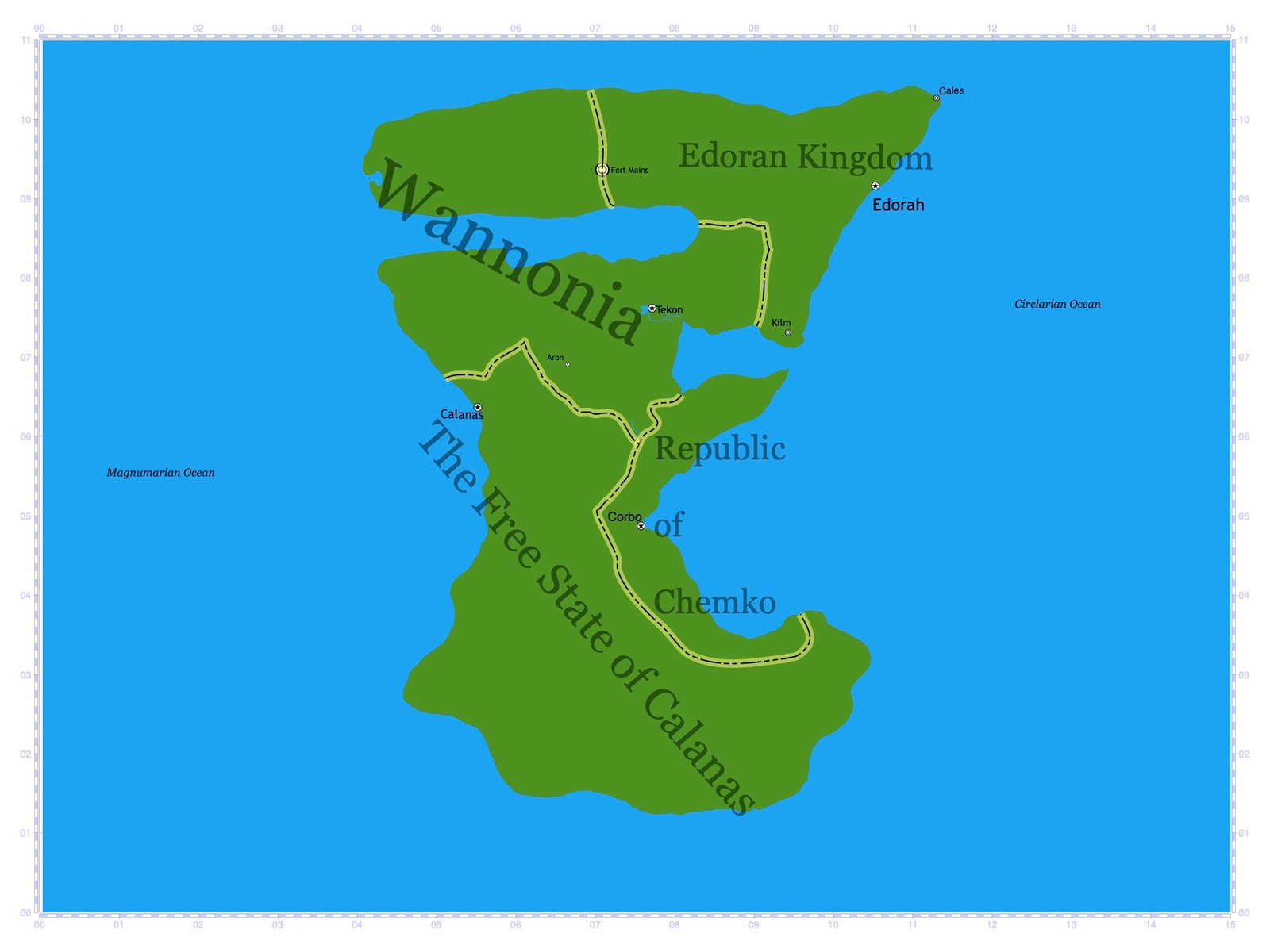
Until February 106 CE, the Wannonians succeeded in overtaking the weakened Edoran castles and fortresses, while, in Combria and Ereautea, they recaptured almost all of the lands of former Karlin, capturing the city of Kilm in the process. The only drawback on behalf of Kamon II was that he did not understand the swift and efficient method of communication, eagle-and-ship messaging, that King Richard II had with the crusader soldiers. Promptly, Richard II drew the Edoran crusaders from Vantacula and returned them to the Remikran battlefronts. Between March 106 and September 107 CE, the Edorans managed to regain Karlin, and the Northern territories with their strongholds, as they began construction of a large fort. Such a fort, named Fort Mains, was completed in October 108.
In March 109 CE, the Wannonians utilized a new invention, the boulder projector, which functioned as a large slingshot. With this, they captured Fort Mains and built upon it with additional fortifications. From this, they launched numerous assaults, pushing the Edorans to the Correns by November. But then, in March 112 CE, the Edorans invented the catapult, which, by June, helped them to recapture Fort Mains, upon which they too built numerous additional fortifications. By this point, the two powers were in an effective stalemate.