Alexia I, Empress of Wannonia
In April 224, Emperor Murstallar IV died. With no son to succeed the Imperial Throne, such an Office was taken by his oldest daughter: Alexia I. As the first Empress of Wannonia, Alexia I inherited a system in which one superguild occupied the flaxweed industry. Promptly, she enacted policies to break up such an entity, fearing that it would become its own government, but compensated by allocating more land, collectively, to the new smaller flaxweed guilds. Meanwhile, she expanded the defensive system of Wannonian Legions to intervene in conflicts abroad and form peace treaties.
Remoh: From Warrior Encampments to a Civilized Society
King Solonmake ruled until his death in 155, being succeeded by King Solonmake II, who ruled until 201. Following Solonmake II was King Kolat from 201-217, and then King Durantakis, who would rule until 255. During this period, the military encampments built during the Remohan uprisings in the 130s evolved over the decades into farming settlements. And the differences were obvious. During the war under King Solon, such places existed as makeshift forts consisting of tented camps with patrolled by troops. In the years that followed, they would build around these camps wooden walls, with guards patrolling their exteriors, while soldiers' tents in the interior surrounded the tents of the Remohan soldiers' families. These walls bore, in certain sections, square frames atop of them, serving as watchtowers. Meat, grains, and water were carried from the outside via defended supply caravans, as all operations were supervised by Remohan soldiers and their generals.
After the war, more permanence was established as the tents were converted into huts and each family, climate-permitting, owned their own small crop. Trading and village life developed within the walls, as a network of roads emerged to connect these new communities. For a brief moment, local councils, elected by the people governed the settlements and regions. Of the things they voted upon included agendas to expand farming beyond the walls, for the demand for food increased with a growing population as the Kings did not specify any use for these lands at the time.
The Rise of Slavery and Serfdom
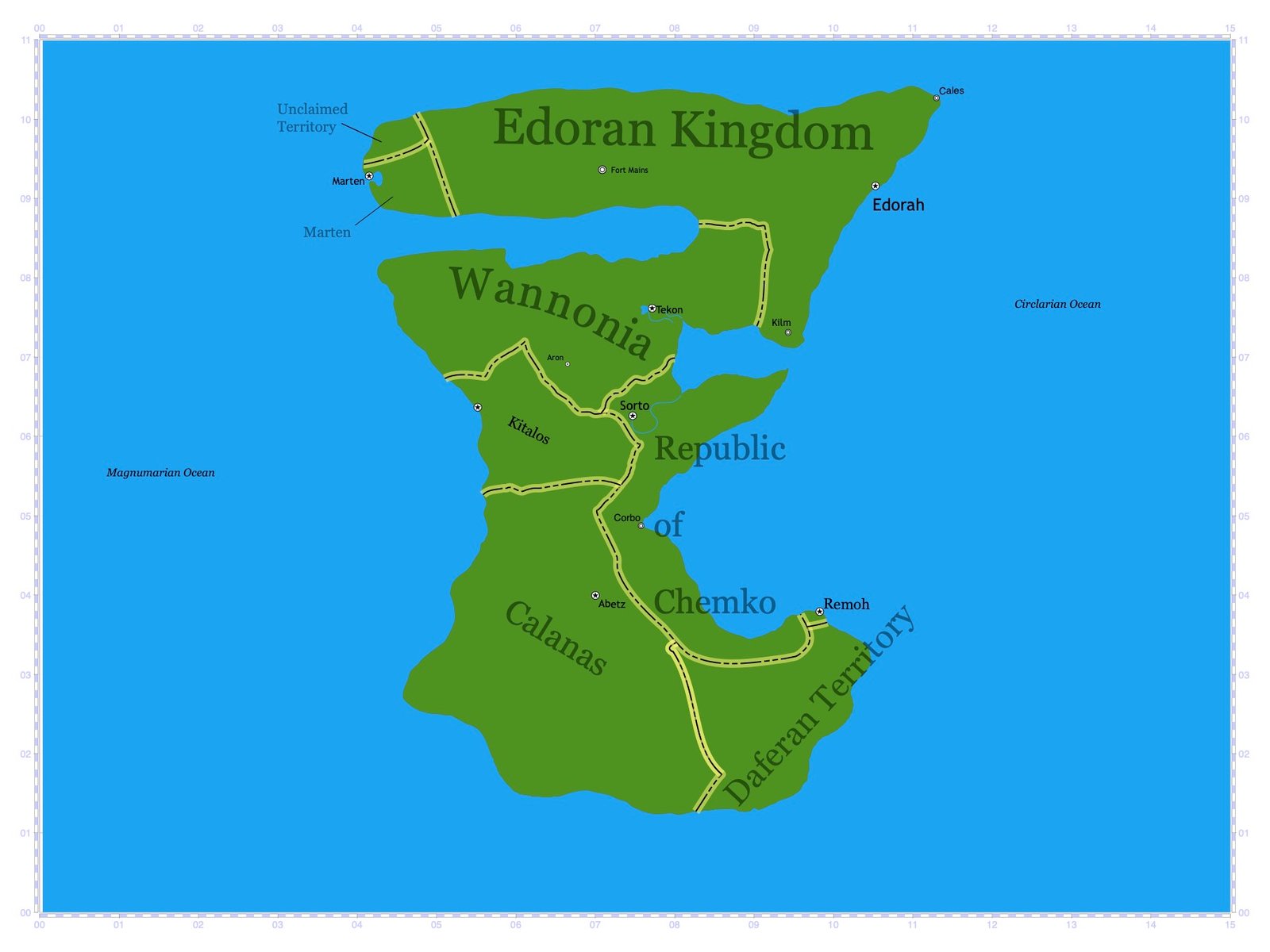
However, by the time of Durantakis' ascension to the Remohan Throne, a noble class had emerged in the Palace of Remoh proper. In September 225, King Durantakis and his nobles, with the employment of their knights, forcibly overtook the settlements and farmlands along the Circlarian and Southern Coasts, turning them into plantations, and taking in serfs and slaves. Over the course of a year, they expanded such pieces of property so that they bordered each other. Before long, in 226, conflict arose. While rival nobles under King Durantakis fought each other with their knights, those not of the noble class fought to regain the land taken from them; however, this third party was divided. Nevertheless, Remoh was in a state of crisis, leading the King, in 231, to send a letter to Wannonian Empress Alexia I for assistance. Alexia I obliged, sending a total of five Wannonian Legions, who wasted no time restoring order to the entire country. In October 231, she called a council with Durantakis and his nobles, where they signed a treaty dividing farmland equally among those who the King favored. The nobles not favored, as well as all the other Remohans, were made into slaves and serfs. More specifically, it was the marginalized Remohans who were made into serfs. Other non-Remohan Tahnish groups, who joined in the conflict, were exiled into the Interior Desert. Such an exile was also justified by their opposition to the Remohan agenda a century earlier, as they followed a religious doctrine dealing with "peace with the dead." As a result, Remohans accused these Tahnish communities of practicing in witchcraft, as they had also practiced using soul gems. Over the years, the Remohans imposed laws banning such practices as they continued to exile the Tahnish. So the exile in the Treaty of 231 was a final manifestation. Meanwhile, the local Quitzdodalan inhabitants became slaves, as Alexia I, King Durantakis, and the Chemkan Senate, who experienced a majority change in their September 232 election, signed a slave, serf, and mercenary trade arrangement.
Of note during this time was the significant difference between slaves and serfs. Slaves had no rights, nor freedom of movement, and were subject to unpaid labor. Serfs, in contrast, were paid, although in coppers, and had permission to move freely within their assigned domain when not commanded to labor. Assignments differed for both slaves and serfs, although both entities were equally subject to such duties. Some of these laborers were sent to plantations, while others, deemed strong and vigilant to do so, were sent to fight alongside Remohan knights against the Tahnish groups who were beginning to attack from the Interior Desert. In each of the plantation and military assignments, the serfs and slaves were divided, as they were not permitted to have contact with each other.
Kumoran
In March 240, while on a mission to fight in the Interior Desert, a band of Remohan soldiers, including a Remohan serf named Kumoran, was captured by a Tahnish group and taken prisoner. Unlike what was propagated in Remohan streets, the Tahnish captors, religious, believed in the doctrine of redemption; and such a doctrine provided for the Remohan slaves and serfs to speak to each other. Over time, the captives achieved redemption and were seen as equals under the Tahnish. And it was the Tahnish that they began sharing stories about life in the Remohan Kingdom. A party of Remohan soldiers, having heard about the capturing of Kumoran's company, arrived at the Tahnish encampment, but the captives, having joined the ranks of the Tahnish group, slaughtered the Remohans. Before long, the Remohan former captives and Tahnish in this encampment united and considered themselves to be one people: the Daferans. This encampment spread their new doctrine of recruitment to other Tahnish encampments, where Tahnish captors and Remohan captives began joining as Daferans in the same way. Before long, these Daferans formed an underground community as they elected Kumoran as their leader. As commander of the Daferans, Kumoran established a ring of spies to seek out other Remohan armies of slaves and serfs. These new "captives" soon joined the Daferans, increasing the size of the rebelling Daferan population. Between September 240 and April 241, Kumoran dispatched another ring of spies, who sent out to sneak serfs and slaves, a few at time, away from the Remohan plantations. By May 241, the nobles on a few of the plantations, noticing disappearances of a large number of laborers, sent out search parties, who began recapturing, and sometimes slaughtering, the escaped slaves and serfs. It was during this month that Kumoran launched the first Daferan assault upon the nobles, overtaking these plantations and freeing the rest of the laborers.
The Daferan Takeover
In October 241, King Durantakis discovered some of the Daferan encampments in the Interior Desert, the source of the assaults, and sent the Remohan Army, which recaptured the plantations and placed the settlements, including Kumoran's, under siege. However, in December 241, the Daferans, consisting of the Tahnish who mastered the difficult art of the use of soul gems, used such to send "ghosts" through siege lines and communicate with the undiscovered Daferan encampments. These encampments sent reinforcements; and before long, the sieges were broken. The Daferans then united to charge back into the coastal regions, reclaiming the plantations. With each plantation overthrown, more Remohan serfs and slaves joined the Daferans. Under Kumoran's leadership, they charged up to the city gates of Remoh proper. King Durantakis' forces managed to push back, claiming land just around the city. However, past this region, the Daferan forces proved too strong; so Remoh attempted to build a wall around the land they had.
Kumoran's Determination
In January 242, Kumoran crowned himself King of the Daferans. He had a grudge against Remoh, Chemko, and Wannonia for the labor trade agreement signed ten years previously; and as King, he vowed to conquer the urban centers of all three powers and take their wealth. This shortly turned into passion for the domination of the known world.