Marten: Line of Kings
Over the next century and a half, the Martenian Throne was handed from King to King in relative peace. King Fredon ruled until his death in May 156, when the Throne was handed to his son, Fredon II, who ruled until his death in September 196. In that month, the Throne was handed to his grand-nephew, Stanley I, who ruled until his death in April 261, after which the Throne went to Stanley II.
The First Coup
Meanwhile, raised within the ranks of minor nobility was a man named Costellus, who married a noblewoman named Marelda and gave birth to Costellus II in 259. Two years later, when Stanley II became King, Costellus I was promoted to the immediate Noble Class of His Majesty, where, in 269, he had an affair with Serende, who then had Costellus I's stepson: Kormon. Upon finding this out, in November 269, King Stanley II imprisoned both Costellus I and Serende. However, the two escaped; and, in March 271, Costellus organized a coup that successfully overthrew and ended the life of Stanley II. Now in power, Costellus I had the Church of Marten legitimize second marriages and births out of wedlock before proceeding to crown himself King one year later.
The Will of Costellus I
Over the years, rivalry had developed between Costellus II and Kormon, who volleyed for the Throne, to be taken after the death of Costellus I, which occurred in January 283. To diffuse civil conflict, Costellus I had dictated in his will for Costellus II to be King, but for him to claim such the position only upon the successful completion of a task: to go to the island-Kingdom of Monassa and claim a Golden Pendant. Upon return to Marten, the Head Cleric, Bordon, would then confirm such an item to be genuine before legitimizing Costellus II's coronation.
However, unknown to Costellus II, as he departed for the distant island in the middle of the Magnumarian Ocean, Costellus I's will contained a well-buried statement indicating for a final letter to be sent to Bordon. In that letter was an order to disregard the statements concerning Costellus II and automatically crown Kormon the King of Marten, which occurred in March 283.
In March 284, Costellus II and his company arrived at Monassa to find the island-nation at war with itself, as a usurper named Mino was attempting to overthrow the tyrant King Fendor. Costellus II joined Mino in his efforts. However, both Costellus II and Mino faced defeat in the following month, being forced to retreat to the island's coastline. Here, Costellus II sent for more Martenian forces. Two years later, in May 286, these forces arrived, and helped Mino and Costellus defeat Fendor. Between May and September of that year, the two men disputed, as Mino wanted to keep the fabled Golden Pendant, which they immediately found in the chamber of the slain Monassan King. However, Mino finally caved in to a deal presented by Costellus II, and handed over the Pendant, as well as a large sum of the Monassan treasury, in exchange for the company of Martenian soldiers assigned to serve as permanent mercenaries; and Costellus II set off in return to Marten, expecting to claim the Throne. Upon arrival in September 287, however, Costellus II was surprised to discover that such the position was claimed by Kormon, who made him the Postmaster. Costellus II investigated the letter exchanges in his new office and discovered the final letter written by his father to favor Kormon. Enraged, Costellus II determined to organize a coup.
The Second Coup
In March 288, Costellus II effectively removed the Head Cleric, Bordon, by paying him to move his services, temporarily, to serve a prescribed missionary agenda in the distant island-nation of Monassa. Meanwhile, he recruited and organized forces opposed to Kormon, and, in May 288, placed the city of Marten under siege. However, such an agenda failed when, in the following month, King Kormon launched a surprise-attack upon the weakest link: Costellus II and his immediate company. Costellus II escaped the assault as the sole survivor, but was then captured and taken prisoner. After a long trial, in October, King Kormon sentenced Costellus II into exile in the uncharted territory North of the Kingdom of Marten.
War Against the Edoran Kingdom
Facing discrimination, religious oppression, and high taxes, the Moorlander-Khap population grew increasingly weary of their Edoran rulers over the years. Emerging from within this community were two figures: Sumon and Composon, who were brothers. They recruited Moorlander-Khaps into a formidable force of organized resistance, and, in October 298, with the utilization of spellfire forces, set two local Edoran fortresses ablaze. Such an attack succeeded, as surviving Edoran soldiers were forced to flee to the East. The two brothers, though, differed in their ideals for governing the new territory, with Sumon wanting a democracy and Composon wanting absolute rule. Such the disagreement brought them and their forces close to conflict. In December 300, the Edorans struck back with reinforcements. With the rivalry between the two brothers softening the resistance, the forts and territories were recaptured. However, King Kormon of the Martens had befriended the two resisting figures in the 290s, and, seeing the Edorans as a threat, supplied mercenaries as well as weaponry enhanced by the Spellfire Guild. Between January and March 301, with these resources at their disposal, the two brothers reunited and struck back against the Edorans.
The Plague
During this time, the Edorans put up a harsh front. But then, in April 301, they drew back and, without explanation, surrendered. As the Martenians and Moorlander-Khaps recaptured the forts, they found Edoran soldiers sick and dying from a mysterious plague. Soon, Martenians and Moorlander-Khaps began to fall ill, while other soldiers, seemingly not yet afflicted, fled back to the city of Marten. However, these people were, in fact, infected; and between April and September 301, in Martenian lands, as well as within the walls of Marten proper, swaths of Martenians, include those of nobility, fell sick and died.
Meanwhile, Sumon and Composon survived the plague. However, with the Martenians having withdrawn, no third party was present to mend the old rift between the two differing political ideals; and in June 301, Composon launched his forces upon those of Sumon, drawing the equally powerful sides into a gridlocked conflict.
The Third Coup
Throughout the 290s, during his years of exile, Costellus II befriended members of the remaining Khap population. It was in the summer of 300 that he and the Khaps caught the mysterious plague that would spread to the Edorans, Martenians, and Moorlander-Khaps to the South. However, with Costellus II and his followers living further apart and Khaps being genetically predisposed to fighting off the disease, they were at an advantage. In May 301, Netor, a spy, reported to Costellus II of the sick and dying in Marten. In the months that followed, Costellus II, seeing the opportunity, organized his Khappan followers into an army and set for Marten. In October, he arrived to find that Marten's city walls were, as expected, less-defended than they were in previous years. Promptly, he launched a third of his forces upon the North Wall, where King Kormon concentrated his forces, most of them being archers, while dispatching Navy boats around the harbor. However, unknown to Kormon, the remaining two thirds of Costellus II's forces were carrying out an unseen agenda. In the middle of one night that month, Khappan warriors, on canoes, secretly boarded the Martenian ships, where they silently killed off the occupying soldiers. That morning, they sailed the commandeered ships into the protected harbor of Marten, where Khappan archers shot flaming arrows into the city. In the same moment, from the immediate East and West, the remainder of Costellus II's forces charged the walls; and by that evening, King Kormon was executed as the city fell. Promptly, Costellus II crowned himself King of Marten, bearing the Golden Pendant of Monassa. Scholars argue that this was the beginning of Remikran Symbolism.
The Martenian Empire
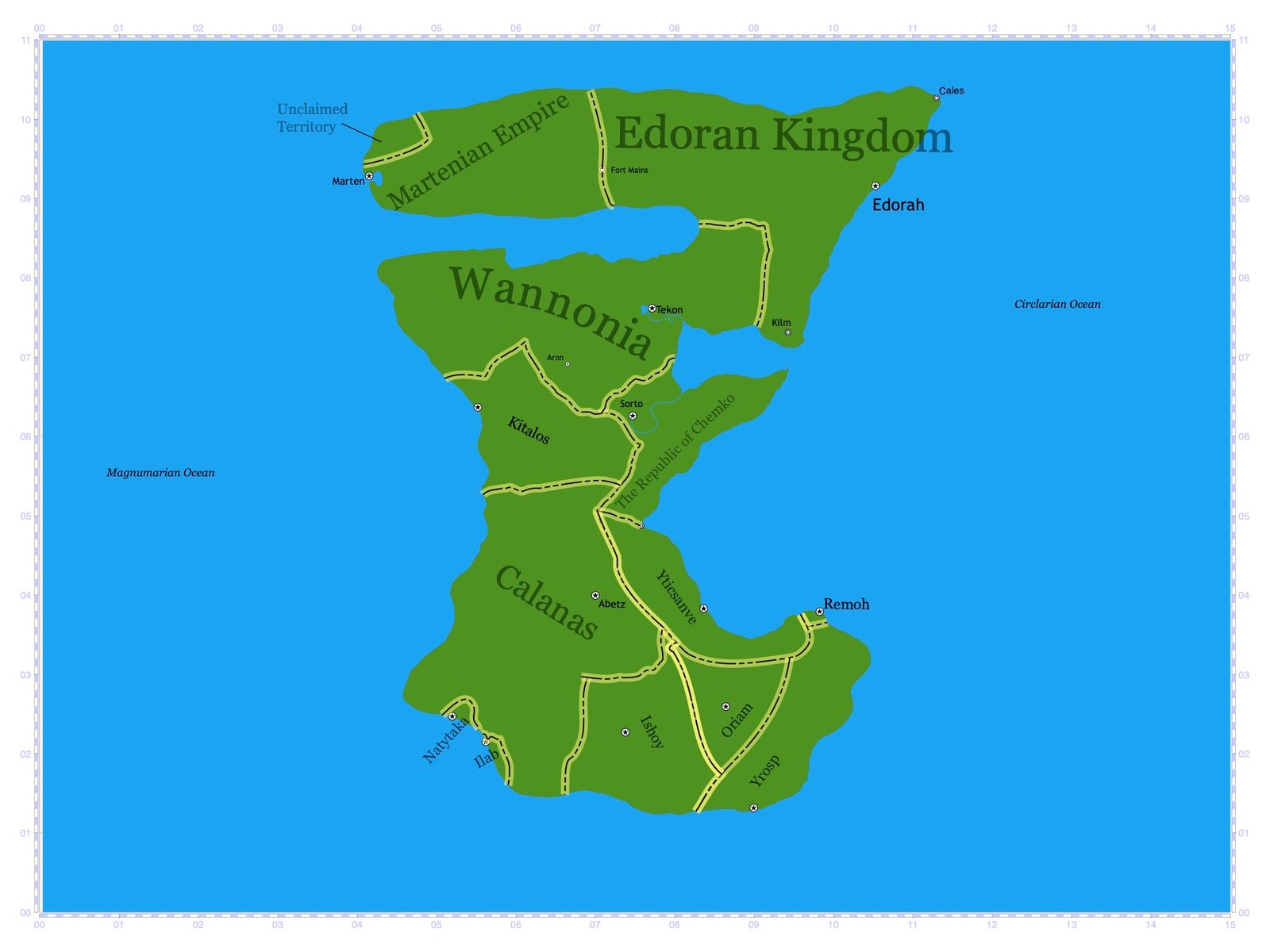
But Costellus II's quest for power did not stop there. In November 301, he had the brothers, Sumon and Composon, secretly assassinated by poison; and by that December, both of their territories were brought under Martenian control, thus making Marten officially an Empire. In January 302, the Martenian Empire pushed further East, capturing unsuspecting Edoran fortresses in one sweep. However, in April 302, such an advancement was halted by Edoran resistance in Fort Mains. Nevertheless, Emperor Costellus II was determined to defeat the Fort, and then proceed to fell the Edoran Kingdom, invade and conquer Wannonia, and defeat the remaining civilizations to the South in a quest to dominate all of Remikra.