The Hanna Line and the Kistanis
Queen Hanna I ruled the Kingdom of Kitalos from 137 to 171, succeeded by Queen Hanna II, who ruled until the year 200. It is unclear whether or not the Hanna line, related to the Quesonas in Calanas, were of blood relation to the Kistani family. What is known, however, was that in 200, after the death of Queen Hanna II, came the peaceful succession of King Tomon I, who was of the Kistani royal family. Ruling from 200 to 212, Tomon I was succeeded by Tomon II, who ruled until 249. King Tomon III then followed from 249 to 271, and was succeeded by King Tomon IV, who ruled from 271 to 297. In 297, Tomon IV's grandson, Terolon, succeeded the Throne, after a short period of controversy within the Royal Court.
Phydon: Early Life
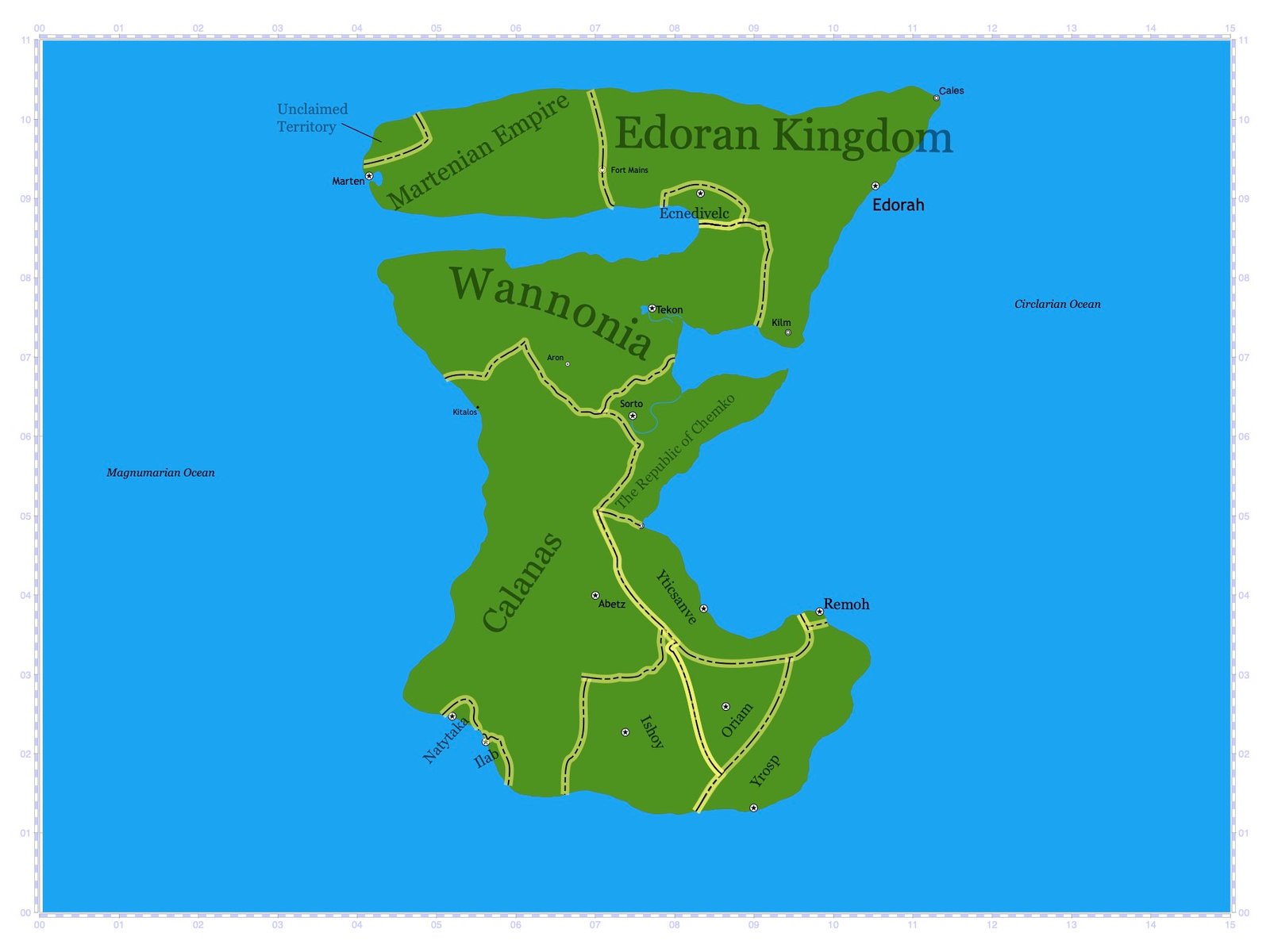
Born in 285 to an upper class family, Phydon spent his childhood on the Isle of Truth, which lay at the Western Mouth of the Northern Edoran Sea and existed as a self-sufficient fishing community. In 291, when Phydon was only six years old, King Tomon IV and the nation of Kitalos invaded the Isle, conquering it within three days. Phydon's family split on the issue, with his father, Edon, joining the ranks of Kitalan knighthood, and his mother, Phyna, adamantly opposed to the idea. In fact, she took the children, including Phydon, to the other side of the Isle in the hopes of sheltering from the Kitalans.
Years later, Edon, having advanced through the ranks of Kitalan knighthood, moved to mainland Kitalos and became a recruiter. For every successful recruit, Edon was rewarded one gold piece, driving him to search relentlessly for qualifying candidates. Upon a return visit to the Isle of Truth, he spotted his own son, Phydon, as a potential candidate. After Phyna refused to let Edon take Phydon, Edon arranged to have Phydon abducted while on a walking journey to a message courier post.
Phydon was sent to a training fortress in the mainland territory of Kitalos, where he advanced through the ranks and became a recruiter, just like his own father. Phydon, additionally, felt a sense of power in his duties, and began to hunger for more. However, he was seen as an outsider both in terms of friendship, romance, and especially promotions. Before long, Phydon realized that the level of recruiter was the furthest he would advance. Meanwhile, as Edon retired with a mass of gold to the island nation of Monassa, he would never offer him any kind of support.
The Overthrow of King Terolon
Phydon's opportunity arose with the overthrow of King Terolon.
After years of high taxes, religious oppression, and serfdom, the Kitalan population began forming grievances. In May 306, they gathered and toppled the Kitalan Crown, executing the ruling Kistani family, and establishing a democratically elected Council in its place. The Simdanis, a noble family having hungered for the Throne for decades, began gathering recruits of their own, hoping to overthrow the Council and establish their Throne. The Council, in response, organized their forces, making Phydon one of their commanders. In the months that followed, the Simdanis were confronted and defeated. The Council, however, was still weak in its leadership capabilities; and Phydon, hungering evermore for power and leading the strongest division in rebel forces, saw an opportunity. In November 308, Phydon overthrew the Council and re-established the Kitalan monarchy, making himself King.
The Quesona Line
Queen Quesona II would continue to rule until her death in the year 300, and would be succeeded peacefully by her daughter, Quesona III.
Quesona III's Overthrow
Throughout the first decade of the fourth century, descendants of the followers of Karmun carried out a movement based on the desire to overthrow Queen Quesona III and establish a new treaty of loyalty to the nation of Ishoy, now under King Karmun II. In May 308, this sentiment manifested, under the leadership of Karmun II's brother, Samon, in a direct attack on the unsuspecting capital, Abetz. The city fell quickly, as the Queen's palace was raided; and the Queen, herself, fled. However, it was Quesona III who pulled the trick of disguising the corpse of one of her advisors as that of her own, which fooled King Samon into thinking the ultimate deed was accomplished. The Queen fled to a secret location far away from the city while her forces lay scattered throughout the Calanasian territory.
From her hiding spot, Queen Quesona III plotted to have recruits disguise themselves as soldiers serving for the new King, joining his ranks, and subsequently attack his regime from within. However, the Queen was faced with two obstacles. First, the usurpers had taken most of her wealth, rendering her unable to compensate any recruits willing to fight for her until the Royal Treasury was recovered. Second, such potential recruits were scattered, divided by King Samon's strategic building of "mini-fortresses." As a last resolution, the Queen wrote a letter of help to the Kingdom of Kitalos, hoping that payment could be rendered later.
King Phydon's Conquest
It was in January 309 that King Phydon received the message from Queen Quesona III, recognizing the faltering of power in Calanas and the opportunity to conquer the desirable lands to the South. The King obliged to the letter, sending his friend, Letor, to command a fresh wave of Kitalan mercenaries to serve under the Queen. However, Phydon also had a hidden agenda: to slaughter the Queen and her forces, following the toppling of King Samon, and subsequently conquer Calanas. That May, the mercenaries arrived in Calanas, accompanied by Mentor, brother of Letor, who the King decided to send as well following news of the dangers of King Samon's "mini-fortresses." The two brothers, Mentor and Letor, met Queen Quesona III, and were both attracted to her not-so-loyal advisor, Zyma. Zyma developed a warm friendship with Letor, leaving Mentor jealous. However, Letor's fortune, as well as, ultimately, the fortune of the Kitalan Kingdom, changed when, on one night, Zyma and Letor became intoxicated with the local white wine. Letor, who was slightly more seduced, revealed King Phydon's secret agenda to the young Zyma, and, later, made her promise not to expose the information to the Queen or her other advisors. Mentor, however, overheard the blunder, and immediately set off to tell Phydon. Later that year, an assassin from King Phydon ended Letor's life, and presented an order to have Mentor as the replacement commander. Queen Quesona III, appearing not to take notice of the hidden agenda, carried through with the plan, successfully overthrowing and killing King Samon in November.
Quesona III Betrays Phydon
However, Zyma, jarred by the death of Letor, informed the Queen of the hidden agenda; and, unknown to King Phydon, the Queen, while fighting Samon, sent messengers, calling her forces together. Moreover, while she was in exile in the Calanasian countryside, she had been taking spellfire lessons from numerous spellcrafters. Using such skills, she had, before the attack on Samon, secretly dug a pit below the chamber where Phydon planned for her to die, and placed a large fire in this. In November 309, after the defeat of Samon, as Phydon's mercenaries gathered into the chamber, preparing to assassinate her, Queen Quesona III opened the floor, causing the soldiers to fall into the pit and burn to death. The Queen's forces, gathered by the messengers, arrived and slaughtered the remainder of Phydon's forces, while the Queen had Phydon's messengers killed, cutting off all communication to the North, while she planned to attack and defeat his Kingdom.
In March 310, King Phydon, concerned over the silence from the Calanasian battlefront, ordered the dispatch of another division of Kitalan mercenaries to serve as reinforcements, leaving Kitalos proper partially undefended. Meanwhile, Quesona III had soldiers sneak into Kitalos and surround the city proper. In September, the Calanasians launched a surprise attack. King Phydon was beheaded, as the Kingdom of Kitalos fell under Calanasian control. Feeling powerful, Queen Quesona III set her sights on the Martenian Empire, figuring that their conflict between the Moorlanders and Edorans had effectively weakened them.
The Martenian Empire: Quesona III's Failed Conquest
In October 310, Queen Quesona III dispatched a fleet of the Calanasian Navy and a division of Calanasian infantry toward the Martenian capital. However, as these forces arrived in November 311, the city of Marten presented itself much stronger than expected. More land and sea divisions on their behalf, combined with more talent in archery divisions, effectively wiped out the attacking Calanasians. As the few remaining Calanasian survivors returned empty-handed to the Calanasian mainland, Queen Quesona III, in December 312, sent a blue and silver pendant to the Martenians as a symbol of peace, as they agreed to keep their original borders.