Timan Yates: Love and Strife
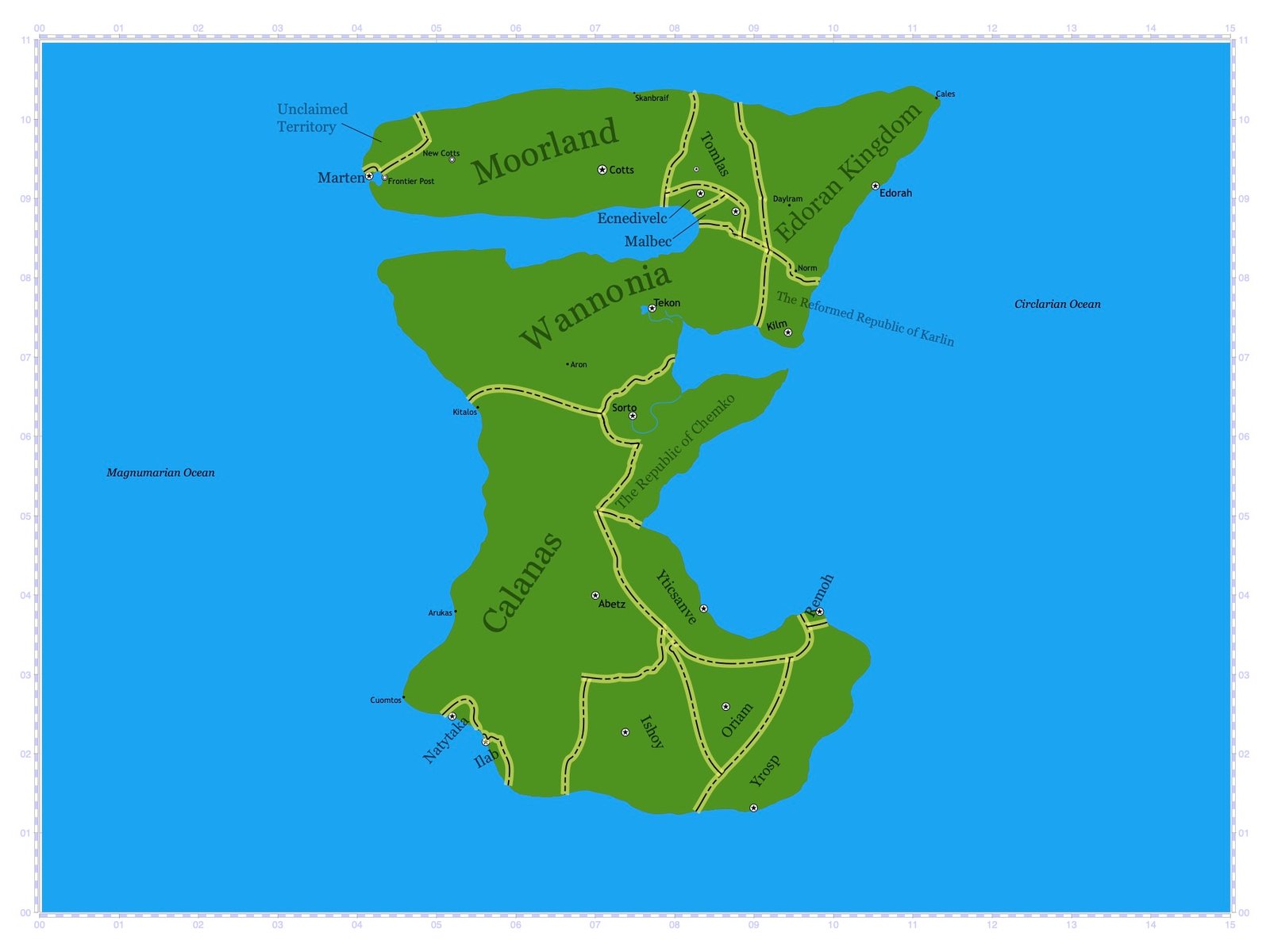
In September 523, Edoran forces surrounding the city of Kilm began launching eagle-riders who dropped spellfire bombs upon Karlinian grain crops, putting their food source in jeopardy. In response, Timan Yates decided to send a message to the Emperor of Wannonia for help, utilizing four secret recruits: Edmund Wellings, Peter Lyte, and Marstan Tegor, who were messengers, and one spellcrafter, Merryl Nors. In equal shares to each of these four, Yates promised land and ten gold pieces for their success. However, internal politics began to brew when the men met Yates' daughter: Mary Yates. Tegor and Nors were attracted to her, accordingly. But as Tegor attempted to flirt with her, Mary rejected him for Wellings. Tegor offered to reimburse Yates with five gold and half of his rewarded land for Mary Yates' hand in marriage, but Timan Yates rejected it, seeing moral wrongness. He subsequently allowed Mary to make the final decision, in which she chose Wellings for marriage. As a result, Tegor and Nors, who was his close friend, held a secret grudge.
Tegor and Nors, Journey and Betrayal
In March 524, the party of four set out for Wannonia. As Edoran forces were concentrated on a weak line of Karlinian defenses to the East, the party, at night, took off on eagles muzzled for silence. They landed outside of the two walls at a post run by a man named Kurlan, who was Edoran but secretly supportive of the Karlinians. Kurlan took their eagles and gave the men horses, telling them of secret paths to take. As the party set out, however, Tegor and Nors, still grudging of Timan, launched a counterplot. The two men of the party purposely fell behind the other two, where Nors released an explosive firespell, making Wellings and Lyte believe that they were under attack. In the ensuing chaos, Tegor and Nors concealed themselves and their horses in invisibility and took off to the East, leaving parts of their burned clothing behind. When Wellings and Lyte arrived to where the cloth fragments were, they believed that Tegor and Nors were abducted by the Edorans. Lyte stayed and searched the immediate area for the presumed missing men while Wellings continued toward Wannonia.
In April, Tegor and Nors arrived to an Edoran fortress, where they, in an act of betrayal, informed the Edorans of Yates' plan. The Edorans asked for them to help a counterplot in exchange for rewards far greater than those offered by Yates.
King Samuel VII and Emperor Bilgondon
In January 524, King Samuel VI died and was succeeded by King Samuel VII, who carried a differing personality. As King, Samuel VII, according to scholarly speculation, believed himself to be almost a god, for he vowed that he would rule "for a thousand years." Immediately, he raised taxes to create a supreme force of Edoran knighthood to keep his Kingdom well-protected and in anticpation for territorial dominance. He fantasized that the Wannonians would one day attempt to fell the Kingdom, but that they would be no match, and that they would be handily defeated. That June, news of Yates' plot reached the King, who ordered the restoration and expansion of the big wall to the West, anticipating a Wannonian assault. He also ordered similar fortifications to be added to Norm and Daylram.
But one month before, Wellings had reached the city of Tekon, where he informed Wannonian Emperor Bilgondon of the situation in Kilm, and that the Edorans seemingly attacked and abducted two of their party, for whom Lyte was still searching. However, after further inquiry, the Emperor began suspecting that Tegor and Nors were conspiring to expose the agenda to the Edorans, which was confirmed when a Wannonian spy informed him of the Edoran fortifications. Aware of Samuel VII's attitude, Bilgondon secretly planted four Wannonian Legions in the immediate vicinity of Edora proper, and a fifth within the streets and harbor of Edora, itself. To the Edoran Palace, Bilgondon dispatched Hydon, a skilled archer and spellcrafter, to assassinate the King.
John Downing's Warning
John Downing was the son of an Edoran cleric, but, after demonstrating himself in the skill of combat, was made to join the Edoran knighthood. In December 524, well-educated on recent politics in Wannonia, Downing, as a high-ranking Edoran Commander, warned King Samuel VII repeatedly of Emperor Bilgondon and his "devilish ways." But the King ignored him, and, instead, gave further orders to carry the original fortification agenda. Seeing the preservation of the Edoran Kingdom as a higher priority, Commander Downing went against these orders and sent knights to secretly assume defensive posts around Edora proper. However, an unknown source relayed this information to Samuel VII, who, in March 525, discharged Downing and sent him to be a serf in Cales.
The Fall of Edora
One night on June 525, Hydon, the Wannonian assassin, shot an arrow from a hidden place, ending the life of King Samuel VII, who was partaking in a public ceremony.
Regarding this event, John Downing supposedly remarked that "cursed are the fools who think they know; and blessed are the wise who know they think."
While fear and chaos ensued in the Palace halls, Hydon went to the top of the Palace and shot a flare into the sky, signaling the hidden Wannonian forces to attack. Wannonian archers confronted Edoran walls and gates. From hidden places inside the city sprung Wannonian infantry, archers, and spellcrafters, who killed the gatekeepers and threw open the gates to the remaining Wannonians. These soldiers poured in, and, by sunrise, felled the city of Edora proper, placing the Wannonian flag atop the Edoran Palace. Divisions from these Legions then split off to conquer territory to the West.
Meanwhile, further West, other Wannonian Legions marched undetected through Tomlas and captured Daylram by surprise from the Northwest. Afterward, they converged with the Wannonian forces from Edora proper, and, with their professional skills in archery far outmatching the Edorans, overran Fort Norm.
In Cales, John Downing was, once again, made a Commander of Edoran knighthood. With critical thinking and cunning observation, he utilized strategies which effectively kept Wannonians in his vicinity at bay, as well as regained coastline up to the area surrounding Edora proper. Over the next few years, Downing recruited a great number of Edoran forces.
Concerning the West, Downing realized that the high concentration of Edorans in Kilm and along the West border, a part of Samuel VII's useless strategies, did provide a lot of organized manpower. Via messengers, Downing organized these forces into divisions anticipating for an assault upon Norm, Daylram, and Edora proper. Downing observed and copied the strategies carried out by the Wannonians, and decided to expand upon them by having all of his forces concealed in invisibility. In May 530, trained like the Wannonians but concealed unlike them, Downing's forces attacked Daylram and Norm. The occupying Wannonians, unable to see Downing's knights, were caught by surprise and experienced many casualties. Emperor Bilgondon ordered the Wannonians to retreat as the Edorans re-captured the three cities.
In June 530, John Downing was made the King of the Edoran Kingdom. As King, John I turned his attention toward Kilm, which he intended to capture.
Wannonian Counteroffensive
Emperor Bilgondon, however, made a discovery. His cousin, who was colorblind, was able to see people who were concealed under invisiblity. The Emperor dispatched recruiting agents, who went through every Wannonian town and village, returning with hundreds of those who were determined to have colorblindness. Wannonian Legions were reassembled, where those with the colorblindness affliction were placed in command and scouting posts, while these Legions were secretly stationed around Downing's forces near Kilm and throughout the territory South of the St. Eschel River.
On January 531, the Wannonians attacked. They far outnumbered the Edorans, as the invisibility skills employed by the Edorans were outsmarted by the colorblind Wannonians. Downing's forces were swept away from the area surrounding Kilm, as both surrounding walls were opened by the Wannonians, who stationed themselves in and around the city for defense. Meanwhile, Wannonian forces pushed the Edorans North of the St. Eschel River, where, in May 531, King John attempted to re-capture Southern lands by Naval forces. Such a plan, however, ended in heavy casualties for the Edorans.
Emperor Bilgondon then sent King John a message calling for a treaty.
March 532: The Treaty
In March 532, Emperor Biligondon and King John signed a treaty, which established the St. Eschel River as a border between the Edoran Kingdom to the North and the Reformed Republic of Karlin to the South. Despite the treaty calling for peace, fortifications for each country were established along the River's banks as a measure of precaution. Meanwhile, the Wannonians would supervise the functions of Kilm until the re-establishment of its government and the carrying out of its next election, in which Timan Yates became the Head Consul. Yates would award the land and gold to Wellings and Lyte, while the former married his daughter. Furthermore, these figures received additional land and wealth that would otherwise have been given Tegor and Nors, who were ultimately killed in the Wannonian assault on Fort Norm.