Moorland: 500-510
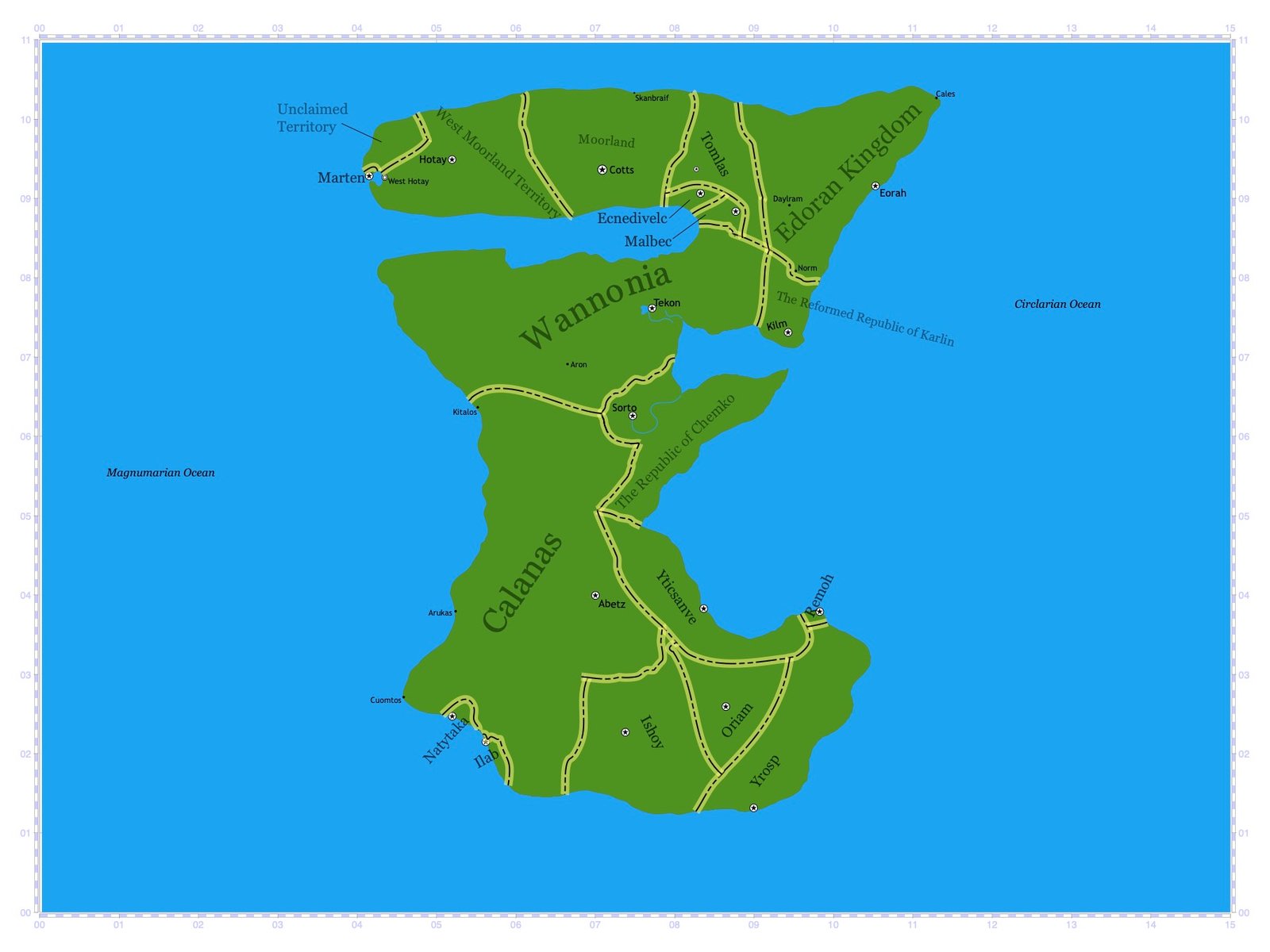
In December 499, Fotoram, King of Moorland since 478, signed a treaty with Martenian Emperor Petrician, establishing peace between the two countries. To reinforce the terms of such, King Fotoram established New Cotts, a fortress-city in the West, to counter enemy attacks, as well as an unnamed frontier settlement on the West Coast for agents spying on Marten. It was during the first decade of the sixth century that Moorland became more of a firmly established civilization, as Cotts and New Cotts became centers of trade. To the latter came the Khaps, who brought whale blubber, animal furs, and the commodities made from silver pines. In exchange, the Moorlanders traded spellfire artifacts, buffalo furs, and grains. As a result, trade guilds began to expand, as more members joined them. Guild posts emerged throughout Cotts into surrounding villages, and then along the newly established trade route to New Cotts.
However, problems began to arise, as guild owners acquired more wealth and wanted to expand. They had a desire for more property in the city blocks of Cotts, so that they could have more of their members in closer proximity for tighter control of their wealth. They petitioned to King Fotoram, who obliged by granting them city blocks inhabited at the time by members of the working class. Such residents were forced out of their dwellings, as spellcrafters hired by the guild owners demolished the dwellings and built guild "palaces," in which the guild owners moved. Initially, they had promised to share these places with their members, harnessing cooperation; but once the buildings were complete, they were reserved only for the owners and their families. To pay for such expenses, they dramatically raised crafting fees from their members. Angered by this, members left the guilds and began practicing their crafts illegally. When informed of this, King Fotoram issued an order where villages, homes, and city blocks were raided, and mass numbers of illegal former-members arrested and imprisoned. Some of the ringleaders were even executed.
Some outlaws, though, escaped the raids and arrests, and traveled to the frontier settlement on the Coast. Here, such a place was mostly underground, embedded into a mountain. Most of the people of duty were spellcrafters, assigned by the King, who considered them outcasts. As a result, these people begrudged the King and secretly traded with the Martenians. They helped to conceal the influx of outlaws and established large underground trade posts.
Among the influx was a man named Kitor, who was a spy for the King. Upon discovery of the underground guilds, he immediately relayed information of such to the King, who sent an army to attack the settlement and slaughter most of its inhabitants. In the wake of this, the King raised taxes on merchant and working classes to help pay for the resulting guild owner "losses" of the underground operation, eliminated taxes altogether for the guild owners, and enacted a law requiring every Moorlander to join a guild, paying fees accordingly.
Queen Aemsdena
Originally a lower-class merchant, Aemsdena gathered a lot of followers when she publicly decried the King's actions for unfairly catering to the guild owners. She called upon these followers to rebel and demand the King for a fair compromise. In April 512, Aemsdena and her followers gathered around the King's palace with a signed petition demanding the repeal of such unfair laws, to which the King responded with the order for their arrests. Aemsdena was imprisoned.
However, such imprisonment did not last long. In November 513, Aemsdena, having learned spellcrafting earlier in life, used such skills to escape. Subsequently, she helped many of her followers leave undetected and began organizing them into an army. In May 515, Aemsdena and her forces launched a surprise attack from within the walls of the King's Palace, which came under the onslaught of her spellcrafters, assassins, and archers. It was an unnamed assassin who ended the life of King Fotoram. The King's forces retaliated as they attempted to instill another King. But with reinforcements outside Palace walls as well, Aemsdena handily defeated them. In June, she crowned herself the Queen of Moorland, and immediately enacted new laws. Of these measures were the allowance for the establishment of independent guilds, heavy taxes against guild owners, and lower taxes on merchants and guild members. Meanwhile, laborers paid no taxes.
King Mundor
In retaliation to this, the guild owners hired indigenous Moorlandish mercenaries and assembled an army outside of Cotts. In October 517, such a force defeated Cotts as an assassin killed Queen Aemsdena, while Mundor, owner of the Fighters' Guild, made himself the King. King Mundor of Moorland avenged the policies of his predecessor by criminalizing the independent guilds, taxing ninety percent of merchant and guild member revenues, and utilized taxpayer gold, silver, and copper to pay guild owners for their expensive properties and their retirements. Meanwhile, the laborers were divided into groups of serfs to work on guild owners' properties, as well as the land of other wealthy entities.
Queen Ledana
Ledana, sister of Aemsdena, gathered spellcrafters from all around Cotts, and dispatched them to various underground meeting places, where they began training willing serfs, each in multiple skills of spellfire combat, including archery, basic spellcrafting, and dagger-fighting. Subsequently, the new recruits were organized into armies; and, in November 520, they overthrew Cotts, assassinating King Mundor. Ledana then became the Queen.
Beginning in January 521, Queen Ledana taxed guild owners based on their owned expensive palace properties, eliminated taxes for merchants, guild members, and serfs, and placed a limit on what guild owners could charge their members in guild fees.
The Establishment of West Moorland
To compensate for the new tax expenses, the guild owners sold their luxurious "palaces" and re-established themselves in the city of New Cotts. Here, they bought city blocks and converted them into similar "palaces" and began charging high fees to their members. Furthermore, they took possession of city streets, charging tolls for citizens and passerby alike. In January 528, Queen Ledana issued orders for these guild owners to cease the street tolls, pay property taxes on the new "palaces," and to pay large fines for the high fees charged upon the members. The guild owners refused; so, in November 529, the Queen dispatched Moorlandish forces, who captured New Cotts and enforced her laws.
Estemor, the new owner of the Fighters' Guild, recruited indigenous mercenaries, but, unlike his predecessor, trained his recruits with tactics similar to those of Ledana's forces. He, furthermore, created more distinct divisions in his army, equipping some with swords and shields, and others with bows and arrows, while having a division of spellcrafters as well. In January 531, he launched a surprise attack on one of the main supply lines to the Queen's forces in New Cotts, weakening her divisions. In March, Estemor's forces captured New Cotts, and immediately began preparations for the Queen's retaliation. As expected, one year later, Queen Ledana's forces attempted to re-capture the city, but were confronted about halfway to the place by Estemor's soldiers, who inflicted heavy casualties. The Queen surrendered the battlefront and called for a treaty.
In June 533, Estemor and Queen Ledana signed a peace treaty, which established a boundary between Moorland and the territory gained by Estemor. Such the latter would be known as the nation of West Moorland. In October 533, Estemor called a council with the other incumbent guild owners in New Cotts. Such a Council was unelected by the people and was established as the government of West Moorland. Meeting once a year, they made all of the trade decisions, and punished defectors and cheaters, with lethal force if determined necessary.