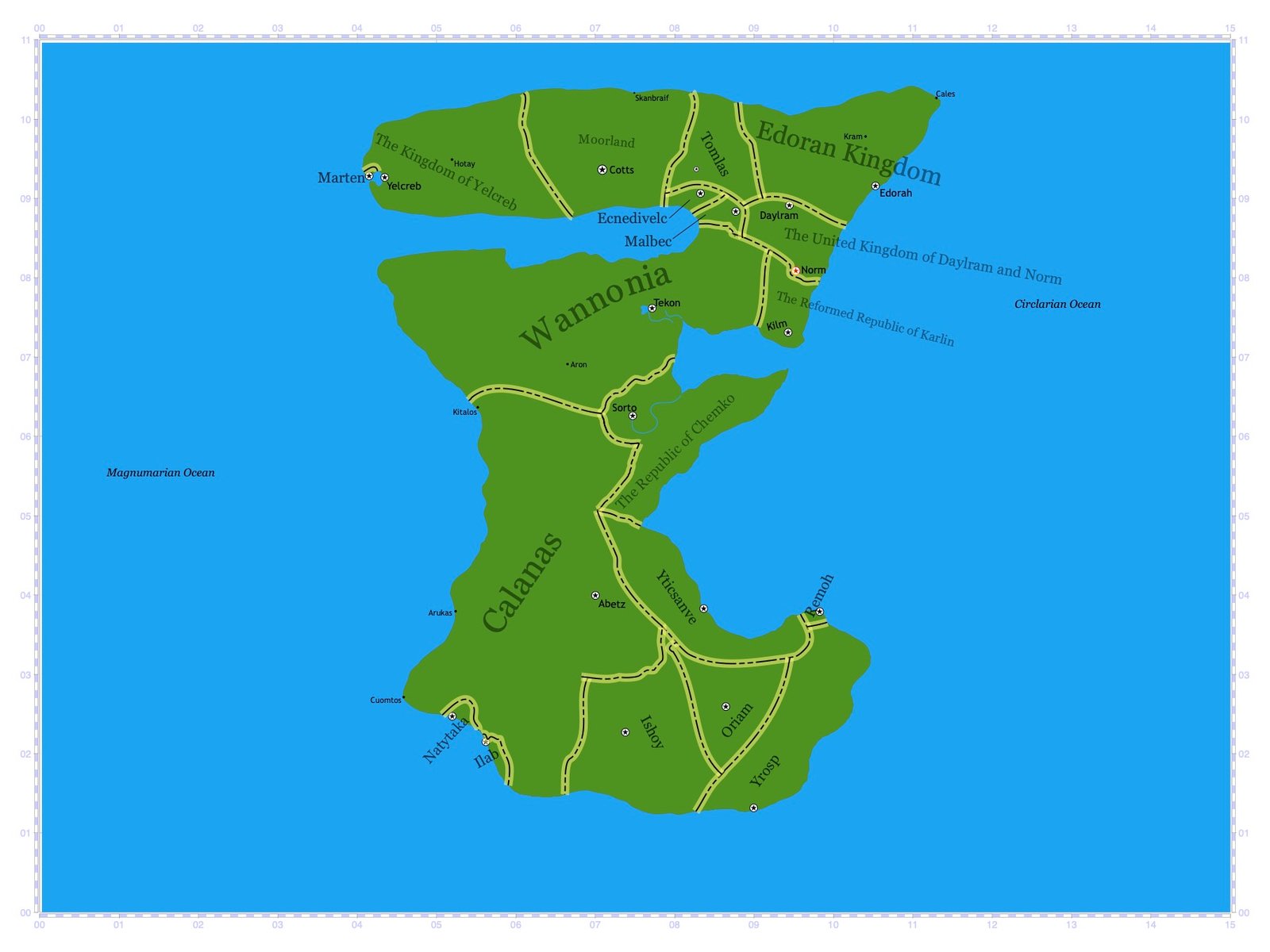
West Moorland
Between the 560s and 650s, the Norman Church ran the government of West Moorland, where it collected wealth from voluntary donors, imposing no taxes, and where Normanites were solid in membership, keeping the lands and city of Hotay well-defended until the Plague years.
As a result of the Plague, though, the population of West Moorland had effectively dwindled; and the guilds, having been unseated a century previously, saw an opportunity. Lord Toran emerged as a leader, merging his Fighters' Guild with the Spellcrafter Guild as they built a concealed army of blade-wielders, archers, eagle-riders, and infantry utilizing catapults and the early "debris-projectors." On 4 March 671, this army was launched upon the walls of Hotay, felling it within 36 hours. Between 672 and 673, the Guilds' Council was re-established, as Lord Toran became its Leader. Under his rule, the traditional Alconist Church was restored, as Normanites and their sympathizers, considered heretics, were hunted and executed. Surviving refugees fled to Kand.
Kand
In Kand, the respective Guilds' Council was still in existence, with the respective Norman Church in place to provide moral checks upon their decisions. However, over the near-century that passed, corruption emerged within this system, as the rich guild owners voluntarily contributed large amounts of wealth to convince the Church to approve of a law requiring all Kandians to join a guild. With such a requirement, the guilds then raised their fees, portions of which were used to further bribe the Church to pass other corrupt measures. Eventually, there arose an aristocratic class of guild owners and Church leaders, who engaged in mutual deals of exchange. Within this class emerged a position of leadership, assumed, in the latter half of the seventh century, by Lord Mecon, owner of the Kandian Fighters' Guild.
Refugees from West Moorland were given asylum in exchange for service in the guilds. In 674, the Gatherers' Guild, of which many refugees were members, launched a party to the uncharted Northern territories, where they discovered silver moss, which could produce light efficiently when activated by spellfire.
The War in the North
Before long, West Moorlandish venturers also discovered silver moss, and saw its value in use and trade. Lord Mecon of Kand dispatched soldiers to these lands to fend off the West Moorlandish squatters, to which West Moorland responded with an army of their own. And thus, in the end of 674, war was begun.
Also in the century leading up to the 670s, Moorlander-Khaps, Martenians, and outcasts from the Gatherer and Spellcrafter Guilds merged to give birth to a new ethnicity: the Yelcrebans. The Yelcrebans upheld a "pure idea" encompassing Norman Church doctrine, accusing both the governments of Kand and West Moorland of corrupting it; and the Yelcrebans were determined to form their own nation. In the early 660s, before the Plague, two separate Yelcreban uprisings occurred, each in Kand and West Moorland. But both ended in defeat. In each country, Yelcrebans were forced into serfdom, with the ones deemed fit being drawn for army recruits as "scouting pawns," often being the first to die in battle. Those who survived were short-changed in terms of reward, and were often returned to their places in serfdom.
The Rise of Queen Vera
Born in April 651, Vera was raised with a family of Yelcreban serfs but later joined the Gatherers' Guild in Kand. Feeling blessed and empowered, as she and her family survived the Plague, Vera was keen to explore, and, in May 667, traveled with a company of Guild members to the uncharted Northern territories. However, it was on this journey that she fell off a cliff. Miraculously, she survived, but was, for the remainder of her life, paralyzed from the waist down.
Initially, in the wake of this accident, Vera was viewed with pity, but she was determined to prove this sentiment wrong. She taught herself to mount and ride a horse without the use of her legs, gaining admiration and a great deal of followers. Such feats drew impression and admiration from Lord Mecon, who, in April 675, called upon Vera to lead an army into battle in the North against West Moorlandish forces in a particular region. Within a month, the West Moorlanders were pushed back, as Vera returned with spoils. She, herself, was given a great deal of rewards, but was displeased to see that her recruits were not treated so well. Each was paid only five coppers and then sent back to serfdom. Vera believed that way of life for Yelcrebans may be better in West Moorland, to which she journeyed later that year. But it was there that she noticed Yelcrebans receiving the same treatment; and thus, she discovered that both Kand and West Moorland were the same establishments of equal corruption, only with each fighting for dominance over the territories while using the Yelcrebans as pawns. Believing that her people deserved better, Vera recruited followers in West Moorland to join her division in Kand. Both divisions secretly merged into one, establishing a unified Yelcreban force.
In 676, after being informed of a weakness in the line of West Moorland defence, Lord Mecon called upon Vera to fight again. Initially, Vera followed through with the call, as her Yelcreban followers used Lord Toran's strategies upon his own city, forcing Hotay under Kandian control. But then, in a surprise move, Vera launched a similar attack upon Kand, itself. Kand fell; and Lord Mecon was executed. In March 679, Khappian forces in the North saw Vera as a threat and attacked. But by October, Vera had handily defeated them, claiming the previously uncharted lands. In June 680, the gained territories became the sovereign jurisdiction of a new country: the Kingdom of Yelcreb, with Vera as its Queen.