Circlarian Rebirth: Climate and Society
In the early 700s, the global climate began to warm again, leading to higher crop yields, especially in Wannonia. This would be a determining factor in the societal growth to take place in Remikra in the years to come.
As the language of Middle Edoran began morphing into Modern Edoran in the respective nations, the Circlarian Rebirth led to the manifest of two movements: the Religious Orthodoxy Movement, and the Secular Movement/Scientific Revolution.
In the wake of such, religious scholars and philosophers blamed the Plague and associated events on corruption via deviation from the intended interpretation of Scripture, leading them to establish what would become the Circlarian Orthodox Church. This organization was presided over by unelected clerics with limited powers, who would dedicate themselves to the intense study of Scripture, focusing on the accountability of themselves and others in following such. The movement originated in Wannonia, but would then, over the years, spread throughout Remikra and overseas to Canticula and the Far North, the latter of which Remikran settlers began to explore.
Meanwhile, other observers and philosophers, in contrast, began questioning religion. Scientists began designing experiments and methods of testing, leading to the emergence of modern practices of studies such as astronomy and medicine.
These influences led to a boom in the arts, which now began focusing on secularism. In music, more sophisticated harmonies emerged as these, combined with new instruments, led to modern opera productions. Visual artists began painting and creating more realistic conceptions, with the former indulging in the use of three dimensions. In theatre, larger venues were constructed, as productions became popular. The largest of these were constructed in Wannonia. Such incorporated music and visual art, as ancient classics were revisited, alternating with comedy and drama current at the time. Writers indulged in modern poetry, as new vocabulary and grammatical mechanisms composed of narratives and novels. Most notably, in this industry, journals, books, and pamphlets were circulated with an even greater amount of ease by a text-printing mechanism. Credit for this was awarded to Charles West of the Kingdom of Daylram and Norm.
Numerous universities were established during this time, with most of these existing separate from the Churches. Within these universities emerged the modern levels of earned degrees: bachelor, master, and doctoral. Serving to precede university education was established the modern system of primary and secondary schools. These and the universities began hosting athletic events and academic competitions.
Circlarian Rebirth: Government, Economy, and Spellcrafting
The old model of "conquer and plunder" carried out especially by the early Edoran monarchs, was becoming more outdated and less popular among the people, who preferred practices of diplomacy and bargained for civil rights.
Numerous serf rebellions struck multiple nations over these years, leading to compromises with rulers and the emergence of an ever-growing middle class. With this came the expansion of sea trade with Canticula and the popular quest to explore remote lands like the Far North and the Magnumarian Westerlies, a group of islands to the West of Monassa.
To the North and West, Monassan settlers brought over a structured lettering system of spellcrafting inscriptions. This would later influence the development of scripting in Edora some two hundred years later.
However, such settling of the Monassans did not come without conflict.
The Monassan Settlement of Yelcreb
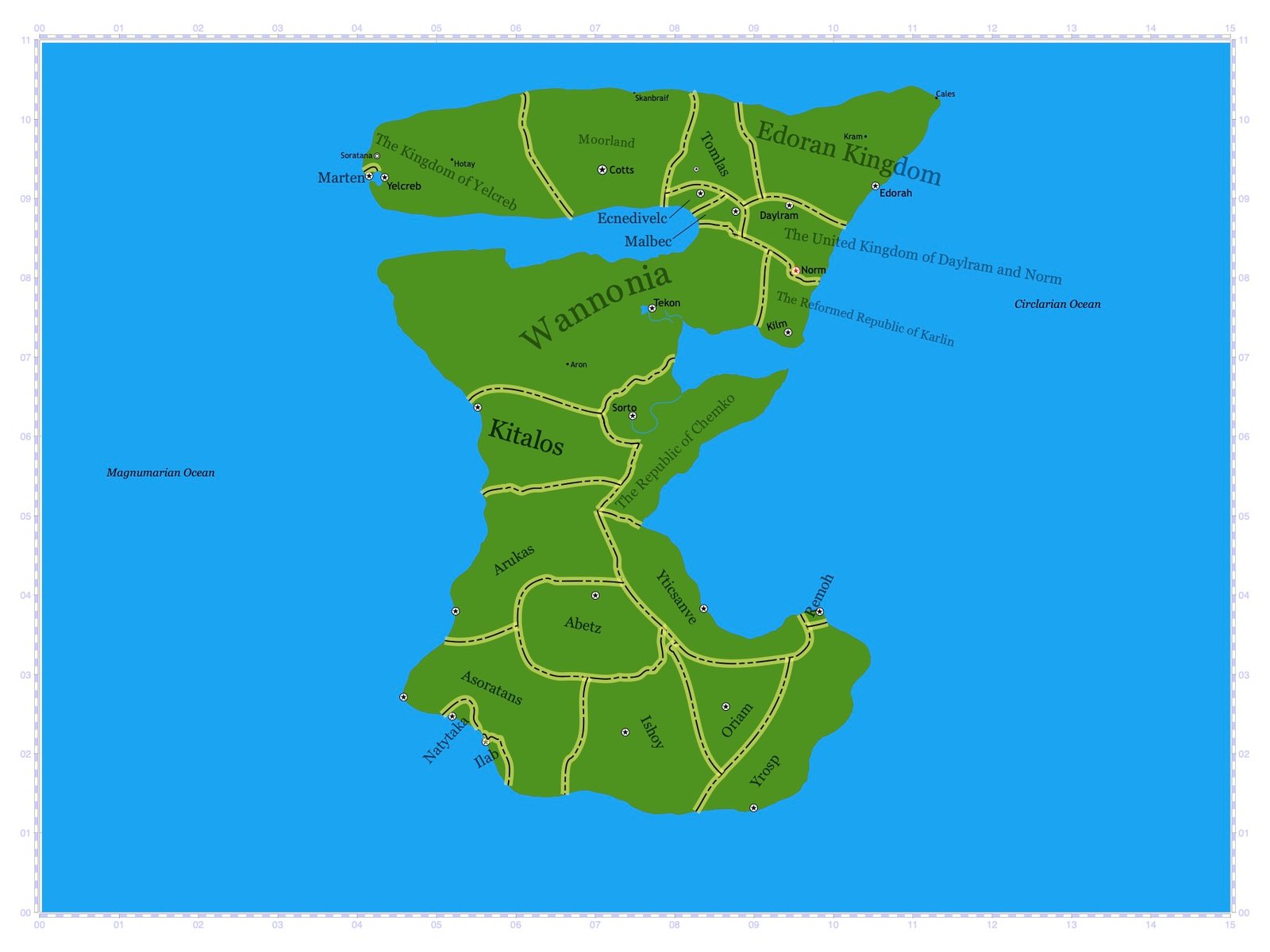
Between the late 600s and early 700s, the Kingdom of Monassa was in a period of prosperity, leading to its increasing influence in sea trade. Before long, Monassan merchants began trading with the Kingdom of Yelcreb and taking up residence in its sea ports. Families of these traveling merchants began journeying with them as they settled and took root. Partly as a result of this, the Yelcreban sea ports became overcrowded, leading the wealthier of Monassans to move inland and buy large sections of land. In the 710s, the Kingdom of Monassa fell under a brutal tyrant, triggering a civil war between its two prominent ethnic groups: the Gomars and the Ivesarans. Large numbers of Monassan refugees, seeking peace, poured in through Yelcreban sea ports, gravitating toward welcoming rich Monassan families living inland, and turning such pieces of property into Monassan refugee communities. Over the years, Yelcrebans, including Queen Vera, began to show more and more contempt toward this.
The Soratana Conflict
Eventually, the Ivesarans lost to the Gomars; and military factions of these fled elsewhere. hearing stories of land and treasure, and intent on looting and plunder, the Ivesarans, in June 721, landed on Yelcreban seaports and attacked. With the nation reeling in fear, Queen Vera blamed this on all Monassan people and declared war on them. In September 722, she issued an order for the Monassans to either leave or be subject to execution. Most of the Monassan population, having nowhere else to go, chose to resist. In March 723, the Queen launched a major offensive against the Monassan encampments, during which Yelcreban soldiers overran the properties and stole the wealth of the Monassan merchants. Large numbers of Monassan refugees were either slaughtered or taken prisoner, while others fled to a well-defended community: Soratana.
Back in the 710s, Monassans, as well as other traveling merchants were, like the Edorans, subject to robbery by bandit groups. The Soratans, a wealthy and prominent Monassan family, offered protection to passerby by fortifying their settlement with numerous layers of wooden walls, each armed with archers, spellcrafters, and watch guards. Shortly before the Queen's offenses, the Soratans happened to have received a visit from a Wannonian ambassador, who brought over muskets.
In June 729, after six years of gridlock between the Yelcrebans, Monassans, and Ivesarans, the Queen's forces closed in on Soratana and attacked. However, the Yelcrebans had not yet been introduced to the musket; so such an invention gave advantage to Soratana, who inflicted high casualties upon the Yelcrebans.
The Treaty of Soratana, 729
Paul Soratan, the father of the family, approached Queen Vera with a call for a compromise. Under such terms, the Kingdom of Yelcreb would grant the Monassans sovereignty and sanctuary over Soratana, while surrounding lands remain Yelcreban; that the Monassans would trade openly; and that they would supply the Yelcrebans with muskets. The Queen expanded on the deal by demanding that they pay taxes and sign an obligation of alliance in time of third-party conflict. To this, Soratan and Vera agreed, and signed the Treaty in October 729.