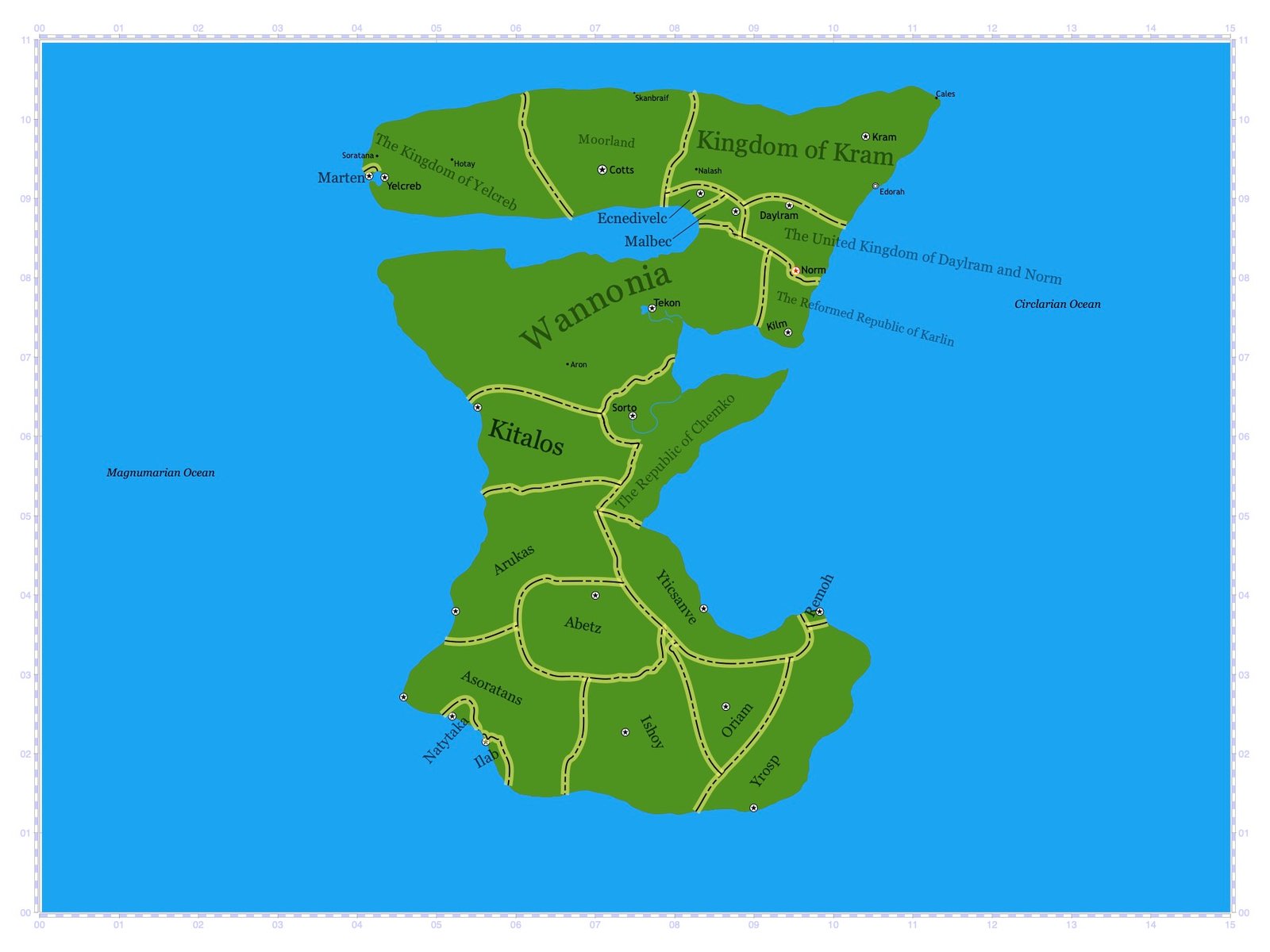
Kingdom of Kram: The Crown Authority and Bill of Rights
From his seat in the city of Kram, King Paul I ruled over the Kingdom of Kram. This Kingdom was in constant war with its rival, the Edoran Kingdom to the South and East, putting every Kramer and every Kramer village on the defensive.
Between November and December of the year 800, a council was held between Kramer nobility and the people, which led to the crafting of two important documents: the Bill of the Crown Authority, and the Bill of the Rights of the People.
Under the Bill of the Crown Authority, a King or Queen could enact laws but had to remain in good standing with the Court of Law to carry out each law. To these laws, a ruler had to adhere faithfully. The ruler, furthermore, had to establish or maintain infrastructure to protect the nation and its people, allocating funds to do so, had the right to raise taxes but to do so without abuse, was obligated to adhere to popular petitions and counterpetitions, and was given power to nominate Justices to Courts of Law, which was limited by freedom of speech and petitions under the Bill of Rights.
The Bill of Rights of the People gave the Kramer people a certain set of rights. First and foremost was the freedom of speech, which included the freedom of religion and the right to peaceful assembly. The people had the right to bear arms and resist a tyrannical government while the government could not employ armies during times of peace. Courts of Law, under this document, could not issue arrests or order searches without a warrant granted by probable cause; and criminals arrested had the right to a lawyer and due process. Courts, furthermore, had the right to uphold and abolish taxataion measures. The Bill of Rights also prohibited cruel and unusual punishments, and granted any powers not spelled out in the Bill of the Crown Authority to the people.
Gridlock
Both the Kramers and Edorans had fortresses constructed along the border, which outlined a boundary known as the Totian River Fifth Diagonal. There were two types of fortification: wooden fortresses built quickly closer to the border, which held front-line fighters, and stone fortress built in a more timely fashion further from the border, which housed reserves. All fortresses were fully staffed with recruits who were armed. Muskets and rifles were heavily employed as special smith shops in both Kingdoms created large amounts of ammunition, setting a predecessor for the "factory model" one century later.
Every two to three years, either the Edorans or the Kramers would launch infantry divisions to charge across the border with an agenda to defeat a specific target, usually a fortress. But always, the outcome for such infantry divisions would be high casualties and forced retreat. The gridlock would pursue for years.
Tomlassan Recruitment
Displaced Tomlassans, following their defeat years previously, were severely marginalized by the Edorans. During the Kramer uprisings of 776-777, Tomlassan recruits served as mercenaries, but it was in 811 that King Paul recruited large numbers of them, providing them with full arms and training, and promising them money and land afterward. Large divisions of Tomlassans joined the Kramer Army and trained. And in November 813, they launched a mass offensive against Edoran reserve fortresses along the border, gaining half of Edoran territories. In March 814, Queen Elaina withdrew partial Edoran divisions from the coast and launched an attack with these reinforcements against the Kramers. The Kramers endured high casualties and were driven back to the border, as the intense gridlock continued. With such a battle proving costly on both sides, Queen Elaina, in 814, recruited more soldiers.
King Alexander
In September 814, Queen Elaina died and was succeeded by her son, Alexander. In response to the raised taxes necessary for the funding of additional Edoran recruits, Edoran commoners began rioting in city streets. Bowing to mounting popular contempt, King Alexander lowered taxes and transferred more coastal defenses inland to the Kramer front.
Udor was the leader of a pirate guild known as the Yndyors, who originated from the Meredythian Islands. Their raids were successful; and they expanded North to Tandeiyah. Earlier on, they attempted to attack the Edoran Kingdom but were driven away by its robust defenses. However, in June 815, Udor saw an opportunity from the Edorans withdrawing inland and launched an attack, killing and raiding villages and setting those and ships ablaze.
King Alexander responded to this by drafting every able-bodied person from every coastline city and village, raising taxes yet again. By September, the pirates were defeated, with Udor dead, as his followers divided into multiple factions that fled in multiple directions. In October, though, the raising of taxes was decried by Edoran commoners, who rose up and overthrew him. Two leaders of this coup, John Weller and Edward Toole, fought for the Throne, as fighting in the streets and Edoran Palace walls ensued.
Edoran Kingdom: The Fall
King Paul I of Kram saw the ensuing chaos in Edora as his opportunity to attack. He gathered many of Udor's followers, recruiting and training them along with his own Army and Tomlassan recruits. He placed a division of these recruits within the city walls of Edora proper, where, upon his command, they launched an attack. Meanwhile, other divisions felled the city of Cales and gained the remainder of Edoran territories. On 11 November 817, the Edoran Kingdom officially fell, as the Kramer flag was raised over the Edoran Palace.