The Great North: Industrial Boom, Overseas Expansion, and the Establishment of Terredon
During this period, the Kingdom of the Great North and its land claims saw the emergence of numerous factories including textile mills, manufacturing plants, and metal crafting facilities.
Scriptfire, having originated in the late 800s and early 900s, evolved into industrial talisman production. Based upon the talisman industry came into existence various trinkets and devices, most notably clocks and gyroscopes.
In the railroad industry, trains connected every major city in Northern Remikra except for Norm; and by the year 1045, a train ran between two major cities twice a day at any given location. Smaller rail lines, meanwhile, connected the suburbs around each major city. The most remarkable achievement was in the year 1050, when a rail line connecting the Edoran and Linbraean Regiondoms was completed, making it possible to travel cross-country directly by rail. Meanwhile, rail networks arose and expanded in Great Northern territories overseas, as the major cities on the West Canticulan peninsula were connected.
Such robust rail networks were all powered by steam engines burning blue-diamond coal sands, the mining of which created many jobs. Along with trains, coal sands powered factories and steam-boats. Before long, a large market emerged for the resource, which was expensive at first but became affordable as more coal sand deposits were discovered.
Most Great Northern land acquisitions in Northern Canticula were peaceful transactions, as the superpower trekked further to the East. However, there were numerous conflicts, carried out by stubborn local figures who resisted; but they were easily defeated by the Great North. Following behind the advancing lines of the Great Northern border were established cities and industrial infrastructures, as the Great North began to have profound influence on the continent. The Great North also gained control over the Hobland territories, although it did fail to conquer present-day Notulfa, due to the brutal resistance measures carried out. Such the latter was abandoned.
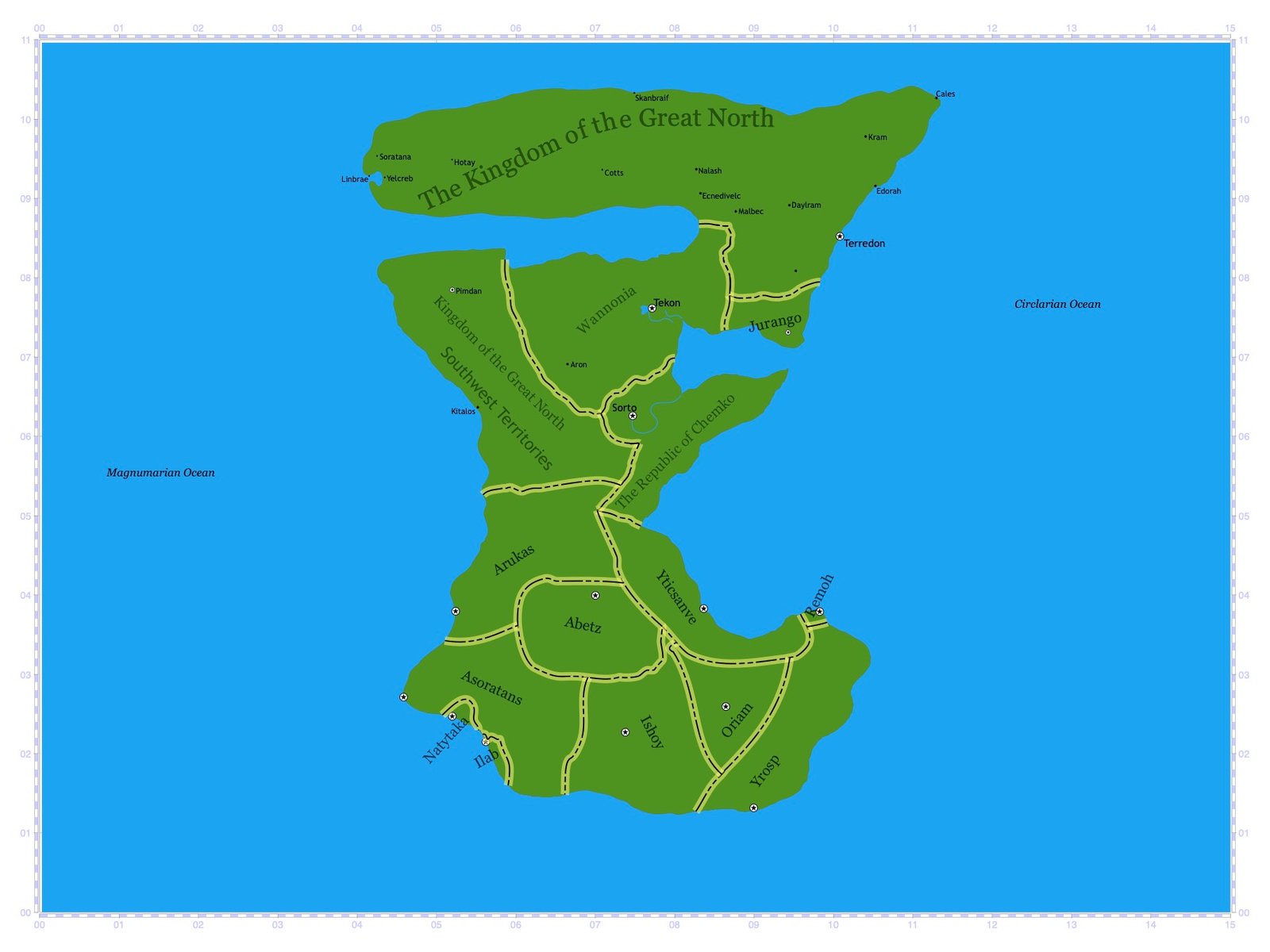
Sulledon was established as a seaport in the year 1001; and by the 1030s, it became quite affluent. In 1021, however, a pirate attack upon the city prompted the King and Queen to establish a large Navy reserve around its harbor. Such an agenda effectively rendered the city safe by 1023, so much so, that King Philip and Queen Mary, wanting to have better enforcement over trade taxes, decided to move the Great Northern Crown to this spot. With such a decision made came the desire for additional layers of protection. So, under the orders of the King, one great wall around the city and harbor, and three defensive layers around a designated perimeter in the center of Sulledon, was built. Upon this perimeter was constructed the Crown Seat, named the Stellion Palace. On 15 October 1036, the project was declared officially completed, as the city was renamed Terredon; and it was here on this day that the Crown's location was officially established.
One year later, King Philip died of a heart condition. Nevertheless, under Queen Mary, the Great North continued to prosper.
The Great North: Early Crises
On 9 June 1039, a coordinated pirate attack was waged against the cities of Edora and Cales. Queen Mary, intent on defeating these pirates, could not yet find the location of their base; so she signed orders to triple the size of the Navy around the Great Northern homeland and recruit numerous additional divisions from lands abroad to provide regular patrol and coverage over the Northern part of the Circlarian Ocean, as well as the Meredythian Islands. By 1045, the Navy presence quota was achieved, as the Great North arguably became the most significant power in the Circlarian Realm.
Meanwhile, in 1041, blue-diamond coal sand mines in the Moorlands began to run dry, leading to a rise in prices and temporary slowing in industry. In response to this, Queen Mary launched an agenda for a Circlarian-wide search for additional reserves. In 1044, large reserves, even larger than the ones in the Moorlands, were discovered throughout Southeast Hobland. To this area, the Queen launched numerous military agendas for tighter control, as land was sold and partitioned off to various Great Northern companies for mining. By 1046, the early blue-diamond coal sands crisis was resolved.
Succession of Great Northern Monarchies: 1037-1079
King Philip and Queen Mary were coronated on 14 May 998, bringing into existence the Kingdom of the Great North. As mentioned above, King Philip ruled until his death in 1037. Queen Mary then continued her rule over the Great North until her death in 1051, arguably the apex for the expansive empire. Mary was succeeded by her daughter, Queen Alexandra, who would rule until the year 1079.
George Benson: The First Invasion of Prove
Born in Cales in the year 1018, George Benson would come to have a distinguished career in the Great Northern Navy, contributing greatly to the keeping of the pirates at bay during the attacks of 1039. He was then promoted to Admiral and assigned to command a Fleet which covered Vantacula and a section of the Eastern Meredythian Islands.
Benson was descended from the Weller family on his mother's side. He was embarrassed and begrudging of Jacob I's decision to abandon the Edoran Kingdom, while he was proud of Jacob II's choice to return and restore the Edoran Kingdom from the Kramers. As discovered later through personal memoirs, though, Jacob II had an agenda to defeat and bring Prove under Edoran influence, but died before that ever happened. George Benson felt that it was his calling to fulfill the latter agenda, but, in order to gain approval from Queen Alexandra, had to find a reasonable cause.
During the late 1050s and early 1060s, numerous pirate attacks became problematic throughout the Meredythian region. Of this, Benson took advantage, claiming to the Queen, in a proposition he made to her in 1061, that these pirates were headed by the King of Prove, who was planning a large-scale and coordinated assault on the Great Northern homeland. He then asked to have at his disposal a division each of the Navy, Infantry, Cavalry, and aerovehicles (part of the Navy at this point) to attack and defeat the Provan Kingdom, and establish it as a Great Northern territory. However, upon viewing evidence suggesting otherwise that a pirate base was found on a Meredythian Island closer to Southern Remikra, and upon knowing of his history and suspecting of his personal agenda, Queen Alexandra denied Admiral George Benson even admission to her Personal Council. To the rejection letter, Benson composed a refutation, alleging that her sources should be questioned. The Queen responded to this by re-assigning Benson to command a Navy Fleet along the West Coast of Tandeiyah, located further North and much further from Canticula.
Frustrated by this, Benson remained determined to carry out his quest.
In October 1062, the Admiral of the Navy Fleet North of where Benson was stationed was dispatched temporarily to address a pirate attack elsewhere, leaving Benson in charge of both Fleets. It was in this moment that Benson saw an opportunity, as he had enough soldiers to carry out an invasion. In the weeks that ensued, he withheld distributions of "The Soldiers' Note," a pamphlet that served as communication between soldiers and Great Northern society, and replaced such a medium with his own pamphlet falsely depicting the Queen addressing a "Provan Threat." As he trained the soldiers for an invasion of Prove, he arranged a supply line and purchased large amounts of coal sands from Hobland, withholding letters of such which were addressed to the Crown. On 17 March 1063, Benson and the two Fleets under his command launched, setting out across the Circlarian Ocean bound for Prove.
On 17 October 1063, Benson's fleet arrived in the Bay of Prove, where Benson's ships fired upon the stone cannon turrets of Provan defenses. The Provans, however, retaliated with "house cannons," cannons hidden in the roofs of homes and shops. Furthermore, Queen Alexandra, having soon heard of Benson's hidden agenda, cut off his supply line. As a result, a majority of Benson's ships were destroyed, as large numbers of casualties were inflicted; and Provan ships soon closed on Benson's. On the last day of the month, Benson surrendered and was taken prisoner.
On 4 March 1064, Provan authorities received a letter from Queen Alexandra ordering the extradition of Benson back to the Great North homeland. Upon return to the Great North on 7 June 1064, Benson was discharged from the Navy and sent to work as a member of the Royal Shipbuilding Guild in St. Eschel. The Queen, furthermore, issued an order for blue-diamond coal sands in the Hoblandish colonies to never again supply fuel to Benson.
The Great North: Tension with the Motanian Empire
Throughout the 1050s and 1060s, the Great North continued gaining land to the East in Northern Canticula. But in October 1064, at the Curatoring River, Great Northerners spotted the Motanian Empire on the opposite bank, as the river served as a border between the two powers. Tension soon developed at the center of which was, in the River, an island containing a great amount of valuable iron ore. Such buildup of friction was preceded, also, by indirect hostility with the Motanians, as independent merchants loyal to each side fought one another. The two powers were equally matched in military and firearms, as it seemed more and more likely that there would be a major conflict; and during this time, the Kingdom of Prove signed an alliance with the Motanians.
George Benson: The Second Invasion of Prove
It was during such buildup of tension between the Motanians and the Great Northerners that George Benson escaped from his post in the Shipbuilding Guild and returned to the Navy, disguised as a freshman recruit. Under this guise, he secretly re-connected with some of his old loyal soldiers while recruiting new followers. He traveled to various locations where he did this, and after determining that he recruited as many people as possible, snuck away with them from each former location and traveling to the new one. By the time he convened with all of them on the Island of Vantacula, their numbers were equal to that of three Navy Fleets, more than he had for the first invasion. In Vantacula, he implemented the same agenda of withholding pamphlets and replacing them with propaganda, except this wave of propaganda depicted Prove as a threat and condemned the Queen for ignoring this. As he trained his recruits, Benson arranged for a secret transaction of coal sands from the Hoblandish colonies, disguising himself in the appropriate letters as the Queen and employing the same methods of withholding any paperwork from the actual Crown. He then arranged a secret supply line, this time with the assistance of the nation of Wannonia. And on 5 January 1067, he and his three Fleets launched for Prove.
They arrived in Prove on 16 June 1067, where they found the Kingdom of Prove noticeably weakened from a war it was fighting in the Red Desert. Benson's ships fired upon Provan defenses, once again. This time, Provan defenses failed; and Benson's soldiers stormed the city, forcing the Provan King to flee. In his place, George Benson crowned himself the King.
Alarmed by this and by news that a messenger ship was hurrying toward Motan, Queen Alexandra of the Great North scrambled five Navy Fleets to confront Benson. On 1 September 1067, these Navy ships arrived in the Bay of Prove and opened fire, toppling Benson's regime within three days, and forcing the defective Admiral to surrender. He was immediately placed under arrest by Great Northern authorities and sent back to the Great North. Other Great Northern ships rushed to the East to send the approaching Motanian Navy a signal of peace, as a Council was called in Prove in October 1067. Here, a peace treaty was finally signed between the Great North and the Motanian Empire and the Provan Kingdom re-established.
Meanwhile, George Benson was tried and convicted of treason, which would have warranted a death sentence. However, being indirectly related to royal blood, Benson was, instead, sentenced to exile in Northern Hobland, in present-day Notulfa and away from the Great Northern colonies.
The Hobland Independence War: 1068-1076
The Great Northern colonies in Hobland held great value to the Kingdom, as they contained 80 percent of the supply of blue-diamond coal sands. However, the colonists and local inhabitants were unhappy with the Great Northern Crown, voicing grievances of high taxation, lack of voice in Parliament, harsh mining conditions, lack of proper payment for labor, and exploitation of resources. Queen Alexandra, concerned primarily with Benson and Motanian affairs, as well as persistent pirate attacks in the Meredythian region, failed to adhere to the colonists' and locals' numerous petitions. As a result, on 1 May 1068, the colonies declared independence and waged war upon the present Great Northern forces.
The Hobland Independence War carried brutal and costly resistance against the Great North, as revolutionaries seized large swaths of precious coal sand reserves, choking off its supply and beginning an economic crisis in the once-prosperous Kingdom.