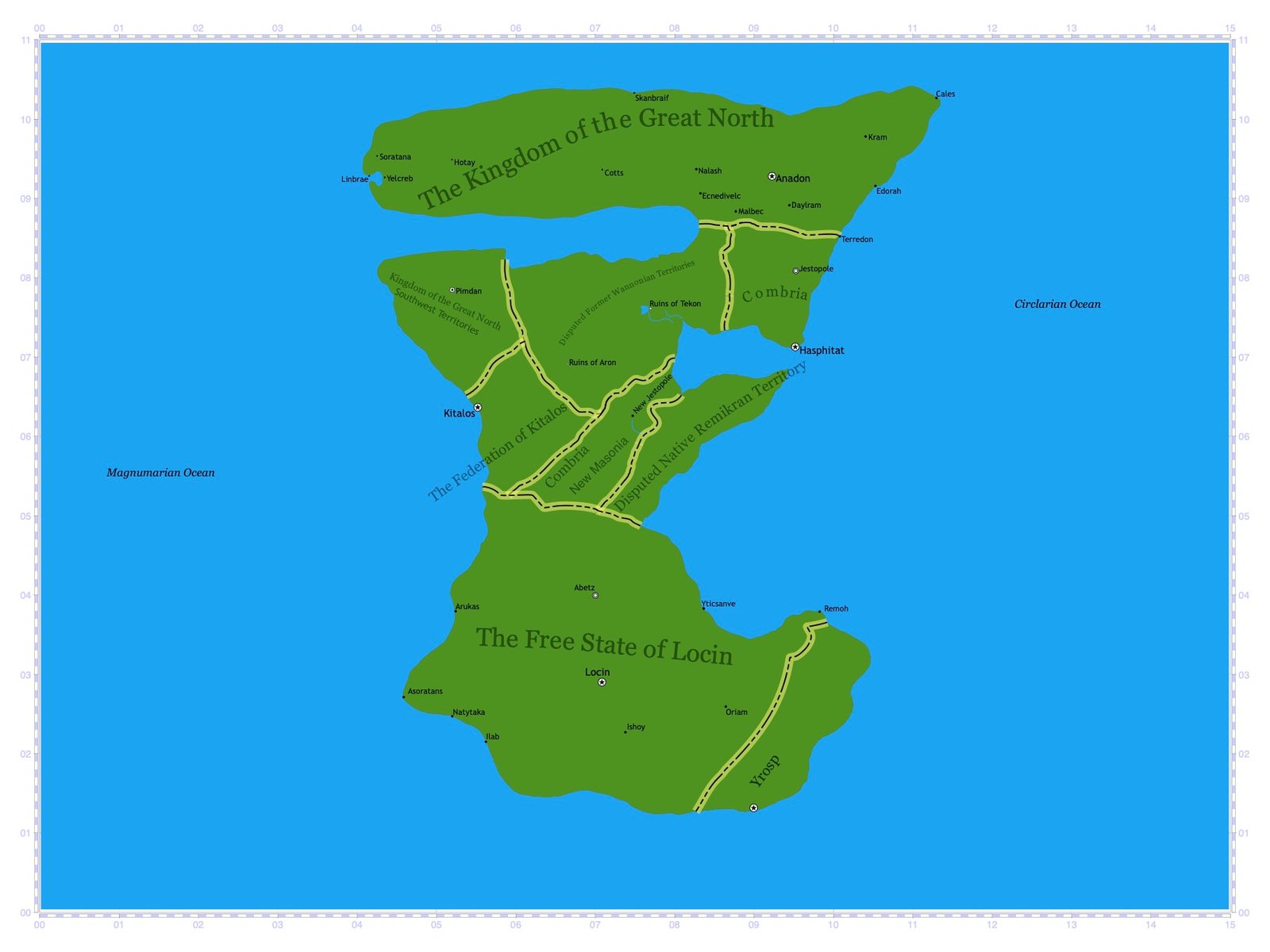
The Fall of Wannonia
The Great Blight was parasitic to the flaxweed crop, consuming each plant's water and nutrients, and in turn, starving and drying it. Eventually, the plant would die. And during the entire process, the fungus, when having reached full maturity, would release floating spores, which would spread to other plants. It was by this that farmers in the Southern and Western regions of Wannonia lost entire flaxweed crops, leading to lack of food and income. They attempted to rid the invasive species via burning. But very soon, educated educated Wannonian scholars learned that setting infected crops ablaze actually helped Blight spores to spread further, as the fungus released large amounts of them as part of a survival tactic.
Emperor Clastye II ordered the Blighted fields to be walled in and filled with water, as it was found that the fungus, in the mature stage, could not survive underwater. Furthermore, he imposed heavy punishments, including the death penalty in some cases, for burning infected crops, and set territorial quarantines for those in the infected regions, fearing that farmers would carry spores on their clothes and boots into non-Blighted regions. In the late 1160s, with the resulting hardship, the farmers rebelled against the Emperor's orders, to which the Emperor responded with measures of martial law. As water was drawn from some of the canals to combat the Blight, such canals were shut down. Nevertheless, Clastye II's measures kept the Blight under fair control to the South and West.
But then, in 1169, the Great Drought hit. Major canal networks dried up, stifling commerce and trade, and leading Imperial authorities to force water from farmers in order to contain the Blight, which began to grow out of control in the ideal dry climate. Very soon, Wannonia saw widespread flaxweed crop failures. And wildfires, caused by dry lightning, helped the Blight spores to spread even more quickly. This plunged Wannonia into a state of crisis, as these wildfires destroyed even more crops. The resulting food and flaxweed shortages helped to drive up prices in the marketplace; and before long, Emperor Clastye II imposed rations. As the Blight grew to consume nearly seventy percent of what was once arable land for flaxweed, the Emperor issued widespread traveling quarantines. And the locals, feeling oppressed by Imperial authority, rebelled, leading to widespread conflict. News of the hardships resulting from these measures reached Wannonians in the North and even in Tekon, itself, leading them to turn against the Emperor. As each year passed, the effects of the drought began to worsen.
In 1173, a large wildfire destroyed the city of Aron, sending thousands of refugees fleeing to the North, where they were blocked by Imperial forces. Such refugees confronted them with violence, and a major civil conflict broke out. In 1174, with many siding against the Emperor and his agenda against the refugees from Aron, an organized coup overthrew the Wannonian Imperial government, as Clastye II was murdered. With multiple figures claiming to be the successor, warring factions battled one another in the streets of Tekon and throughout Wannonia. On 17 October 1176, a wildfire destroyed Tekon, itself, sending remaining Wannonians in the region to flee elsewhere.
Between 1177 and 1200, the Wannonian territory consisted of nomadic militant groups roaming the countryside, battling each other while scavenging for food and resources.
President Henry
In 1183, President Harold Jameson of Combria was aging and seeking a figure to succeed him. In doing so, Jameson focused on two candidates: Jacob Thomas Henry and David James Pennwell. In November 1183, Jameson determined Pennwell to be the most qualified of the two, and appointed him to be the next President. However, Henry was determined to unseat Pennwell, and staged a scandal that landed the President-appointee under scrutiny. In March 1184, the Court found Pennwell guilty of such staged accusations; and the Council disqualified him from his future office. In April, seeing no other alternative, Jameson appointed Henry. When Pennwell uncovered evidence of Henry's involvement in the scandal, Henry's popularity led the Council and Court to dismiss such charges. And on 14 May 1184, Jacob Henry became the President of Combria.
The Perennial
President Henry, in the years that followed, implemented economic policies that would lead the nation through an unprecedented chapter of prosperity. He began with the payment of large sums of money to merchant Chiefs of Staff, who funded and established various firms that traded independently within the nation and abroad. Under Henry's orders, two canals were constructed to bisect each of the lower tier perimeters of the Diamond District.
As a result, Hasphitat became a major post of trade, with ships and barges frequenting its piers. Meanwhile, throughout the inland regions, the ebony mining industry became popular, as it was found that such material was useful in the efficient production and use of talismans. Most notable, however, was the resulting boom in the aviation industry, where large funds given to the newly-founded Department of Aviation led to the construction of government facilities that constructed mass numbers of planes and airships. Meanwhile, the Department gave remaining funds to notable aviation families, who established aviator leagues.
A very important innovation in the aircraft industry during this time was the invention of the pressurized cabin, making it possible to fly higher and further. In 1189, the first fleet of high-flying aircraft, consisting of military and passenger planes, was launched. In the years to come, aviator leagues, renting these aircraft, would establish regular passenger flight routes.
In 1192, the Perennial was launched, being noted as the first airship with a pressurized cabin. It was capable of flying at altitudes of 21000 feet and a distance of 5000 miles. As a demonstration of its potential, the Perennial took its commercial flight from Hasphitat directly to the city of Kitalos between 12-16 September 1192. That October, Combria and the Federation of Kitalos established an air trade route.
Marion's Disease
Infecting the victim by entering through the mouth, nose, eyes, or open wounds, Marion's Disease harms the body by consuming its host's nutrients and releasing a harmful waste byproduct into the blood stream. The body's response to this is a fever, accompanied by coughing, diarrhea, and vomiting. Without effective treatment, the disease usually would kill its victim in one of two ways: high fever and dehydration as a result of the body's immune system response, or effective suffocation by the high presence of the toxic byproduct.
Throughout the 1100s, industrialization in Southern Canticula led epidemics to spread, via trade flow, to the North. In the 1170s, several outbreaks of an "unknown disease," an earlier and weaker strain of Marion's Disease, swept through the nations of Furthing and Nassem. In 1184, another outbreak hit the region, claiming the life of one child. In 1189, the disease reached Hasphitat, where it was called "Dockman's Flu," and claimed one life. One year later, Hasphitat was struck by a worse strain of the disease, as 600 lives were lost.
And then the disease spread to Mikant.
Living from 1133 to 1217, Doctor Philip Marion, an archaeologist from Terredon, the Great North, was on a tour to study mysterious inscriptions on a stone slab near Mikant proper. On 1 May 1192, he left on a ship to the region, to which he arrived four days later. It was during the month of June that Marion, well into his studies, began noting local Mikanians falling ill. In the weeks that followed, many of them died, with such mortality in staggering numbers by the end of September. Fearing the conditions, Marion returned quickly to his home in Terredon, where he wrote letters describing the disease to Doctor Philip Osman, an honored figure in medicine. Osman traveled to Mikant, where he diagnosed the disease, naming it Marion's Disease, and developed effective treatment, which he wasted no time administering to the locals. Before long, the spread of the disease was effectively stopped.
President Henry vs. President Slaya
In January 1193, a coup in Abetz, the capital of Mikant, led to the overthrow of President Von DeKere, who was replaced by the revolutionary Mara Slaya. As the new President, Slaya opened a free market and expanded on Inland Sea trade. Favoring Mikanian traders, Slaya imposed stricter enforcement over Mikanian maritime claims, which upset the nation of Combria, which had been dominating the trade route for a number of years. Thus, tension began to mount.
Such tension broke in April of that year, when Jerrod Brown, illegally operating a side business in Combria, had a Combrian Court issue a warrant for his arrest. Instead, Brown fled to the nation of Mikant for asylum, which Slaya honored. President Henry approached Slaya, demanding that she extradite Brown; but Slaya refused, stating that Brown's actions were considered legal in Mikant. Henry retaliated with military force, which all but leveled the city of Mikant. Throughout Combria, President Henry paid media venues to maintain silence over the matter, fearing backlash. To this day, his actions are considered quite controversial with a speculation over the details.
Nevertheless, the Remikran Union levied repercussions against President Henry, as the Great North sanctioned the nation while rebuilding Mikant. Then, in June, a treaty was signed within the Union, which allocated Mikant and surrounding territories to President Henry as a form of consolation in exchange for reparations. Under Henry's orders, the city of Mikant was renamed New Jestopole. Slaya, seen as an aggressor, was made to leave, as a new Mikanian presidency and business market was established. The appointed Governor-General founded a special Trades Department to oversee all Mikanian economic transactions.
Slaya decried such an arrangement for the lack in freedom of trade, especially in terms with the new Department. In November 1193, she organized and launched a coup, which toppled the new government and Department as the Governor-General was forced to flee. Abetz and Mikanian territories were renamed Locin, as Slaya's free market policies were re-established. As she furthermore vowed to take back Mikant and its surrounding territories, President Henry ordered the construction of a wall at the new border.