The Bandits' War
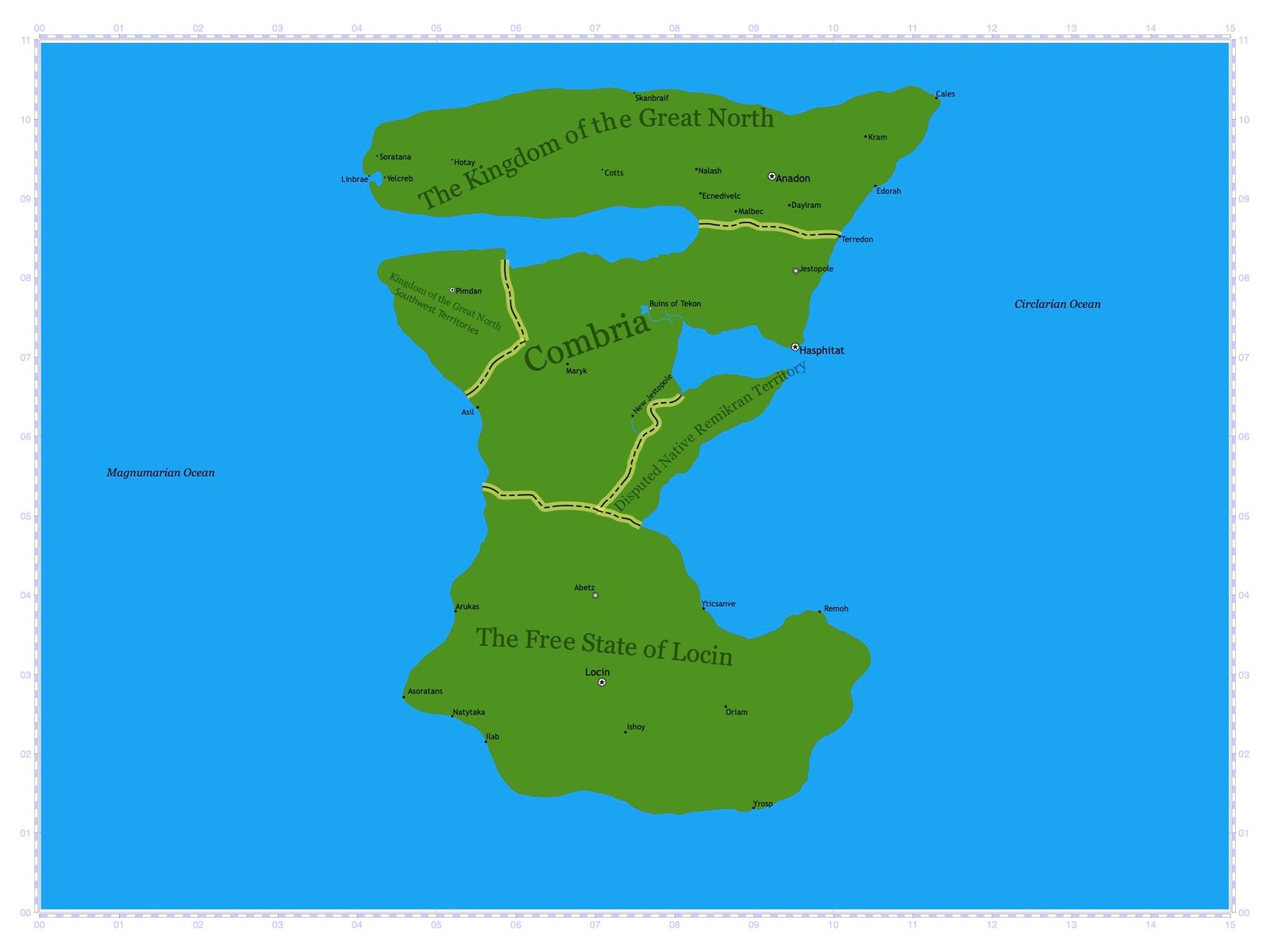
Throughout the 1180s, militant groups scavenged the former Wannonian territories for resources. Seeing the fall of Wannonia in the 1170s and the resulting vacuum in power as an opportunity, bandits from the Southwest migrated into the region and dominated it. Initially, they existed as multiple factions, but toward the end of the decade, the bandits came under the leadership of one man, Desteran Korabi, and named themselves the Korabians. During the 1190s, the Korabians conducted brutal raids against other scavenger parties, as well as passerby caravans from neighboring countries including Combria. Such acts of violence occurred in the form of roadside ambushes and campsite raids, during both of which armed bandits would disable traveling vehicles, abduct those fit for human trafficking, kill those who were not, and then proceed to take valuables. Two established bases for the Korabians existed in each of the ruins of Aron and Tekon. Despite this, Combria and Great North had little involvement in the matter other than traveling restrictions.
On 1 October 1197, the Korabians gathered their forces and invaded Kitalos, where its trade deal with Combria led to economic downturn and poverty. The resulting spike in debt led the Kitalan government in previous years to downsize in its police and military forces. This proved an advantage for the Korabians, who easily toppled the Federation and replaced it with a kleptocratic establishment. On 17 October, the Korabians invaded the Pimdanian territories of the Great North.
The Great North declared the assault an act of war, and, on 1 November, invaded the Kitalan and former Wannonian territories. With no defined battlefronts, the Korabians and the Great North became gridlocked in guerrilla warfare, prompting President Henry of Combria to provide assistance in the form of troops and arms. In the Pimdanian territories, Great Northerners began discriminating against Kitalan refugees, blaming them for the conflict, which sparked religious and moral controversy in the North.
The Great Unrest
Alexander Foreman, the incumbent Archduke of the Edoran Regiondom, was initially a devout follower of the Edoran Orthodox Church. He viewed the Bandits' War and Kitalan discrimination as immoral and sinful, and presumed that the Orthodox Church, historically opposed to any kind of war, would call for peace and welfare to those suffering in the South and West.
However, Thomas Weller, the Archbishop of the Edoran Orthodox Church, publicly claimed the war to be justified in holy terms, citing divine intervention as his basis. Archduke Alexander publicly decried Weller's testimony as blasphemous and froze tax revenue for the Church, calling for Great Northern Parliaments to pass laws of similar nature. On 23 June 1198, the Archduke announced to the public that he had become an atheist.
This announcement sparked what became known as the Secularist Movement in the Edoran Regiondom, primarily in the fields of education and politics. Meanwhile, conservative Great Northern citizens in the Linbraean Regiondom invoked a clause in the Constitutional Writs and formed independent militias. Edoran progressives reacted to Linbraean militarization by forming militias of their own.
In the 1198 Parliamentary Election, the Edoran Regiondom, as well as subordinate duchies and counties, appointed radically progressive members of Parliaments, while the Linbraean Regiondom elected radical conservatives. More seats were given to political extremists in the 1199 election. In January 1200, the Edoran Parliament passed a law finalizing the termination of tax revenue to its religious institutions; and in March of that year, a coalition of Linbraean conservatives filed a lawsuit against the Edoran Regiondom for this decision.
Throughout the year 1200, the militias of the opposing sides engaged in occasional skirmishes, which began to increase in frequency as time passed. On 23 June 1200, the Great Northern Supreme Court in Anadon ruled in favor of the Edoran Regiondom in a landmark decision that sparked protests and acts of violence from Linbraean conservatives. On 4 March 1201, Archduke Alexander stated in a press conference with Combria that he would discontinue the Combrian-Edoran Church Initiative Fund.
On the evening of 23 March 1201, a religious organization known as the Yelcrebban Coalition of the Right Hand of God attempted an assassination on the Archduke, as he was giving another press conference in his Palace in Terredon. The plan failed; and Great Northern authorities placed surrounding Terredon city blocks under martial law. The Yelcrebban Coalition viewed this as "unholy government oppression" and engaged the martial law officers, leading to a conflict that progressed well into the early hours of 24 March.
And thus began an era of civil conflict known as the Great Unrest.
During this, independent militias of opposing sides continually fought each other throughout the Kingdom and its territories. Regiondom and Duchy armed forces engaged in these conflicts as well, but were careful not to violate, within the Constitutional Writs, one or both of two provisions: that Regiondoms and Duchies must never directly engage each other, and that Regiondoms and Duchies must never engage independent militias unless provoked. The ensuing unrest led Great Northern forces to withdraw from Wannonia and Kitalos.
Defeat of Korabi and Settlement of New Territory
The withdrawal of the Great North from Wannonia and Kitalos allowed for the Korabians to strengthen, posing a growing threat to Combria. In response, President Henry amassed a great store of tanks, planes, and airships, while training fresh divisions of military recruits. On 13 October 1201, Combria invaded Kitalos and the former Wannonian territories. On 21 October, near the Pimdan border, Korabi was assassinated, marking the defeat of the Korabians.
In the months that followed, Aron was rebuilt into the city of Maryk, while Kitalos was rebuilt into the city of Asil. As Wannonian and Kitalan territories fell under Combrian sovereignty, widespread areas in the Plains were sowed with special minerals having been found previously to kill Blight spores while replenishing the soil with nutrients. These regions would be re-settled into grain and corn fields. Meanwhile, numerous Combrian scholars visited the ruins of Tekon to study how Wannonia fell.
1206: Prosperity in Combria
In March 1201 came the launch of a new fleet of airships, which included the Pirafone and the Marran. Such vessels were noted for their new systems of automation, communication, and navigation. Meanwhile, large ebony reserves were discovered in the West near Tekon. The town of Cabotton, initially dedicated to ebony extraction, was established in the summer of 1201. However, larger slabs of the valuable material were discovered 50 miles East of Cabotton; and thus, in 1203, the town of Ebony Valley was established. As a result, most talismans produced were now made of ebony, while clay talisman crafters in Western Combria were effectively put out of business. As Ebony Valley experienced an industrial boom, Cabotton's industry began to shrink.
Between 13 April and 5 October 1206, the Meredythian Forum was hosted between the Remikran Union and Canticula, during which major transactions, exchanges, and trade deals were made. This added further stimulus to Circlarian trade, and brought Combria to its peak, which would last until 1209.