Post-Chadwick Combria
After Chadwick's departure, the Leon and Kontacet families in Jestopole volleyed for power. The Kontacets wanted to restore the economic and social balances present during the days of President Jeson while the Leons carried a nationalist movement to make Combria an independent nation, to make Jestopole the Combrian capital, and ultimately conquer Hasphitat. Throughout the 1160s and 1170s, constant shifts in power between the two parties occurred as each side failed to achieve its full agenda before the other overtook the Governor seat and Council.
Upon his ascension to power, President Henry brought an end to this by invoking a legislative clause to solidly establish the Kontacets by removing all Leon family members from their respective political positions. Over Combria, Martin Wayne was instilled as the Governor.
During the 1180s and 1190s, the Leons, now unseated, turned to the people in the working and lower classes, sowing seeds for a populist movement. They staged subsequent attempts to overthrow the Kontacet establishment via attacks on infrastructure and street riots. However, most of these attempts were thwarted by President Henry's methods of order preservation. By the late 1190s, with society in the Chartered State of Combria improving under President Henry's economic and trade policies, the Leons lost popularity and became divided among themselves.
Divided Combrian Resistance
The economic downturn throughout the 1210s and 1220s led to numerous business closures and rising unemployment. Factions loyal to the Leons blamed this on President Henry's "corrupt establishment" and began rallying the disgruntled working class. To combat this, Governor Wayne instilled tax deductions upon businesses based on the number of jobs created, thus resulting in increased employment opportunities. However, many Combrians found these occupations undesirable. So in the 1230s, President Henry came forward with the opportunity to work on the Basin Project in New Hasphitat, to which many relocated in anticipation of the promised compensations. Nevertheless, distrust had been sown among large sectors of the population during the first part of the century, leading many Combrians to remain loyal to the divided Leonic factions, who began to revive nationalist sentiments. The momentum increased in such factions as trade slowed, once again, between 1233 and 1234. In 1236, Leonic activists, inspired by the uprising in Savel, attempted a coup of their own. But the plan failed; and Governor Wayne remained in power.
Independence and the Deal with Hetia
Richard Marren was initially raised with the Jameson family. However, his loyalty to the family was in question as they moved to New Hasphitat in 1236, where Marren grew increasingly rebellious, desiring not to follow his father's wishes to become a lawyer. Very soon, he joined the Retunian Resistance, but allied more closely with Alexander Morgansen, who believed that New Hasphitat should be an authoritarian system of command like the Chartered State of Combria. Furthermore, Morgansen fantasized that the gaining of New Hasphitat Governor John Marshall's Eagle Emblem would be the ultimate symbolic achievement of the Retunian Establishment.
However, between 1237 and 1238, as the Laborers' Council began to form, Morgansen and Arnold Stone became rivals, with Stone being a proponent of democracy, and Morgansen condemning such a system. Just after Marshall's abandonment, Morgansen proceeded to claim the Eagle Emblem, conceded by Marshall after lengthy negotiation, only to find that it was missing. He went on a brutal "manhunt" for the object, unleashing chaos within the ranks of the Resistance. As a result, Stone and the Council determined Morgansen to be an enemy of the state, and voted to have him put on trial as a criminal. Arnold Stone launched an offensive internally which all but vanquished Morgansen's forces. In light of this, Morgansen fled to a remote location outside the Basin District and committed suicide by gunshot.
Having guilty association with Morgansen and his party, Marren fled to Combria, where he was determined to gain power and pressure the Retunian Council into a deal.
In Combria, Marren further cemented Combrian nationalist sentiment by uniting the various Leonic factions into a single political force, which received an additional boost from news of the declaration of independence by the Federal Estates of Retun in February 1238. However, the issue was that, unlike in Retun, Marren's forces did not have access to so many military resources.
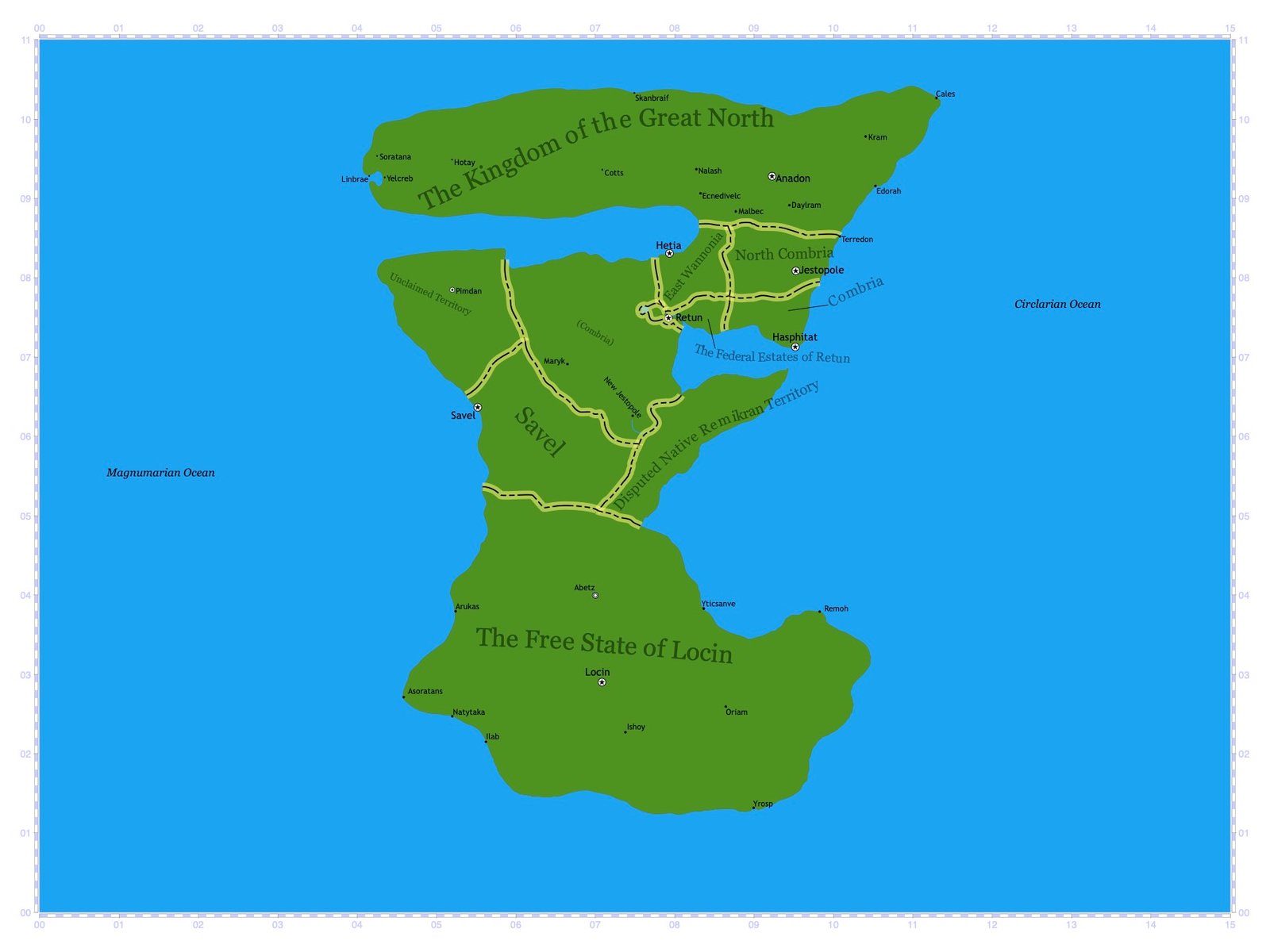
Since 1176, Wannonian refugees had been gathering in a location along the North Coast of Middle Remikra, where they built the underground city of Hetia. Hetia was initially a self-sustaining settlement with occasional military posts for its defense. But then General Zeyk arrived and turned Hetia into a military compound, building an incredibly large arsenal of weapons and ammunition.
A band of Combrian nationalists found out about this compound and reported it to Marren, who then approached Zeyk with a deal. Such a deal would involve Zeyk's assistance in the overthrow of the Combrian Governor and Council, as well as the gaining of Combrian independence from President Henry, thus establishing the nation of North Combria, though they would call themselves the Genuine State of Combria. This would be achieved by Marren with the help of Zeyk, with the exchange of favor being for the Western half of the new territory going to the control of General Zeyk, himself. The two parties agreed to this deal, as Zeyk prepared for the agenda with the secret dispatch of troops and arms. It is important to note that, according to personal memoirs, Marren had a hidden agenda to overtake Zeyk's base while his forces were spread out and claim all of the land for North Combria.
On 7 June 1238, troops under the command of Marren and Zeyk attacked Jestopole. Governor Wayne was assassinated while public infrastructure was compromised. With his forces weak due to the war in Retun and Savel, President Henry was, at the time, unable to overcome the insurgency. And thus, the deal between Marren and Zeyk was achieved, with the Eastern half of the territory going to Marren's jurisdiction and the Western half falling under Zeyk, the latter of whom establishing his territory as the nation of East Wannonia.