Savelian Insurgency
Poor economic conditions ensued in the nation of Savel, as drought brought on crop failure, and military expenses put the government deep into debt. Furthermore, the lack of a standard for paper currency production led to uncontrollable inflation.
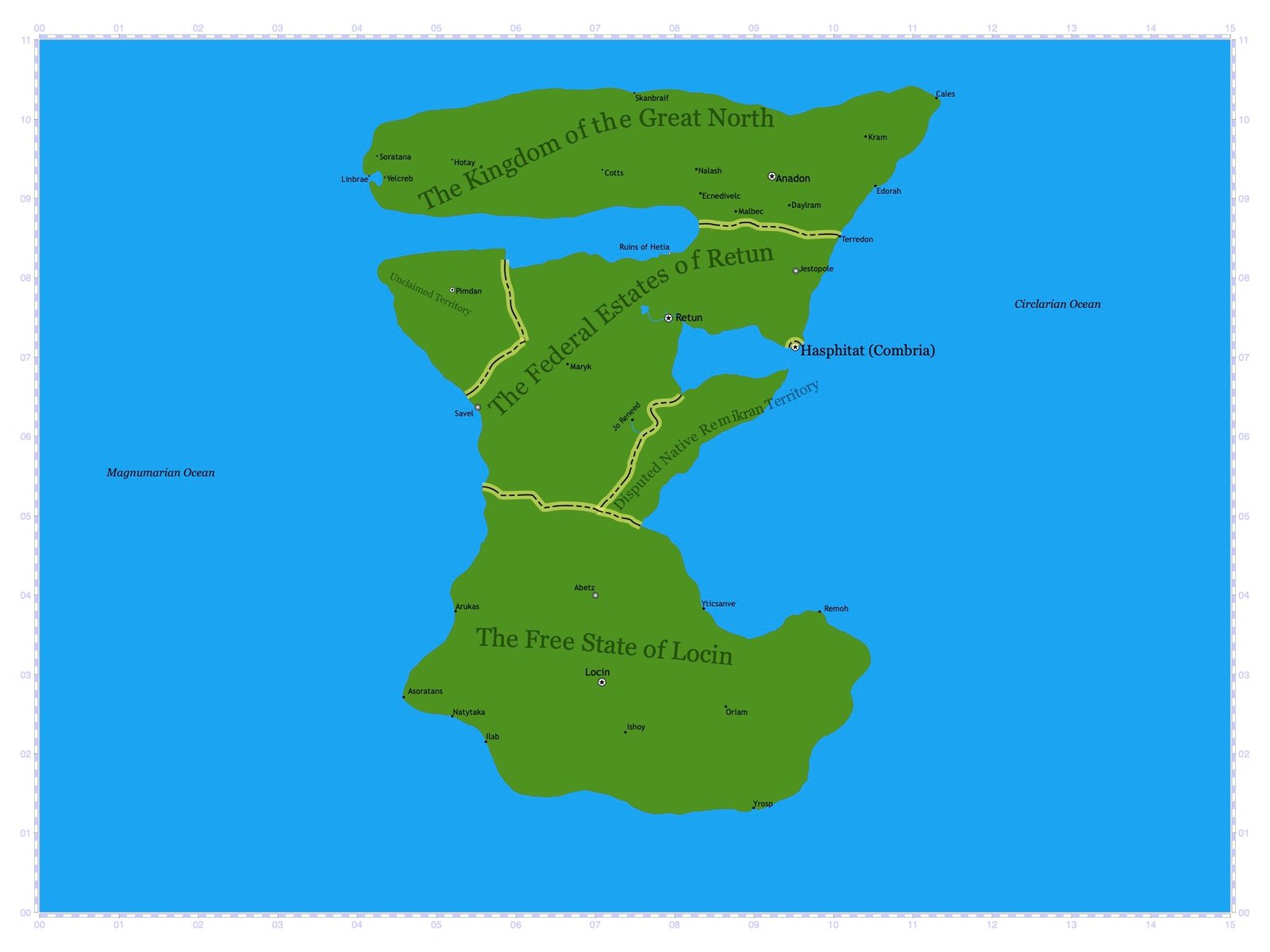
In this environment, Korro Pidan rose to prominence with an agenda to bring the nation to prosperity, blaming its current Combrian-like government for the nationwide misfortunes. As a result, the incumbent government outlawed Pidan and issued arrest warrants for his followers. However, on 1 February 1243, Pidan and an overwhelming number of armed soldiers staged a military coup, storming the capital and toppling its government. He then established numerous military posts throughout the territory to administer martial law and keep order. Against this regime rose Myro Redone, who succeeded in overthrowing Pidan's insurgent post in New Jestopole and established the surrounding territory as East Savel. Pidan, in response, dispatched reinforcements in an attempt to unseat Redone, only to confront East Savelian forces and plunge the region into a wartime stalemate.
Retunian Acquisition of Savel
Myro Redone, in mid-February 1243, transmitted a message for assistance to the Federal Estates Council, who voted to implement defensive measures. Federal Estates Governor-Generals dispatched airships, planes, and tanks to East Savel and assisted in driving back Pidan, while more divisions of Retunian forces lined the border with the Plains and the coast of Savel. On 2 April 1243, James Black broadcasted a message for Pidan to surrender his agenda by May or that there would be an invasion. With silence from Pidan, the Federal Estates continued to dispatch more forces to the battlefronts. On 23 April 1243, Pidan transmitted a letter to Redone, announcing his departure and flight to Monassa. While it was intended to be confidential, news of Pidan's leave spread to resisting Savelians, who rioted in Savelian cities, including the capital. East Savel and the Federal Estates quickly restored order in the territory and put the original Savelian government back in power.
The additional military expenses, however, led to a spike in inflation, causing a collapse in Savelian currency. This led to widespread closures of businesses and banks. The restored government, fearing another coup, made an offer to the Federal Estates to sell some of its land for revenue. In response, the Federal Estates Council voted to propose the deal to acquire the entirety of Savel, its government, and all of its assets. The Savelian government agreed to this; and on 11 May 1243, Savel and its surrounding territory became part of the Republic. Over this territory, the Federal Estates Council appointed Governor-General Michael Lovan.
Administrative Reform in the Federal Estates
Initially, the Federal Estates government consisted of one Council, having been elected by the laborers in Retun and immediate surrounding territories. As the nation began acquiring territory, the Council would vote to appoint Governor-Generals to preside over these jurisdictions with executive power; though the people living within these same territories had a right to vote for Council members. Early on, the administrative territories retained the same boundaries and names of the former Chartered State of Combria. But controversy arose on how to administer the territory encompassing the original borders of the nation of Combria, present during its founding in 1086. For each territory, the Federal Estates Council voted to appoint Court justices, who implemented court systems. These Courts would help to regulate the hierarchical governments that would eventually come into being by the late 1240s.
Controversy ensued in the Combrian districts, as sentiment grew in support of Peter Korren, who had attempted to restore the nation of North Combria. In May 1243, Thomas Hyden, the leading figure of this movement, called for a general strike in Masonia, and a mass protest in the House of Masons in Jestopole. This general strike would cease infrastructural functions in the other four Combrian districts. In response, the Federal Estates called for representation from Combria, as the Combrian districts carried out a special election, which took place on 2 June 1243. Later, a compromise would be made leading to the establishment of Combria as the Republic's first Province.
Summary of the Federal Estates Constitution
That week, the other territories held special elections, choosing representatives who joined Combria in the Federal Estates Council, as this particular body would later form into the House of Representatives.
On 7 June, the Council began a session for the formation of the Federal Estates Constitution. Such a Constitution presented an article that was similar to the Edoran Bill of Rights, while it would later spell out the establishment of the Provinces. Each Province would have its own fully-established government, while its people elected a Governor. Meanwhile, only one Governor-General would preside over all of the Provinces, as the Office would be referred to as presiding over the Provincial Domain (as opposed to the Territorial Domains). The Provinces had equal sovereign powers over their jurisdictions with exception to having a military and having its own currencies. They were also prohibited from crafting certain economic policies that would compromise the unity in the Republic.
The Constitution of the Federal Estates prescribed that the national government, or the federal government, be divided into three branches: Executive, Legislative, and Judicial. At the head of the Executive Branch was, ultimately, the Prime Minister; though it was the Governor-Generals who had the final say in decisions carried out. The Prime Minister was elected by the Popular Assembly, who was elected, hierarchically, by the Federal Estates population. The Prime Minister's job was to enact or veto bills, as well as appoint Governor-Generals, Court Justices, Ambassadors, and other diplomatic representatives.
The Prime Minister's main role was to approve or veto bills. A Prime Minister could also propose bills but was never permitted to vote on them.
The Ministry Council Chamber was led by a Head Councillor, who was elected by the majority of the chamber every three years. This Chamber consisted of three Councillors from each Province, one Councillor each from a territory, as well as one from the Basin District, itself. This chamber was divided into three classes, one for each of the three Councillors for each Province while the territorial Councillors were divided evenly among them. One of the three classes was elected on a rotating basis every three years, meaning that one Councillor served a term of nine years. The primary role of a Councillor was to present a bill and vote 'yay' or 'nay' on each decision.
The House of Representatives, the second highest legislative body, was presided over by a House Speaker, voted in by the Representatives. The number of Representatives in this body consisted of the original 71 Councillors of the Federal Estates plus a number of seats equal to the total number of counties in the Republic. However, neither the counties nor any section of Federal Estates territory served as a respective district for each Representative; rather, Representatives were chosen based on the number of seats in the House and placement on a rank of candidates having received the most votes in elections, which took place every three years. Just like Councillors in the upper chamber, Representatives proposed bills while casting a 'yay' or 'nay' vote on legislative decisions.
The Hall of Public Assembly, the third and most numerous chamber, was presided over by the Assembly Leader, who was appointed in the same fashion as the Speaker of the House and the Ministry Council. Its membership was based on hierarchical appointment representation (people voting estate members, who voted in county members, etc.); and similarly, its number was determined by a hierarchical formula. Members of Popular Assembly were charged with the same duties as Councillors and Representatives, proposing and voting on bills, but were also responsible for casting the final vote in the election of the Prime Minister. All seats in Public Assembly were up for election once a year.
The basic hierarchical structure of the Federal Estates Court System was the placement of a Judge or Justice, Mediators, and Jurors. Each Court had responsibility over its appropriate jurisdiction, wherein it would preside over civil and criminal cases, and decide on constitutional legitimacy of the actions of respective Legislative and Executive branches. Within the Judicial Branch was also a separate entity known as the Electoral Court System, serving the purpose of carrying out the elections in a fair and balanced manner. Nine Supreme Court Justices, appointed by the Prime Minister, presided over the nationwide court system from their seats in the Basin District, while a Federal Circuit established a Courthouse in each of the five Districts of each Province.
Furthermore, the Constitution established the rights of the Estates and the rights of the Provinces, while prescribing additional limits on federal government powers. On 28 June 1243, this Constitution became officially ratified; and the first gubernatorial elections were set to take place on 24 September 1245, in which candidates would be appointed to Provincial Governor seats, Territorial Offices, Representative seats, Public Assembly seats (they held elections yearly), and the first third of Councillor Seats in the Ministry Council. The first General Election, to choose the Prime Minister, was scheduled to occur on 16 September 1248.