Ereautea: Coastal vs. Inlander Views
By the mid-1240s, Middle Remikran society had developed into two distinct cultures: the Coastal Culture and the Inlander Culture. Coastal culture, predominant along the coastal regions of Middle Remikra, was comprised of individuals known to be flashy, outspoken, and open to global trade. They were also known to draw and fiercely adhere to government and urban political boundaries. In contrast, those of the Inlander Culture living in regions like interior Combria, interior Gymia, and the Central Plains of Nintel, were modest and survival-oriented. They valued tradition and community preservation over open trade, and had a tendency to follow more closely to factional boundaries, rather than political.
Coastals and Inlanders, upholding such contrasting values, frequently clashed, and, in the 1240s, argued over the formation of provinces. It was in the Ereautean debates that the differences between provinces and territories were most significantly brought to light. A territory was under the direct jurisdiction of the Federal Estates Government, where executive powers were carried out by a governor-general, who was appointed by the Prime Minister. Judicial powers were administered by the federal courts but were carried out mostly by local arbitrator offices. The legislative branch of each territory consisted of a territorial House of Councillors and Representatives, elected by the local people and functioning similar to the Federal Estates Council, and was headed by a House Leader, a territorial equivalent of a Prime Minister. Bills passed by a territorial House would proceed to the Federal Estates Council, where they would be subject to a vote. Territorial bills passing this vote would then, like bills normally proposed in Council, be signed into law by the Prime Minister and be enforced by the respective Governor-General.
Meanwhile, executive powers under a province were carried out by a provincial governor and enforced by a provincial lieutenant-governor, while judicial powers were administered by a provincial court system. A provincial council, headed by the governor and functioning like the Federal Estates Council, served as the provincial legislative branch. Provincial bills passed in this legislative body became law only when signed by the governor of the province, and were never required to go to the Federal Estates Council for approval.
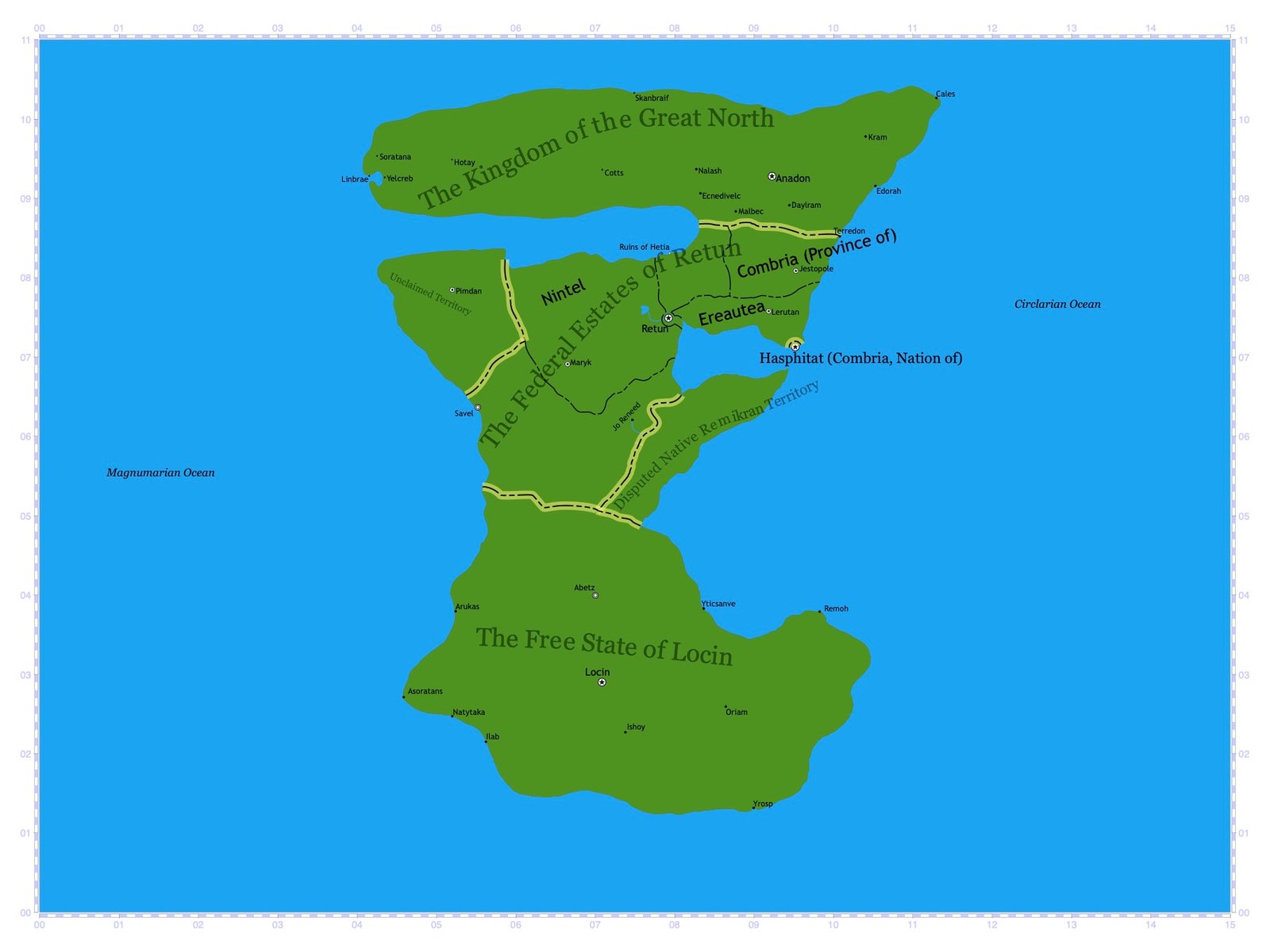
Inlanders supported the idea of forming a province, for a province's greater amount of independent powers rendered it more capable of serving the needs of the local population. Provinces also carried more identity, primarily in the form of official provincial flags. And most importantly, a province carried more representation in the Federal Estates Council. Coastals, in contrast, opposed the idea of forming a territory into a province, touting concerns over conflicts of provincial power with the Federal Estates, power being delegated to a respective province from the estates, and even provinces becoming their own nations. In March 1243, a proposal was made for Ereautea to become a province; but later that month, under pressure from Ereautea's Coastal-leaning population, the House voted it down.
Such political sentiment continued only until September of that year, when Jason Kellerton, from further North, filed his proposal to establish a unified province of Combria.
George Picon and the Provincial Establishment of Ereautea
In October 1243, Coastals from Ereautea reacted to Kellerton's proposal by protesting in the Basin District. In Lerutan, a call was made to its respective House by the Coastals to establish the province of West Ereautea; but more than half of the entire Ereautean Coastal population opposed this measure, viewing this as reactionary and equal in charisma to Combrian sentiment. Simultaneously, a majority of Ereautean Inlanders filed a proposal to the House to establish the province of East Ereautea, prompting further resistance from the Coastals.
Born in 1201 to a sea merchant family in the seaport of Caylor, located East of Hasphitat, George Picon became a leading figure in the resistance movement that overthrew President Henry in 1238. Picon, in the years that followed, became publicly known for upholding Coastal values and opposing Combrian sovereignty. However, with respective family ties, he also carried sympathy for the needs and wants of the Inlanders, and therefore called for a compromise. In November 1243, Picon arrived in Lerutan and submitted a proposal for a single Ereautean province, arguing that it would lead to more representation in the Federal Estates Council to balance against the number of Combrians, more control over coastal trade policies, and better compromises between the Inlanders and Coastals. This bill, though, almost stalled in the House, as opponents touted the measure as being even more reactionary to the Combrian movement, and expressed concern over a possible restoration of the Chartered State of Combria.
Such opposition was dashed in the last week of November 1243, when Kellerton's proposal for a single province of Combria passed the Federal Estates Council. Concern over this prompted the last of the undecided Ereautean Councillors to pass Picon's measure, which was promptly sent to the Basin District. On 2 December 1243, the Federal Estates Council passed the measure; and on 17 March 1244, the province of Ereautea was established.