1344
At 8:00AM on 6 March 1344, Commonwealth Prime Minister Alexander Schraber officially resigned from his post. He would be succeeded by George Borwell, who helped sign into law the Seventh Amendment of the Constitution of the Basin District. Under that Amendment, term limits were re-established; the Retunian Qors was reinstated; and the Waltmann Highway Project was re-scheduled for completion.
That year, the next elections occurred, with the two most popular candidates being John DeMaaj of the National Establishment Part, and Raol Robinson of the RAD Party. On 16 September, the election was very close, but was won by Robinson. Also on that day, the Council passed a budget for the construction of the New Chadwick Building in the Diamond District of Hasphitat.
The Chadwick Scandal
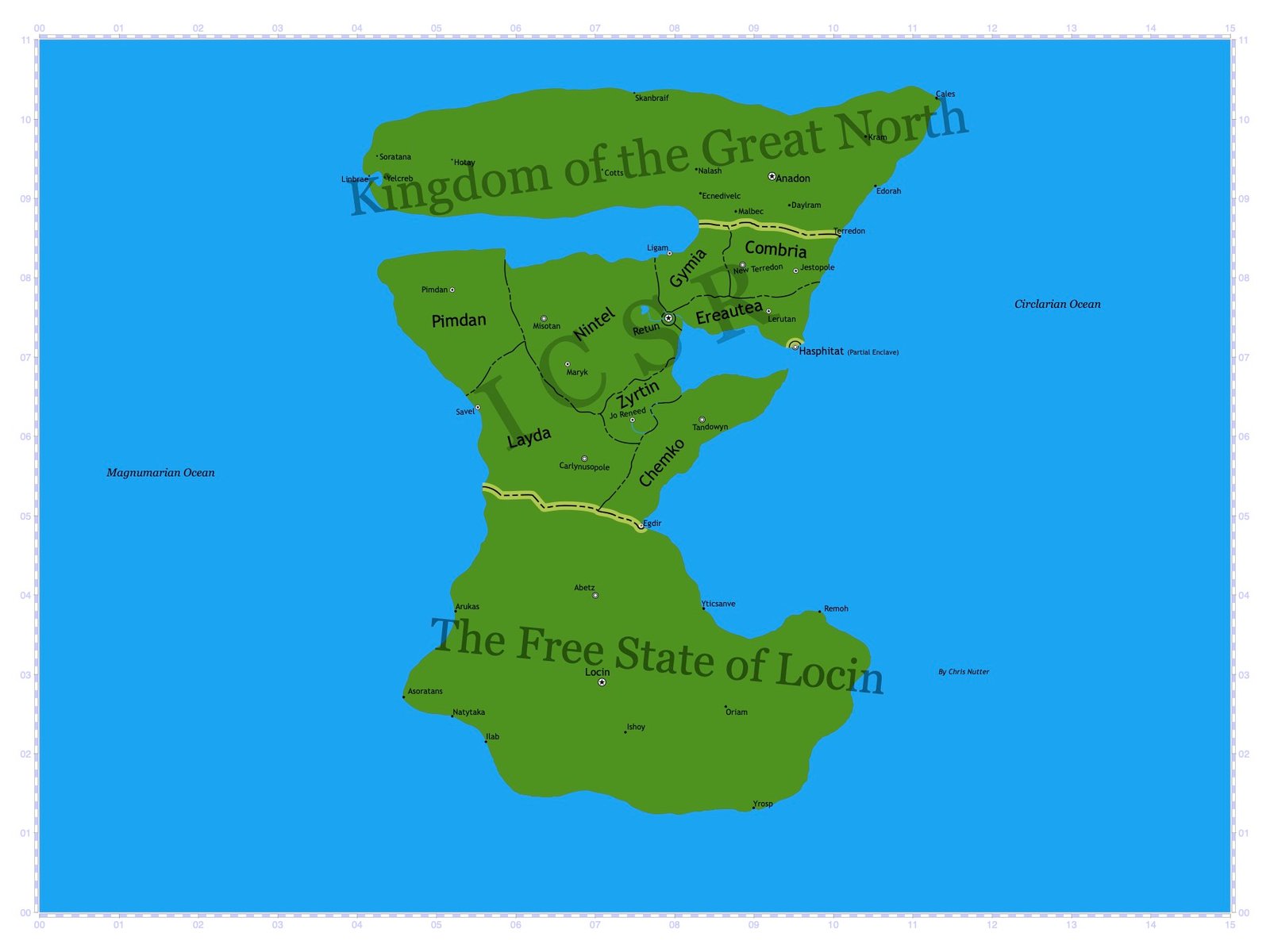
On 7 January 1345, while the College Handball Championship was underway nearby, a shooting incident occurred in front of the Nintel Governor Don Norris' Residence in Maryk, leaving two dead. One person was arrested, and, under questioning, claimed that the Governor of Nintel was involved in a tradestone stagmarcation scandal, which also involved a Combrian business figure: Brandon Bell.
In the nationwide investigation that followed, a lot of vaults throughout Middle Remikra were found to have staggering numbers of fake trade stones. Meanwhile, the Governor Norris was tried and impeached during the month of May.
Bell discovered that he was named in the incident and fled the Commonwealth. However, on 1 January 1347, he was arrested and extradited by authorities on the island nation of Rakara, located East of the nation of Prove. During questioning, Bell admitted the location of large numbers of tradestones in secret vaults underneath the Diamond District of Hasphitat, and that Arthur Cummings, the recently-deceased former-Prime-Minister of the Early Republic, was involved. On 6 February of that year, during a final report being delivered to the Commonwealth Council, it was announced that a massive scandal existed which tied together many cases, including an incident at Skywater Bank in Pimdan in 1340-1. It was also delivered that John Waysworth, having been involved in the events leading up to the Lykian War, was involved in the same scandal. Alexander Schraber, the former Commonwealth Prime Minister, and the Knights of the Common Good were also involved. As Bell had indicated, vaults had been discovered under the Diamond District.
To the shock of the public, this massive scandal was found to have been started more than 200 years previously, by President Chadwick of the nation of Combria, thus earning this scandal the term: Chadwick Scandal. In the beginning, Chadwick authorized the theft of select tradestones from vaults established by the previous Combrian President, William Jeson. These tradestones were then transported to the secret vaults under the Diamond District, where "Keepers" made false copies of them, selling these through numerous heists of stagmarcation (where a trader places a higher value on a trade stone than its actual worth). This continued unknown to the public or any outsiders over the course of 200 years, during which the vault Keepers in Hasphitat would occasionally steal from each other, resulting, sometimes, in internal politics.
Brandon Bell and his accomplice were convicted; however, their lawyers managed to reduce their sentences until just the year 1369. Former Prime Minister Schraber was also indicted, but managed to dodge prison time. All other families named in the mass-scandal were ordered to pay large sums of money in reparations. Meanwhile, the Commonwealth Council enacted a law, signed by Prime Minister Robinson as the public considered this one of his most important accomplishments, requiring that all tradestones were to be appraised according to new federal standards upon transaction, while all trading parties were documented. This law was known as the Genuine Value Act.
The Four-Square Act
In his first attempt to resolve the pressing economic issues at the time, Prime Minister Robinson signed into law the Four-Square Act, which specified a set of agendas to improve the lightfire industry, the darkfire industry, deep-trade, and overall diplomacy. With lightfire, a federal agency known as the Lightfire Trade Committee was formed to note and satisfy lightfire quotas for both domestic and foreign sectors. Meanwhile, the Darkfire Research Foundation, a prequel to future Prime Minister Wen's Darkfire Decision Committee, was formed. For deep-trade, specific quotas were set, while the Deep-Trade Administration launched inquiries to seek out deep-trade opportunities abroad. And finally, the existing Department of Foreign Affairs was charged with the obligation to note the diplomatic situation between the Commonwealth and a select number of Ancondrian entities, and to draft an improvement measure for each. This act, signed in January 1345, would be amended and reconciled numerous times between 1345 and 1347.
The Vac Train
Until 1345, most cross-country mass transit consisted of a mesh train network. Comprised of metal mesh tubes for tracks, which carried trains along via magnetic levitation, passenger mesh trains were developed in the late 1320s, and were in full force by the 1330s. They became commonplace by the end of former Prime Minister Schraber's first term.
In Uhlstead, Ereautea, however, an engineer by the name of Drienne Macklin devised a track consisting of a vacuum tube moving cars by levitation at a much higher velocity. Furthermore, each train car consisted of private compartments for passengers, the first to do so since the cable trains of the 1280s. Termed "vacuum-magnetic trains," or "vac trains" for short reference, the first model of such was tested in Uhlstead in June 1345. That October, the Commonwealth Council passed a budget for the first commercial line to be constructed between Hasphitat and Jestopole.
On 2 March 1346, this line opened to the public and proved immensely successful. Later in 1346, the Council approved a network encompassing Jestopole, Hasphitat, Retun, Maryk, Ligam, and Savel, which would be completed in 1349. In 1350, construction began for lines to Chemko and Zyrtin.
1347
By the beginning of 1347, little progress had been made by the Four Square Act to restore diplomatic damages incurred by the events of 1343 among numerous Ancondrian entities, while two fallouts occurred, early on, with deep-trade. On 23 January 1347, the House of Archives was, once again, destroyed by fire. This, combined with the preceding difficulties, led the Commonwealth to enter a mild economic recession.
In March, Roberta Clyde, future founder of the Proculturalist Party, proposed legislation for a 100-Week Project for the darkfire industry, which would enhance darkfire saturation over the course of that time period. It was the third time the proposition was made, and, citing economic troubles that would be resolved by this, the Commonwealth Council approved it. On 7 March, it was signed by Prime Minister Robinson, and was set to take effect in June.
Meanwhile, legislation to expand the High-Altitude Aviation Program, started under Schraber, into the Independent Commonwealth Department of Space and Aeronautics, was proposed, aiming to launch a Slingshot Pod from Elsa Island into lower orbit around the globe. With budget shortfalls being the primary concern, the bill was amended for the program to be financed by a Public Interest Fund, and was signed into law in September 1347.
Before long, the ongoing 100-Week Project began to produce enhanced darkfire saturation, leading to unit price increases, tradestone price increases, and surpassed expectations in numerous Public Interest Fund figures.
Library of Circlaria: The Dymensional-Plane-Building Organization
Modern dymensionalism planecrafting had been in practice since the 1240s, beginning with the Third Level Society at Cabotton University. In the 1319, the Peter Quora Project dissolved after numerous scholar disagreements, combined with Combrian nationalism and the rise of Benjamin Arnold Syndrome. The facilities in this region became abandoned as the said Project dissolved into numerous independent chapters. In 1343, the lightfire fallout in Ancondria led to dissidents within the ranks of that industry to unite and form a dymension industrial platform.
On 20 February 1349, these founders established, at Cabotton University, the Library of Circlaria.
1350
By the end of Robinson's first term, the vac train network in the Provincial Domain was completed. Meanwhile, parties outside Silba not involved in the events of 1343, hosted the Ancondrian Lightfire Forum, which consisted of numerous exhibition platforms. The Commonwealth acquired many of these and presented on them, resulting in unprecedented economic returns, business opportunities, and a surge in the Retunian tradestone markets.
In June of that year, the New Chadwick Building was completed, and homecoming festivities were held that November. Meanwhile, the economy experienced more unprecedented growth as the end of the 100-Week Project generated more revenue than expected, handing Prime Minister Robinson enough popularity to win re-election on 24 September.
1351
On 2 June 1351 at 4:32PM, the first unmanned Slingshot Pod was launched from Elsa Island into lower orbit around the globe. It was in orbit for 24 hours, and, after recording data and taking photographs, landed smoothly in a "catcher."
Meanwhile, the Terief Trade Contract was signed between the Commonwealth and the Terief Guild, lasting for two years. During this time, recruiter firms sent Commonwealth workers, in a bid to bridge employment gaps in the Commonwealth, to work abroad. This proved a temporary stimulus, but this marginal revenue was cancelled out by ongoing diplomatic clashes with Locin and culture clashes with Circlarian society. To this, Robinson responded with "radio silence" in the short-term but overarching diplomacy in the long-term. This approach had relative success.
1352-1353
The Commonwealth solidified its standing in Ancondria with the establishment in the territorial capital of Kronoston of New Canton One in early 1352. Being the size of one county, New Canton One served as the new venue for the government seat of the Commonwealth Ancondrian territory, and was home to numerous emerging Commonwealth businesses. Not long after its establishment, New Canton Two was established outside Kronoston city limits, where began the construction of a large air and military base, which would prove vital during the Esurchian War, and a new base for space and aeronautics missions.
In October 1352, seventeen professors and scholars gathered at Cabotton University and created one of the most notable works in darkfire research: the Bill of Dynamics.
In that same month, the regularly held Silba Forum of Lightfire resulted in a coalition of Ancondrian entities forming an arrangement that financially short-changed Commonwealth businesses, leading to a minor recession. However, that was compensated by the rise of the Malfua Lightfire Trade Deal at the beginning of 1353. This expanded the Global Academy of Ancondria and lightfire trade with Ancondrian entities not involved in the 1343 trade fallouts.
On 14 September, New Canton Two saw the launch of the first human, Urnamine Plake, into orbit around the globe.
1354-1355
The Canticulan nation of Gyrosak, prospering as a constitutional monarchy since the 1320s, also developed a space program. They were the second nation to launch a probe each unmanned and manned into orbit, but were progressing at a rapid rate. They became pioneers in SolHub propulsion, an original method of propulsion combining hubstone and solar energy into a so-called "forever fuel," which is used in modern gyroplanes around the world today. Wanting to calm any potential for a competition in technological advancement, representatives from Gyrosak convened with the Commonwealth in March 1354 to construct an international permanent base in low orbit. Such a base, later named UP (Ultima Porta), would carry out experiments and observations, as well as launch missions, most desirably to Planet Nephina.
In the summer of 1355, an exhibition known as the Carousel Show occurred in Hasphitat, which presented a combination of the arts with the "carousel", a unique multipurpose spellfire machine, to demonstrate the latter's ability use lightfire to generate dymensional plane components. A project related to this was later launched both in South Masonia and Cabotton University.
1356
As tradestone prices and Public Interest Funds continued to soar, the Commonwealth marked the end of Robinson's second term with the first "spacewalk," carried out by Robert Aromine in a pod launched from the New Canton Two. In orbit, his mission, which occurred in 17 March 1356, became known for him taking photographs of the globe and astronomical objects. That June, construction was completed for the first stage of a Commonwealth space station, with plans for subsequent renovations set to occur.
On 16 September, Robinson won an overwhelming majority popular vote for a third term as Prime Minister of the Commonwealth.