The Synarin Confederation
The Synarin nomadic peoples traveled mainly by boat as they lived along the many rivers and lakes of the West Peninsula of Canticula. They spoke a variety of native tongues and dialects. Their religious pantheon was very much like the Ancient Circlarian Pantheon, except that the deities were elemental like that of the Earth, of the Sky, of the Oceans, and of the Streams and Lakes. The Synarins were known for their cave and stone paintings as well as their clay reliefs. Their system of education consisted of oral tales and common chores for primary ages, hunter-gatherer skills and combat skills for secondary ages, and opportunities to lead such aforementioned expeditions for adult ages. Synarins lived as clans, ruled by clan leaders. Their territory was that which enjoyed a marine-temperate climate, and was rich in important resources like wood and kelwick plants as well as mineable resources such as gold, silver, copper, salt, and gems.
The presence of such resources attained the interest of Coromaean Consul Tyrion Limus. Between 825 and 810 BCE, the Coromaeans ruled over the lands of the Gudinians in the North; and in the latter half of that period, some Gudinian factions, receiving aid from the Isarin peoples to the East, began resisting Coromaean rule. Coromae launched campaigns to quell the uprisings, but such campaigns required a great amount of wealth and resources; thus they began overtaking Synarin factions and taxing them for their land so that they would be able to open mines for the valuable resources.
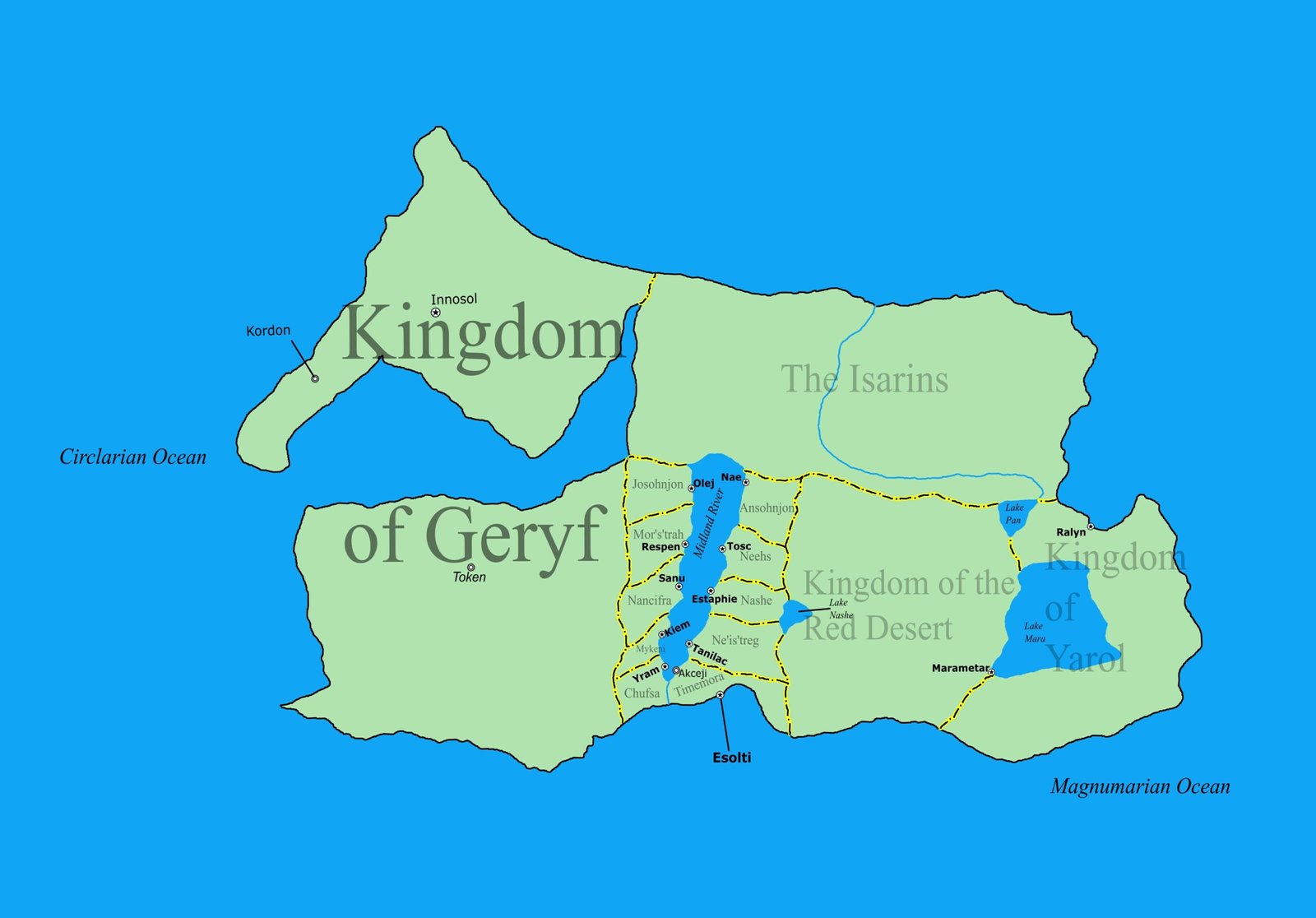
Xanen, a significant leader among the Synarin peoples, called the numerous clans together and, in October 818 BCE, waged war against the Coromaeans. With the Coromeans weakened by the fighting in the North, the Synarins drove them easily back over the border, which stood just South of the city of Coromae proper. Meanwhile, Xanen and his fellow leaders collaborated, establishing the Synarin lands on the remainder of the Peninsula to be the Synarin Confederation.
The Four Synarin Kingdoms
Peace would not last long in this new Confederation, however, for Coromaean Consul Limus dispatched a figure named Formo, who assassinated Xanen. Limus then sent additional conspirators. First was Ormendaeon, disguised as a "free-wonderer" sent by the Divine to be an apparent adviser to the Synarin leader: Yecourem. Ormendaeon advised Yecourem that Revenon, the Synarin leader of the lands neighboring to the South, was leading a conspiracy to assassinate him, and that Revenon had been behind Xanen's assassination. Yecourem was swayed by such counsels and, in March 817 BCE, launched an attack upon Revenon and his people. The second to be dispatched by Limus was Envon, also disguised as a "free-wonderer" sent by the Divine, who advised Revenon that Yecourem was the one behind Xanen's death, and that Yecourem intended to overtake the remainder of Synarin lands. Such advice was made all the more believable when Yecourem attacked from the North, forcing Revenon to defend his lands. Third was Miriem, posing as a Coromaean citizen having been cast out of Coromaean society, who advised the third Leader, Tennuros, that Ormendaean was an insider for Tirion Limus, and that he was having Revenon and Yecourem engage in conflict with one another in order to help Tirion Limus to divide Synarin lands.
And the fourth conspirator to be sent was Teros, who was a leader of a coalition of sea peoples of Gudinian and Isarin descent, and was, in secret, paid by Consul Limus to pose as a leader of anti-Coromaean dissent as well as to be an adviser to the remaining Synarin leader: Paolorien. Teros advised Paolorien that Limus had placed insiders in the other three Peninsula territories in order to divide and conquer, and that the only solution was to take back all lands of the Peninsula in the name of the Synarin peoples. Paolorien accepted such counsel and, in September 817 BCE, launched a massive assault upon the lands of Revenon, Yecourem, and Tennuros. During this onslaught, Paolorien's conjoined forces succeeded in assassinating Revenon and Yecourem as both territories were overtaken. In October, they attempted to defeat the Synarin peoples of Tennuros. However, they were met with fierce resistance. And deeming Paolorien to be the bigger threat, Tennuros went to Coromae and sued for peace. Consul Limus came forward and convinced all Synarin parties to terminate the fighting and to sign onto an agreement of peace. Included in the terms of this agreement was the splitting of territories into Four Synarin Kingdoms: Tennur, Yecourt, Rewen, and Paoll. And between these Kingdoms were established written terms of fair trade as well as a term of taxation from all Four Kingdoms toward Coromae. Limus justified that such taxation would pay for the keeping of the peace. Though grudgingly, the Synarins accepted this.
Coromaean Conquest of Northeast Canticula
The presence of plentiful acres of arable farmland in Northeast Canticula drew the interest of the Coromaeans. In 815 BCE, Consul Limus launched twenty legions to travel into this region with the intent of defeating and subjugating the Isarin peoples.
Gereon, the orphaned son of Sera and Gavament, had been sent to the land of the Gudinians as part of an arrangement with the Priestess Gera in order to protect herself from any possible vengeance. Growing up, Gereon adapted successfully into Gudinian norms. However, Gudinian society, since Gereon was at a young age, had been subjugated under the crushing and exploitative rule of the Coromaeans, who imposed a rigid societal structure with themselves in the upper class, those of mixed Coromaean and Gudinian descent in the middle class, and those of purely Gudinian or foreign descent in the lower class. Gereon, therefore, was fated to live a life in the lower class.
Kingdom of Geryf: Formation
In April 810 BCE, Gereon became an outlaw. As an outlaw, he united all people in the region to reject utterly the social hierarchy imposed by the Coromaean rulers. They then attacked all Coromaean outposts, defeating them and leading the Gudinian territories to cutting off communications and supplies to the Coromaeans who remained in the Isarin territories. In September, the Coromaeans stranded in the Isarin territories attempted to travel back by sea, but Gereon's forces sunk or captured most of their ships.
In March 808 BCE, Gereon noted the exceptionally weak position of the Coromaeans, who were now relying on the Synarin Kingdoms for trade and help in defense, and saw an opportunity. Gereon spoke with the leaders of the Synarin Kingdoms, who voiced contempt over the terms imposed upon their lands by the Coromaeans. They, as a result, signed a pact to join Gereon in overthrowing Coromae in exchange for Gereon giving the Synarins equal status. In April, the conjoined forces of Gereon and the Synarins overthrew the city of Coromae, after which Tirion Limus was executed and the city renamed Kordon.
Meanwhile, the Lake-and-Pillar to the North was renamed Innosol.
To Kordon, Gereon summoned the Synarin Kings and Generals on the premise that he would deliver his end of the bargain. Instead, Gereon had them massacred before imposing direct rule over the entirety of the West Peninsula.
In May 808 BCE, Gereon rode back to Innosol, where he was crowned King of the newly-established Kingdom of Geryf. This new Kingdom at the time ruled over Northwest Canticula and the West Peninsula.
Kingdom of Geryf: South Canticula Campaign, 806 to 805 BCE
In March 806 BCE, Gereon, desiring vengeance for the deaths of his parents, launched a campaign to bring down the Gerian Kingdoms and overtake all of Southern Canticula. The region of the Karos peoples fell with ease in April. Inspired by this, Gereon gave little time for his forces to prepare their assault upon the Gerian Kingdoms, themselves. This would prove futile in May, as his forces, expecting to capture the city of Akceji by the end of summer, sustained heavy losses along the outer borders of the Kingdoms while Gereon's ships were destroyed just outside of Akceji by fire arrows and sophisticated works of spellfire. As a last desperate measure, Gereon sought the aid of the Nymian peoples in the Mountains, but the Nymians refused to negotiate.
Finally, in June 805 BCE, after more than one year from the start of the campaign, Gereon signed a treaty of peace with the Gerian states. To satisfy Gereon's desire for revenge, Gera the Priestess sent one of her kin to be sacrificed; such was the custom at the time.
The Kingdom of Geryf, meanwhile, would keep the territories it gained thus far.