Cabotton University: Progress and Expansion
With more classroom availability in the new buildings came a lesser presence of the classroom pavilions. This, along with the opportunity to engage in freedom of voice and self-determination in education, made Cabotton University an increasingly attractive option for prospective scholars, though it was still only locally known at the time.
The year 1235 was considered a relatively peaceful one for the University. The matter with the Emorans had been settled, and more measures met with fewer impasses, since Martin Cross and Thomas Snow, two de facto leading figures now, had now been in league with each other on the most part. In fact, the future seemed bright, as Martin Cross at a Council meeting declared publicly: "Let every Scholar, having been given ample opportunity at this University, contribute to the opportunity of future Scholars."
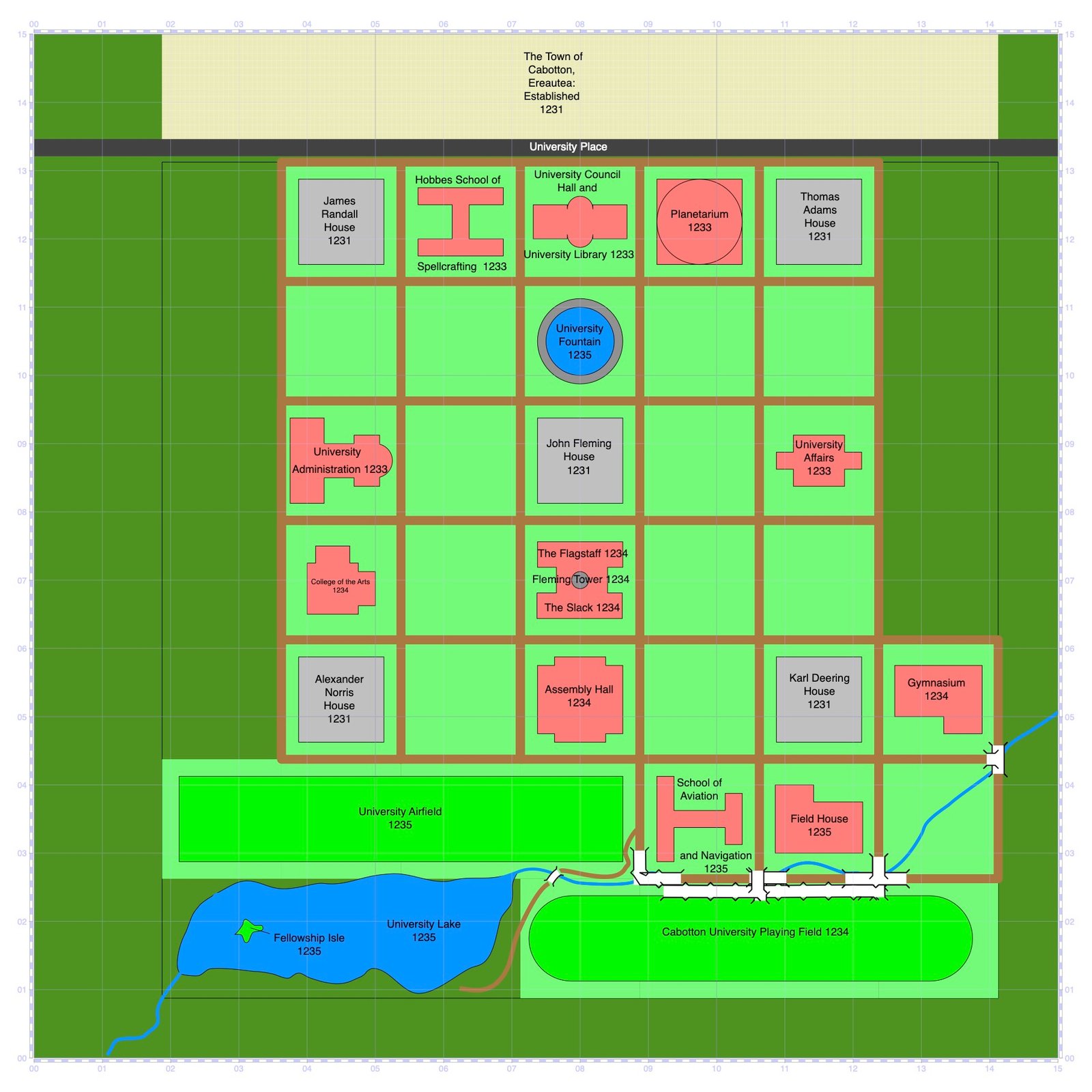
This led to an dramatic increase in the number of creative projects proposed to the Council by the Cabotton Scholars. But of this large plethora stood three significant figures: Steven Rothyn, proposing the construction of an Aviation School and Airfield, Jon Orr, proposing the addition of a Field House, and Bella Koth, proposing the creation of a University Lake connected to a University Fountain. All three propositions were passed by the University Council in March 1234 with nearly unanimous support. Construction would be completed on said renovations by June 1235.
School of Aviation and Navigation, University Airfield
The School of Aviation and Navigation was built purposefully in the larger-than-life shape of a fixed-wing aircraft with the intent to facilitate the designated spaces within for specific parts of experimental aircraft to be designed, built, and tested. The Aviation School itself sat on the Second Floor of the Building, below which stood the First Floor on ground level, and a Basement below ground level. The First Floor was dedicated to the design, construction, and testing of experimental automobiles, bicycles, and mesh trains. The Basement, consisting of a large pool known as the Water Tunnel, was dedicated to experimental boats, submarines, and other watercraft. This was important because, with only rare exceptions, such watercraft experiments were forbidden expressively by University Administration from being tested in the University Lake.
The University Airfield was a well-trimmed grass field. On the rooftop of the Aviation and Navigation School overlooking the Field was the Air Traffic Control Tower. And the Eastern half of the Field contained retractible rail moors for experimental airships. It is important to note, however, that this was not a public airport, and that no aircraft was permitted to take off from or land on this Field without reservation in advance from the Office of University Affairs.
The Field House
The Basement of the Field House consisted of a large swimming area including the Current Pool and the Stationary Pool. The Current Pool was about twenty feet in width and ran along the inside perimeter of the Field House. The current of this Pool ran clockwise during the first half of the week and counter-clockwise during the second half of the week. The Current Pool served as a venue for kayaking and other boating sports, as well as the occasional experiment for innovative small watercraft built by Navigation School students. Within the perimeter created by the Current Pool stood the Stationary Pool, consisting of a deep Diving Area on its West End and a vast Lap Pool on its East End.
Running around the inside perimeter of the First Floor of the Field House was two-deck track, with the upper deck dedicated to the Indoor Bicycling Track and the lower deck dedicated to the Indoor Running Track. The area within this perimeter was divided into two sections with the West Section dedicated to multi-purpose ball courts and the East Section dedicated to fitness equipment like weight-lifting. At the very East end of the latter section stood a health clinic dedicated to sporting injuries.
The West End of the Second Floor was dedicated to four Handball Ranges, each of which could be set up as either Throwing Ranges or Goal Ranges. The East End of the Second Floor served as a venue for the well-known "Gravitron Complex" a three-dimensional maze, rock wall, and fitness course made solely of spellmatter. The "Gravitron Complex" was named as such because of its experimentation with pseudo-gravity dynamics so that participants could experience such things as zero-gravity.
University Lake, University Fountain
Westerhill Creek was dammed up in the Southwest Corner of the University Campus grounds, and tons of earth moved so that the area would fill with water into the University Lake. Land in the Southwest portion of this Lake was raised to create Fellowship Isle, upon which sat Fellowship Lodge. The First Floor of this Lodge consisted of a Banquet Hall and Kitchen while the Second Floor consisted of ten guest bedrooms. Two piers extended from Fellowship Isle: one extending East and one extending South. The Eastward Pier was capable of altering its length to accommodate differing sizes of boats while the Southward Pier was capable of converting into a bridge. There was also a pier on the East Shore of the Lake, one on the West Shore, one on the South Shore, and one on the North Shore. Water from this Lake was piped from water vents below Fellowship Isle and filtered extensively as it was transported via the Estrayon Method to the University Fountain.
On the North End of the University Campus stood the University Fountain, which began operations on 15 May 1235 and would run a yearly schedule of operation from 1 April to 24 September of every year that followed. The spouts were, by default, shaped as models of the Five Houses and Fleming Tower. However, the spout apparatus was made solely of spellmatter with the intent to enable skilled students to get creative and shape it temporarily into various shapes and designs. Scholars in the years to come would take part and create things like artistic expressions, passionate messages, political messages, and even marriage proposals. To note, the latter evolved into a generational tradition for some scholars. And alongside the spellmatter-morphing was the ability for scholars to craft pseudo-tidal forces in the Fountain Pool, and thus carry out tests and tournaments for miniature model watercraft.
There were, of course, University policies governing what was considered appropriate for the University Fountain. And the High Scholar Delegation Timekeeper was tasked with restoring the Fountain to its default settings every Sunday evening. This role would later be transferred to the University Headmaster.