1253-55
The music program, up to this point, had been collectively run by numerous Cabotton Scholars, serving as the last "holdout" of former Headmaster Thomas Snow's old curriculum and being known for having numerous informal music group ensembles. Headmaster Cross, however, had a vision to re-establish this program as one with more integrity and unity. Slightly more than half of those in the program actually supported Cross in this endeavor despite opposition led by Kara Tomwell. And in May 1253, Cabotton University hired Robert Manning, who started his tenure that fall and established a new music program which would grow into one of good repute in the years to come.
Also under Cross' leadership, and with majority passage of University Council, the University filed for and officially became an accredited institution under the Congress of Circlaria, meaning that it received important international funding.
Cross sought re-election as Headmaster in 1255, proposing in his next term to have the University build much-needed off-campus housing as well as four more Schools on the Campus. These new Schools were to be focused on the subjects of finance, trade, and medicine. Challenging him, from former Headmaster Snow's faction, was Kara Tomwell, who promised to bring back the old research-based curriculum from the Thomas Snow era. Tomwell was also opposed to Cross' student housing expansion agenda, citing the excessive costs, and proposed alternatively to build library branches carrying University textbooks and establish a remote learning curriculum. The majority of the student body, however, was very supportive of Cross' achievement of Cabotton University's Congress of Circlaria accreditation in that it helped to avoid budget shortfalls without having to force the University to charge tuition. And so Cross won re-election in 1255 with 60 percent of the vote.
1255-61
Under Cross' policy, with construction beginning in the summer of 1256 and finishing in the summer 1257, the First Student Housing Expansion Initiative included a Fleming House Residence in downtown Cabotton Proper, a James Randall House Residence North of Cabotton, a Thomas Adams House Residence East of Cabotton, a Karl Deering House Residence South of Cabotton, and an Alexander Norris House Residence West of Cabotton. Each Residence had only one level and was considered to be the Sixth Floor of each University House. Each Residence also followed the same floor plan as the Fifth Floor of each House at Cabotton University. And each Residence was connected with the other Four, and also the Main Campus, by an underground granular thread cable rail tram system.
In 1257, an incident on Mount Carris triggered panic across the University as well as across the nation. Headmaster Cross responded by stepping up the powers and security measures of the Campus Watch, and also by dispatching University Reserve Corps to the Mount Carris region and take part in an agenda that ultimately failed to subdue the Finzi Darkfire Community but resulted in compromises between them and the Retunian Federal Government. Nonetheless, those in the Corps received recognition from the Federal Government and academic credit from the University.
James Black was the incumbent Prime Minister of the Retunian Republic at the time. However, Edward Jackson, an alumnus of Cabotton University, announced in June 1257 his intent to run for the Prime Minister position in the upcoming 1260 election, running on behalf of a new centrist third party called the Diplomatic Party. As a highlight to his campaign, Jackson promised to conference with the Great Northern banks for donations to fund a Retunian federal block grant that he, should he become elected Prime Minister, promised to give to the University as well as a similar block grant to the Pagotta family to establish a deep-trade business. Jackson made a campaign stop at Cabotton University in the summer of 1258, where he oversaw a temporary model deep-trade market exchange forum for participating students, at the end of which he gave an inspiring speech. Student sentiment up to that point, both on behalf of the liberal National Labor Party and the conservative Foundationist Party, had been against deep-trade, which was seen as nothing more than a money game among the privileged elite. After Jackson's visit, however, a large faction of both camps in the student body had come to support Jackson's deep-trade agenda for the Republic.
In 1259, the Retunian Republic was made to engage in a short-lived but intense conflict, known as the Chemkan War, against a notorious maritime terror organization known as the Vandalish. Headmaster Cross recruited numerous University Corps to take part in this. And incumbent Prime Minster James Black gave them honors and monetary awards afterward, while Headmaster Cross gave them, once again, credits toward graduation. This led some Cabotton Scholars to gravitate toward the Thomas Snow faction and decry such "privileges" as compromising the University principle of student equality. Cross defended his policies, though he was still concerned about his prospects for the upcoming 1261 Headmaster election. So he broke with an unwritten precedent by endorsing Edward Jackson for the Prime Minister election.
This endorsement gave those Cabotton students supporting Jackson a feeling of empowerment; and so they voted in droves in the 1260 general election. Cross was seen as more conservative as Thomas Snow, and so had only roughly more than half of the student body supporting him. However, many in Snow's faction were Jackson supporters, and so had turned to support Cross after his endorsement.
Edward Jackson had narrowly won the 1260 election, but this was nonetheless a win. So Jackson began his tenure as Prime Minister per constitutional protocol in January 1261. That year, he worked an agenda involving infiltration and shrewd diplomacy against the remaining government seat of the former Combrian Chartered State in the Diamond District of Hasphitat. After they submitted to Retunian federal jurisdiction, the Combrian National Bank was subsequently liquidated and divided into what would become the Big Five Banks. The Five Banks, after a round of legislation, donated further funds to the block grants that Jackson promised the University and the Pagotta family, grants which he finally signed into policy by the end of the year.
Meanwhile, in September 1261, Martin Cross, up against the now-divided Snow faction which failed to back a single opposition candidate that year, won handily re-election as the University Headmaster for a third term.
West Horizon and the Renovations
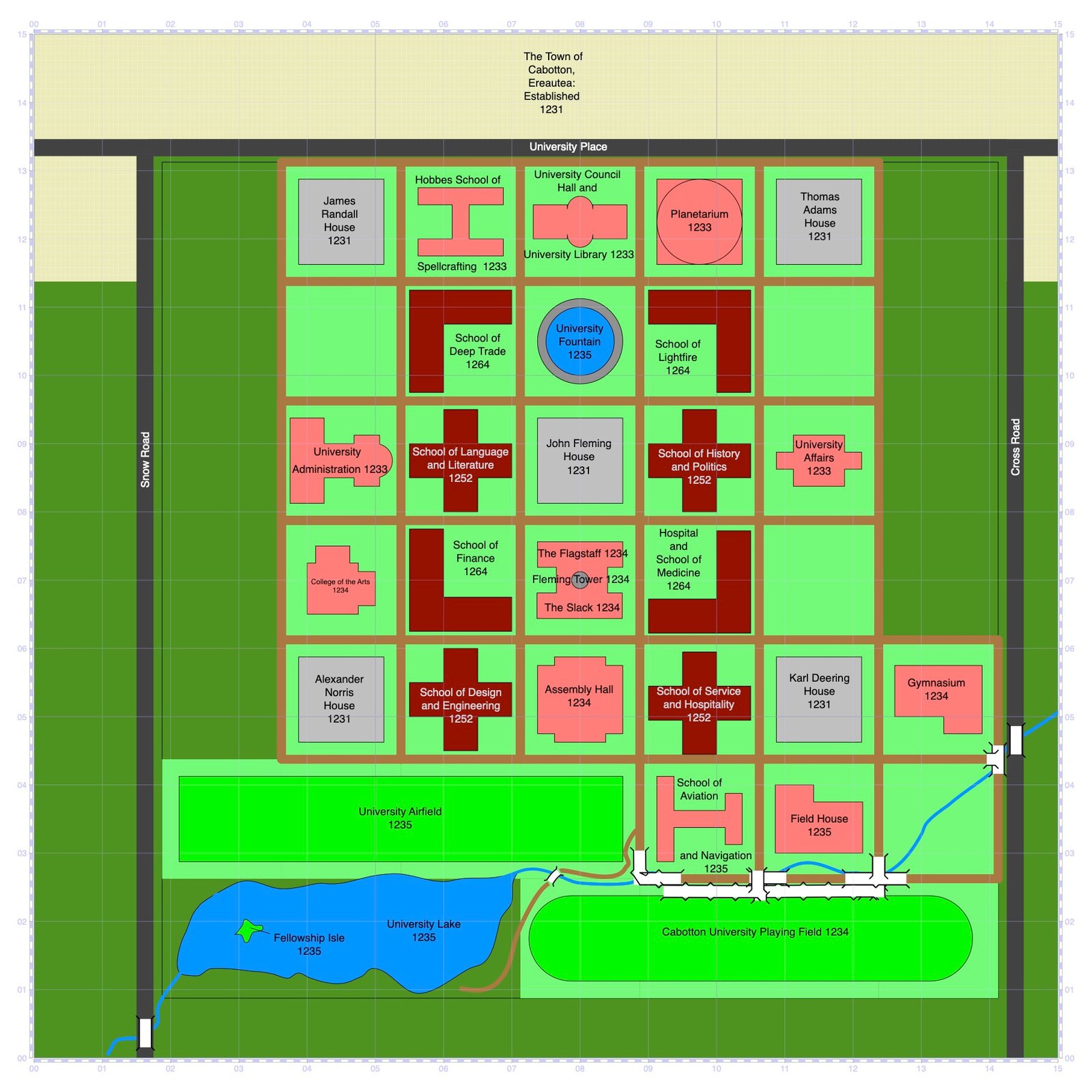
The measure signed by Prime Minister Jackson in late 1261 delivered the promised block grants to Cabotton University and the Pagotta family. For the University, this meant funding for the construction of four new Schools: the School of Deep Trade toward the Northwest, the School of Lightfire toward the Northeast, the School of Finance toward the Southwest, and New Hospital and School of Medicine toward the Southeast. The measure almost came to an impasse in University Council in 1262, as Kara Tomwell and the Thomas Snow camp made enough counter-arguments to spark intense and prolonged debates. However, after endorsements and promises made by the Pagotta family, the University Council finally voted to proceed with the construction project.
Construction on the four Schools began in the summer of 1263 and concluded by fall 1264. On 02 September 1264, the Pagotta officially opened a newly-constructed state-of-the-art facility in Three Points, Ereautea, establishing the lightfire company: West Horizon.