King Gereon, The Kingdom of Geryf, and the Isarin Shipwrights
While many Isarin factions remained as nomadic groups in the grasslands of Northeast Canticula, others took to the seas around West Canticula and the Peninsula as shipwrights and traders. Many of these sea-bound Isarins, having been exploited by King Gereon since his rise to power, banded together in October 803 BCE and staged a general strike for higher wages. In short time, the King signed an agreement meeting their demands.
However, in January 802 BCE, King Gereon signed an agreement with the Kingdom of Josohnjon for the construction of ships and the establishment of a trading network to replace that of the Isarins, all for much lower costs and wages. This would create undue hardship for the Isarins.
Rise of Queen Sarya Remstraya
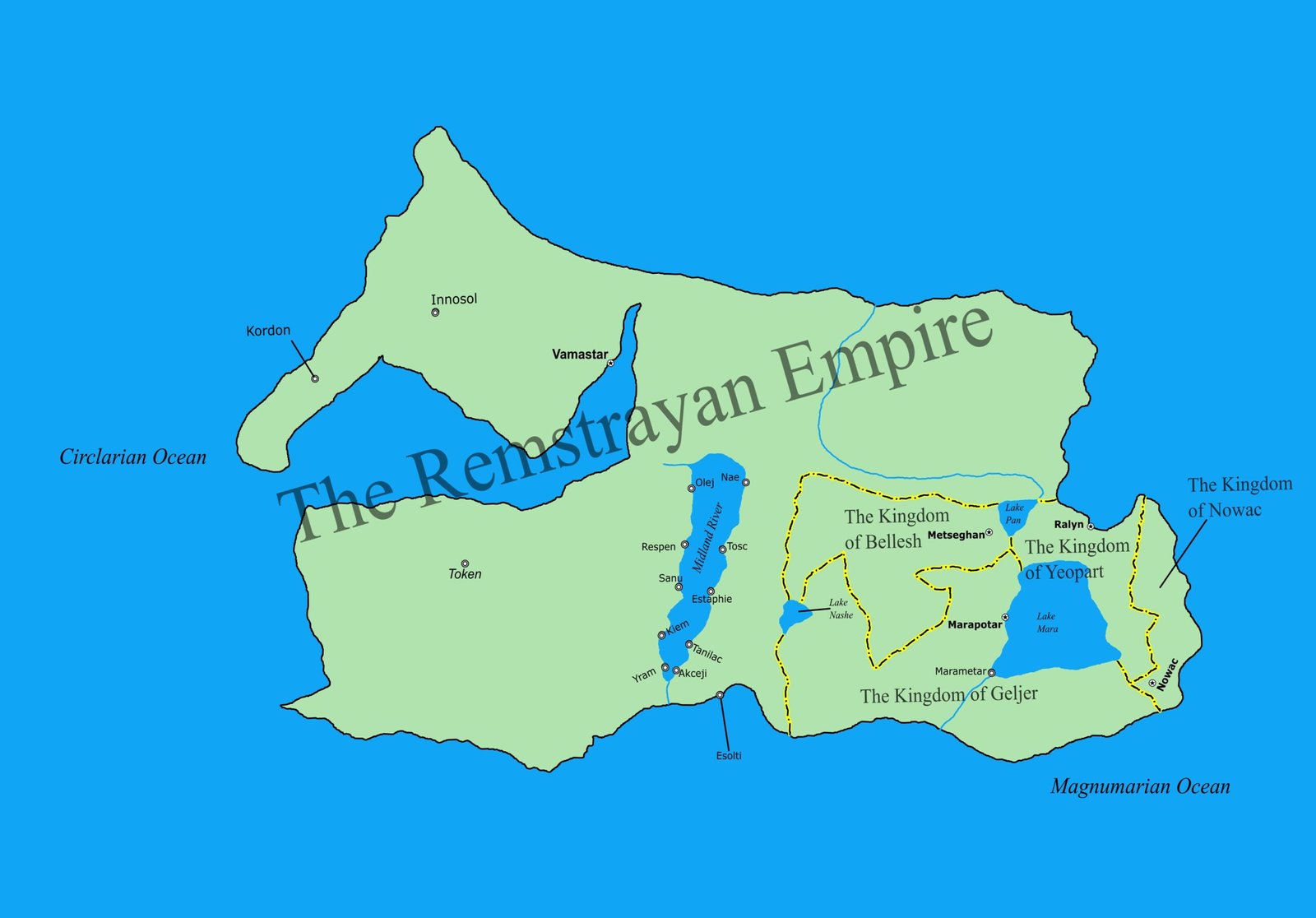
Born to Isarin shipwrights Petir and Raya in December 827 BCE, Sarya Remstraya led a team of defenders, in March 802 BCE, to ward off a band of Isarin pirates from a rival faction who were intent on slaughtering her family and taking her ship. Remstraya and her fighters defeated the pirates and commandeered their ship. In November 802 BCE, Remstraya rallied together all Isarin sea factions and led them in an invasion of the Eastern part of the Kingdom of Geryf. Poorly defended at the time, this land was defeated as the Kingdom of Remstraya and its capital city, Vamastar, were established. Over this Kingdom, Remstraya would rule as Queen.
Fall of King Gereon
In January 801 BCE, King Gereon declared this new Kingdom illegitimate and its Queen a dire threat to the Kingdom of Geryf, declaring war and sending an army to sack the city of Vamastar. The agenda failed as Remstraya drew loyal Isarin warriors from the grasslands to the East and kept the Geryfians at bay. In April, Queen Remstraya captured the shipping ports of Josohnjon, where she would sign an agreement with the Priesthood to have all Remstrayan forces withdraw after the anticipated defeat of Gereon.
King Gereon sent more of his forces, this time to Josohnjon, in an attempt to take back the ports. However, being that a large portion of his forces were still fighting near Vamastar, the Geryfian capital of Innosol was left largely undefended. Queen Remstraya saw this opportunity and launched an armada, which led to the death of King Gereon in battle and the fall of Innosol on 12 September 801 BCE. The powerful Geryfian commander, Arndun, who would have been a potential rival to the Geryfian Throne in peacetime, took his remaining forces and fled to Token. There, he crowned himself the next King and pledged to defend and restore the Kingdom. However, his forces were no match for Remstraya; and, less than two weeks after the sacking of Innosol, Arndun surrendered the city and surrounding lands; thus all were brought under Remstrayan rule.
Fall of the Gerian Priesthood
Gera and the Priesthood of Akceji, by March 800 BCE, had been made well-aware of the fall of Innosol and the death of King Gereon. In adherence to the previous agreement, they demanded Remstraya return Jonsohnjon and its ports to their rightful owners. However, Remstraya had come to learn how some of the shipwrights and traders were subjected, under Josohnjonian rule, to either slavery or heavy taxation. In May 799 BCE, in total defiance to the will of the Priesthood, Remstraya, with her growing army, captured the lands of Nancifra, Chufsa, Ansohnjon, Nashe, and Ne'is'treg. The Priesthood responded by commanding the forces of the remaining Midland River Kingdoms, in June 799 BCE, to carry out a campaign which successfully took back Ne'is'treg, Nashe, Ansohnjon, and Nancifra by September.
This, however, prompted Remstraya to launch a renewed and sweeping campaign, which captured all of the Western-Bank Midland River Kingdoms by March 798 BCE, Ansohnjon and Neehs by April 798 BCE, Nashe in May 798 BCE, and Ne'is'treg by June 798 BCE. Shortly thereafter, they arrived at the gates of Akceji, where they fought bitterly with the armies of the Priesthood for three grueling months. In the end, however, by November 798 BCE, Timemora, too, fell under Remstrayan control as the ruling Priesthood in Akceji was toppled and the Priestess Gera was executed.
Rise and Fall of the Kingdom of Marastaye
Over the course of a few generations emerged a population of those identifying as ethnic Marastayans, whose factions by the 790s BCE, in both the Kingdom of Yarol and the Red Desert Kingdom, felt that they were divided and oppressed. In April 797 BCE, the Remstrayans invaded both Kingdoms with intent to conquer them; and Marastayans on both sides faced conscription. In September of that year, the Marastayans, seeing an opportunity, united and overthrew the two Kingdoms from within, thus bringing both territories under one new entity: the Kingdom of Marastaye. This Kingdom would be ruled from Marapotar by King Jordyn.
In March 796 BCE, King Jordyn, also seeing the Remstrayans as a threat, rallied his soldiers under the new banner and launched a campaign to drive out the Remstrayans. However, Remstraya still had the advantage of numbers from an ever-growing Isarin population, whose reinforcements she deployed against the Kingdom of Marastaye in June 796 BCE. By December, the short-lived Kingdom was defeated as Jordyn had his life spared after giving surrender.
796 BCE: The Treaty of the Four Kingdoms
Queen Sarya Remstraya led the signing of The 796 BCE Treaty of the Four Kingdoms. Under this agreement, Jordyn and the Marastayans were made to live freely; however, the former Kingdom of Marastaye would be divided into the Kingdoms of Bellesh, Geljer, Nowac, and Yeopart. The remainder of Canticula would fall under the Remstrayan Kingdom, now established as the Remstrayan Empire.