Brief History of House Esary: 1117 to 1213
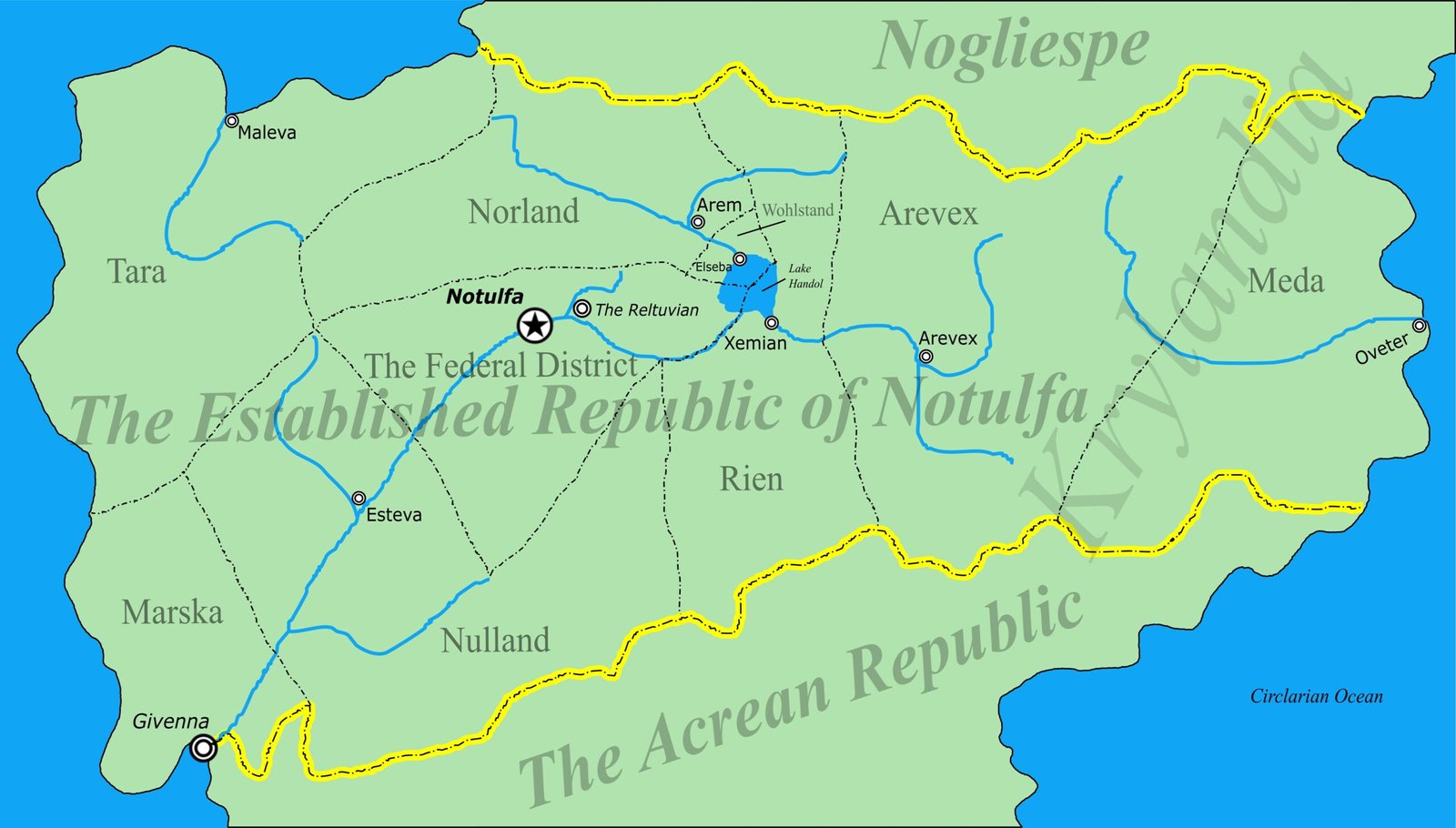
Not much is known about the foundation and emergence of House Esary, seated in the far-Northern nation of Notulfa. What is known was that they were initially a small but powerful family of spellcrafters who, in the late 1000s, settled in the location of the present-day city of Notulfa proper, which at the time was a small outpost named New Givenna. In the early 1100s, House Esary was challenged by various nomadic militant groups in the area as well as contemporaries of the infamous Great Northerner: George Benson. Owing to superior spellcrafter skills and wartime strategies, however, House Esary prevailed in 1117 and brought all surrounding lands under the nation of Notulfa. New Givenna became home to the government seat of this new nation, as the settlement would be, itself, named Notulfa and be developed into a proper municipality. Each leading member of House Esary was given his or her own provincial seat to govern over a particular region of the nation. And the century to follow would be one of unprecedented technological and economic progress; and by the end, Notulfa would have an expansive trade and diplomacy network extending across Canticula and the Circlarian Ocean.
Brief History of House Esary: 1213 to 1218
House Esary was forced by a workers' collective bloc to abdicate the Notulfan government in 1213. In their place was established by an "equalitarian" regime deemed democratic on paper but authoritarian in practice. Conflict ensued between the worker bloc and House Esary over the next few years; but by 1218, House Esary admitted defeat and retreated to the bounds of its mysterious fortress: the Reltuvian. Shortly thereafter, House Esary and the new Notulfan government signed the Treaty of 1218, dictating for House Esary to remain at peace within its jurisdiction surrounding the Reltuvian, provided that they did not import additional arms or wage further conflicts against the Notulfan government.
Events Leading to the Invasion: 1221 to 1223
The First Continental War in Canticula, a grand conflict between Northerly and Southerly nations, began in 1221. Initially, the Northerly nations had the advantage, owing to more powerful weapons and supplies produced by their private corporations. However, Notulfa gave military aid to the Southerly nations, who were deemed to have more favorable sentiment toward the working classes. In March 1221, House Esary and the Notulfan government called a Conference in Budlapeiyay, Tandeiyah, where they invited the attendance of envoys from the Southerly Canticulan nations of Gamroa, Tymol, Tennur, Yecourt, Rewen, Paolina, the Chokian Republic, Gyrosak, the Midland River States, the Red Desert Federation, Yarol, Raisek, Strawtep, Frawcord, and Yeopart. Here, they signed an arrangement whereas Notulfa received partial payments to manufacture weapons, vehicles, and other military assets. The two years to follow would see the establishment throughout Notulfa of large industrial sites dedicated to the mass-production of such assets. Such deliveries of aid included guns, tanks, ships, submarines, shells and ammunition, and spellfire resources.
In anticipation of the War, Furthing and the other Northerly nations, as well as Prove, formed the Northern Alliance. In 1221, the Northern Alliance sought aid from the Remikran Union, who obliged accordingly, thus leading to the establishment of regular cargo shipping routes, patrolled by the Furthish Merchant Marines, across the Circlarian Ocean. In November 1222, a Furthish Merchant Marine ship intercepted an empty cargo ship returning to Notulfa, thus finding evidence confirming a long-standing speculation that Notulfa was providing aid to the Southerly Canticulan nations. All member leaders of the Northern Alliance signed and had delivered a formal letter to House Esary and the Notulfan government, warning them to cease and desist and giving them an ultimatum of 1 January 1223. Notulfan leadership sent back a formal statement of refusal as the nation of Notulfa began arming itself for impending retaliation.
The Invasion: January 1223
On 4 January 1223, the Northern Alliance invaded Notulfa. By 16 January, they captured the trading hub of Givenna and the surrounding Notulfan province of Marska. By 23 January, the Northern Alliance had complete control of Esteva and the surrounding province of Nulland. And by 2 February, they passed the city limits of Notulfa proper. However, Northern Alliance forces discovered, at this point, that the Red House of Parliament and other administrative buildings were empty. Furthermore, there emerged reports of strange spellfire activity near the Old Forest Gate, located some miles East of the city. Determining that to be the hiding place of Notulfan government officials, the Northern Alliance decided, on 3 February, to mount an assault on that specific location. However, that was when a trap, long designed and long in the making, was sprung by House Esary.
It is unknown exactly what kind of spellwork was deployed by House Esary in retaliation, but such a counter-offensive all but eliminated Northern Alliance forces in quick fashion around Notulfa proper. What is known was that black, sleek, mysterious hybrid-marine-submarine vessels armed with heavy artillery, accompanied by seemingly civilian structures armed with the same kind of heavy artillery, fired upon the Northern Alliance forces stationed in Givenna and Esteva. By the morning of February 4, only three Northern Alliance ships were intact, and intact only due to House Esary granting them pardons after surrender, to make it back to Canticula; all other Northern Alliance vessels were utterly destroyed as thousands of Northern Alliance soldiers were killed or taken prisoner. Meanwhile, the Notulfan government would reward House Esary for its role in the defense of the nation with the repeal of the remaining restrictions in the Treaty of 1218, replacing that Treaty with a new Mutual Non-Intervention Treaty. Signed in 1224, this Non-Intervention Treaty offered much lighter restrictions against House Esary, most notably allowing them to trade in firearms and even allocating funds for each House Chamber to expand maritime commerce.