1065-1070: The Status Quo
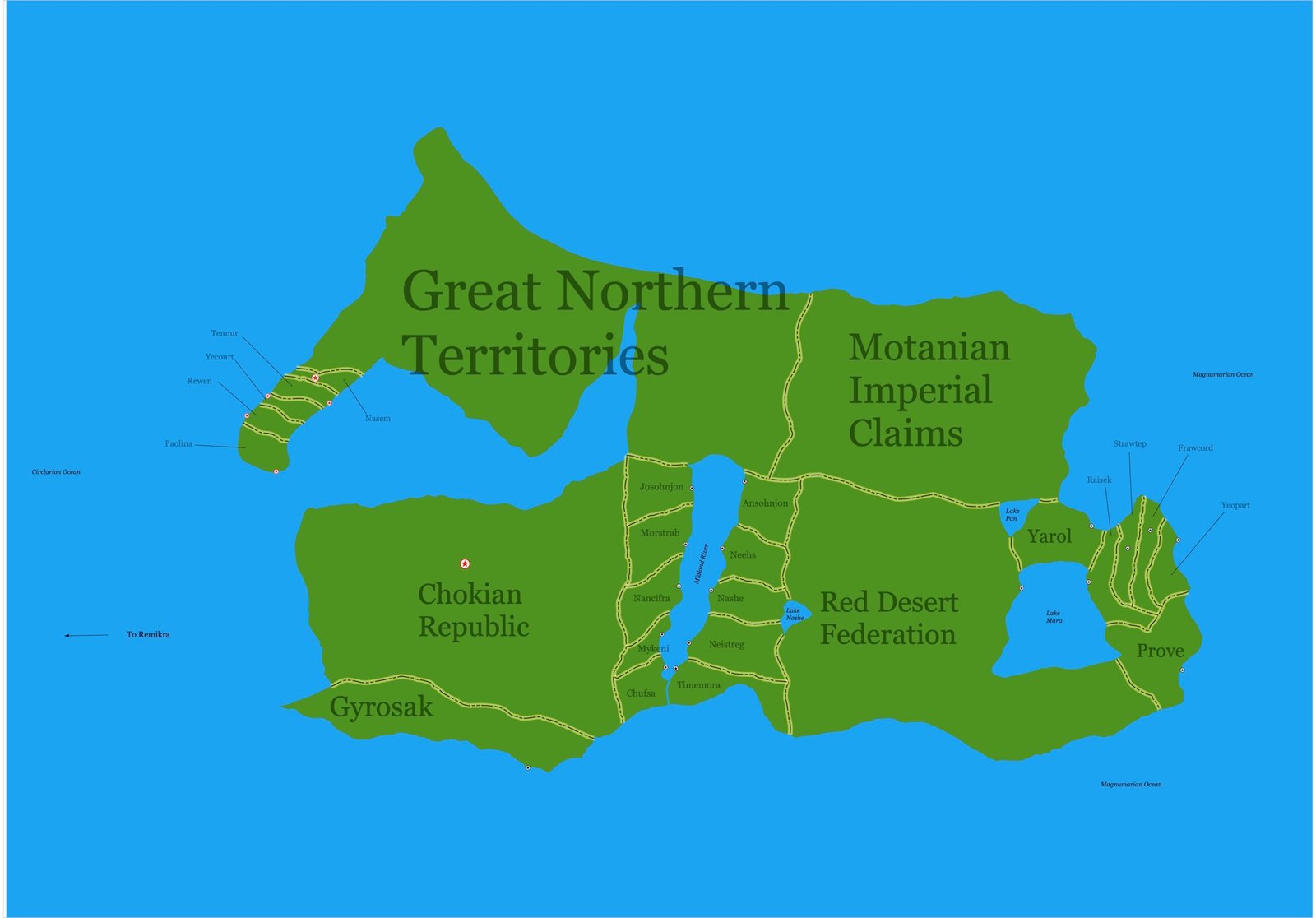
Before 1071, the area of Northwestern Canticula between Nasem in the Southwest and the Motanian Empire to the Northeast was under jurisdiction of the Kingdom of the Great North, seated in Remikra. Northeast Canticula was under control of the Motanian Empire, seated in the Ostar-Nabuka region; Nasem and the remainder of the West Peninsula nations stood as constitutional monarchies; the Chokian Republic, having re-united in 1065, was a constitutional republic, as was Gyrosak; the Midland River States were constitutional monarchies; the Red Desert Federation was a federal republic; the Five Coastal States (North of Prove) were republics; and finally, Prove was a constitutional monarchy.
1071: Overthrow of the Provan Crown
The first signs of the change to come arrived in 1071 with the deposition of the Provan Crown. Of the Weller Royal Family, Queen Rebecca ruled the Provan Kingdom from 979 to 1060, and was seen as a fair ruler presiding over relatively prosperous and stable times. Upon her death in 1060, the Throne was succeeded by King Daren, whose rule was rejected by the inhabitants of the Red Desert. In 1061, they rebelled, beginning a war that would last until 1062, when the newly-established Red Desert Federation would gain recognition from the Provan Kingdom. In 1063, George Benson, a defecting naval commander from the Kingdom of the Great North, attempted to attack and conquer the Provan Kingdom but was defeated by Provan forces. The Great North would sentence Benson to a lower position, but Benson was defiant and, in 1068, gained enough recruits and invaded the Provan Kingdom again. This time, he would succeed in capturing Prove and driving Daren from the Throne. Once again, however, the Great North removed Benson, sentencing him to a distant ranger post in present-day Notulfa and restoring Daren to the Provan Throne.
Beginning in 1069, there emerged more pirate attacks along the Provan coastline, dampening popular confidence in national security. Daren addressed this by expanding Provan defenses. However, such expanses were required to be supported by food and resource rations as well as increases in taxes. With King Daren having the same drive of moral intent as Queen Rebecca but lacking the sense and intuition to navigate the political landscape, King Daren's policies were left to exploitation by Provan banks who lobbied numerous members of Parliament. Thus, taxes began to be imposed on or raised on such everyday items as coffee and tea, as well as ship-building materials and anything traded to Prove by the Kingdom of the Great North.
It was the moment when, having married into the Unjoy family, King Daren gave his daughter, Sarah, a retirement fund supported by taxes imposed on food staples such as grains that tensions between the Provan Crown and population reached a breaking point. On 06 April 1071, a significant branch of the Provan Army, led by Gordon Marris, surrounded the Royal Palace and demanded King Daren to abdicate, a demand to which the King surrendered. Then Marris overtook the Palace and State Houses, establishing a governorship in place of the deposed Crown. This new government structure would serve as a prototype for what would become known as an incumbent-appointed presidential council, or IAPC.
Great Northern Partitions
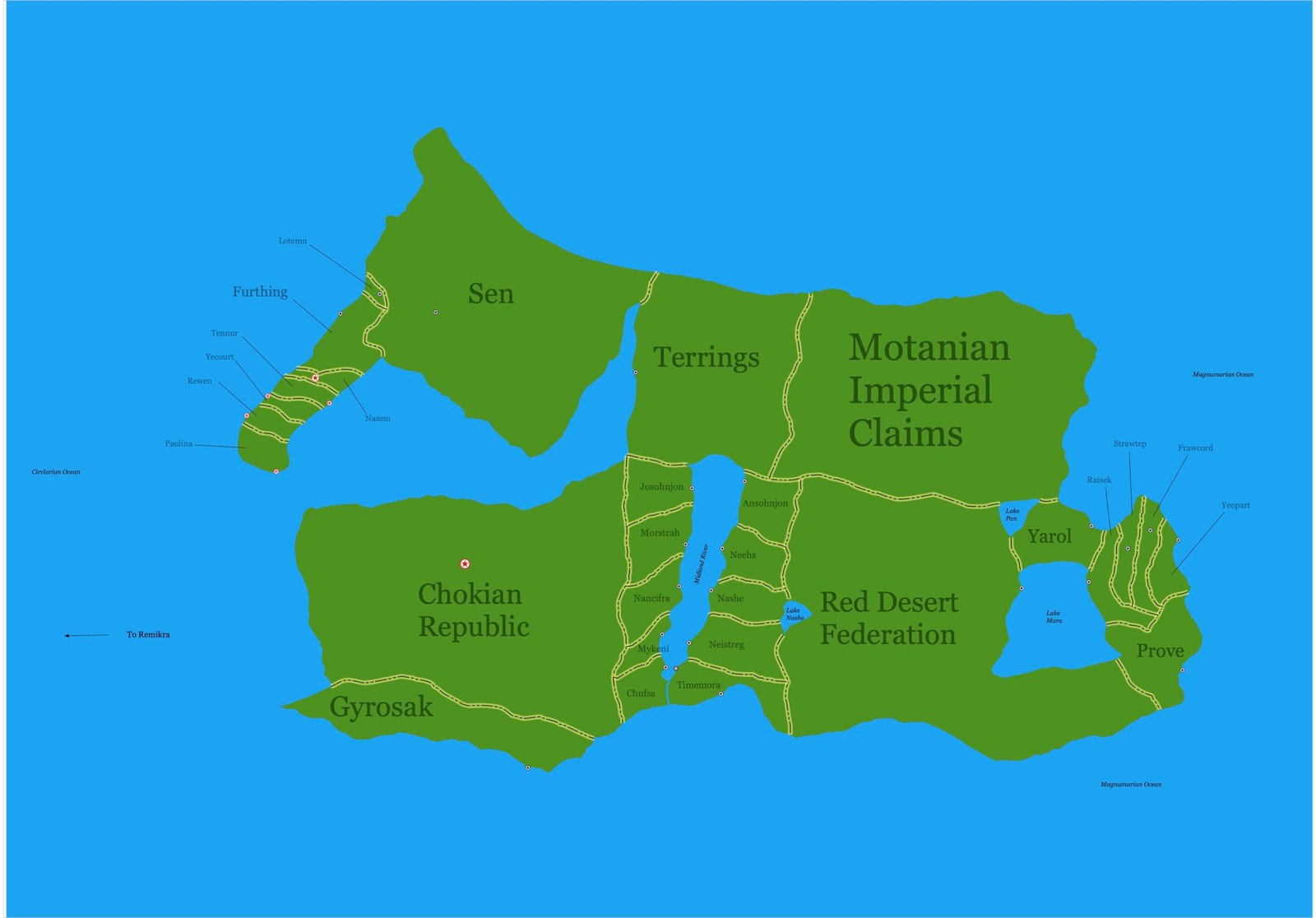
In 1076, the Kingdom of the Great North lost an eight-year-long war in Hobland, as the Kingdom was forced to recognize the independent Hoblandish territories. The territories, afterward, imposed an embargo against the Great North on its most essential source of energy: blue-diamond coalsands. This would have devastating impacts on the Great North, as this resulted in both an economic and energy crisis. After all other options weighed, the Great Northern Parliament eventually resolved to address the pressing economic issues with the selling of its other territories to independent Great Northern families. All Canticulan territories would be sold as a result; and in 1081, such partitioning began with the selling of land to be established as the independent nation of Terrings. This nation would be the first, officially, to be governed by an IAPC. Therefore, its head of state would be vested in a President, the first of which was voted in by landholders but with successors appointed by incumbents. The President would appoint up to 100 candidates to serve as members of a 100-person Council with a constitution calling for the President to be responsible for ensuring the Council represented every part of Terrings equally. Per constitutional protocol, the President was made responsible to appoint a successor upon retirement. The Council would vote on said successor if there was ever an unexpected vacancy in the Presidency. In the event that the Council was unable to choose a successor President to fill said unexpected vacancy, all landholders would be called upon to vote on a successor President. And in the event that neither the Council nor the landholders were able to choose a successor, the Great Northern Crown would send a governor-general to appoint a successor. However, it is important to note here that this governor-general only served temporarily and for the appointment purpose, under a Terringish office. Terrings was still an independent nation.
Similar to the Presidency, every Member of Council was expected to appoint a successor Council Member upon retirement. In the event of an unexpected vacancy, the President would appoint a successor. If the President was unable to do so, the landholders of the District represented by said Council Member would vote to choose a successor. Otherwise, the Great North would, in same fashion as aforementioned, dispatch a governor-general to appoint said successor. Terrings, as well as other IAPC nations to follow attained such independence through peaceful means with the signing of the Queen's Mandate, a document containing a set of terms in order to maintain warm political and economic relations between the Great North and the newly-independent nation.
In 1082, the Great North partitioned its second independent nation: Sen. Over the course of the past millennium, the ancient Gudinians intermarried with other peoples, thus giving rise to the Sennish. Under the Galacian Empire, the Sennish had cultural and societal autonomy; however, such autonomy was lost under the Furthish Kingdom who, after the end of the Galacian Empire, brutally oppressed them over the centuries to follow. It was only in 981 when the Edoran Kingdom, having defeated the Furthish Kingdom and acquired all of its territories that year, ended such oppression and granted progressive equal rights to the Sennish. One-hundred years later, the Sennish were in equal standing with the other demographics. They had become softly divided between the Remstrayan and Vasilcan factions, but had one common rival: the Furthish, who had been demonstrating themselves to being as racist and prejudiced against the Sennish as they were over the distant past. When the Great North looked to partition Northwest Canticula in 1082, the Furthish petitioned for themselves to be in charge of this territory while the Sennish advocated for the opposite. Siding with the Sennish, the Great North split the territory, giving most of it to the Sennish to be governed as an IAPC, hence the foundation of the nation of Sen. Only a small portion of land surrounding the Furthish Capital of Kindol remained to be partitioned, which the Great North planned to give to the Furthish.
Such partitioning would come in 1083, as the Great North initially planned to evenly split the remaining territory between the Furthish and the Lesterrans. The Furthish, however, formed a united political lobby and succeeded, through negotiation in terms of consolation given after the partitioning of Sen, to have the Southerly Lesterran Counties placed under Furthish jurisdiction. The caveat in this deal was that the Great North ceded part of the remaining Furthish territories to be governed as the nation of Lotemn, a region known to be rich in metals and resources needed in the manufacture of firearms The Great North intended to have Lotemn governed independent of Furthing as well as other possible rival powers in order to satisfy a call made by Congress of Circlaria for a balance in political powers. Furthermore, Furthing and Lotemn would both be governed as IAPCs and not as monarchies. This, the leadership of Furthing grudgingly accepted.
Crisis in Nasem
Throughout most of the 1000s, the Kingdom of Nasem served as a trading and retail crossroads between the West Peninsula Kingdoms to its South and the Great Northern trading bloc to its North. However, the Great Northern trading bloc collapsed in the 1070s following the blue-diamond coalsand embargo. This led to economic hardship in Nasem, with such hardship inherited by King Robert II when he ascended the Throne in 1079. Initially, King Robert II suspended Nasemian Parliament and ordered much-needed cash stimuli into various key industries. While this provided hope to improve the economy in Nasem early on, the Great Northern trade bloc collapse was too much of an adverse force. Furthermore, the Nasemian Royal Treasury was under considerable financial strain. Thus, when allowed to re-convene in 1081, Nasemian Parliament, with the approval of King Robert II, began enacting tax increases.
Funds from these new taxes were used, this time, to build trade with the nearby Chokian Republic; and by 1083, the economy in the Kingdom of Nasem was stable. During this time, though, Nasemian businesses began merging and engaging in legal methods of excessive wealth attainment. Between 1084 and 1085, they lobbied Parliament into imposing more and more taxes. In 1086, King Robert II approved an infamous tax known as the Gate Passage Tax, which imposed taxes against travelers and commuters traveling between Counties within the Kingdom. Regardless, the population was divided between Royalists and anti-Royalists, and would remain so over the five years that followed.
Popular contempt did begin to grow, however, as it became more and more apparent that the new taxes were to satisfy wealthy interests rather than offset economic strains as the King had announced. Existing companies from before the 1070s had, during the time of the trade collapse, initially needed a bailout from the Royal Treasury. As part of the policy enabling the cash stimuli, King Robert II had the Royal Treasury enable stimulus checks to be requested and granted per the call of any particular business owner in need. However, this policy imposed no regulation on request reasons, thus creating a loophole that would become abused by business owners not long after. Furthermore, the Crown shared in such interests and would thus not have the government close this loophole. Worse yet, this policy was very arbitrary as an inner circle formed of the wealthy elite; and the Treasury would hesitate on granting requests made by those, such as small businesses, outside this circle.
Thus, unrest emerged from the working classes.
Such unrest, in the past, was able to be contained by martial law assistance provided by the Kingdom of the Great North upon request by the Nasemian Crown until the 1070s. However, after that point, citing the aforementioned economic strains, the Great North began imposing budget cutbacks on this service.
Matters came to a head with the 1086 Gate Passage Tax, imposed in March of that year to charge each commuter 25 silver credits for each crossing of a County border. In the wake of the resulting popular resentment, the King issued a settlement whereas a special carriage network would be offered for travelers wishing to bypass this tax legally; however, this service did charge 250 silver credits per year. Large numbers of the Nasemian population were outraged at this form of consolation and began carrying out some of the most intense street protests thus far. Great Northern martial law officers succeeded in containing the protestors into legally designated town blocks. But unlike the past, they only gave verbal curfews and would only arrest the most extreme protestors, again thanks to the budget setbacks. Despite King Robert II's pleads for more intervention, the Great North only gave assurances that they would be open to negotiating, a few years into the future, rollbacks of their recent budget cuts.
Despite even these weak assurances, the Great North, in October 1089, announced in a letter to King Robert II the complete elimination of martial law assistance to Nasem. The unrest here had only been growing, leading to an uptick in resource costs as well as casualties for the Great Northern service. Still on a limited budget, the Great North had also promised to allocate its Royal Treasury funds toward the investing in the expansion of hubstone industry infrastructure in Combria. In exchange, the Great Northern Treasury eliminated its overseas martial law program. Then, in March 1090, a Furthish columnist named Tom Johnson, in an appeal of consolation to those Furthish Royalists saddened over the territory of Furthing no longer being under governance of a King or Queen, published a letter to the Furthish public reasoning that the people did not need a King or Queen after all. This was received very differently by the Nasemian public, who voiced further contempt against King Robert II after he, that same month, established a mercenary-staffed martial law task force to fill the void left by the Great North, raising taxes in the process.
Tedrick Payne, riding on Tom Johnson sentiment, ran on behalf of the Liberal Party for the Prime Minister position in Parliament in the year 1090. During this campaign, he made a call to abolish the monarchy, which led him to win by a landslide on 16 May of that year.
In September 1090, King Robert II signed for an increase in taxes on workers' wages. Shortly thereafter, union leaders across multiple industries came forward to negotiate with the Crown to roll back the increases; but the Crown would repeatedly call off such conferences. In March 1091, the Crown imposed yet another wage tax increase, but, in an act of consolation, agreed to submit to such negotiations calls. The Crown, however, would only be open to lowering or eliminating only the new tax increase imposed that month, and would not negotiate further terms. To this, the union leaders responded with a call to the public for a general strike. The public, meanwhile, united and began calling for King Robert II's abdication.
Afterward, the Crown continued to refuse further negotiations. And on 18 April 1091, the general strike began. The Crown dispatched its mercenary martial law forces, which were pushed back by a militia formed by the strikers. On 21 April, the strikers and militia pushed past barricades and stormed the Royal Palace and Hall of Parliament. The union leaders, at this point, announced that they had keys made for the King's personal quarters. They gave the King until midnight on 01 May to abdicate, and threatened to storm his personal quarters if he failed to follow on this demand. The King initially refused, thus leading to a standoff. It was just after 11:00 P.M. on 24 April, one hour before the deadline, when Jaime Terryn, the King's Hand, ascended the podium of the Parliament Hall to deliver a new statement made by King Robert II. Terryn intended to announce that the King was willing to recuse his Scepter temporarily and open the Crown to negotiations. However, he mis-spoke and announced, instead, that the King had rescinded the Scepter and opened the Crown to negotiations. It was only when one of the union leaders declared the call to negotiations by the Crown invalid since the Crown was no longer in power that Terryn realized his mistake. It is said that Terryn attempted to correct this verbally, but it was too late. Numerous publishing platforms across the nation in favor of the labor movement had already begun printing that the King had abdicated. The popular wave was too strong for Terryn to make his correction heard. As a result, King Robert II decided to follow through and formally abdicate. Thus, both the King and his Hand were allowed to leave in peace and retire to the nation of Furthing.
Meanwhile, the strikers and militia proclaimed Nasem to be a Republic.
The Amelioration Movement
King Rennox of the Kingdom of Paolina, having ascended the Throne in 1078, also drew popular contempt with the imposition of the same sort of taxes and wage policies as King Robert II. In the summer of 1091, news had spread among the Paolinian population of the overthrow of the Nasemian Crown and subsequent proclamation of the Nasemian Republic. Kary Morna, a labor rights activist, called for the abdication of King Rennox and proclamation of the Paolinian Republic. The Crown jailed her for treason. On 02 November, Korme Delo, leading activist allied to Morna, led militant forces and stormed the Royal Palace. In response, the Crown had Morna executed. On 04 November 1091, the rebelling militia captured and executed King Rennox; and afterward, the Republic of Paolina was proclaimed.
The Kingdom of Timemora, located in the Midland River region, transitioned peacefully, similar to Nasem, to a Republic on 14 November. This was followed by a similar transition in Tennur in January 1092, one in Yecourt in February 1092, and one in Rewen in March 1092. In May 1092, the Kingdoms of Josohnjon and Ansohnjon were overthrown, replaced by two Republics respectively. The transition in Josohnjon was violent, involving the execution of numerous Royal family members and the desperate but successful escape of its Queen who later took refuge in Furthing. Ansohnjon, on the other hand, saw a peaceful transition. In October 1092, the Kingdoms of Morstrah, Neistreg, Chufsa, and Mykeni transitioned to Republics. And in November 1092, the remaining Midland River States of Nancifra, Neehs, and Nashe would follow suit.
These events were later named by scholars to constitute continent-wide political event known as the Amelioration Movement.
The Restoration Counter-Movement
The Amelioration Movement, however, did not proceed unchallenged.
President of Furthing since 1083, George Furlong enacted policies to re-establish trade and economic stability for the nation. However, such policies did not favor the working classes, who were made to deal with both inflation and wage stagnation. Furthermore, Furlong was reputed to be a "hard boss," for he conducted business in league with significant leaders in commerce and hesitated to negotiate with labor unions. Meredyth Kormer, a significant union leader in Furthing, was inspired by the Amelioration Movement happening abroad, and resolved with her followers, in late 1091, to overthrow Furlong's regime and establish the Republic of Furthing. This bloc, however, had neither the resources nor the firepower to do this at the time.
In May 1092, the democratic forces behind the Amelioration Movement united and formed the Rebirth Coalition, with an objective to bring about democracy to all nations in Canticula. That same month, they answered a call made to them by Meredyth Kormer and sent much-needed resources, as well as mercenaries, to her cause. On 14 June 1092, Rebirth Coalition forces, under Meredyth Kormer's command, launched an assault upon the national government in Kindol and surrounded the State House. President Furlong, however, had military reserves on the premise, and they pushed back while Furlong commanded forces stationed outside Kindol to attack Kormer's forces from the other side. Furlong also called upon the Kingdom of the Great North for assistance. Citing that Kormer's forces were using heavy artillery, the Great North agreed to honor this request and dispatched military forces who, on 16 September, landed on the coast near Kindol and joined the Furthish, forcing Kormer's forces to scatter and retreat. Kormer, herself, would flee to the Republic of Tennur while the Furlong Administration in Furthing was restored.
On 06 October 1092, in opposition to the Rebirth Coalition, Furthing and the Great North signed an alliance treaty and formed the Restoration Coalition. Their primary objectives were to assassinate Meredyth Kormer, and to topple the democratic governments in Canticula in order to replace them with IAPCs. On 17 October 1092, the Restoration Coalition toppled the Republic of Nasem and re-established it as a hierarchical IAPC. However, Kormer would never be found, and would live out the rest of her days in Tennur under immunity protections.
The Chokian Republic, in Southern Canticula, was historically rich in gold, silver, and copper. Their greatest trading partners in the 1000s were within the Great Northern bloc, owing to their eagerness to sell to the Chokian Republic significant industrial means and capital. By the end of the century, the Chokian Republic became the most industrialized nation in Southern Canticula. Because of this, in the 1090s, the majority of the Chokian population and government grew opposed to the Amelioration Movement, seeing them as a possible threat to the aforementioned trade dynamics. On 19 December 1092, the Chokian Republic joined the Restoration Coalition, doubling the Coalition's military strength.
Signed by the Great North and all Canticulan Kingdoms in the year 1012, the Crown Trade Act limited the trade of participating sea-bound companies to other sea companies and member-Kingdoms within the Crown Trade Coalition; all members were forbidden to trade with those entities who were not members. Compliance was effectively enforced by the threat of such penalties as imprisonment, fines, and seizures of cargo. Similar to the situation in Nasem, an inner circle formed between the Crowns and favored sea-bound companies; those compliant companies outside this inner circle were subject to abuses permitted in the Crown Trade Act such as low prices for goods sold by the companies and high sales taxes imposed on them. After becoming Republics, Timemora and the other Midland River States repealed Crown Trade terms between themselves and the sea-bound companies, thus permitting free trade. Seeing this as a liability to their trade via increased economic competition, the remaining Crown Trade members amended the Act to allow membership from nations were not specifically monarchies but who otherwise enforced similar trade terms; thus the Chokian Republic could join. In December 1092, the Restoration Coalition determined that the toppling of the Republic of Timemora and establishment of a Crown-Trade-conforming IAPC government in its place would effectively close the Mouth of the Midland River to free trade and therefore stem the increasing competition. With backing from the Chokian Republic, the Restoration Coalition, on 21 December, captured the Timemoran Capital of Esolti and the major trading hub of Akceji; thus, with an IAPC government being set up in Esolti, the Midland River was successfully blocked from free trade. On 23 December, the Restoration Coalition successfully toppled the governments of Chufsa, Mykeni, and Neistreg, establishing IAPCs here as well.
Settlement and Compromise
In February 1093, a constitution was finalized in Cenofan for the nation of Nasem to stand as a dual-democratic IAPC. More specifically, Nasem as a whole would be governed by a national IAPC government while the nation, itself, was split into two regions: East Nasem and West Nasem, governed by democratically-elected governments seated in East Cenofan and West Cenofan respectively. Nasem would, that same month, join the Restoration Coalition, who succeeded in toppling the democratic governments of Nancifra, Morstrah, Josohnjon, and Ansohnjon in favor of IAPC governments in each. In response, the remaining West Peninsula Republics to the South of Nasem would form the Coalition for Defense of Democracy, which would be joined by a large number of sea-bound companies, and threaten to make a war declaration upon the member nations of the Restoration Coalition. This was significant as despite the ensuing conflicts, no political entity in Canticula had actually made a formal war declaration thus far. Wishing to avoid such an escalation, the IAPC government in Nasem, on 11 February 1093, called for a Conference in Cenofan dedicated to the signing of terms to facilitate peace. Lotemn declined to join, re-asserting its commitment to neutrality in all Canticulan affairs. But the other nations obliged, and talks began on 02 March. On 19 April 1093, after a consensus was reached between all parties, the Coalition of Peace and Order was initiated with the signing of peace terms that included the allowance of the West Peninsula Republics South of Nasem to remain democratic republics without foreign intervention. Furthermore, an International Committee was formed to meet in Cenofan on a yearly basis in order to outline terms of peaceful trade. Also, tariffs were removed between participating nations, while the Crown Trade Act of 1012 was repealed. Concessions were made to the Restoration Coalition, however, in that they were allowed to implement measures legal under Congress of Circlaria standards to have the remaining Midland River Republics become IAPCs. Thus, the Coalition replaced the democratic governments with IAPCs in Nashe and Neehs in June 1093.
Despite such concessions, the governments of Sen and Terrings were dissatisfied with the repeal of the Crown Trade Act, the terms of which they believed were essential for stable trade relations. Thus, in 1094, they left the Peace and Order Coalition and formed an independent North Coalition of Peace and Order. Shortly thereafter, Furthing left the original Peace and Order Coalition to join Sen and Terrings, beginning the formation of the two economic and political blocs of "North Canticula" and "South Canticula."
Regardless, such settlements and compromises helped to establish what would become known as Pax Canticula, which would last well into the century that followed.