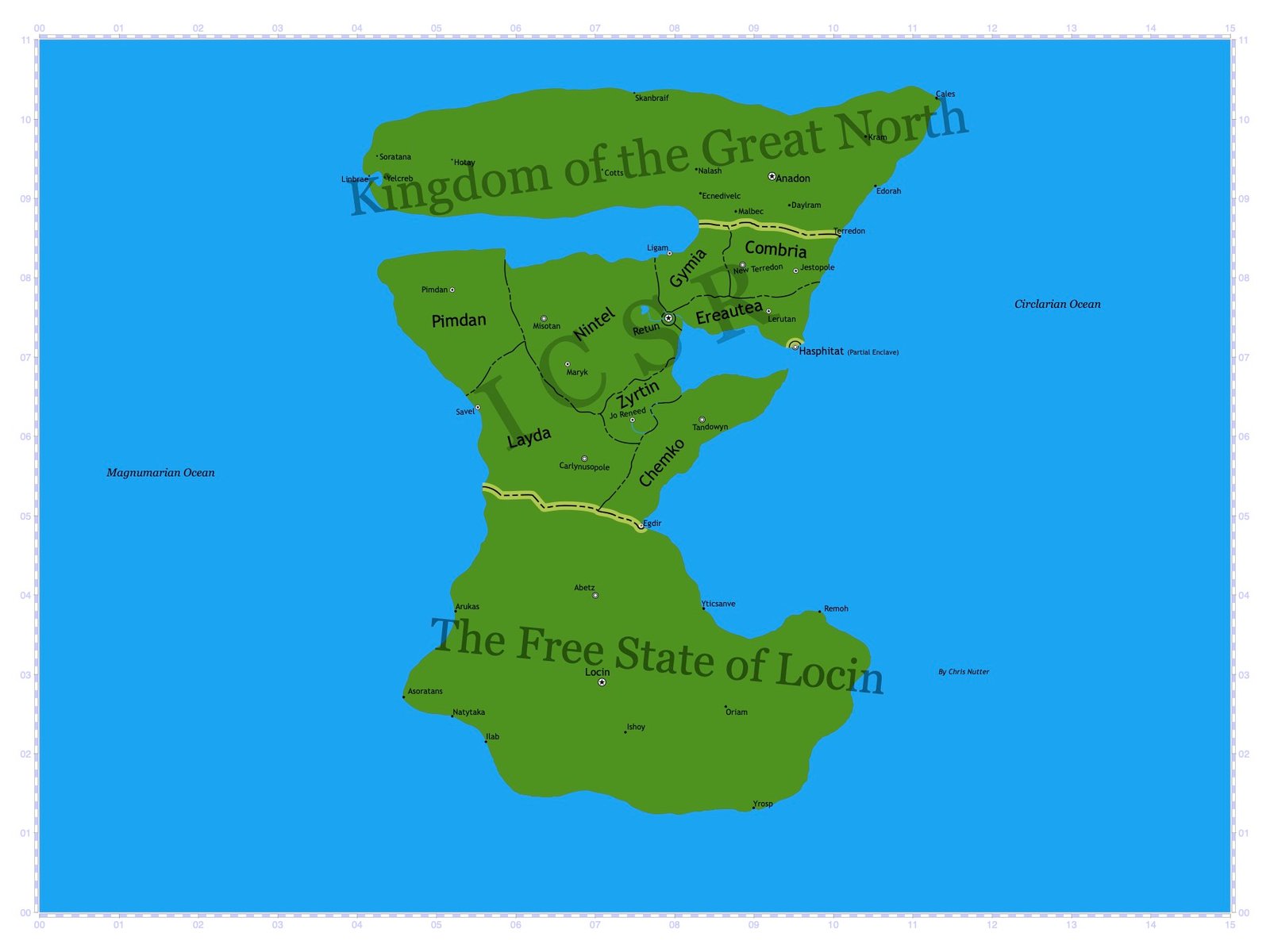
CAD Virus Pandemic of 1488-89
During the month of October 1488, numerous reports began to emerge of CAD Virus cases in the Sayleronian Maritime State; and on 13 October, the Sayleronian Maritime State declared a pandemic emergency. This was followed by a similar declaration by the government of the Independent Commonwealth State of Retun (ICSR) on 24 October following numerous cases in Middle Remikra. Between October 1488 and March 1489, both nations implemented rigorous vaccination and containment policies, and both officially declared the pandemic over by 01 May 1489.
1489: New Prime Minister of the ICSR - Salonmae Rickardson
After numerous calls made by prominent Sayleronian OCEA platforms, ICSR Prime Minister Salonmae Rickardson, having begun her tenure on 01 January 1489, signed a measure for 100 billion Retunian Credits to fund the domestic lightfire industry, 100 billion credits to fund the darkfire industry, and 100 billion credits to fund the Matriarchal Line of the House of Masons. Rickardson also nominated 10 more ambassadors, approved by the Retunian Council shortly thereafter, to negotiate and strengthen ties with the Carricon Isles Darkfire Community.
1490: The Hubstone Quarry Fracture of Northern Ereautea
Little known to the general public, hubstones are actually semi-living organisms, like viruses, and are cousin to the "rock species" of Planet Nephina. Hubstones usually live up to 1200 years; and their quarry-veins, stretching underground out from the center of the hubstone for up to hundreds of miles, occasionally go through "quarry strains," meaning that they experience extreme temperature fluctuations. Such strains produce common hazards such as sinkholes and landslides in the immediate vicinity. Therefore, experts monitor quarry veins for these temperature fluctuations, and will have the authorities impose temporary evacuations if a significant risk is detected. Under very rare circumstances, a quarry vein will fracture under extreme temperature fluctuations. Known, simply, as "quarry fractures," these events will trigger earthquakes as well as the outgassing of life-threatening volumes of carbon dioxide if specially-trained spellcrafters do not nullify the affected quarry vein in time. A significant quarry fracture event occurred in the Duchy of Kram in the Edoran Regiondom of the Great North in the early 900s CE, resulting in strong earthquakes; though outgassing was successfully prevented by trained spellcrafters from Cenofan.
On the morning of 19 September 1490, unprecedented temperature fluctuations were detected along the quarry vein near the town of Lach, Ereautea. Initially, parks in the area were closed as authorities were citing the sinkhole and landslide risks. The strain was expected to last several hours; however, it would actually last the entire day, and showed signs of worsening by the evening. Such circumstances were still relatively frequent, though, and were seen as a source of inconvenience. However, overnight, residents in the area began reporting the sound of "groans" coming from the ground.
On 20 September 1490 at 8:47 AM, reports emerged of thunder and rumbling sounds despite clear skies. Fourteen minutes later, Lach, Ereautea was rocked by a massive earthquake. Alongside the resulting damage and casualties, this event triggered a great deal of shock and dismay as there never before in recorded history had ever been an earthquake in the province of Ereautea.
However, this would not be the only place hit by earthquakes on that date. An equally strong earthquake would hit Stockton, Ereautea at 9:16 AM. This was followed by earthquakes in the Ereautean towns of Pedestal at 9:25 AM, Boring at 9:51 AM, Ebony Valley at 9:56 AM, Former Cabotton at 10:31 AM, and Bales at 10:39 AM. Then came earthquakes in the Gymian towns of Kimmel at 10:48 AM, Lyne at 10:55 AM, and Bogedary at 11:04 AM.
This prompted the largest national-level response taken in Middle Remikran history. The understandably obvious lack of earthquake preparation in the region resulted in the earthquake swarm causing 123 fatalities as well as large amounts of property damage. And immediate investigations determined that, since all affected towns were adjacent to the hubstone quarry vein, there was a strong likelihood that the events were signs of an impending quarry fracture. This was confirmed by expert analysts from Cenofan on 22 September, who also determined that the outgassing would likely occur at a spot along the quarry vein in Northern Gentry County. The entirety of Gentry County had been restricted from the public since the year 1367, but wind patterns and proximity of the site to nearby towns in neighboring counties made this potential event highly dangerous. The areas around the site were evacuated; and on 23 September, a special team of spellcrafters traveled to the site and utilized spellfire script injections, which successfully nullified the fracture.
The regional economy and community would take up to two years to recover from the events of 20 September 1490. Many homes and businesses were destroyed. Thousands of residents were displaced due to their homes being destroyed or being in danger zones. Thousands of employees were placed on furlough. And the Retunian government would provide emergency housing, resources, and supplemental income on the largest scale since the Esurchian War.
1491: ICSR Gubernatorial Elections
From the gubernatorial elections of 1485, the Commonwealth Progressive Liberal Party, or CPLP, won a Governor seat in the Mid-Westerlies as well as 50 percent of national and provincial council seats previously held by the conservative-leaning Commonwealth Democrats. Present in 1491, however, was an entirely different set of political and economic issues. The earthquake swarm and quarry fracture of 1490 had affected Northern Ereautea, a significant region in the ICSR in terms of population and the economy. With many evacuated and on furlough, many Retunians were congregating in new locations like restaurants and cafes, and were forming new relationships with one another. With the help of initiation measures from numerous Sayleronian OCEA platforms, many Retunians began discussing reforms during the recovery process, primarily including the idea of organizational identity and leadership being replaced by matriarchal figures as opposed to patriarchal figures of the Retunian past. It was also from these informal meetings that there emerged a collective call for the Retunian economy to be run as a domestic economy rather than an international trade economy.
As with every gubernatorial election, one-third of the Ministry Council, all seats of the House of Representatives, every Governor seat, one-third of each Governor Council, and all provincial House of Representative seats were up for election in the gubernatorial cycle of 1491. The CPLP offered candidates to run for every contested seat.
This election cycle resulted in gains of majority for the CPLP in the national Ministry Council and House of Representatives, and gains of majority in the Legislatures of Ereautea, Nintel, Layda, Chemko, Zyrtin, and the Meredythian Isles. The CPLP also won Governor seats in Combria, Ereautea, Layda, Chemko, and Zyrtin. The CPLP would also keep its Governor seat and legislative majority in the Mid-Westerlies. The opposing RAD Party would keep its Governor seats in Gymia, Nintel, and Pimdan; and its legislative majorities in Combria, Gymia, and Pimdan.
In response to significant electoral losses, the RAD Party, led by incumbent Prime Minister Salonmae Rickardson, re-organized its agenda to provide soft opposition in order to moderate agendas put forward by the CPLP, rather than block them outright.
1492: Open-Contract Trade Act
The quarry fracture of Northern Ereautea in 1490 had a significant impact on the Retunian economy, causing an surge in trade deficits having been in place over the past five decades and leading to a growing need for economic change. The proceeds from the Dorican Trade arrangement were not sufficient to address this.
Early in the year 1492, a group of CPLP legislators in the Retunian Council proposed the Open-Contract Trade Act, which would set aside funds for businesses to attain resources and take part in the budding dropshipping industry of the Carricon Isles. Accordingly, any entrepreneur with these additional funds would be able to obtain manned or unmanned air or water vessels and, per gig, pick up inventory in one location for delivery to a patron in another location for profit. Taxes from such proceeds would also help the Retunian government in its agenda to close the trade deficit. Proponents of the Act stated that the temporary expansion in trade would provide a stimulus for the domestic economy while opponents, led by Percy Mackwell of the RAD Party, voiced concern that this would require upfront investments inevitably leading to diversions from standing industries like Library of Circlaria. Regardless, on 07 June 1492, the Retunian Council passed the Act, which was signed into law that same day by Prime Minister Rickardson.
1492: The Great Storm of the Carricon Isles
Between the 1480s and 1490s, the economy in Eisel, on the Carricon Isle of Lymmcer, was dominated by the Sayleronians, who rented large numbers of properties from the Prefecture Bank of Eisel and had recently begun sub-leasing them to Retunian businesses. Throughout the Carricon Isles region, the ICSR and Sayleronians jointly owned a small share of vessels and capital involved in the dropshipping industry.
On 14 December 1492, the Carricon Isles region was struck by a freak event consisting of an unorganized cluster of unusually severe thunderstorms. Such storms produced tornadoes, waterspouts, microbursts, and hail. The Northern half of the Isles was hit harder than the Southern half, but both sides nonetheless took significant damage. The Isle of Lymmcer was hit particularly hard, sustaining significant property damage. Also from around the Isle of Lymmcer came reports of freak events such as lightning striking upwards as well as large waves materializing despite lack of wind and precipitation. As it turned out, for the latter, such waves occurred around the South side of Lymmcer, which was protected by lee-side slopes from the winds and rains of the storms, which were moving from Northwest to Southeast. Regardless, the office branches of Retunian businesses in Eisel were significantly damaged; though the dropshipping vessels, stationed either in places less-affected by the storms or in safe places around Lymmcer, sustained minimal damage.
As a result, dropshipping would continue to grow while the other businesses in Eisel would take up to two months to recover, resulting in furloughed workers. Like in the weeks following the quarry fracture of 1490, people began discussing business and leadership reforms favoring a shift from patriarchal to matriarchal communities.
1493: Lightfire Trade Fallout with Etpost
Founded in the year 1405, the Maritime Council of Etpost specialized in the manufacture and shipping of lightfire-made products to various clients throughout the Carricon Isles region. In 1492, Etpost launched a banner program to pay lightfire production services to assist them in their agenda. On 06 April 1492, a group of Retunian lightfire industry leaders consulted with Etpost for prospective arrangements of trade, to which Etpost responded with a detailed agenda to bring back to the ICSR a profitable lightfire industry. Over the course of a year and a half, the lightfire industry in Remikra began building investments and capital accordingly.
On 14 September 1493, however, Etpost admitted that it did not plan to pay directly into this agenda, and that the detailed agenda given in April 1492 was rather a plan to create simple incentive in the ICSR. Seeing this as a scam, Retunian investors and workers abandoned the agenda in droves. And on 23 November 1493, Retunian lightfire business leaders declared to the public that the Etpost agenda was a lost cause.
In the weeks that followed, some Sayleronian journal outlets criticized the Retunian business sector, as well as the Retunian government, for its slow bureaucracy, using the Etpost fallout as an example. Some Retunian platforms, supporting the CPLP, added to the narrative, blaming RAD Party rhetoric for making matters worse through "capitalistic expectations."
1494: ICSR Prime Minister Election Cycle
For the 1494 ICSR Prime Minister election cycle, the three most contested issues were the patriarchy versus the matriarchy in terms of organization identity and policy, the prioritization of international trade versus domestic trade in the Retunian economy, and the physical location of ambassador seats in the Carricon Isles for both the ICSR and the Sayleronians. To note, the latter emerged in 1494 in the wake of a call for Sayleronian and Retunian embassies to be established in closer proximity to one another to facilitate tighter deep-trade policies.
On behalf of the RAD Party ran incumbent Prime Minister Salonmae Rickardson for re-election. Rickardson campaigned on the idea that the Matriarchal Line of the House of Masons should be recognized but that economic reform took equal to higher priority, and that a robust international trade policy would ensure those of the Matriarchal Line would have a fair opportunity to be elected to and lead businesses. Rickardson also campaigned that international trade was a higher priority than the domestic economy, even though Retunian hegemony over international trade, supported by the Commonwealth Democrats, was not necessary to achieve this end. Finally, she campaigned that the ICSR should take initiative in helping to settle the debates of where to locate Sayleronian and Retunian embassies in the Carricon Isles, and yield only if the Sayleronians take initiative.
Rickardson was challenged by Nara Faye Morrison of the CPLP. Morrison countered the RAD Party narrative by stating that the bolstering of the Matriarchal Line as an identity for the House Masons was crucial to reforming the ICSR economy, and that Matriarchy Line candidates running for business leadership positions should be given extra support in compensation to societal pushback they received in the past. Morrison also campaigned that the domestic economy took precedence over international trade, and that the Sayleronians alone should be left to take initiative on the discord over embassy locations unless they petitioned otherwise to the ICSR.
The election was held on 24 September 1494 during which Morrison won by a landslide, unseating Rickardson, while the CPLP made yet more gains in other contested seats.
1495: New Prime Minister of the ICSR - Nora Faye Morrison, Diplomacy with the North Circlaria Trade Federation
Upon the beginning of her tenure as the new Prime Minister of the ICSR, Nara Faye Morrison signed numerous measures to increase protections for organizational Matriarchal Lines, to prioritize the domestic economy over international trade with a few exceptions, and to hand most issues with embassy locations to the Sayleronians. Such actions continued with little to no opposition for the remainder of the six-year term.
On 23 April 1495, the Sayleronians proposed to stage a mutual trade forum with the North Circlaria Trade Federation to occur in the following year. The aim of this agenda was the hope to establish trade and diplomacy with the entity in unity against the increasingly radical Congress of Circlaria. The ICSR would agree to this agenda. On 23 September, the Sayleronians called for a smaller, short-term Forum with the Federation in the hopes that currency exchanges could be tried and give assurance that such would not be an issue come the Forum of 1496. Prime Minister Morrison agreed to this and called for the smaller Forum to be scheduled for the first week of November 1495. This short-term Forum, though lasting only 16 hours, was determined to be a success.
1496: Factional Conflict Within the Norica Maritime State Federation, The Joining of the ICSR to the Sayleronian Trade Federation of Lymmcer
Between 1489 and 1496, there emerged conflicts of interest between the Eronma Trade Council and fellow member-organizations of the Norica Maritime State Federation, housed primarily on the Carricon Isle of Lehtem. Tensions broke on 19 March 1496 when unmanned robotic ships from Eronma attacked and destroyed numerous unmanned Retunian ships. Such an act stemmed from the contempt that Eronma had against the leadership of the ICSR over mooring locations of such ships. On 20 March, the Sayleronians dispatched an envoy in an attempt to settle the conflict through peaceful means. However, leadership in Eronma rejected the envoy upon "infiltration" accusations, and began destroying unmanned Sayleronian vessels. On 21 March, the Sayleronian State dispatched defense ships in order to help evacuate Retunian figures and property to the safety of Eisel, Lymmcer. Meanwhile, the Locan Maritime Council, the leading faction of Norica, voted to expel the Council of Eronma from the Federation.
Negotiations between the ICSR and the Sayleronian Maritime State had begun in 1495 over the prospect of the ICSR moving its embassies to Eisel, thus having the ICSR join the Sayleronian Trade Federation of Lymmcer. Retunian embassies and leadership offices would, under such an arrangement, move to be in-house with those of the Sayleronians. Such resulting benefits of this move would include trade without extra taxes and tariffs. Per Retunian Constitutional protocol, this measure was also proposed as a measure to be voted on by the Retunian Council. Here, a very small group of RAD Party legislators voiced opposition over an apparent over-reach of Sayleronian influence in Retunian affairs.
However, such matters would change drastically following the attacks made by Eronma. As a result, embassies and offices moved into Eisel in March 1496, nearly one year earlier than anticipated. The corresponding measure was re-introduced in the Retunian Council which, this time, secured a unanimous vote of approval.
Thus, residency of the offices involved would begin in Eisel in March 1496; though the full trade-terms of the measure would still take effect only in January 1497.
1496-97: Further Diplomacy with the North Circlaria Maritime Federation
The aforementioned Trade Forum between the ICSR, Sayleronian Maritime State, and the North Circlaria Trade Federation would occur as scheduled between 26 May and 27 June 1496, and would be hosted in Cales, Great North; Budlapeiyay, Tandeiyah; Endport, Acrean Republic; and Noratornet, Vasilca. Trades during this Forum consisted mostly of non-dropshipping foreign inventory, mostly in the form of imports toward the Sayleronian Maritime State and the ICSR. There would also be a great deal of currency exchange. This brought an economic stimulus for the domestic economies of the ICSR and Sayleronian State, as well as a boost in approval ratings for the CPLP and Prime Minister Morrison.
Between 10 December 1496 and 07 January 1497 was held a smaller Trade Forum with the North Circlaria Trade Federation, with the other main participants being the ICSR and Etikouron Moritime State. This event would be hosted in Oveter, Notulfa and Noratornet, Vasilca. Like the previous larger Forum, this Forum involved mostly trade in non-dropshipping foreign inventory in the form of imports, as well as currency exchange. The domestic economies of the ICSR and Etikouron States experienced financial stimuli from this, though there arose complaints from Retunian traders of high taxes imposed by the Etikourons during subsequent transactions between the two entities.
James Lawrence Kontacet: 02 December 1362 to 22 April 1497
Born in Jestopole, Combria on 02 December 1362, James Lawrence Kontacet obtained his high school diploma from South Masonia in May 1379 and attained a college education in the study of business from the National Institute of Research and Development in 1383. Over the years that followed, he would serve as an elected Dungeonmaster of the Third Level Society as well as a Head Librarian of the Library of Circlaria. In 1391, countering an agenda proposed by House Maderon for the ICSR to enact policies to restore a profitable lightfire industry, Kontacet led a coalition in the OPEN Forum to, instead, attain funding extensions toward Library of Circlaria as well as the remainder of the Retunian dymensional planecrafter industry. In 1398, Kontacet was elected Prime Minister of the ICSR, a role he would serve from 01 January 1399 through 24 December 1404. At the end of his term, Kontacet would lose to challenger Vet Silonk of the Realist Party after a shift in Retunian economic interests within the electorate.
In January 1405, Kontacet would move back to South Masonia, Combria, where he would serve as a career Contributor to the local Library of Circlaria server until 1422. In May 1422, he moved to the Mid-Westerlies where he took part in environmental restoration efforts. In 1470, he moved to Maxima, Nintel, where he served as a part-time editor for scholarly journal entries published through the National Institute of Research and Development. In 1484, he moved back to Jestopole where he began full retirement. It was here, on 22 April 1497, that Kontacet would pass peacefully from cardiac arrest related to old age.
Though seen as a controversial figure at times, James Lawrence Kontacet gained a large following from Library of Circlaria, the Third Level Society, and various other communities. Many attended his posthumous memorial held in May 1497.
1498: Diplomacy with the Liem and Nuen Trade Federation of Dower
When the new radically conservative power bloc took over leadership in Congress of Circlaria on 05 September 1493, it became clear throughout the Circlarian Realm that the institution, established in ancient times with a duty to preserve a balance of political power, intended presently to favor special interests. Through this radical agenda, Congress of Circlaria began, from that day forward, to engage in unprecedented measures of oppression, including but not limited to the seizure of maritime state ships, the restriction of their movements, the restriction of the movements of individual people from ship-to-ship within each affected maritime state as well as between maritime states, the setting of curfews and detention of individuals deemed non-compliant, and the imposition of tax penalties on maritime states who did not conform to certain trade decisions, as well as subsidies to those who did.
Such measures sparked outrage from numerous entities throughout the Circlarian Realm, many of whom decried that basic rights and principles were being violated and that the Congress of Circlaria was acting against its principle duty to balance the powers. This was, as previously mentioned, the reason for attempted diplomacy between the ICSR and Sayleronian and Etikouron States and the North Circlarian Trade Federation. However, the ICSR and Sayleronian Maritime State sought further alliance-building, and therefore, began conferences with ambassadors of the Liem and Nuen Trade Federation of Dower. Between 16 and 17 June 1498, the ICSR, Sayleronian Maritime State, Liem-Nuen Federation, staged a military demonstration ceremony, alongside flagships of numerous other entities, at Point Fort on the Carricon Isle of Tririefe to convey a symbol of resistance against Congress of Circlaria. A subsequent conference was held between the ICSR, Sayleronian State, and Liem-Nuen Federation between 26 and 27 June 1498 during which they discussed further measures of solidarity. Periodic conferences have been occurring since.
1498: Recognition of the House of Masons Matriarchy by the Dorican Trade Federation
Until 1484, the House of Masons, seated in Jestopole, Combria, had been led by elected figures from within who were male and had each sworn an Oath of the House of Masons upon the Patriarchal Bloodstone. As has been history, numerous organizations throughout the Circlarian Realm, like the Dorican Federation, use Bloodstone Registries for the basic purpose of determining representation by an organization like the House of Masons to be legitimate. As they have continued to wield a large share of the Retunian economy, directly and indirectly, the House of Masons recognized the importance of consistency in Bloodstone Registry information. And having switched to a Matriarchal Line Bloodstone Registry since 1484, the House of Masons launched a petition, on 04 October 1498, for the Dorican Trade Federation to recognize the Matriarchal Bloodstone Registry to be deemed the legitimate source of representation. The Dorican Federation, that same day, presented a Letter of Recognition accordingly.
Meghan Elisabeth Wen: 21 September 1338 to 21 November 1498
Born on 21 September 1338 in Cabotton, Ereautea, Meghan Elisabeth Wen spent most of the first 18 years of her life in the town of Caylor, Ereautea, a town located along the South Coast of Citadel County and a few miles East of the District of Hasphitat. She graduated high school in Citadel County in May 1355, and, that year, returned to Cabotton, where she enrolled in Cabotton University. Wen graduated early from the University with a degree in music in May 1359. In 1360, she enrolled in the Three Points Military Academy in the hopes of helping to fight against the Esurchian State. In 1361, she joined the ICSR military and became a special operative. Between 1362 and 1365, she was stationed as a reserve in the Mid-Westerlies, where, in March 1365, she took part in active combat against the invading Esurchians. Afterward, she would receive an honorable discharge.
In September 1365, Wen returned to live with her parents in Caylor. Three years later, she was elected to serve in the Retunian House of Representatives on behalf of Citadel County, a role she would hold until 1374.
In 1374, Wen answered a call to run for Prime Minister of the ICSR. She won this election, which was held on 24 September of that year. Wen would be re-elected three more times and thus would serve the Prime Minister role until the year 1398. During her tenure, Wen helped to preserve the Retunian lightfire industry, helped to found the National Institute of Research and Development, and helped to restore ecosystems including the Chemkan Bee habitats of the Chemko/Zyrtin region. She would endorse her close colleague, Macon Debi to be the next Prime Minister starting in 1399. However, in 1398, Debi lost to James Lawrence Kontacet.
In 1399, after her retirement from the Retunian Prime Minister position, Wen was elected as a Member of Scholar Leadership for the National Institute of Research and Development. She would be re-elected to the role in 1405, and again in 1411. In 1417, she announced her retirement, and moved, in 1418, to the Mid-Westerlies, where she would take part in various local environmental restoration projects. During this time period, she made regular public posts on the OCEA platform, with such posts consisting mostly of recruitment into and promotion of the aforementioned restoration projects as well as promotions of the domestic lightfire trade industry. Wen maintained resilience in this position, despite the death of one of her closest friends, Elisabeth Browen, in 1462. In 1492, Wen moved back to the residence of her long-deceased parents in Caylor, Ereautea. It was here that she fully retired, requiring extensive care due to her age. Like Kontacet, Meghan Elisabeth Wen died peacefully on 21 November 1498, after which her posthumous memorial was attended by many.
1498: Introduction of the Remikran Common Trade Credit
Between 02 and 04 December 1498, representatives from the Sayleronian Maritime State gave a presentation introducing to the Retunian Council an alternative international currency known as the Remikran Common Trade Credit, referred to informally as the Common Credit. Accordingly, if the Council approved a measure to have the Common Credit accepted as legal tender, the Retunian Credit would still be the primary official currency of the ICSR. However, being that the Common Credit was already accepted by the Salyeronian Maritime State, the Retunian adaptation of the currency would facilitate trade between the two entities through a common currency. Moreover, there was an agenda in place to have the Common Credit accepted by Pharonde and the Great North.
For a short time, controversy arose after a few RAD Party members voiced opposition to the currency, claiming that there was an infiltration movement at large to dismantle the very existence of the ICSR. Despite this, the Retunian Council passed the measure on 19 December 1498. And on 02 January 1499, Prime Minister Morrison would sign for its implementation.
1499: Recognition of the House of Masons Matriarchy by the Kingdom of the Great North
Very much like with the Dorican Trade Federation, the House of Masons recognized the need for the Matriarchal Bloodstone Registry to be recognized by the Kingdom of the Great North; and so sent a petition accordingly on 22 December 1499. To this the Crowns of Edora, Linbrae, and the Great North sent Letters of Recognition; furthermore, the Linbraean Royal Treasury pledged, in February 1500, to give financial support.
1500: ICSR Prime Minister Election Cycle
For the 1500 Retunian Prime Minister election cycle, the most contested issues included debates over an agenda timeline to attain international recognition for the House of Masons Matriarchal Bloodstone Registry, debates over Retunian economic agendas, and debates over a new and emerging issue: the official designation of the city of Pallenmore.
Before the year 1309, the land surrounding Mount Carris and Lake Maern was designated as the Mount Carris Perimeter, and was divided into Five Districts, with each District containing a certain number of Boroughs and each Borough containing a certain number of Cantons. After 1309, more land was added to the Perimeter as it was renamed the Lake Maern Reserve. And to the Lake Maern Reserve was added two more Districts, one of which was named the North Bank. The North Bank District ran along the River flowing into Lake Maern. Over the 190 years that followed, the North Bank District developed rapidly, and, before long, became the largest and most affluent urban center in the Reserve. In recent years, and primarily from the backers of numerous Matriarchal Lines, came a call for the North Bank District to be renamed the City of Pallenmore and for the entire Lake Maern Reserve to be renamed the District of Pallenmore. The motive for such a call was that the Lake Maern Reserve was, until this point, designated as a subsidiary land area for the District of Retun. This meant, according to pro-Pallenmore advocates, that Pallenmore was under-represented. The ensuing debate would bring into light a controversial notion that the Republic of Retun was an institution having been established to reinforce the existence of the Patriarchal Lines of the House of Masons, among those of other Retunian organizations.
On behalf of the CPLP, incumbent Prime Minister Nara Faye Morrison of the ICSR ran for re-election on supporting the pro-Pallenmore stance, assuring the opposition that there was still enough backing to preserve the existence of the ICSR as a nation. Morrison also campaigned for diverted funding toward a more ambitious timeline agenda for increased international recognition of the House of Masons Matriarchal Bloodstone Registry, as well as more priorities for the domestic economy. Challenging Morrison was Moryn Tyner of the RAD Party, who advocated for the existing funding toward Matriarchal Bloodstone Registry recognition to be placed in equal priority to funding for increases in international trade. Tyner furthermore voiced opposition to the recognition of the Pallenmore District while offering concessions for more representation from that region.
With a large portion of the Retunian voting population viewing Tyner's platform as too reactionary and Morrison's as more favorable, Nara Faye Morrison won re-election, and the CPLP gained more seats, in the general election held 16 September 1500.