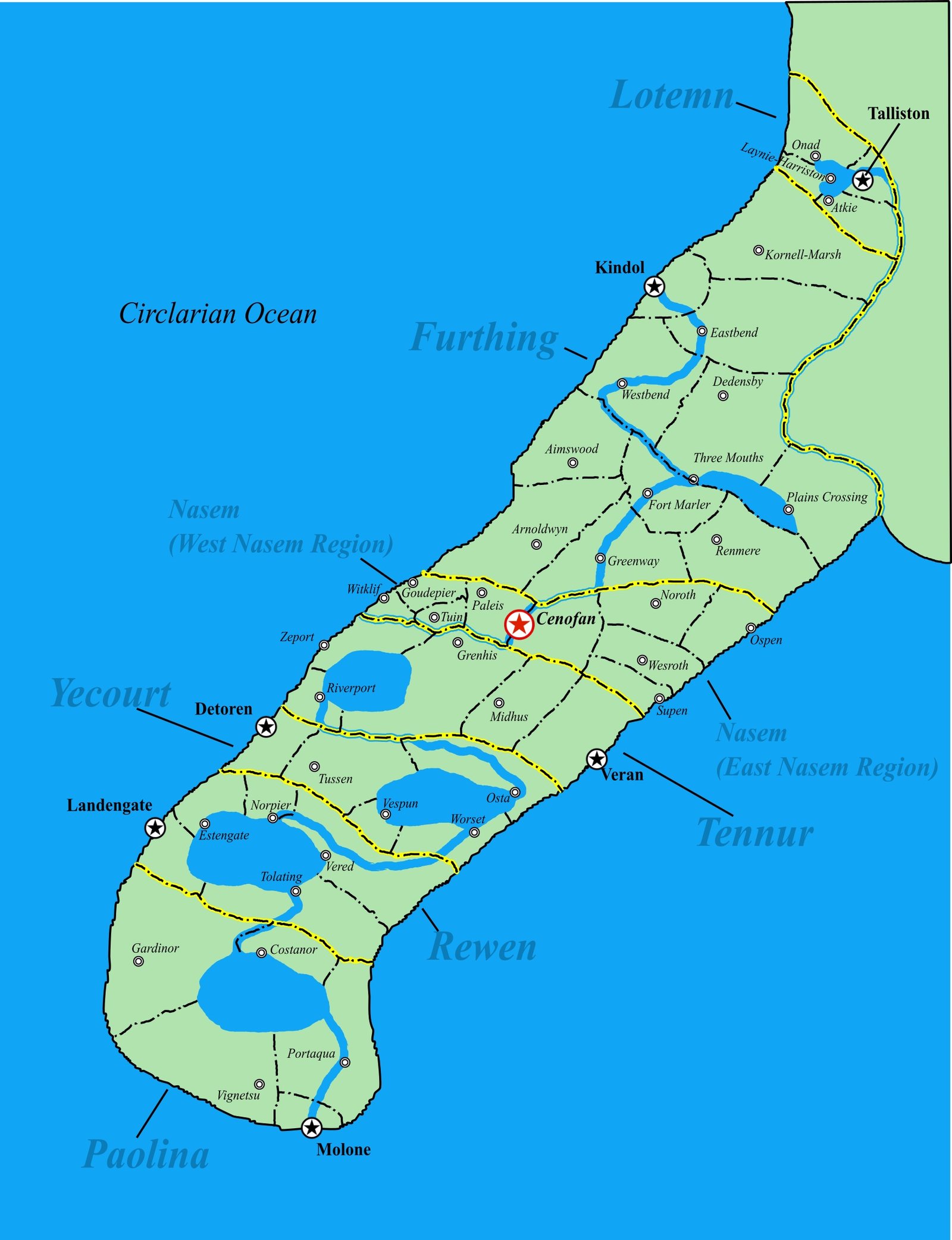
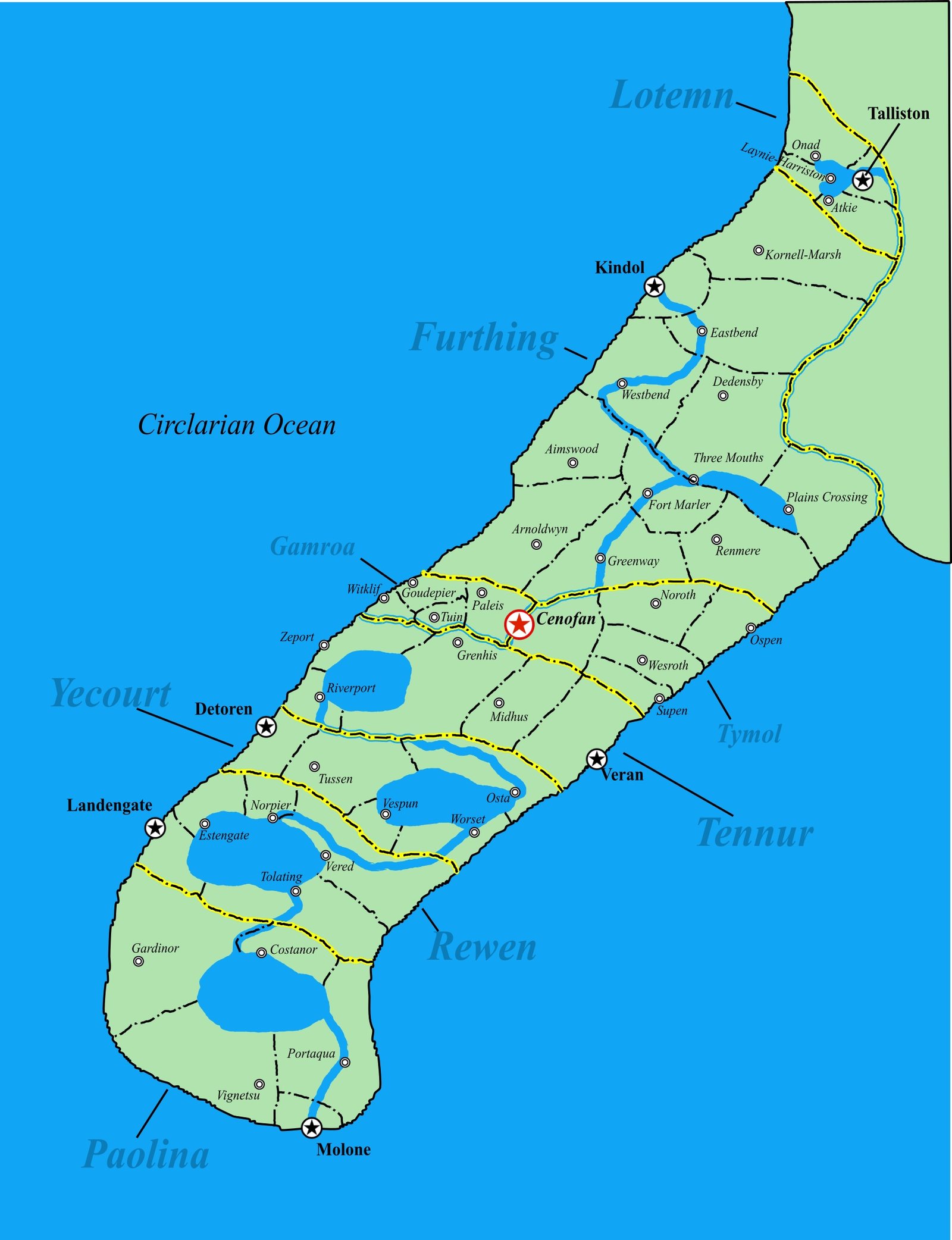
Before 1091
Before 1091, Nasem stood as a constitutional monarchy.
Throughout the 1000s, the Kingdom of Nasem served the Canticulan economy as a trading and retail crossroads, with the remaining West Peninsula Kingdoms to the South and the Great Northern trading bloc to the North. In the 1070s, after losing its war with the territories of Hobland, the Kingdom of the Great North was hit with an embargo on its most precious resource: blue-diamond coalsands. Thus, trade with the Great Northern bloc collapsed, triggering hardship in Nasem.
1079 to 1090
Such was the situation when King Robert II inherited the Nasemian Throne in 1079. Immediately upon taking the Throne, King Robert II suspended Nasemian Parliament and ordered the Royal Treasury to write stimulus checks to businesses hit hard by the collapse. This resulted in a significant improvement to the economy early on. However, such improvement was short-lived when, by the end of 1080, it became abundantly clear that the collapse of the Great Northern trading bloc was too much of an adverse economic force. Furthermore, the Royal Treasury was now under considerable financial strain. In 1081, in order to compensate for this as well as provided further cash stimuli to impacted businesses, King Robert II imposed an increase to worker wage taxes. By 1083, the economy regained stability; however, these businesses began to merge, engaging in legally grey methods of wealth attainment. Between 1084 and 1085, they lobbied Parliament into passing more tax increases.
The working classes, as a result, began to speculate whether or not these tax increases were simply a legal means for bankers and business owners to exploit wealth from them. Initially, the taxes were designed to provide cash bailouts to struggling trading companies. These were voted in by Parliament and signed by the King, who authorized such payments to come from the Royal Treasury. But there stood no regulation on how businesses could request such payments or what reasons were deemed legitimate. This, the business owners and bankers began exploiting; and the Crown, itself, was also a beneficiary.
Matters were made worse when King Robert II signed the infamous Gate Passage Tax, which charged each commuter or traveler between Counties within the Kingdom a tax of 25 silver credits per crossing. The population was initially divided at this time between the Royalists and anti-Royalists, but it was this tax that began to sow solidarity. Over the years that followed, it became apparent that an inner circle was present between the Crown, business owners, and bankers over the stimulus checks. Those within this inner circle were granted payments regardless of reason while outsiders and small businesses were almost always denied them. Popular contempt emerged, to which the Crown responded, in 1088, with the introduction of a program for regular inter-County commuters where a traveler could purchase membership at 250 silver credits per year to travel in one of a network of special horse-drawn carriages or trains to cross County lines without being charged the Tax. Many felt slighted by this compromise, however, and began coming together more often in solidarity against the Crown.
Thus, street protests began to emerge to which King Robert II responded with the dispatch of a martial law task force, supported by agents from the Kingdom of the Great North. However, since the 1070s, due to the ensuing collapses in trade, the Great North had been making budget and program cutbacks on its martial law assistance. Whereas they had been more brutal in the past, during the Nasem protests of October 1089, they simply cordoned protestors into designated city blocks and only gave verbal curfews, only arresting those acting the most extreme. King Robert II wrote the Great Northern Crown for more assistance but the Great North stated only that they would give the assistance "further consideration in the near future." Later that month, they sent King Robert II another letter announcing that they were making a complete withdrawal. The unrest in Nasem had only been growing in recent years, leading to an increase, for the Great North, in resource costs as well as recruitment costs amidst the mounting casualties. Furthermore, the Great Northern Treasury had also promised to make investments in the hubstone industry, which stood to resolve the ensuing energy crisis. Under strain, the Treasury would pay for the hubstone investments with the elimination of martial law overseas assistance programs.
In March 1090, Tom Johnson, a Furthish journalist, appealed to the Furthish Royalist population in consolation over saddening news of Furthing existing as an incumbent-appointed presidential council (IAPC) rather than as a Kingdom, reasoning how Furthing did not need a King or Queen. This rationale was viewed very differently by the population of Nasem; for Tom Johnson's statements were made public right as King Robert II raised wage taxes to pay for a new mercenary martial law force acting in place of the Great North. Many Nasemians, at this time, began calling for Robert II's abdication and the complete abolition of the Crown.
On 16 May 1090, Tedrick Payne won the election for Prime Minister of Nasem, having run as a liberal candidate. Riding upon the sentiment propagated by Tom Johnson, Payne initially promised to lead effort to abolish the Nasemian Crown. However, upon taking office, Payne rolled back on his promise, vowing instead to protect both the Crown and his party from the "far-left."
Meanwhile, in September 1090, King Robert II signed for yet another increase in worker wage taxes. Union leaders from multiple industries reacted to this by coming forward and demanding negotiations with the Crown for a roll back on such increases. The Crown responded by repeatedly agreeing to a given meeting time followed by calling off the meeting shortly before it was scheduled to occur.
In March 1091, King Robert II increased worker wage taxes again. This time, he submitted to calls by union leaders for negotiations. However, during these meetings, the Crown stated that they were only open to tax rollbacks to the levels enacted in September 1090, and that they were not going to negotiate any other terms.
Amelioration Movement: 1091-93
In response to this, the union leaders, in late March 1091, called for a general strike. This began on 18 April 1091, the general strike began, to which the Crown responded by dispatching its mercenary martial law task force in an attempt to keep order. However, this was overcome by a striker-backed militia. On 21 April, the strikers pushed past barricades and stormed the Royal Palace and Parliament Hall, where the union leaders announced that they had the keys to the King's Personal Quarters and threatened to storm them if the King did not abdicate by May 1. The King, initially, refused, leading to a standoff.
On 24 April 1091, just after 11:00 PM, Jaime Terryn, First Royal Secretary to the King, ascended the Podium in the Parliament Hall, where he stated that King Robert II intended to withdraw temporarily and open the Crown to negotiations. However, in delivering this statement, Terryn stated that the King rescinded, rather than recused, the Scepter, meaning that Terryn announced, unintentionally, that the King had abdicated. Terryn only realized his mistake when one of the union leaders declared that the request by the Crown for negotiations was invalid since the King had abdicated. Terryn attempted to call for the presses to be stopped in order to correct his blunder but it was too late to stop the momentum of communication. In salvaging peace, King Robert II followed through and formally abdicated while he and Terryn were allowed to relocate safely to Furthing. And in the early morning hours of 01 May 1091, the strikers occupied the remainder of the government buildings in Cenofan and proclaimed the nation of Nasem a Republic.
This moment had seismic implications throughout all of Canticula as it inspired similar movements abroad. On 04 November 1091, the nation of Paolina became a Republic in similar fashion. This was followed by the establishment of the Timemorian Republic on 14 November 1091, the Tennurian Republic in January 1092, the Yecourtian Republic in February 1092, the Rewenian Republic in March 1092, and the Josohnjonian and Ansohnjonian Republics in May 1092. Then came the establishment of the Republics of Morstrah, Neistreg, Chufsa, and Mykeni in October 1092. And in November 1092 emerged the Republics of Nancifra, Neehs, and Nashe.
In May 1092, the multiple democratic movements throughout Canticula united and formed the Rebirth Coalition, with an agenda to bring about democracy throughout all of Canticula. In June 1092, they attempted to bring down the IAPC government in Furthing. However, by September of that year, that agenda failed. And on 06 October 1092, Furthing and the Kingdom of the Great North signed a treaty to form the Restoration Coalition.
Coalition of Peace and Order
On 17 October 1092, the Restoration Coalition toppled the Republic of Nasem and re-established the nation as an IAPC. In February 1093, the Coalition gave consolation by working with the new government in Cenofan to establish a constitution in which the national government of Nasem would function as an IAPC while the nation was divided into two administrative Regions: East Nasem and West Nasem, each with its own democratically-elected government to function under the national IAPC government. West Nasem would be governed from West Cenofan while East Nasem would be governed from East Cenofan.
On the international stage, Nasem joined the Restoration Coalition and assisted in its agenda to replace the newly-established Republics in the Midland River region with IAPC governments. In response, the Republics South of Nasem formed the Coalition for Defense of Democracy, which existed within the Rebirth Coalition.
Fearing an actual war, the new government in Cenofan, on 11 February 1093, called for a Conference between all Canticulan nations, both within the Restoration Coalition and the Rebirth Coalition. Lotemn would decline to join the Conference, declaring their national agenda of peace through neutrality and non-alignment. All other Canticulan nations would join, however, as Conference talks began on March 2.
Such talks concluded on 19 April 1093 with the signing of all participating Canticulan nations into a new international organization: the Coalition of Peace and Order. Provisions within the agreements therein included the right for all West Peninsula nations South of Nasem to remain Republics without foreign intervention, an International Committee to meet on establishing peaceful international trading terms on a yearly basis, the removal of all tariffs between member nations, the complete repeal of the Crown Trade Act of 1012, and finally a compromise allowing the Restoration Coalition continue replacing the Midland River Republics with IAPC governments. Thus with the latter, Nashe and Neehs would be the last two Midland River States re-established as IAPCs by June 1093.
This marked the beginning of Pax Canticula. During this period, Furthing would trade mostly in the manufacturing, scriptfire, and hubstone industries; the Motanian Empire would trade in mineral resource extraction; Terrings and Sen would trade in lumber and logging; the Gyrosakian and Chokian Republics would trade in gold, silver, and copper; the Red Desert Federation and Five Eastern Coastal States would engage in general trade and retail; Lotemn would specialize in the trade and storage of firearms; the West Peninsula Republics South of Nasem would specialize in banking; and finally, the nation of Nasem would deal in modern engineering.
With the help of the Restoration Coalition, a one-time election was held among a voting population mostly of Gamroan landowners to elect the first President of Nasem, a position to be held by the candidate until retirement. Shortly before retirement, the President would appoint a successor through a semi-democratic process. To serve as the first President of Nasem, the electorate chose Gerald George.
President Gerald George - 1093 to 1124
President Gerald George, in 1093, repealed all forms of taxes to everyone except for the wealthiest ten percent of income earners. He also enacted the policies of Clean Air, Clean Water, Safe Food and Medicine, Safe Housing and Building Codes, Safe Transit, Standardized Communication Technology, Standardized Healthcare, and Standardized Education. That same year, he also commenced trade and diplomatic arrangements with the Remikran nation of Combria, primarily to trade in the hubstone industry. With resources and ideas imported from Combria, Nasem established a hubstone infrastructure of its own in 1094, being the first Canticulan nation to do so. Also established in 1094 was the Engineering and Technical School of Paleis. Between 1095 and 1096 saw the establishment of modern aviation infrastructure in Cenofan, Paleis, Tuin, Goudepier, Witklif, Noroth, Wesroth, Ospen, and Supen. These cities also saw the construction, between 1097 and 1098, of a new form of transit: the mesh train.
To help fund this and other future engineering projects to come, President George enacted the Appropriations Decree, which imposed land-estate taxes on properties greater than one acre based on 15 percent of its value. Though this would spark issues between the Gamroan and Tymish peoples many years later, the Appropriation Taxes were effective in producing the needed public funding.
Between 1100 and 1101, modern maritime infrastructure was established along the coasts of Nasem. And in 1102, Nasem established and signed with numerous Canticulan nations the International Development Initiative, which sought to develop land, sea, and air travel through hubstone technologies. Companies in Nasem led the development, and would profit from royalties in the years to come.
As its first significant international agenda, Nasem helped to establish hubstone infrastructure in the nations of Furthing and Lotemn between 1103 and 1104. This was followed, between 1105 and 1106, by the establishment of hubstone infrastructure in Tennur, Yecourt, Rewen, and Paolina as well as the establishment of modern aviation infrastructure in the Furthish Capital of Kindol and the Lotemnian Capital of Talliston. Between 1107 and 1108, modern aviation infrastructure was established throughout Furthing and Lotemn, while it was introduced in the Tennurian Capital of Veran, the Yecourtian Capital of Detoren, the Rewenian Capital of Landengate, and the Paolinian Capital of Molone. The years 1111 and 1112 saw the establishment of mesh train networks throughout Furthing and Lotemn and its introduction in the aforementioned capitals of Tennur, Yecourt, Rewen, and Paolina. Such mesh train networks in these four Republics would expand nationwide while modern maritime infrastructure would emerge in Furthing and Lotemn between 1113 and 1114. Modern maritime infrastructure would spread to Tennur, Yecourt, Rewen, and Paolina by 1118. And between 1119 and 1120 emerged hubstone infrastructure in Sen.
Furthing would develop its hubstone industry better than most, modernizing at such a rate as Furthing would begin to grow into a dominant power over the Circlarian Ocean. As a result, Furthing's hubstone industry, by 1121, surpassed that of Nasem and even Combria. Meanwhile, modern aviation infrastructure was introduced into Sen in 1121, and, by 1124, became nationwide infrastructure here.
Retirement of President Gerald George, Transfer of Power to President Simon Brandt
As previously mentioned, the nation of Nasem was divided into two Regions: West Nasem and East Nasem, governed from West Cenofan and East Cenofan respectively. In West Nasem stood the County of Paleis, County of Tuin, County of Goudepier, and County of Witklif, each with five Boroughs. In East Nasem stood the County of East Cenofan, County of Noroth, County of Wesroth, County of Supen, and County of Ospen, each also with five Boroughs.
West and East Nasem each functioned as a democratic government under the IAPC national government in Cenofan proper. And under Region was established, through President Gerald George via the appoint of the first incumbents, a six-year election cycle to begin in the year 1095. Boroughs would run their elections on the second year of said cycle, Counties on the fourth year, and the Regions of East and West Nasem on the sixth year. Each winning candidate, therefore, would serve a six-year term; though each was permitted to run for re-election to additional terms, on which there was no limit.
The first Governors of East and West Nasem were nominated by President George in 1093 to serve until the year 1099, after which succession would be determined by the election by their constituents that year. Each first Governor would, in the same fashion, appoint candidates to the seats of Regional Council to serve until the election year 1099, as well as candidates to the County Commissioner roles to serve until the election year 1097. Each first County Commissioner would appoint members to the respective County Council to serve until election year 1097 as well as members to respective Borough Magistrates to serve until the election year 1095. Finally, each first Borough Magistrate appointed candidates to Borough Council seats to serve until the election year in 1095. Under the tenure of President Gerald George, the election calendar ran as follows: Borough Elections on 15 May of the years 1095, 1101, 1107, 1113, and 1119; County Elections on 15 May of the years 1097, 1103, 1109, 1115, and 1121; and Regional Elections on 15 May of the years 1099, 1105, 1111, 1117, and 1123. To note, these election years consist only of the ones to have occurred before Gerald George's retirement, after which the election cycle would be reset by the next President per constitutional protocol.
During this time, there emerged four main political parties: two serving the Region of West Nasem and two serving East Nasem. Established in West Cenofan in February 1101 was the first political party of these four: the Labor Party of Nasem, campaigning as a moderate-liberal party in West Nasemian elections with core ideals calling for better worker pay, better working conditions, lower consumer prices, prioritization of basic needs in public spending, and environmental cleanliness. Next came the Traditional Party of Nasem, established in East Cenofan in April 1103 to campaign as a moderate-conservative party in East Nasemian elections with core ideals calling for the preservation of current economic and social conditions. To note, the Traditional Party would be informally referred to by the population as the "Frozen Party" owing to its tendency to have its incumbents frequently oppose measures of change in favor of preserving the status quo. Established in Witklif in January 1107 to campaign as a nationalist party (and later a far-right conservative party) was the National Party of Nasem, nominating candidates to West Nasemian offices upon core ideals of the prioritization of national defense, putting forward laws governing personal and social conduct such as dating and personal appearance, and putting forward laws facilitating global trade between the business owners of Nasem and those from other allied nations. Finally, established in Noroth in March 1108 was the far-left-liberal Equality Party of Nasem, aiming to fill East Nasemian roles upon ideals involving the expansion of rights to all workers, the addressing of lingering racial barriers against the Tymish peoples, expanding the rights of the Nasemian Darkfire Community, and the push to provide free public transit for all.
On 03 June 1122, President Gerald George announced his retirement from the Nasemian Presidency, scheduled to take effect on 02 January 1124. In preparation for a smooth transfer of power, the Nasemian government called for Presidential Candidate Elections, to produce one candidate each from West Nasem and East Nasem, to take place on 15 May 1123. Shortly thereafter, President George would nominate one of the candidates as his successor.
On 15 May 1123, the elections were held as scheduled, resulting in a winning candidate, Simon Brandt, from West Nasem having run on the National Party ticket with 60 percent of the vote, on the promise to expand international trade through a policy known as the Open Market Initiative; and winning candidate, Madame Gerya Melnor, from East Nasem having run on the Traditional Party ticket with 51 percent of the vote, on the promise to maintain the social and economic conditions achieved under President George.
On 19 May 1123, having determined that the Open Market Initiative was better for the economy, President George nominated Simon Brandt to be his successor, with such transfer of power scheduled to occur on 02 January 1124. The general population of Nasem responded with relative indifference owing to the overall comfortable living and economic standards.
President Simon Brandt - 1124 to 1150
All persons serving Borough, County, and Regional government offices under President George were, on 02 January 1124, scheduled by constitutional protocol to commence early retirement. And upon taking office, the new President, Simon Brandt, nominated the first candidates to serve the Regional Governor seats of East and West Nasem, beginning the cascading government appointments similar to the process in the beginning of former President George's tenure in 1093. Thus, the election schedule was established as follows: Borough Elections to be held in the years 1126, 1132, 1138, and 1144; County Elections to be held in the years 1128, 1134, 1140, and 1146; and Regional Elections to be held in the years 1130, 1136, 1142, and 1148.
President Brandt would sign measures providing business grants to prospective entrepreneurs as well as to open negotiations for increase in trade with Combria and, controversially, Wannonia.
Meanwhile, under Brandt's tenure, the international engineering projects led by Nasem would continue. Between 1125 and 1126, a mesh train line was extended to Floport, Sen; and by 1128, Sen was home to its own nationwide mesh train network. By 1132, the coasts of Sen all had modern maritime infrastructure. Between 1133 and 1134, hubstone infrastructure was built in the Chokian Republic, which would have its own modern aviation infrastructure by 1138, its own mesh train network by 1140, and modern maritime infrastructure along its coastlines by 1142. Nasemian companies would next consult with the nation of Terrings, where there was completed hubstone infrastructure by 1144, modern aviation infrastructure by 1148, and a mesh train network by 1150.
On 03 June 1148, Simon Brandt announced his retirement from the Nasemian Presidency, scheduled to take effect on 02 January 1150. Per constitutional protocol, the Nasemian government called for Presidential Candidate elections to occur on 15 May 1149. These elections would nominate Bethany Renmore of the Labor Party, having won 65 percent of the vote in West Nasem after campaigning on the notion of establishing trade initiatives for ordinary working class citizens; and Gordon Hariet of the Traditional Party, having won 51 percent of the vote in East Nasem after campaigning on the notion of preserving the social and economic conditions achieved under Simon Brandt.
On 19 May 1149, to satisfy popular pressure despite insistence from lobbyists, President Brandt nominated Bethany Renmore to succeed him on 02 January 1150. To this the general population of Nasem responded with overall optimism.
President Bethany Renmore - 1150 to 1197
As with the beginning of Brandt's tenure, all office-holders in the Regional, County, and Borough governments, per constitutional protocol, accepted early retirement. To the Regional Governor seats of West and East Nasem, Renmore appointed candidates to serve until said seats were up for election in 1156. Thus, the hierarchical cascade of role appoints began again to form the new government of Nasem. And the new election schedule would be set as follows: Borough Elections to occur on 15 May of the years 1152, 1158, 1164, 1170, 1176, 1182, 1188, and 1194; County Elections in the years 1154, 1160, 1166, 1172, 1178, 1184, 1190, and 1196; and Regional Elections in 1156, 1162, 1168, 1174, 1180, 1186, and 1192.
President Bethany Renmore would begin her tenure by signing policies to establish working class trade opportunities between Nasem and Remikra nations, expand this trade agenda to the Midland River States as well as the Motanian Empire, and to establish consistent trading arrangements with maritime states. By 1152, under Renmore's administration, modern maritime infrastructure was established along the coasts of Terrings. This was followed, in 1154, by the establishment of hubstone infrastructure in Timemora. By 1156, hubstone infrastructure was established in Josohnjon and Ansohnjon while modern aviation infrastructure was established in Timemora. The year 1158 saw the completion of hubstone infrastructure in Neistreg, Chufsa, and Mykeni; the completion of modern aviation infrastructure in Josohnjon and Ansohnjon; and the completion of a connected mesh train network throughout Timemora. The year 1160 saw the completion of hubstone infrastructure in Morstrah, Neehs, Nancifra, and Nashe; the completion of modern aviation infrastructure throughout Neistreg, Chufsa, and Mykeni; the completion of a connected mesh train network in Josohnjon and Ansohnjon; and the completion of modern maritime infrastructure along the coasts of Timemora. The year 1162 saw the completion of modern aviation infrastructure throughout Morstrah, Neehs, Nancifra, and Nashe; the completion of a connected mesh train network throughout Neistreg, Chufsa, and Mykeni; and the completion of modern maritime infrastructure along the Midland River Coasts of Josohnjon and Ansohnjon. And the year 1164 saw the completion of a connected mesh train network throughout Morstrah, Neehs, Nancifra, and Nashe; and a completed modern maritime infrastructure along the coasts of Morstrah, Neehs, Nancifra, and Nashe.
This was followed by the completion of modern maritime infrastructure along the coasts of Morstrah, Neehs, Nancifra, and Nashe in 1166; and a mesh train network built to connect the nations of Sen and Terrings in 1168.
In March 1169, Nasem began construction for a mesh rail to connect the mesh train network of Terrings to that of the Chokian Republic and that of the Midland River States. In May 1169, Nasem began negotiating with the Motanian Empire for the possible establishment of a mesh train network in its Northeast Canticula Territories beginning in 1171. The agenda here would be to eventually build modern infrastructure between this region down to Prove. Lastly, Nasem sought to have modern infrastructure constructed throughout the Red Desert Federation.
Such expansion agendas were interrupted, however, with the sabotage and obliteration of the Furthish Merchant Marines by an enemy sea guild coalition in June 1169. This triggered an economic downturn that affected both Furthing and Nasem. Between 1171 and 1172, the Nasemian government expanded its welfare and emergency housing programs to address the growing number of people affected by the ensuing downturn. Facing financial strains and mounting public debt, the Nasemian government, between 1173 and 1174, sold its mesh train networks to the local national governments of the Midland River States. This was followed by a similar transaction of the mesh rail networks to the Chokian Republic between 1175 and 1176, the mesh rail networks to Terrings between 1177 and 1178, the mesh rail networks to Sen between 1179 and 1180, and the mesh rail networks to Tennur, Yecourt, Rewen, and Paolina between 1181 and 1182.
Also stemming from economic hardships was another issue: racism between the Gamroan and Tymish peoples, triggered by a large number of welfare recipients being of Tymish descent as well as an increase in taxes on predominantly Gamroan-held land estates under the Appropriations Act signed by former President Gerald George. Before the 970s CE, the ownership of Tymish people as slaves by the dominating Gamroan ethnic group was commonplace in the Kingdom of Nasem. In the 970s, Edoran Kingdom gained all territories of Furthing after a war with them. And by this time, the Edoran Kingdom had long established constitutional provisions for basic civil rights as well as had a law against slavery since its foundation in the beginning of the Common Era. Thus, not long after, representatives from the Edoran Kingdom succeeded in having the Crown of Nasem abolish slavery. In 1061, the Crown of Nasem expanded upon equal rights for the oppressed Tymish by instilling the Racial and Civil Equality Act, which deemed the Tymish people as Nasemian citizens with full rights and in equal standing to the Gamroans. So it seemed from that point forward that racism against the Tymish population had been eradicated. However, lingering racism grew during the economic hardships of the 1170s, and manifested itself in 1177 with the enactment of a law in the County of Witklif allowing the open discrimination by Gamroan businesses against Tymish employees and clients. This was primarily backed by the Legion of Gamroa, an ultra-nationalist organization established in Witklif in the year 1173. In 1178, a class action lawsuit filed against Witklif by a large group of Tymish Community members alleged that the County was violating the Racial and Civil Equality Act. Counter to this, representatives of the County of Witklif alleged that the implementation of the Act upon local businesses was a violation of free speech, a core constitutional provision. Within the timeline of this lawsuit, Witklif was joined by the Counties of Tuin and Goudepier, who expanded on the narrative by insisting that businesses throughout the entire nation of Nasem should be allowed, under the free speech provision, to engage in such discrimination. President Bethany Renmore directed this to be heard by the Grand Arbitrators in Cenofan, who later ruled that the interpretation of the free speech provision versus discrimination protections should be arbitrary to the power of the Regional governments of West Nasem and East Nasem. West Nasem would allow its Counties similar arbitration while East Nasem, in 1179, enacted a Region-wide ban on such discriminations in respect to the Act of 1061.
In the same year 1179, the government of West Nasem, in spite of opposition from both East and West Nasem, allowed its Counties to enact laws allowing business discrimination against the Tymish. The Counties of Tuin and Goudepier followed the precedent set by Witklif and allowed such discrimination while the three involved Counties began lobbying pressure upon the County Government of Paleis to enact similar legislation; though Paleis refused to follow through. In 1180, the Counties of Witklif, Tuin, and Goudepier responded by initiating a dispute against Paleis under West Nasemian Arbitration, who ruled that laws forcing businesses to accept Tymish clients and employees was a violation of free speech. Stunning even supporters of the Witklif-Tuin-Goudepier coalition, the government of West Nasem, shortly afterward, enacted a law banning businesses from accepting Tymish clients and employees. In 1181, the Tymish Community initiated a dispute to the Grand Arbitration in Cenofan proper, alleging that the ban against them imposed by the government of West Nasem was in violation of their equal protections under the Act of 1061. Both Renmore and the Grand Arbitration ruled that West Nasem had a right to impose such a ban if its constituents demonstrated, in a legitimate poll, a clear majority in favor of such a ban. The poll was carried out not long after, yielding a large representative majority in favor of the ban, though later experts have disputed its legitimacy.
Aside from such social issues, matters began to improve for Nasem in 1182 when House Esary, seated in the East Hoblandish nation of Notulfa, gave a major package of economic aid to the Nasemian and Furthish economies. With these additional funds, Nasem renovated its mesh train network between 1183 and 1184, and then renovated the mesh train networks of Furthing and Lotemn between 1185 and 1186. Nasem then re-purchased the networks of Tennur, Yecourt, Rewen, and Paolina between 1187 and 1188. This was followed by the re-purchase of the mesh rail networks of Sen between 1189-90, the mesh train networks of Terrings between 1191 and 1192, the mesh train networks of the Chokian Republic between 1193 and 1194, and the mesh train networks of the Midland River States between 1195 and 1196.
This rebound, however, was overshadowed by the continued escalating tensions between the Gamroans and Tymish. In 1182, the government in West Cenofan enacted a new law, this time banning people of Tymish descent from working jobs anywhere in the jurisdiction of West Nasem. Another class-action suit by the Tymish Community was brought to Cenofan proper in 1183 over this, but the national government, once again refused to act against West Nasemian discrimination. In response, the government in East Cenofan, in 1184, enacted a similar law of discrimination against Gamroans from businesses and workplaces throughout East Nasem, with a repeal conditional only upon the repeal of the law in the West.
West Cenofan responded, instead, with a law enacted in 1185 to ban Tymish students from attending any school in West Nasem, including the Engineering and Technical School of Paleis. In 1186, East Cenofan responded with a similar law against Gamroan students in East Nasem. In 1187, West Nasem banned Tymish individuals from hospitals and healthcare facilities. President Renmore's Administration in Cenofan proper refused to address this, prompting protests and unrest by the Tymish Community in Cenofan's streets. Renmore responded with the dispatch of City Watch forces to quell the unrest while the President made a promise to consider a Tymish candidate as her successor come her retirement.
In 1188, West Nasem banned Tymish individuals from attaining and maintaining any form of residential housing in its jurisdictions, evicting even those Tymish individuals who had lived in the West for years. In 1189, East Nasem retaliated with a ban on all Gamroan individuals from both healthcare and housing, and furthermore established a special police agency to enforce this. West Nasem condemned this move and, in 1190, enacted a ban on all Tymish individuals from entering the Region of West Nasem for any reason. East Nasem retaliated with a similar ban against all Gamroans from travel to the East for any reason, upgrading its special police force to a para-military program. In 1192, the government in West Cenofan ordered Nasemian National Guard units within its borders to fortify its borders with East Nasem to "counter the mounting threat posed by potential Tymish insurgents." This was followed, in 1193, by a call from the government in East Cenofan to put all of its Nasemian National Guard reserves stationed throughout every County in East Nasem to report for "active standby." The West responded in 1194 with the preparation of its National Guard reserves in similar fashion.
1195-96
Tensions between East and West Nasem broke on 02 May 1195, when Tymish and Gamroan forces clashed in a two-hour battle in the streets of Northrange, a small town near the East-West border just North of Cenofan, resulting in 65 fatalities. President Renmore condemned the act and initiated peace talks between the two sides, which resulted in a cease-fire agreement on May 17. Shortly afterward, Renmore announced her retirement from the Presidency to take effect on 02 January 1197 and renewed her promise to consider a Tymish candidate as her successor. The Gamroan Community retaliated against this promise, in June 1195, with protests and rallies in Cenofan proper. These turned violent and warranted a call by Renmore to dispatch martial law forces to restore order.
Per constitutional protocol, an election was held on 15 May 1196 to appoint a candidate from East Nasem and a candidate from West Nasem for the Presidency. From the East came Xandria Tommens, a candidate of Tymish descent representing the Equality Party, having campaigned on the promise to grant equal protections for Tymish individuals as well as individuals of all other races, diversity quotas in businesses and organizations, the complete disarmament of regional forces in both East and West, and finally a vow to do the opposite and declare war on the West should the Nasemian Presidency be succeeded by Tommen's rival: Arnold Blayne.
Arnold Blayne, a candidate of Gamroan descent representing the National Party, campaigned on the promise to extend, nationwide, the policies in the West against the Tymish, to enforce such policies through the Nasemian Military, to disarm the Tymish people, to place all Tymish individuals into labor camps while imposing internal passports on them, and a vow to declare war on the East should Tommens succeed the Nasemian Presidency.
Despite Tommens having earned over twice as many votes as Blayne, President Renmore cited controversial matters to resolve in Office regarding the final nomination and announced that she had no choice but to wait until a later date than usual to announce her decision.
1197
It was not until 02 January 1197, the day of her scheduled retirement, that President Bethany Renmore announced her final decision on her successor: Arnold Blayne, scheduled to take office on 04 January instead. Renmore reasoned that despite Tommens' popular ideas, Blayne was the one most capable of preserving order and stability across the nation. This sparked outrage from the Tymish Community, who alleged that Renmore had betrayed them. Riots broke out in Cenofan proper to which Renmore responded by dispatching the National Guard, who fatally shot three protestors. On 03 January, Tommens, acting upon her promise and citing Renmore's National Guard dispatch as an act of war, commanded East Nasemian military forces to launch from concealed locations and overtake the State House in Cenofan proper as well as the State House of West Cenofan. This they achieved by that very evening. Renmore resigned effective immediately from the Presidency and sought asylum in Furthing. Arnold Blayne condemned the act and afterward assumed the Presidency of Nasem, declaring war on the Tymish insurgents of East Nasem and deeming the ceasefire of May 1195 to be null and void. Blayne and his forces re-located to the County of Tuin, establishing it as a government seat.
Thus, 03 January 1197 marked the beginning of the Nasemian Civil War.
The Fall of Nasem
Constant fighting dominated the city of Cenofan and the communities lining the border between East and West Nasem between January and February 1197, during which the constant exchanges of bullets and missiles constituted a stalemate as casualties mounted on both sides.
On 03 March 1197, under Arnold Blayne's command from Tuin, West Nasem launched a major air and land offensive into Cenofan. By 04 March, West Nasem overtook West, Central, and East Cenofan. On April 5, Xandria Tommens commanded East Nasemian forces to launch a counter-offensive, which recaptured East, Central, and West Cenofan. On May 16, West Nasem re-captured West and Central Cenofan, and attempted to re-take East Cenofan; though Tommens' forces would ultimately hold the latter. And on September 2, East Nasem took Cenofan proper while Blayne's forces continued to hold West Cenofan.
For the remainder of 1197, stalemate fighting ensued while Arnold Blayne sent envoys to Furthing and the Great North to as for provisions, to which the two nations obliged. On 03 March 1198, in celebration of the one-year anniversary of the previous year's offensive but now with aid from the two allies, Blayne launched an offensive which captured West, Central, and East Cenofan. On March 4, West Nasem captured the County and Town of Wesroth, driving a wedge in Tommens' forces. On March 7, Blayne's forces overtook the Counties and Towns of Noroth and Supen, driving Tommens' forces to Ospen where they held their ground. On March 18, Tommens' forces pushed back and successfully re-captured Wesroth and East Cenofan, driving a wedge in Blayne's forces in the same fashion that Blayne's had done to Tommens' forces back on March 4. On March 21, Tommens' forces attempted to re-gain Supen and Noroth. Noroth fell easily back under East Nasemian control, which bore a significance as this was where the Equality Party had been founded more than 80 years previously. Blayne's forces, however, held their ground in Supen; furthermore, they launched a surprise attack and captured Ospen. On April 2, Blayne's forces moved to re-capture the recently-lost territory in East Nasem, successfully re-gaining Wesroth, East Cenofan, and nearly all of Noroth County. Tommens' forces, however, managed to keep Blayne's forces out of the Town of Noroth as well as out of the Northerly Borough between Noroth and the Furthish border. Though Furthing was in alliance with Blayne, the Southerly Counties of Furthing were friendlier to East Nasem and facilitated a critical supply route through here. This helped to create a new stalemate in the conflict while both sides volleyed relentlessly with missiles and bullets. Meanwhile, an underground movement was established to help Tymish civilians escape the war-torn nation.
On 03 May 1199, Arnold Blayne was overthrown and executed in an internal coup led by second-in-command Maryk Vaughn, who had a concise plan to overtake Noroth and finish off Tommens' forces. On May 7, seeing Blayne's removal as a cause for division within the enemy, Tommens commanded an offensive that re-captured the remainder of Noroth County and re-gained the Counties and Towns of Wesroth, Ospen, and Supen. West Nasemian forces, meanwhile, would continue to hold their ground in East Cenofan. Between May 8 and September 2, Tommens collaborated with the Chokian Republic and Midland River States for aid, to which the two regions obliged. And on September 3, with this new backing, Tommens commanded another offensive, this time capturing the remainder of East Nasem, all of Cenofan, and the West Nasemian Counties of Paleis and Goudepier. West Nasemian forces held their ground in Tuin and Witklif, for Tuin was the stronghold for West Nasem's provisional government while Witklif was home to the seat of the Legion of Gamroa.
Xandria Tommens, many years previously, was a student at the Engineering and Technical School of Paleis. However, over a questionable matter of academic dishonesty, Tommens had been expelled from the School, leading her to developing a slight against the institution over the years that followed. During the September 1199 offensive, Tommens projected this slight, justifying that the School was a stronghold for Gamroan racism against the Tymish; Tommens, herself, was Tymish. Succeeding in instilling into her forces a patriotic cause for the Tymish people, Tommens commanded them to brutally assault the Campus between September 3 and 9. This prompted condemnation from her Cabinet of Officers, who initiated an investigation against her and discovered the details of the aforementioned expulsion case. On September 14, deeming that she was exploiting the use of military forces for personal interest, the Cabinet unanimously voted to dishonorably discharge Tommens as Head Commander.
On 18 September 1199, seeing a weakness in East Nasemian forces over Tommens' untimely discharge, Maryk Vaughn commanded West Nasemian forces to launch an offensive which successfully captured Paleis, driving the remaining East Nasemian forces to Goudepier, and capturing the East Nasemian Counties of East Cenofan, Wesroth, Supen, and Ospen. On September 23, Verylin Cormer was elected by the Cabinet of Officers to be the new Head Commander of East Nasemian forces. On October 2, Cormer launched a counter-offensive, re-capturing all of East Nasem plus the West Nasemian County of Paleis. As a result, a clear and safe route of travel was established for the East Nasemians in Goudepier, who had been facing brutal persecution by invading West Nasemian guerillas. This, in addition to the overall lowering of morale over Tommens' discharge, led many East Nasemians to desert their posts, going either to Noroth or to seek refuge abroad. On October 9, seeing a resulting weakness in the East Nasemian forces station in Paleis and Goudepier, Vaughn launched another offensive, driving Cormer's forces out of all of West Nasem as well as out of East Cenofan and Wesroth Counties. On October 20, Cormer retaliated with an offensive pushing Vaughn's forces out of East Nasem and Paleis County. On November 19, Vaughn launched an offensive which re-captured Paleis and East Cenofan Counties. During this offensive, Vaughn's forces attempted to re-capture Wesroth and Noroth. However, Cormer's forces, fighting more intensely with continuing aid from the Chokian Republic and Midland River States, held their ground. As a stalemate ensued, Vaughn called upon Furthing and the Great North for additional aid.
Between November 20 and 24 calls of concern from a growing number of experts abroad, who feared that the Nasemian Civil War, with both sides receiving aid from allied foreign nations, would escalate into a regional conflict, or even a global one. During this time, they met in an informal Conference held in Tandeiyah; but every solution proposed here would hit an impasse for one reason or another.
On 02 December 1199, however, House Esary, seated in the East Hoblandish nation of Notulfa, intervened to put an end to the conflict in Nasem. That day, Cixela Esary I arrived in Cenofan, where she implemented an oathcrafting measure known as a "Word of Mouth Speech," which emotionally swayed military commanders on both sides into ending the conflict. Such a decision was deemed controversial, for since the foundation of the Congress of Circlaria it had been against international law throughout the Circlarian Realm for a government head of state to engage in any form of spellfire-crafting. However, the Congress of Circlaria Adjudicators deemed Cixela Esary to not be an official head of state and, furthermore, her spellcrafter deed necessary to prevent regional escalations. Regardless, the War in Nasem was ended.
On 03 December 1199, peace talks began with the leaders of both East and West Nasem. By 13 December, all sides agreed to the following terms: that the city of Cenofan be demilitarized and its jurisdiction split between West Cenofan and East Cenofan while maps would be allowed to label the area as simply Cenofan for informal reference purposes; that a concrete wall would surround the entire city of Cenofan in order to enforce demilitarization, while only a line boundary existed between East and West; that a concrete wall and fence mark the border between East and West Nasem outside the city; and that such terms would go in effect on 02 January 1200, to expire on 02 January 1400.
Meanwhile, West Nasem would be established as the Independent Republic of Gamroa, governed from West Cenofan; while East Nasem would be established as the Independent Republic of Tymol, governed from East Cenofan.
Thus, the nation of Nasem ceased to exist.
Afterward
Between 1200 and 1267, the governments of Tymol and Gamroa would continue negotiating with one another in an ongoing agenda to pacify mutual relations, though would not yet achieve a level of consensus required by the terms signed on 13 December 1199 to dismantle the walls around Cenofan or the one dividing Gamroa from Tymol. In 1267, both nations would fall under occupation by the Lykian Republic, which would not lift until 1290.
In 1291, Tymol and Gamroa resumed talks during which they finally came to the consensus required to de-construct the walls. Such de-constructions began later that year and would see the walls gone by the end of 1293. The demilitarization zone and land boundaries would still be respected and enforced between the two nations until 02 January 1400. And since 02 January 1400, simple border crossing policy has been in effect.
Congress of Circlaria, commanded since the year 1489 by a radically conservative voting bloc, allegedly attempted to re-ignite tensions between the Gamroans and the Tymish. Thus far, however, diplomacy has prevailed between the two nations.