1279 to 1280 - Exploration and Settlement:
In the years before the major nations of Circlaria began exploring Ancondria, there emerged two groups constituting a Chokian Diaspora. The first group, having emerged during the peak years of the Kingdom of the Great North, was the Chokian Shipwrights, who sought to span the Magnumarian and Circlarian Oceans in pursuit of lucrative trades. Over the two centuries to follow, the Chokian Shipwrights would form independent sea guilds and maritime states. The second group, having emerged during the years of the Lykian Occupation, was the Chokian Voluntary Outcasts. Though Chokians, on the most part, were not nearly as oppressed by the Lykians as other demographics, they were still resentful of taxes and required demonstrations of loyalty toward the Lykian government. So they migrated out of the Chokian Republic, with some joining the aforementioned Shipwrights, and the others traveling as land nomads into Northern Canticulan lands.
Both the Shipwrights and the Voluntary Outcasts maintained close contact with each other other, developing one of the most durable webs of communication to exist before the arrival of the OCEA platforms. The two groups maintained a proud Chokian heritage, which drove them to expand and explore in order to not only survive, but thrive.
In March 1279, Lovel Ten, a seasoned Chokian Shipwright, landed in the Havenlands region of Northeast Ancondria, and made note of the exceptionally fertile soil there. Word of this discovery spread quickly among the Shipwrights and Voluntary Outcasts. And between April 1279 and December 1280, a major wave of migration occurred, as the two Chokian groups flocked to settle the Havenland territories. Before long, the Chokian settlers began having disputes with Ancondrian natives over lands already claimed. This was followed by disputes between Shipwrights and Voluntary Outcasts over the same matter; then similar disputes arose among parties within each group.
Before long, wealthier families from both groups resolved to travel inland to the Great Ancondrian Plateau and claim farms in the vast prairies. Everyone else spread out along the coasts, where, given there being less arable land, many settlers resorted to fishing and shrimping.
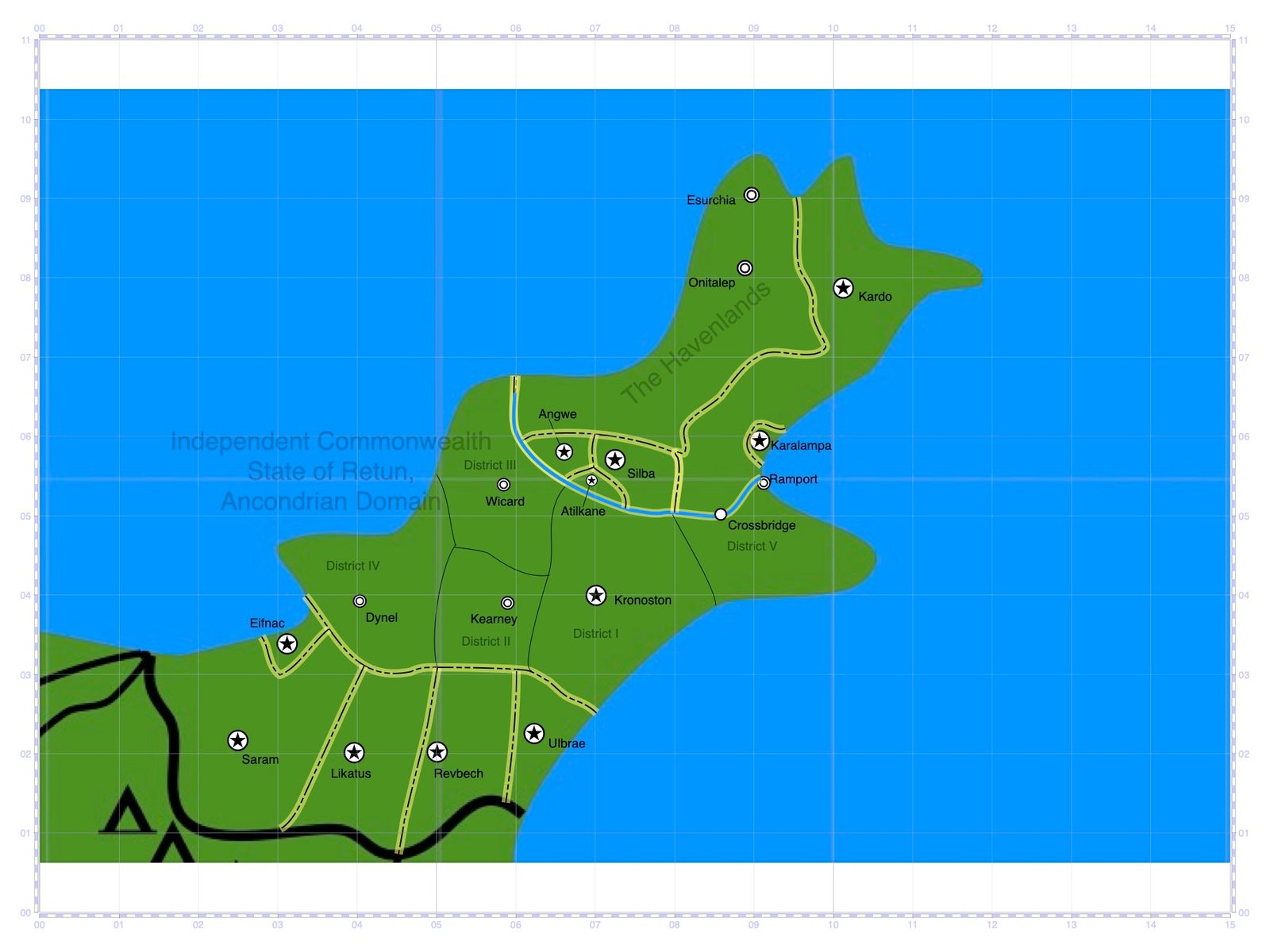
The most striking aspect of this discovery was Northeast Ancondria's geography. The Havenlands, as it would be named later on, was found to be part of an ancient crater to a super-volcano; most notably, the Havenlands existed in the form of "steps" down toward the shore, and was covered in fertile soil. Beyond the Havenlands stood the Great Ancondrian Plateau, with its top surface area 3000 feet above sea level, where the climate was mild year-round. Covering the relatively flat surface of the Plateau was Ancondrian Grass, which was found to provide up to 20 percent of the world's oxygen. Meanwhile, the surrounding coastlines, existing as a thin margin of territory around the edges of the Plateau, was home to a much more humid and tropical climate. Extending East from the Great Ancondrian Plateau was the Lesser Ancondrian Plateau, which would be home to District V of the Retunian Ancondrian Domain years later (and Minlon much later than that). Being lower in elevation than the Great Ancondrian Plateau, the Lesser Plateau had a warmer, more tropical climate.
Toward the center of Northeast Ancondria, the terrain rose dramatically into towering mountains, which received snow during the winter months (April thru September, as this region is in the Southern hemisphere). This mountainous region was home to the city of Silba, and would be home to the Ancondrian States of Angwe and Atilkane in the years to follow. Aside from this part, the Great Ancondrian Plateau extended Southwest until the drop-off down into the Edomian Region.
Most Chokian Shipwrights and Voluntary Outcasts who had decided to move inland concentrated mostly into those regions of the Great Ancondrian Plateau ranging from the Havenlands to the East Coast. In the middle of this northern part of this region emerged an agricultural trading stop, established as the city of Kardo. In December 1280, both the inland and coastal settlers gathered in Kardo, and voted to organize the surrounding territory as the nation of Kardo, named after the city. And on 12 January 1281, House Maderon signed an authorization to have Kardo recognized internationally as a democratic republic.
1281 to 1290 - Provisional Government:
Between 1281 and 1290, Kardo was under a provisional government structure, in which governors were elected over provinces and mayors were elected over municipalities. Each provincial governor would send representatives to the federal government in Kardo proper where they would all gather in an Assembly and pick the top three Governors to lead federal affairs.
In 1282, the Constitution of Kardo was ratified, in which the Assembly narrowly voted to remain as a unicameral body to pass laws and other measures, as the legislative branch of government. The executive branch of Kardo would be headed by a Governor-General, who would be elected every ten years on June 13 and be retained every fifth year of a ten-year term, also on June 13 of the said fifth year. For both occurrences, after the June 13 popular vote, the election would be certified by a majority vote of the Electoral Public Assembly (not the aforementioned legislative Assembly) on June 15. To note, this certification stage was the stage that counted.
Meanwhile, the judicial branch would be headed by a Superior Court, consisting of five Justices. This Court would preside over a hierarchy of provincial courts and municipal courts; and every level of this hierarchy would be accompanied by federal, provincial, and municipal arbitrators respectively.
It is important to note that during this period of Kardan history, the government was very small and de-centralized due to the predominantly libertarian beliefs of both the Shipwrights and Voluntary Outcasts, meaning that laws and politics were carried out mostly by local communities.
Remarkably, during this time, Kardo became one of the first nations in the world to develop a consistent gyroplane infrastructure. Though development occurred mostly in Canticula, Kardo would be one of two nations, the other being the Humerian Kingdom in faraway West Hobland, to adapt accordingly. Such a gyroplane system in the 1280s had its limits and risks; but Kardo would advance this industry in pace with everyone else in the coming years.
The nation of Kardo was, otherwise, deemed a "wild and lawless place" during the 1280s, which was a striking attribute when contrasted with the orderly, even pseudo-authoritarian, state that Kardo would be in years to come. The aforementioned early government of Kardo was small, meaning that there were no regulations when it came to property zoning; and law enforcement rested almost entirely upon the local communities. As a result, factional politics, disputes, and even outright feuds were the norm. However, this also provided an incentive for explorers to roam around the new nation for resources, leading to the discovery of vast reserves of gold and silver. Before long, scores of mines were dug and open for business.
This emerging market, though, gave rise to another issue: sea pirates. Since the peak years of the Great North, Chokian Shipwrights had consistently been targets for sea pirates, owing to the wealthy commodities that the Shipwrights frequently trafficked. When gold and silver emerged on Kardan markets, the Kardans initially traded with those other Shipwrights and Voluntary Outcasts who had chosen not to settle in Ancondria. Before long, pirates discovered the lucrative opportunity in early Kardo, and began attacking along Kardan coasts with exceptional ferocity. They even began attempting to make in-roads from the Havenlands, though this had little to no success.
In March 1286, Ruffnor, the leader of a Vandalian offshoot called the Bormeans, overtook the north coastal Kardan city of Kosepart, beginning the First Crisis of Kardo. He then led his forces in a sweep of terror up the Discovery River toward Kardo proper. In the city of Kardo, Derrick Calo, an honorable Kardan descended from the Shipwrights, summoned community leaders and local militias from across the nation, and promised payment to those who united under his leadership and pushed back against the Bormean invaders. Over the next couple weeks, Calo borrowed money from Silban banks and used such funds to buy advanced military gear from Silban vendors. On 24 March 1286, Calo ordered the deployment of naval, air, and land forces, who defeated the Bormeans and killed Ruffnor within hours. Afterward, Calo's united forces established themselves as the official Armed Forces of Kardo, beginning Kardo's federalization process.
Per the established Constitution, Kardo was scheduled to elect its first Governor-General in the year 1290, and then every ten years afterward. In 1290, a growing number of people called upon Derrick Calo, citing his heroic leadership efforts during the First Crisis, to run for this position. Calo, for the longest time, vowed to do everything in his power to ensure that there would be no political parties in the federal government. However, in 1289, some Kardans gathered to form the Conservative Party of Kardo. The drive for this came from the issue of Kardo owing debt to Silba from the First Crisis. Calo had been calling for donations to be made to the Kardo Treasury to help pay off this debt. However, numerous local communities refused to do so, adhering to their beliefs around de-centralization and freedom from taxes. As federalization laws were enacted, though, provincial and municipal governments volunteered to make such donations, and enacted mandatory taxes on its constituents. About 50 percent of these constituents yielded to the taxes while the other half voiced resentment. This latter half served as the base forming the aforementioned Conservative Party.
In June 1289, opponents to the Conservative Party united and formed the Liberal Party of Kardo, calling for federal taxes to be enacted. Initially, Calo refused to join either party, doubling-down on his resolve to remain independent and prevent partisan politics. However, pressure increased on Calo over this, when Faernon Quay emerged as a leading Conservative Party candidate, who called for the abolition of all taxes nationwide. This, of course, would mean no reliable funding for public services such as healthcare, nor would there be such funding for the Kardan Armed Forces. And other sea pirate groups, angered at the defeat of the Bormeans, presented a growing threat. The ultimate pressure came, though, when many voters, who had previously supported Calo, threatened to abandon him and either boycott the vote or even vote for Quay, if Calo did not join one of the parties. Finally, in September 1289, Calo yielded to public pressure and joined the Liberal Party, citing the importance of public funding.
On 13 June 1290, Derrick Calo won the election as the first Governor-General of Kardo, securing 51 percent of the vote. This was later certified by the Electoral Public Assembly on June 15.
1290 to 1300 - Derrick Calo:
Shortly after taking office, Governor-General Calo signed a measure approved by the Assembly for the enactment of federal taxes. Through an act of consolation, though, the Liberal Party voted in, and Calo approved, lower tax rates for working class individuals than what was previously floated. Meanwhile, the Kardan Armed Forces would be fully funded as well as public services, which were federalized and standardized. Also during this period, more specifically between 1291 and 1295, a mesh train network, exactly like the one that used to exist throughout Canticula, was established, connecting significant hubs throughout Kardo with reliable cargo and passenger lines.
Most citizens, including former-conservatives who had switched over to the Liberal Party, were satisfied with Calo's policies. There was, however, one pressing issue: the power of trade guilds (a leftover institution from medieval Chokian society) to exempt themselves from taxation.
This issue sprang from an exemption in the tax code, which allowed parties to deduct expenses deemed "necessary." Individuals from the working class benefitted from this to a certain degree. However, more benefits went to banks, corporations, and guilds. Meanwhile, trade unions, consisting of employees and not employers, did not benefit from this deduction clause, as they did not have direct access to financial ledgers. And the guilds who drew the most benefit were able to gain considerable, and even unfair, leverage over the commercial real estate market.
This was especially magnified in the field of agriculture, where ranches, run predominantly by guilds, had free reign to expand properties; while farms, owned mostly by trade unions, were left at a disadvantage. This drove up nationwide food prices to levels deemed unacceptable by the mid-1290s, leading to tension.
Around 1295 to 1296 came the emergence of "superfarm" guilds, who owned both ranches and farms. In April 1296, one of these superfarm guilds purchased a property, located just outside Dereton. Said property was previously owned by a trade-union-run business, but the transaction occurred after the superguild offered massive payment sums to trade union members. This transaction sparked outrage throughout Dereton; and on 17 May 1296, numerous members of other trade unions as well as their allies, with many in this group armed, occupied the property. The guild responded to this by sending in armed security personnel, who clashed with the armed occupiers, and left 21 dead.
This marked the beginning of the Second Crisis of Kardo.
In the wake of the Dereton incident, there began nationwide feuds between guilds and trade unions as well as allied families and community members. It was not exactly a civil war, per se, as the Kardan National Guard was sent in to pacify both sides. Nonetheless, this sparked tense debates between Liberals and Conservatives in the Assembly as well as other legislative chambers.
Ultimately, Calo was unable to resolve the Second Crisis; thus responsibility would fall upon the next Governor-General.
In 1300, Calo endorsed Endro Suman of the Liberal Party, who promised to dismantle the guilds and expand trade union power. Meanwhile, Robert Mender of the Conservative Party vowed to strike a compromise: not to dismantle the guilds, but to allow guild members to unionize while also having guild owners to hire non-Chokian migrants for lower pay. It was initially the Liberal Party who had supported a more open immigration policy; but the Conservatives displayed the same sentiment with better appeal while promising to match tax subsidy payments to the guilds with expenses involved in hiring such workers.
On 13 June 1300, Robert Mender of the Conservative Party of Kardo won the Governor-General election, securing 52 percent of the vote.
1300 to 1310 - Robert Mender:
By signing his aforementioned compromise into law upon taking office on 15 June 1300, Governor-General Robert Mender resolved the Second Crisis of Kardo almost literally overnight. He would then expand diplomacy with Silba, form relations with more nations, including the Retunian Republic, and push an agenda to establish an international deep-trade market.
During this decade arrived the Noanaccian Nomadic State. Initially, the Retunian Republic had begun working with the Noanaccian State in order to establish a deep-trade arrangement. However, under Mender's strategy, Kardo bought out Noanaccian deep-trade interests, an agenda supported by extra funds borrowed from the migrant class of Kardo in order for the Kardan government to avoid raising taxes. A mutual deep-trade agreement between Noanaccia and Kardo would be formalized in late April 1305.
However, though such borrowing occurred through the voluntary payment by the migrants into high-yield government bonds, such advertising for this was quite aggressive. As they remained underpaid, a great number of migrant workers were left financially destitute until the bonds would pay back after five or ten years depending on the bond program selected. In 1307, trade unions who were allied with the migrants began submitting numerous petitions for the government of Kardo to impose a minimum wage requirement. The Assembly, in 1308, would pass the minimum wage measure, but Governor-General Mender would stop it with a veto. This same patterns would occur again in 1309 and 1310.
During the 1310 election cycle, Mender endorsed Arthur Gorman of the Conservative Party to be the next Governor-General. Running against Gorman was Darren Carns, on behalf of the Liberal Party, who promised to sign the next minimum wage measure passed by the Assembly. This won Carns the election on 13 June 1310 with 61 percent of the vote.
1310 to 1320 - Darren Carns:
In September 1310, the Assembly passed a minimum wage measure again. And immediately after, Governor-General Carns signed it into law, thus improving economic standards throughout Kardo.
Back in the 1290s, the lorry transit industry, dominated by the Retunian lightfire company, West Horizon, approached the government of Kardo, who agreed to let them rent land to build lorry track along the southern part of the nation. This became part of Route A1 while the lorry industry paid rental money to the Kardan government.
Meanwhile, by the year 1311, the nationwide mesh train network of Kardo had been needing more and more maintenance due to age. However, Assembly debates brought funding measures for such to an impasse. In the midst of this, the lorry industry approached the Kardan government again, this time proposing to build a lorry track from Crossbridge to Kardo proper at no cost to the Kardo government. Both the Assembly and Governor-General Carns approved this measure. And in 1312, construction began, continuing the track was completed in 1317. This new lorry route would be inaugurated as part of an even longer route extending down to the Ancondrian State of Saram, and would be named the Great Ancondrian Freeway.
This was a remarkable achievement, considering that a significant period of its construction phase occurred during the Third Crisis of Kardo. Roots of this Third Crisis emerged in 1313 when, atop raised wages, migrants finally began receiving repayment from matured high-yield bonds, bringing them to a higher economic standard of living than their Kardan counterparts. This fueled racism from the Kardans, a group of whom carried out the first reported attack against foreign nationals in an outskirt community of Kardo proper on 13 October 1313. This began a trend of migrant-citizen feuds throughout the nation, thus beginning the Third Crisis.
Governor-General Carns attempted to pacify tensions by advising the Assembly to vote on additional tax deduction clauses geared toward Kardan citizens. However, Liberals would demand amendments to such measures due to inherent racism in the original versions, while Conservatives would oppose the compromises due to them not being sufficient to address the issues at hand. The Conservatives, furthermore, called for all migrants to be deported.
In December 1314, Doug Seth, a moderate Conservative in the Assembly, proposed a compromise by which migrants would be made to move to the Havenlands in exchange for the migrants being free in the Havenlands from taxes, law enforcement, and military intervention from the Kardan government. Furthermore, though the Havenlands would still be under Kardan jurisdiction, on paper, this region would be open to entry without a visa or passport. Such would still be required in order to travel elsewhere in Kardo aside from the Havenlands. But nonetheless, this compromise held enough appeal for many, as both Liberals and Conservatives in the Assembly gave enough votes to pass it. Fearing a veto from Carns, the measure was put to a popular referendum, which passed on 13 December 1314. Having no other choice but to follow the law, Carns directed migrants to move to the Havenlands accordingly.
Though Carns' attained enough retention votes in the 1315 election cycle, it was Doug Seth who was credited with settling the Third Crisis. In February 1315, Seth answered a growing call to run as the next Governor-General for the 1320 election by forming the Common Conservative Party of Kardo, which aimed to stabilize and moderate politics.
Running against Seth was Mordrik May, on behalf of the Liberal Party and endorsed by the incumbent Darren Carns. May vowed to roll back the Havenlands compromise, which he stated was a mass deportation. However, Doug Seth's popularity over settling the Third Crisis overshadowed May's sentiments, leading Seth to win the Governor-General election on 13 June 1320 with 52 percent of the vote.
1320 to 1330 - Doug Seth:
As the new Governor-General, Doug Seth expanded diplomatic efforts with Silba, Angwe, Atilkane, Revbech, and Ulbrae. He also expanded international trade networks to ports in Canticula and the Carricon Isles. And under Seth's administration, Kardo expanded on trade and diplomacy with the Retunian Republic.
This brought about Kardo's first true era of stability and modernization, marked by an even more drastic increase in economic standards.
During the 1330 election cycle, Seth endorsed fellow Common Conservative John Kendry, who vowed to continue Seth's efforts. Running against him from the Liberal Party was Maryk Endber Sr., who vowed to address growing inequalities by hiking minimum wage, and to facilitate the re-integration of Havenlandic migrants into the rest of Kardo. However, popularity was strong with Seth and his policies; so it was John Kendry who won the election on 13 June 1330, securing 55 percent of the vote.
1330 to 1340 - John Kendry:
Under Governor-General John Kendry's administration, such economic growth continued, except it was accompanied by the emergence of OCEA networks throughout the nation.
There also came a growing call for Kardo to be included in the Greater Fellowship of Ancondria. Begun as a non-profit organization in 1304 by significant figures of Silban society, and dominated in leadership by House Maderon, the Greater Fellowship of Ancondria sought to promote peace, unity, and diplomacy throughout all of Ancondria, among all its peoples. The Fellowship would grow to wield a surprising amount of lobbying power across multiple Ancondrian States, as well as the Retunian Ancondrian Domain, in terms of trade and diplomacy.
Early on, however, official recruitment into the Fellowship was open only to lightfire employees with union membership. With lightfire being a relatively small industry in Kardo, Kardan citizens were mostly shut out of the Fellowship. However, Kardo's ally, the Noanaccian State, had significant membership and therefore greater lobbying power. In September 1339, the Noanaccians used such lobbying powers to get the leading class of the Fellowship to broaden membership requirements in order to allow more Kardans to join. This succeeded, and on 2 January 1340, the Fellowship officially changed its recruitment criteria for union teamsters from all industries to join, a major benefit for Kardo.
This accomplishment, however, occurred in the shadow of the Fourth Crisis of Kardo. Going back to January 1339, Charley Ron, an avowed Liberal member of the Assembly, decried that gerrymandering was used during the 1330 election cycle, particularly in the predominantly Liberal districts near Crossbridge, to produce more Conservative election wins. In September 1339, a case about this was brought to the Superior Court, with the case calling for a rollback of the involved voting district boundary adjustments. However, the Superior Court ruled in favor of the Common Conservatives, deeming such adjustments to not constitute gerrymandering. Thus brought about the beginning of the Fourth Crisis, marked most significantly by Liberal voters rioting in the streets of towns and cities throughout Kardo, infamously termed the "Smashing of Buildings and Things".
The Liberal Party was divided, though. Benla Deron, a Liberal figure of Noanaccian descent, justified the riots, stating that the court system was swayed by the Common Conservatives, who she stated were intending to subvert democracy and rule with autocratic power. Deron's statement was opposed by David Mayrrer, a moderate Liberal with a call to compromise even more with the Common Conservatives despite the ongoing Fourth Crisis. In November 1339, Deron responded to this by announcing her intent to run for the Governor-General role during the 1340 election cycle. Mayrrer, however, filed a lawsuit against her candidacy, aiming to have her disqualified over deemed "terrorism" charges. The Superior Court, in short time, declined to disqualify Deron, but did order for her to be presented as a write-in candidate while Mayrrer was to be presented officially as the Liberal Party candidate on the official ballot.
Thus, the stage was set for the 1340 election cycle. David Kendry, son of the incumbent John Kendry, ran for the Governor-General role on behalf of the Common Conservative Party, vowing to enact legislation to allow the Provinces to decide voting districts. As aforementioned, running against Kendry, officially, was David Mayrrer of the Liberal Party, who vowed to restore the original voting district boundaries and abolish the practice of boundary changes, both from federal and local government levels. Running against the other candidates was Benla Deron, also of the Liberal Party but as a write-in candidate. Deron vowed to divide the Assembly into two classes within the unicameral Assembly model, the first class consisting of equal numbers of representatives from every province, and the second class consisting of additional representatives based on a hierarchy similar to the Public Assembly hierarchy in the Retunian Republic.
And finally, there emerged Maryk Endber Jr., son of Maryk Endber Sr. Maryk Endber Jr. led the formation of the Common Liberal Party of Kardo in early 1340 and presented a proposal to stabilize the Kardan election process going forward. In accordance to this proposal, both the Common Conservative Party and the Common Liberal Party (very much like the Common Conservatives except slightly more favorable toward worker interests) would be deemed as the two official ballot parties. An international observer asked, during this election cycle, if the proposal would allow write-ins from other parties, to which Endber answered yes. However, observers from the Retunian Commonwealth did not trust this response, while Retunian influencers began indirectly backing Deron.
Also in Endber's proposal was a provision authorizing the establishment of completely new voting districts, which could only be changed by a supermajority vote of the Assembly. The proposal also sought to increase the power of the courts to disqualify candidates based on perceived "radical" beliefs and agendas. This latter provision was a subject over which Retunian observers sounded alarm.
Regardless, on 13 June 1340, with his appeal and charisma, Maryk Endber Jr. won the Governor-General election, securing a record 73 percent of the vote.
1340 to 1350 - Maryk Endber Jr.:
On 3 September 1340, Governor-General Maryk Endber Jr. signed into law the Electoral Stability Preservation Act, which included the aforementioned provisions except, passed by the Assembly, two amended provisions: first, a total ban on third parties from future election cycles, even as write-ins, meaning that said write-in candidates would be required to join either the Common Conservative or the Common Liberal Party; and second, a requirement for both parties to meet with each other on a yearly basis to craft or adopt mutual criteria to deem candidates "radical," whether that meant radically conservative or radically liberal.
In October 1340, Endber accused the Retunian Commonwealth of having deployed the Retunian influencers who indirectly backed Deron during the 1340 election cycle. Alex Schraber, the Retunian Prime Minister at the time, was charged with "foreign infiltration," an offense punishable by impeachment; but very soon, the impeachment effort was dropped, citing lack of sufficient evidence to back up this claim. Regardless, Endber ordered the residencies of all Retunians in Kardo to be terminated and banned the issuance of any future residency or work permits to Retunian incomers.
On 7 March 1343, Endber ordered a toll checkpoint to be established at the Crossbridge border crossing of the Great Ancondrian Freeway, due to diplomatic friction that emerged between Silba and the Retunian Republic. Being that this countered the reputation of the Freeway as being free of such tolls, this move would mark the beginning of the downfall of the lorry industry; though many Kardan residents had been complaining of the noise and environmental implications imposed by the lorry transit system.
In September 1345, Endber succeeded in lobbying the Greater Fellowship of Ancondria to include all individuals aged 18 years or older, regardless of nationality, as fulfilling recruitment criteria. In January 1347, he signed a law abolishing trade guilds, which had been a dying institution at this point. And between 1345 and 1350, in response to another uptick in pirate activity in the Magnumarian Ocean, Endber built up Kardan military defenses.
In accordance with the Electoral Stability Preservation Act, the Common Conservative and Common Liberal Parties, during the 1350 election cycle, held a special caucus where delegates decided on a candidate from each party. Karlin Endber of the Common Liberal Party emerged as a candidate, vowing to keep toll checkpoints at the Crossbridge border crossing, to invest more funds into the advancement of the nationwide gyroplane network, and to preserve the existing social hierarchy, keeping Noanaccian influencers in their place, in order to keep the economy stable. Marya Smith of the Common Conservative Party vowed to restore the Great Ancondrian Freeway by terminating the Crossbridge toll checkpoint, to reconsider diplomacy with the Retunian Commonwealth, and to allow the Noanaccian Community to have equal standing in Kardan affairs.
Satisfied with Maryk Endber Jr.'s leadership, Karlin Endber won the Governor-General election on 13 June 1350 with 65 percent of the vote.
1350 to 1360 - Karlin Endber:
Up to this point, the economy of Kardo had begun to stagnate. Gold and silver mines ran dry in 1347, forcing Kardo to resort to imports. Many other industries turned into retail-based businesses. Meanwhile, deep-trade proceeds went increasingly to an emerging "leadership social class," which included Endber's family and colleagues, other leading Common Liberal and Common Conservative figures, and leading Noanaccian Community figures. Many potential public office candidates sought to dismantle this system, but were kept out of election cycles via the "radical" criteria of the Electoral Stability Preservation Act.
Karlin Endber sought to compensate the working class impacted by the consequences of such economic stagnation. On 21 September 1350, he signed a wave of concessions, which normalized relations between the Kardan working class and the Retunian Republic, the latter of whom had elected Raol Robinson as the new Prime Minister. As part of Endber's efforts, the Kardan government removed the Crossbridge toll checkpoint and replaced it with a protocol to bill lorry travelers after usage. Though this did not restore free travel on the lorry route, it did ease logistics. Respectively, the route would be renamed the Great Ancondrian Thruway.
Karlin Endber, otherwise, continued the policies of his predecessor by continuing investments in gyroplane advancement as well as program incentives for Noanaccians to conform to Kardo's social hierarchy.
Kardo would encounter a new challenge with the emergence of the Esurchian Council by the end of the decade. The Esurchian Council was a hierarchical portion of House Onitalep, who, in 1343, settled in the Havenlands after fleeing Aldonya, located in the faraway Ostar and Nabuka region. By the 1350s, House Onitalep had been causing a great deal of violence and instability in the Havenlands region, prompting other Havenlanders, mostly migrants, to petition the federal government of Kardo for a peacekeeping intervention. Karlin Endber vetoed such petitions repeatedly, deeming House Onitalep to not be a big enough threat to Kardo or its government. In 1359, however, the Esurchian Council began growing in power even more considerably, now receiving proceeds from deep-trade with West Horizon and the Retunian Commonwealth.
Regardless, the 1360 election cycle proceeded as normal, just like previous cycles; though the emergence of the Esurchians in the Havenlands was a popular issue. Running on behalf of the Common Conservative Party, David Shore vowed to build up military defenses along the Havenlandic borders to protect against the growing Esurchian threat. Running on behalf of the Common Liberal Party, Maryk Endber III voiced opposition against Shore's idea, deeming it an overstepping of military power.
Such an issue was controversial, dividing the population along very even lines. Nevertheless, on 13 June 1360, Maryk Endber III won the election for Governor-General with a slim 51 percent of the vote.
1360 to 1370 - Maryk Endber III:
Between September 21 and 24, 1360, just weeks after Maryk Endber III began his Governor-General tenure, the Esurchian Council toppled its co-constituent Councils as well as House Onitalep leadership and, in short time, overtook the entire Havenlands region, declaring it to be the Esurchian State. Days later came to Endber's desk a military build-up proposal for the Kardan military. Endber issued a veto on this. However, in early October 1360, he approved a consolation measure to call up more troops on standby at bases throughout Kardo.
Maryk Endber III otherwise deemed the Esurchian State issue to be a Retunian business affair, one in which he did not wish to intervene. He presumed that the Retunian Commonwealth, a more powerful nation than Kardo, would deal with any issues that would emerge.
Despite Endber's measures and assurances, however, the Esurchians, between 1362 and 1365, found ways to conduct nefarious business in Kardan territory. In early 1362, the Retunian Commonwealth terminated many trade agreements with the Esurchian State, citing many abuses by the Esurchians, and ordered a mass deportation of Esurchian influencers. The Esurchians, in response, had declared debts owed to them by the Retunian Commonwealth; though such debts were deemed illegitimate by the international community. Regardless, the Esurchians took aggressive approaches to debt collection by waylaying vessels on the Magnumarian Ocean as well as lorries along the Thruway in Kardo. The latter would happen in remote Kardan regions, an intentional tactic of the Esurchians, thus making it difficult for Kardan forces to prevent the incidents from occurring. As it became apparent, years of economic stagnation led the Kardan military to become more easily strained. To alleviate complications, Kardo allowed the Retunian military to construct bases in Kardan territory to help address the Esurchian issue. This proved especially helpful when a para-military group known as the Esurchian Scouts, as part of what became known as the First Magnumarian Offensive, which began on 1 June 1364, started attacking Kardan ports along the coasts.
After being ordered by the Retunian Commonwealth, on 16 February 1365, to withdraw heavy weapons from Kardo, the Esurchians, instead, began sending their resources to a secret base being built in the southern portion of Kardo. And on 7 March 1365, the Esurchian State began the Second Magnumarian Offensive, prompting the Retunian Commonwealth to declare war on the Esurchian State and to strike the Havenlands territory with devices of molecular destruction (DMD bombs), the latter of which Governor-General Maryk Endber III granted permission in earnest. The Retunians would strike the Esurchian State with DMD bombs again in 1366 and 1367.
On 4 November 1365, in retaliation against Endber's decision to support the Retunians, the Esurchian State launched a full invasion into Kardo. Three days prior, the Esurchians had given Endber an ultimatum to order Retunian forces out of Kardo, an ultimatum that Endber refused. And so on November 4, the Esurchian State began with air raids, then land assaults against Kardan targets along the Havenlands border. This prompted Kardo to formally declare war and for Endber III to dispatch Kardan reinforcements to the Havenlandic border. The border assaults, however, served as a diversion tactic, after which the Esurchian State then deployed cloaked planes to slip past the border and begin a heavy assault on Kardo proper, destroying key air bases and highway interchanges. By 7:30 PM on November 4, the Esurchian planes achieved their agenda while cloaked Esurchian tanks arrived and blocked main entrances into the capital city, beginning the First Siege of Kardo.
During the First Siege of Kardo, the Esurchians demanded the Kardan government to leverage diplomacy with the Retunian Commonwealth in order to have the Retunian Prime Minister, Raol Robinson, resign, and for the Retunian Commonwealth to restore previously terminated economic relations with the Esurchian State. The Esurchians also demanded Kardo to formally recognize the existence of the Esurchian State, and for Kardo to ally with them against the Retunian Commonwealth and its allies. Finally, the Esurchians demanded Kardo to join forces with them and take back Aldonya by force. Endber responded to these demands by honoring the second demand: to give formal recognition to the Esurchian State, and offering to facilitate diplomatic talks between the Esurchian State and the Retunian Commonwealth, which would take place in 1367. However, Endber refused all other demands. The Esurchians responded with a vow for the Siege to remain in place until Endber changed his mind on the rejected demands, and began to double-down on Siege measures: including for each highway blockade to be armed with a turret from which soldiers could engage both land and air targets, with each turret connected to a tunnel toward a concealed location. This forced the Kardan government to halt all non-essential air travel while essential air travel was authorized to be protected by escorts.
Meanwhile, the Retunians would assist the Kardans by sending an air squadron once a week in an attempt to knock out Esurchian blockades. This was, however, not effective on a consistent basis, and many Kardans began to feel that the Retunian Commonwealth's efforts were insufficient when compared to its potential. This sentiment grew especially when Esurchians began setting up checkpoints along the Thruway to stop Kardan and Retunian lorries carrying supplies and reinforcements.
On 2 December 1365, Retunian intelligence discovered the hidden Esurchian base in southern Kardo, and found that this was the location feeding the tunnels to the highway blockade turrets in Kardo proper. With permission given by Endber III, the Retunian Republic, on 23 December 1365, dispatched military planes which flew over and destroyed the Esurchian base. The Esurchians, on 11 January 1366, retaliated with attacks on Retunian bases throughout Kardo and Silba, though the Kardans and Retunians gave a strong pushback. With Esurchian forces stretched thin, the Armed Forces of Kardo, on 1 March 1366, took advantage and carried out the Kardan Offensive, which neutralized Esurchian forces around Kardo proper and ended the First Siege.
From March 1366 through February 1367, the ongoing Esurchian War consisted of back-and-forth struggles between the Kardans and Esurchians in lands lining the Havenlandic border while the bulk of the Esurchian War was fought outside Kardo, in the regions surrounding Silba.
On 12 February 1367, the Esurchian State launched the Third Magnumarian Offensive, which involved a futile attempt to capture the Middle Remikran mainland of the Retunian Commonwealth. The Retunian Commonwealth responded with another DMD bomb strike in the Havenlandic territories of the Esurchian State. On 11 April 1367, the Esurchian State responded with the Fourth Magnumarian Offensive, which started with heavy air raids along the Great Ancondrian Thruway, forcing the lorry track to close. That same day, Esurchian forces returned to Kardo proper with renewed strength and blocked all highway entrances, beginning the Second Siege of Kardo. This time, however, the Esurchians carried extra brutality, building a spellmatter wall around the capital through quick lightfire construction methods, and then bombarding the city relentlessly with air and missile strikes. By its end, this Siege would leave thousands dead and most structures destroyed or heavily damaged.
On 17 January 1368, the Retunian Commonwealth facilitated a Congress of Circlaria hearing with the Esurchian State, which mandated the Esurchian State to sign a cease-fire agreement and withdraw its military from abroad. This was what ended the Second Siege of Kardo, as well as the Esurchian War altogether (though the latter not officially until the signing of the 1370 Treaty of Silba). Nonetheless, Governor-General Maryk Endber III earned a high reputation for his incredible leadership in helping to save as many Kardan lives as possible.
Between 1369 and 1370, Kardo participated in an international conference, which was crafting what would become the Treaty of Silba. This Treaty, in the works, would confine the Esurchians and other Councils of House Onitalep to three small metropolitan areas enclosed by fortified borders, thus ending the Esurchian State in the Havenlands. Meanwhile, the remainder of the Havenlands would be enclosed with its own fortified border, and divided into three new nations, each separated by its own set of fortified borders. Kardan forces would be assigned along with Retunian and allied forces to enforce these jurisdictions. This policy would be supported by the Common Conservative and Common Liberal Parties.
However, during this period, a grassroots movement took shape against the Kardan government and this policy. Already before the signing of the Treaty, movements giving rise to what would become the Ancondrian Liberation Army began to take shape in the Havenlands; and the grassroots movement in Kardo allied with this, decrying the Treaty for inhibiting freedom of movement. This grassroots movement met with stiff resistance in the Kardan government as well as its electoral system as the Electoral Stability Preservation Act prevented grassroots candidates from running for office. Resentment to this Act emerged among grassroots activists, and such was fueled even more so by the growing corruption and inequalities imposed by the "establishment" of Kardo, as well as the government's soft stance on the unethical business practices carried out by West Horizon, which were beginning to come to light.
Amathea Kahjes, a person of Noanaccian descent who broke away from "establishment" life and began allying herself with the grassroots activists, validated the aforementioned grievances, and led a petition demanding that the Kardan government put a measure to a referendum to repeal the Electoral Stability Preservation Act and allow third parties to run for election again. In January 1370, the Assembly unanimously vetoed the measure. And the people of Kardo responded to this with city riots throughout the nation.
For the 1370 election cycle, Godric Myd ran on behalf of the Common Conservative Party, promising to enforce Kardo's role in the Treaty, once it was signed, and to step up martial law measures in order to contain any backlash from grassroots protestors. As for the Common Liberals, incumbent Governor-General, Maryk Endber III endorsed his son, Maryk Endber IV, to run for the Governor-General position. Maryk Endber IV famously refused the endorsement, coming out in support of the grassroots movement and endorsing Amathea Kahjes. In the face of unfavorable odds, Maryk Endber III and the Common Liberal Party establishment capitulated and supported this endorsement, after which they ensured that Kahjes would not be kicked off the ballot during the double-party caucus delegations. In a move that some of her supporters deemed controversial, Kahjes accepted the endorsement and agreed to run as a Common Liberal.
On 13 June 1370, this move paid off, as Amathea Kahjes won the Governor-General election with 65 percent of the vote. To note, this would be the last election carried out by Kardo as an independent nation.
1370 to 1371 - Amathea Kahjes:
In November 1370, the Treaty of Silba was officially signed, codifying the aforementioned provisions deemed by grassroots figures as oppressive. Backlashes ensued immediately; and in December 1370, grassroots figures in the Havenlands formed the Ancondrian Liberation Army and declared the entire Havenlands region as the United Confederation of Ancondria, or the UCA. The Retunian Commonwealth and its allies attempted to double-down on Treaty provisions. However, the grassroots movement in Kardo prompted Kahjes to withdraw Kardo from its role in the Treaty and give official recognition to the UCA. In response, the Retunian Commonwealth and its allies did capitulated to the UCA movement.
The formation of the UCA gained overwhelming popular support throughout Northeast Ancondria, as there emerged a push for many States and territories to join the new nation. Supporters of the UCA sought to build an economy and society that never again depended upon a lightfire franchise like West Horizon; and also pushed for an agenda to end Retunian influence in the region. In Kardo, the economy had grown severely stagnant, due to costs from the Esurchian War as well as two previous decades of economic outsourcing and corruption. In contrast, the UCA began enacting many economic policies which would address such endemic issues, overriding Kardan Assembly impasses in the process. The grassroots population of Kardo called upon the Assembly to put "Proposition 4," named after the first measure of its kind, floated in Ramport, to a popular referendum. This would have Kardo join the UCA as a territory. On 4 March 1371, the Assembly very narrowly passed the measure to initiate the referendum.
The popular referendum would be carried out on 16 September 1371, and would pass with 65 percent of the vote. Thus, Kardo, that day, would join the UCA as a territory.