Article Written: 3 September 1452
Early Republic: 1238-1301
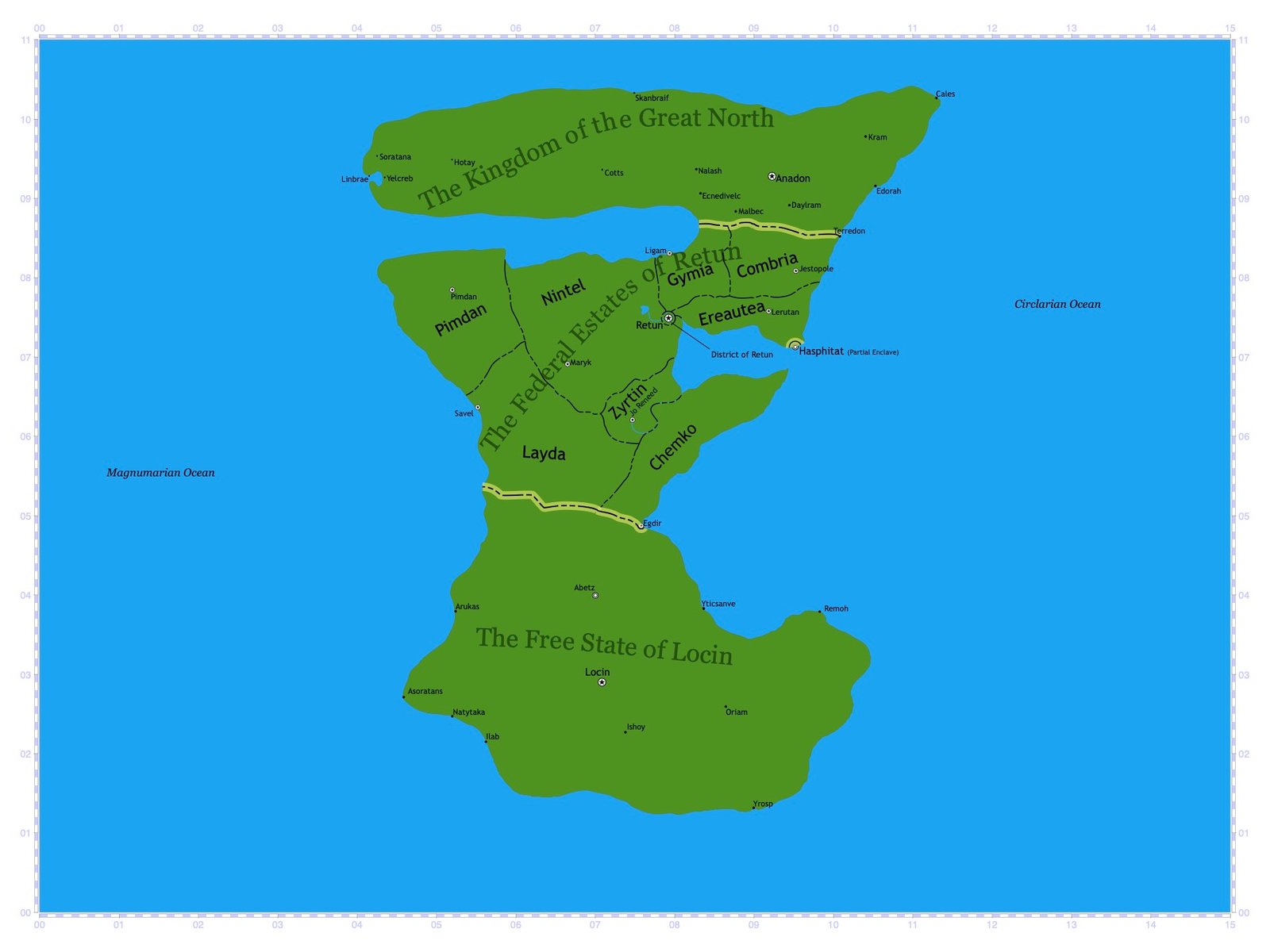
Map of Remikra, 1264-1308
In 1238, when the surrounding territories of the Basin District gained independence from Combria, the new nation of the Federal Estates of Retun established a democratic government and a new currency. Its currency, the Retunian Qor, was based on the exchange of credit gained in the form of Combrian Merchant Qors, and the base unit of the new currency was based on the quantity of Remikran Union Credits. Eleven years later, Prime Minister James Black signed into law the first minimum starting wage: 1.00 Retunian Qor per hour. This payment, at the time, was enough to cover expenses necessary for a comfortable living; and employees would receive a 1.00 qor raise every year, based on the employer pay scale, so that come retirement 40 years later, an employee would be making 40.00 qors per hour. Furthermore, employees worked six hours a day for six days a week (remember, a week is eight days in the Circlarian Calendar). This meant that, for a first-year employee, gross yearly salary would be 1080.00 qors per year.
Taxes were imposed on businesses in terms of capital gain but were also imposed on employees in terms of their income. The income tax rate was 5 percent each for the estate, the municipality, the county, the province, and the federal levels. These taxes were aggregated into a singular tax bill charged to each individual, with the bill making up approximately 25 percent of income. And such taxes would go to pay for infrastructure including food, water, sewage, electricity, energy, housing, transit, communication, critical infrastructure (police, fire, healthcare), and education. With this established, Retunians paid rent via the tax bill. For an individual making 1.00 qor per hour or 1080.00 qors per year, such a tax bill would amount to 270.00 qors per year.
Upon taking office in 1261, Prime Minister Edward Jackson initiated economic reform by raising the minimum starting wage to 2.50 qors per hour, and allowing private banks and businesses to buy out publicly-held estates and charge rental adjustment fees up to 7.5 percent of an individual's income. This meant that a first-year employee would be making 2700.00 qors per year but would be paying 877.50 qors per year in the estate tax bill, which included the rental adjustment fee. As business growth ensued, employers found themselves competing for employees, creating pressure to raise starting wages. This made the average starting wage go up to 2.51 qors per hour in 1263, to 2.53 qors per hour in 1264, and to 2.56 qors per hour in 1265. It surpassed 3.00 qors per hour in 1270. And by 1272, the average starting wage was 3.51 per hour, with a yearly gross salary of 3790.80 and an estate tax bill of 1232.01.
Numerous financial institutions had invested in deep-trade through loans in 1272. However, between 1273 and 1274, a market crash ensued as the result of fallout in deep-trade with the Acreans, prompting private estates and their lending banks to raise the rental adjustment fees from 7.5 percent to 10 percent of income. This decision was made at a summit between flat managers and bank figures in 1276 and, with the approval of Retunian Council in a sweeping legislative measure, took effect in 1277. There was little to no protest from the people over this as not only did it not receive media coverage, but also the increase was relatively minimal while starting wages were surpassing 5.00 qors per hour.
However, bankers and flat managers convened in a similar manner in 1281 to raise rental adjustment fees to 15 percent starting in 1282, and met again in 1286 to raise them to 20 percent for 1287. It was when they convened in 1291 to raise them to 30 percent for 1292 that numerous citizens began to demonstrate contempt. Starting wages at that point had stagnated, which had further solidified the growing opposition of the population against the Jacksonian economy. It was for the 1296 elections that Ereautean governor John Waltmann campaigned for Prime Minister with one of his agendas being to lower the rental adjustment fees to 15 percent. This, along with his promises to establish national healthcare, education, and transportation standards, led him to beating the incumbent Prime Minister Arthur Cummings that year.
While Waltmann followed through with his infrastructure standard promises, he and his fellow Progressive Party colleagues encountered stiff opposition from politicians backed by the banks, who resented such lowering of the rental adjustment fees. In November 1297, they reached a compromise and settled with a 25 percent cap on the rental fees while Waltmann signed into law a measure to raise the minimum starting wage to 10.00 qors per hour.
In 1298, Retunian legislature amended the bill capping the rental fees at 25 percent to include exemptions for estates to temporarily raise them in case of financial strain; and such an amendment which would prove catastrophic in the years to come. Between 1298 and 1301, the economy recovered from its temporary slump beginning in 1290, and began to grow again, leveraging itself on promising investments for lightfire trade in Ancondria. However, in 1301, the banks held a summit and decided to liquidate all investments involving Ancondria, leading the market to collapse. Millions of jobs were lost as the minimal growth in wages was erased, falling back to the minimum 10.00 qors per hour. At the same time, estates and banks feeling financial pressure, as well as attempting to maximize marginal profits, invoked the emergency clause passed in 1298 and raised rental adjustment fees up to 27.5 percent in 1303. They made similar increases in 1304, 1305, 1306, 1307, and 1308. By 1308, rental adjustment fees were at a staggering 40 percent.
Early Commonwealth: 1310-1344
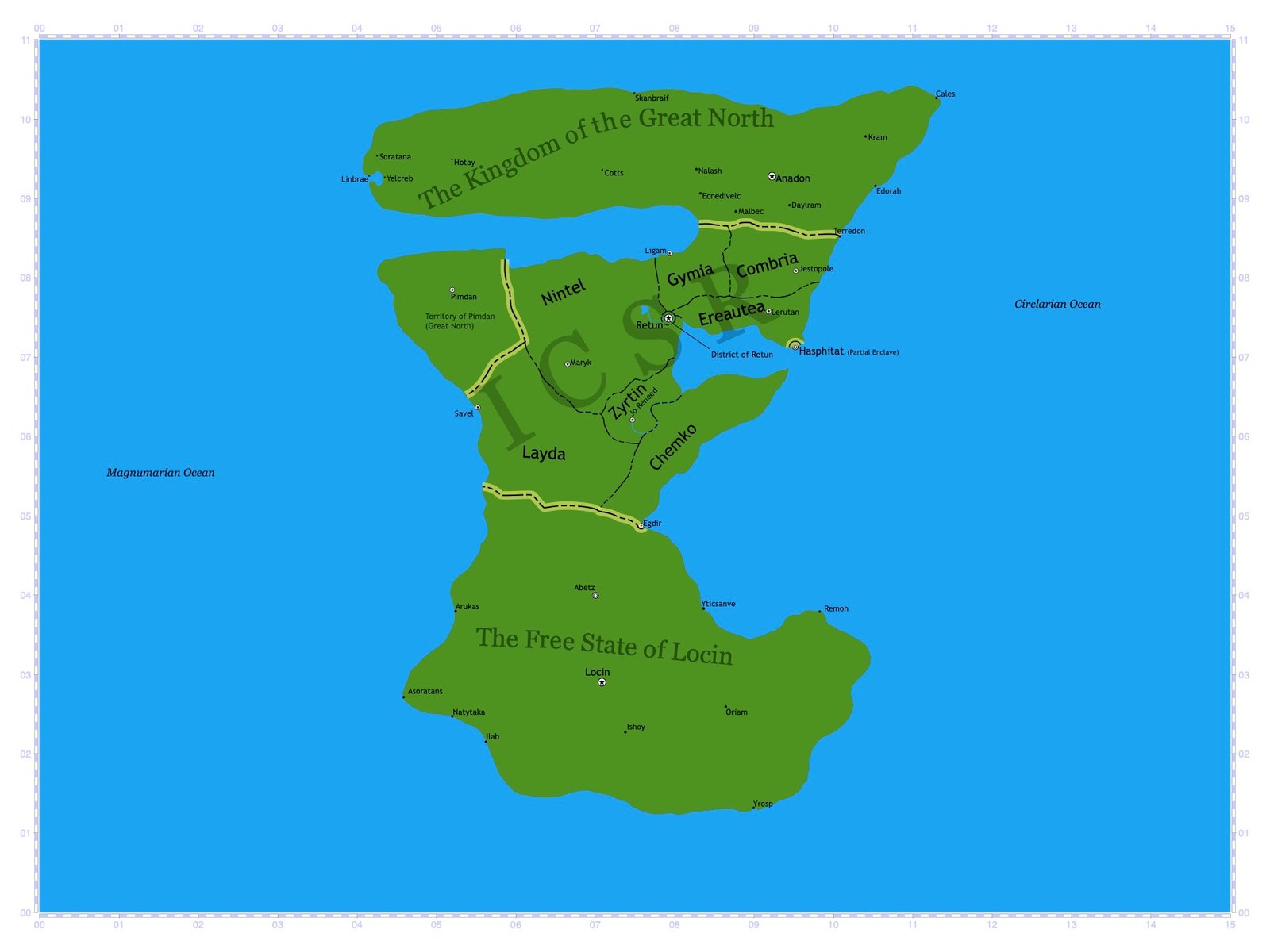
Map of Remikra, 1312-1319
Such high rental fees resulted in political tension leading to the toppling of the incumbent Waltmann Administration, establishment of the Fourth Amendment, and establishment of the Finzi Administration. The Finzi Administration repealed private estates and banks, as well as the rental adjustment fee altogether. This meant that the estate tax bill consisted only of 5 percent of income going each to the estate, municipality, county, province, and federal governments, just like it did before Jackson. Furthermore, the Finzi Administration established a new currency: the Commonwealth Qor.
In payment of Commonwealth Qors, minimum starting wage was set at 15.00 qors per hour. Initially, in 1310, one Commonwealth Qor was worth seventeen Retunian Qors, meaning that employees were making the equivalent of 255.00 Retunian Qors per hour. The issue with the Commonwealth Qor, however, was that it was based on and directly exchangeable with one darkfire floan (or darkfire tradestone). This was not originally an issue; in fact, with darkfire floans increasing in value, the value of the Commonwealth Qor increased as well. By 1314, one Commonwealth Qor was worth 38.51 Retunian Qors. The issue was that by 1314, hordes of Commonwealth citizens decided to invest in the recently-legalized industry of darkfire production. This was due to the initial explosion in demand. But by 1314, the darkfire floan supply outpaced the growing demand, and began to decrease the value of the floan. Furthermore, the darkfire concentration of the floan began to decrease due to overproduction. In 1317, as a result, the Commonwealth Qor began to decrease in value. And its economic impact began being felt by the 1320s.
In 1325, the value of the Commonwealth Qor fell below the Remikran Credit value of 1.00 Retunian Qor, prompting Commonwealth legislature to pass amendments to minimum wage standards to set starting minimum wage to the Commonwealth Qor equivalent of 15.00 Retunian Qors per hour. The Commonwealth Council also paid with stimulus checks to back-credit those who worked during that year. The Commonwealth Qor, meanwhile, continued to fall in value. In 1326, 1.00 Commonwealth Qor was equal to 0.27 Retunian Qors; and in 1327, it was 0.07 Retunian Qors. It was around this time that bank reserve treasurers began buying darkfire floans with Remikran Credit and exchanging them with the Commonwealth government for Commonwealth Qors, transferring the resulting financial gains into trust funds for business grants. This was an act of which the lightfire industry began to take advantage.
Alex Schraber, campaigning on a platform of economic reform and restoration of societal stability, had won the 1332 elections and taken office in 1333. By 1333, one Commonwealth Qor was worth 0.000006 Retunian Qors; and upon executive order, Prime Minister Schraber ended the Commonwealth-Qor-floan exchange and re-established the Commonwealth Qor as a fiat currency very much like the Retunian Qor. The new Prime Minister, furthermore, mandated the trust funds to be utilized to further fund the lightfire industry or face taxation. Schraber's policies led the Commonwealth Qor to recover its value to a certain degree. By 1338, the Commonwealth Qor was worth 0.0011 Retunian Qors. However, inflation pressure from a now-robust lightfire industry led the Commonwealth Qor to begin losing value again in 1341.
By 1344, the Commonwealth Qor fell back to 0.00043 Retunian Qors. Facing domestic backlash for his aggression in Ancondrian politics, Prime Minister Schraber resigned from his post that year and was replaced by Interim Prime Minister George Borwell, who signed into law the Seventh Amendment of the Retunian Constitution, which re-established the Retunian Qor as the official currency.
Commonwealth: 1345-1455
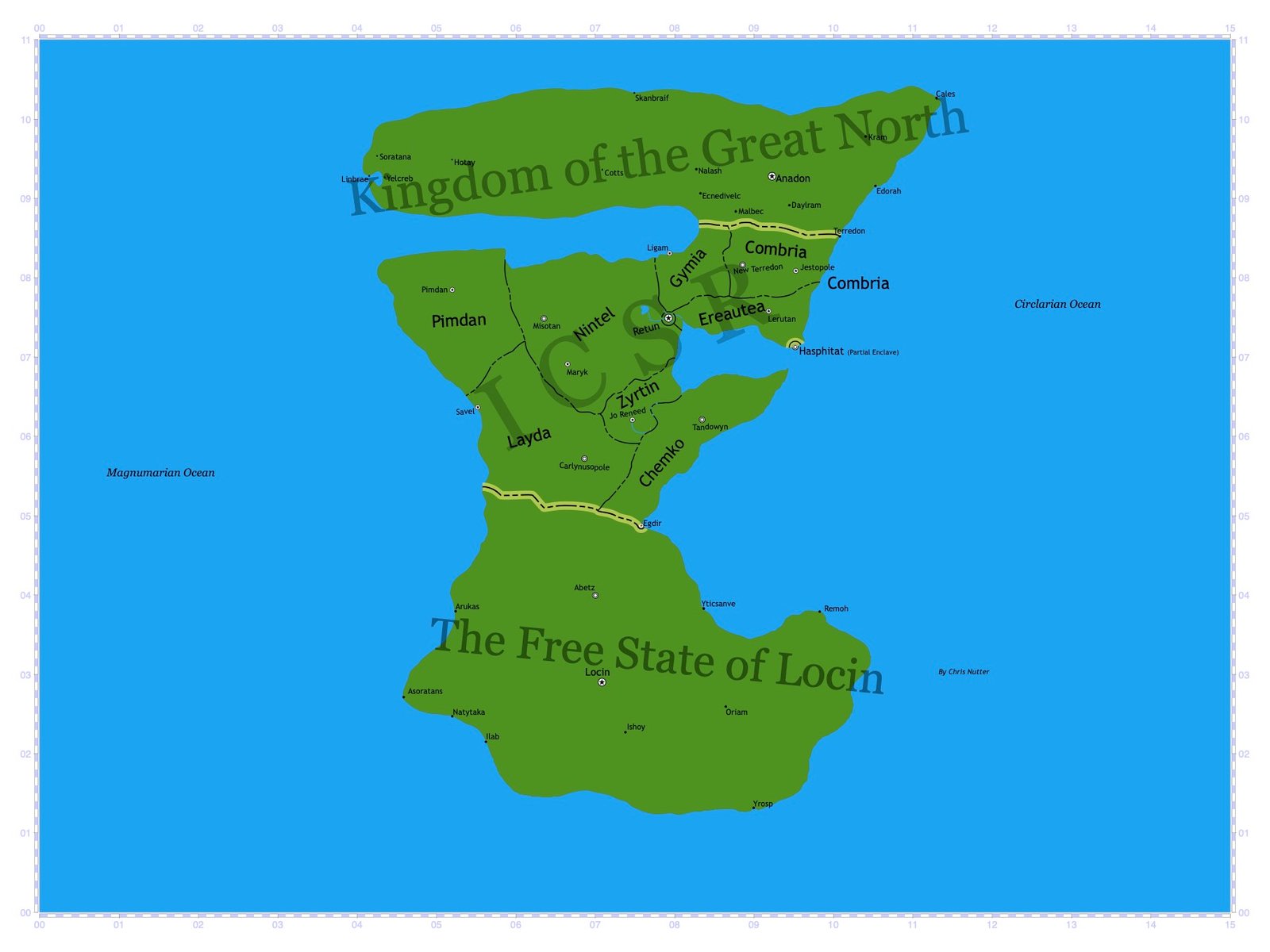
Map of Remikra, 1345-1481
George Borwell publicly announced that he did not intend to run for a full term as Prime Minister. So the 1344 elections were won by Raol Robinson, who took office in January the following year. The Retunian Qor as an official currency took effect at the same time while a five-year program was enacted to provide every Commonwealth citizen an opportunity to exchange their Commonwealth Qors for Retunian Qors at the rates according to the Remikran Credit System.
Along with the re-entry of the Retunian Qor came the official establishment of the minimum starting wage of 15.00 qors (Retunian Qors) per hour. The average starting rate remained at that level for the years of 1345 and 1346. However, with the implementation of the 100-Week Project, which involved a macro-industrial method known as "long-term banking" for the darkfire industry, the economy began to grow, with surplus revenues from the darkfire industry funding the lightfire industry. By 1350, average starting wages increased to 16.71 per hour; and by 1359, it was at 88.93 per hour. In 1360, average starting wages surpassed 100.00 qors per hour. However, mass exploitation against the Commonwealth and its businesses during the Esurchian occupation began to slow such economic growth. Nonetheless, an economic bubble led by a peaking lightfire industry appeared during the Esurchian War. And by 1368, starting wages were at a staggering 837.94 qors per hour.
The lightfire industry collapsed following an investor "freak event" in 1369; and gradually but at an increasing rate, lightfire businesses began to shutter. Such a downturn was rushed by Ancondrian investors dashing, owing to both the downturn and contempt against Commonwealth for its conduct during the Esurchian War. Between 1369 and 1374, unemployment rates began to skyrocket, although the Commonwealth had a much more reliable unemployment infrastructure than the Early Republic to keep citizens' basic needs met. Nonetheless, the Commonwealth Council and the incumbent Prime Minister Rez Kame wasted no time implementing economic policies to reduce unemployment; and thus small businesses emerged spurred by government grants. However, these businesses offered pay based on the required starting wage of 15.00 qors per hour. The Commonwealth up to this point had two markets: one for those making high income from the lightfire and darkfire industries, and the market tailored to those in the lower-paying industries. And with the lightfire industry shrinking at an alarming rate, pressure was on the Commonwealth Council to enact a raise in its minimum starting wage.
Meghan Wen campaigned on such a raise as one of her issues in the 1374 Prime Minister elections, which she won. By that point, the average starting wage had fallen to 256.41 qors per hour. When she took office in 1375, that average had already fallen further to 112.82 qors per hour. It took a surprising amount of effort in collaboration and coalition in Council, but by November of 1375, Prime Minister Wen signed a 20.00-qor minimum starting wage into law. And in 1377, the average starting wage had fallen to 20.32 per hour, and bottomed out to 20.26 per hour in 1380, but never went lower thanks to the 20.00 qors per hour minimum starting wage.
As a result of Prime Minister Wen's tireless efforts to rebalance the economy through the OPEN Forum, which was established in 1375, the economy began to stabilize in 1381 and follow a yearly growth pattern of between 10 percent and -5 percent. The average starting wages grew slowly during that period and reached 30.13 qors per hour in 1396 before starting its predicted shrinkage in value. However, public interest had taken a major shift toward an emerging industry: Library of Circlaria, which had the undying support of Prime Minister candidate, James Lawrence Kontacet, for the 1398 election. Kontacet secured a victory that election, and took office in 1399 to repeal the OPEN Forum and allocate more funding toward the Library. This led to a bubble in the economy with average starting wages to increasing to 54.43 per hour. However, investment scares across the Remikran Union between 1399 and 1400 led this gain to be erased. Average starting wages fell below 30.00 qors per hour in 1400 and bottomed out at 20.39 per hour by 1404, the year Kontacet lost to the candidate Vet Silonk for Prime Minister.
Prime Minister Vet Silonk stabilized the economy by introducing policies to spread more federal funding to scriptfire businesses, but average starting wages struggled to maintain above 21.00 qors per hour, as economic and political uncertainty across Circlaria hampered confidence. Prime Minister Stanley Arland Moore took office in 1417 and raised the minimum starting wage to 25.00 qors per hour, and implemented economic integration policies between the scriptfire industry and Library of Circlaria. This led the Library, now with updated technology, to open its first facility on Planet Nephina in 1419. Average starting wages grew as a result of increased confidence and business growth; and by 1423, the average starting wage had increased to 32.75 qors per hour. The Bar-Tar Sea Council fallout in December 1423 led to a slowdown in this growth, but starting wages still continued to grow, peaking at 40.86 qors per hour in 1426.
The slowdown from the Bar-Tar Fallout, along with deep-trade disappointments involving the Cidaleron Council, led the starting wage to fall to 31.16 qors per hour by the time Prime Minister Mary Anne Heits took office in 1429. That year, however, Prime Minister Heits raised the minimum starting wage to its present level: 35.00 qors per hour. Prime Minister Heits fully re-established the OPEN Forum, whose sentiment began to strongly favor Library of Circlaria. This, along with the re-unification of the RAD Party, led the economy into a period of gradual growth up to the present day, as average starting wages hovered between 35.00 and 40.00 qors per hour.