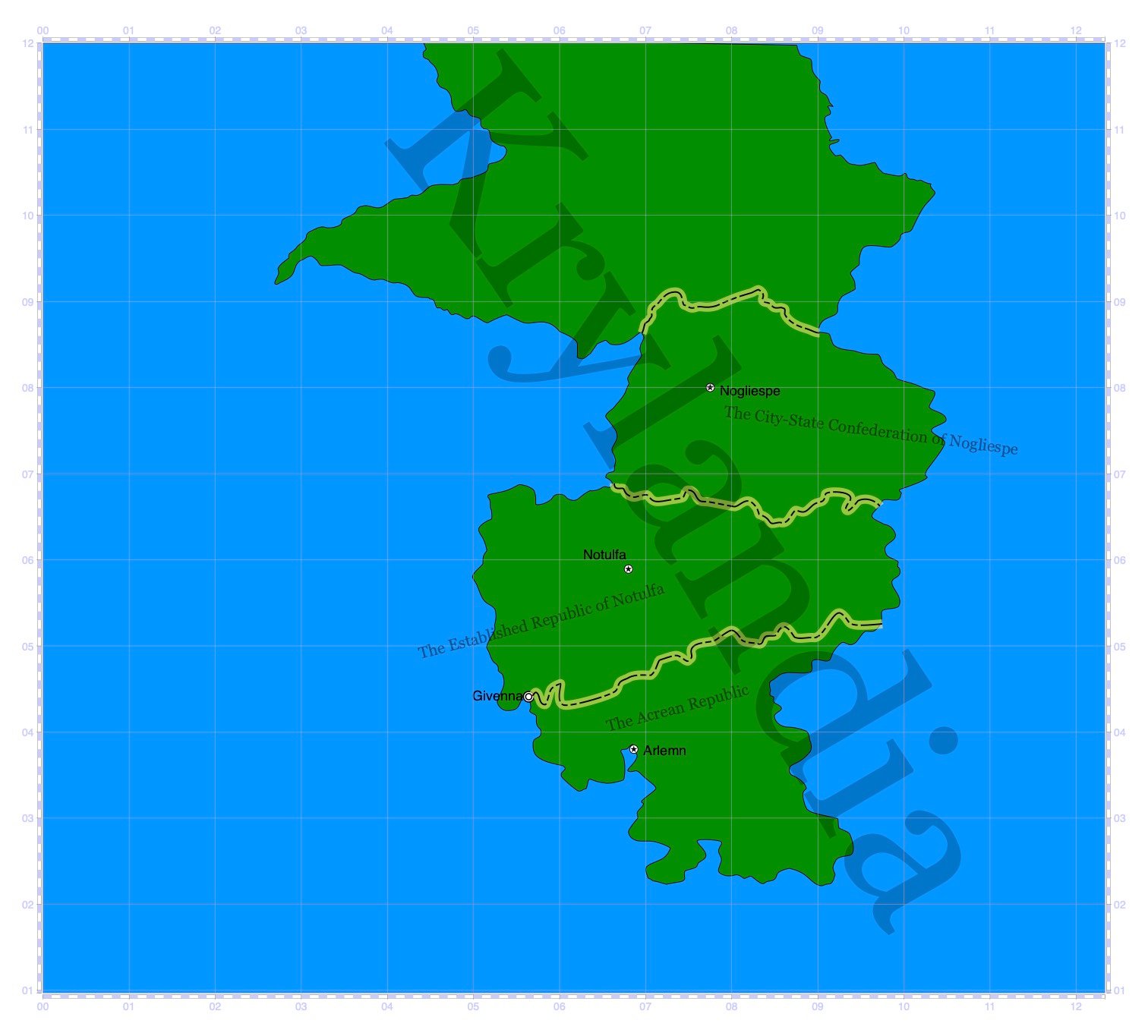
Map of East Hobland, Present
Article Written: 16 April 1456
It is rather difficult to draw a map of East Hobland for the nearly two-thousand-year period between the Ashen Years and the twelfth century because of its drastically ever-changing borders. And this is due to the fact that the region during this time was consistently fought over by numerous small rival kingdoms, duchies, and city-states of varying sizes and power. Some of these entities formed alliances with one another and sent mercenaries to assist one another against enemy factions in order to make territorial gains or defeat government heads entirely. However, diplomatic alignment in this place and time was rather dynamic and unstable. Furthermore, much of the land area consisted of territories under dispute between rival factions (be it two, three, or even five of them); and in some of these fought-over territories, numerous social uprisings establishing temporary or long-term self-governing towns or counties would occasionally occur. Thus, it is difficult to draw affixed borders for any particular time during this period.
Basic Hierarchy
The entities, themselves, were numerous and drastically different from one another in terms of culture and custom; and that was because they were primarily governed each by a ruling family. However, be it that these entities had a common root, having been descended from the settlers of the ancient Circlarian Empire, these entities each had somewhat of a similar power structure.
At the top of the power structure sat either a Monarch or a Chancellor. Monarchs had absolute power, and upon death were succeeded by the oldest living member of the royal family. Chancellors, on the other hand, held positions that were formerly top general positions of military units. In a Chancellorship, lines of immediate succession (as in the event of a sudden death) were determined by ranks of positions of power; and the ruling class consisted of the family of the Chancellor as well as those in the line of succession. Barring any sudden events, the successor of the Chancellor was otherwise appointed by the incumbent Chancellor upon the basis of merit, and was usually not a family member.
Next below the ruling class was the class of Spellcrafters and Clerics. Spellcrafters were appointed based upon merit by Monarchs and Chancellors. Each Spellcrafter ruled over an administrative region of jurisdiction like a province or a county, and imposed the laws of the ruling class as well as local ordinances through acts of spellwork. Spellcrafters also implemented law and order by appointing Knights and Warlords to keep the peace. Clerics, on the other hand, were appointed by the ruling class to serve as legal and moral interpreters, very much like judicial branches of modern governments. A few did acts of spellwork, but most Clerics focused solely on religious practice.
Knights were appointed by Spellcrafters in a Monarchy System with such appointments receiving formal confirmation and honor from the Monarch. They commanded legions of armed fighters to defend territory, and also presided/appointed Sheriffs to enforce local ordinances. Knights also appointed Trade Guild Leaders. Warlords were also appointed by Spellcrafters in the same fashion as Knights, but received no honors or customs from royalty, for Warlords served only under Chancellors. Nonetheless, Warlords served nearly the exact same duty by commanding fighters and employing Sheriffs, as well as appointing Trade Guild Leaders.
Appointed by Knights or Warlords, Guild Leaders recruited laborers and crafters in their trades, and appointed foremen to preside over them. Sheriffs would then appoint landlords to own and lease manors and numerous properties in which the common people lived. Common people rarely owned their own property.
Givenna
Established in the 600s, Givenna was the most robust and successful of the East Hoblandish city-states, and was governed by a non-familial Chancellorship. It's unusual prosperity was credited to its location along the West Coast of East Hobland, where it developed a well-established fishing industry, formed trade with distant lands such as Remikra, Tandeiyah, and Canticula, and signed important trade contracts with traveling sea guilds.
In 917, Givenna acquired the territories of three surrounding royal duchies through military conquest, during which they subjected enemy fighters to a fair and due process after capture. Furthermore, Givenna allowed for the local duchies to continue functioning as they did previous to the invasion. However, their sovereign figures were more like puppet-figures promising loyalty to Givenna. And thus, they were able to subjugate the local populations through an image of justice and fairness.
Maleva Tere was initially a minor figure in the ranks of the Givennese Chancellorship during the 1000s. However, she married Estevus Esary, a nomadic warlord to the Northeast with an agenda to reclaim a fortress known as the Reltuvian. Maleva Tere was able to utilize her association with the Givennese Chancellorship to secure essential funding and to have Givenna form a conjoined campaign with Esary and his followers to launch a major military conquest to the Northeast. Givenna succeeded in gaining this territory, in the midst of which was constructed a fortified city named New Givenna (which would become the city of Notulfa in the century that followed). Estevus Esary reclaimed the Reltuvian, and the House of Esary was officially re-established, leading to a political transformation that would eventually undo the traditional power hierarchies of East Hobland.