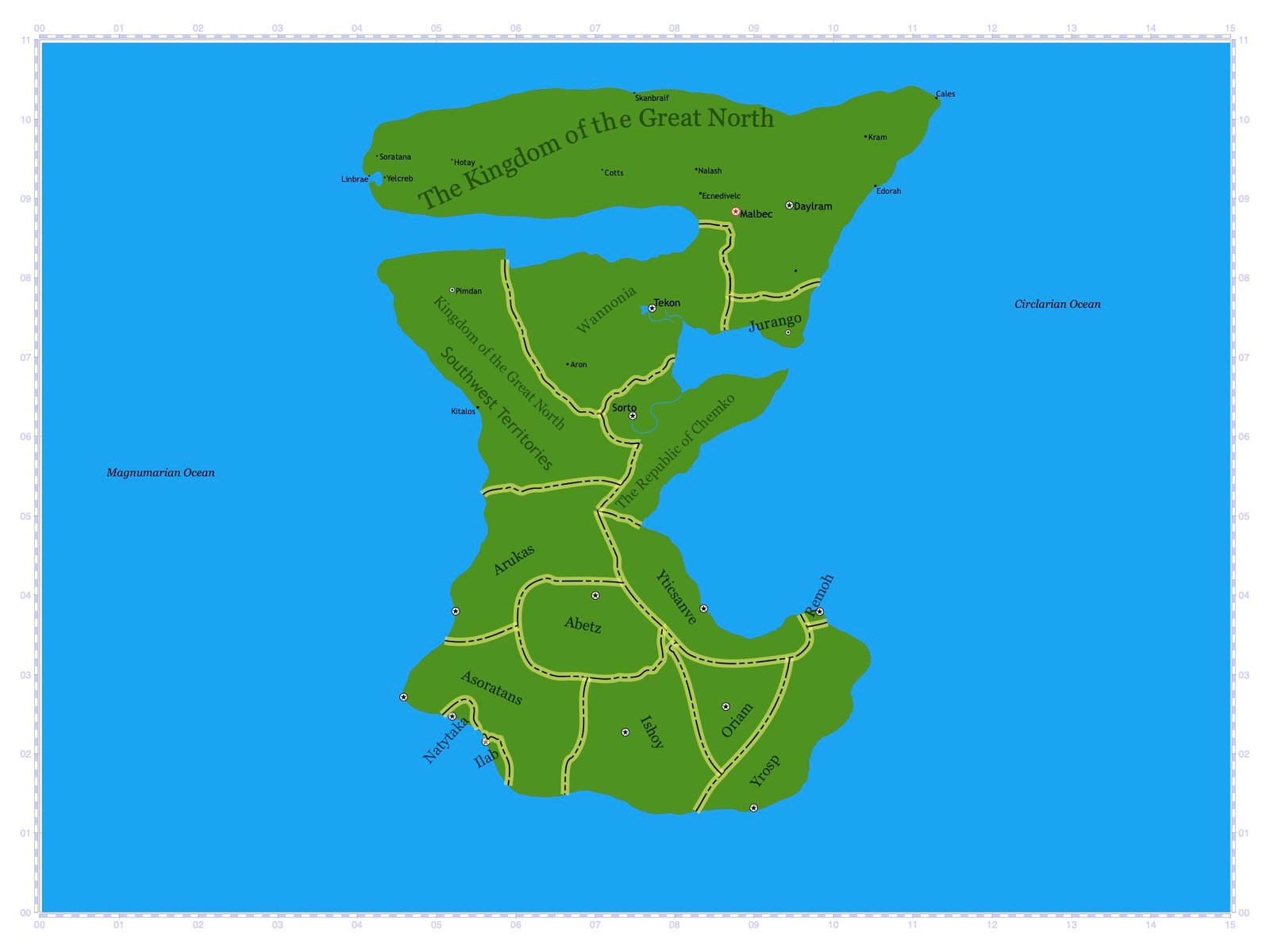
Map of Remikra, 998-1026
Article Written: 19 June 1451
The year 1013 was noted by many written sources across North and Middle Remikra as an unusual one. For one, it was one marked by an unseasonably warm autumn followed by an outbreak of severe weather in December.
Unusual Seasonal Pattern
Spring and summer were not out of the ordinary for the region, with Great Northern and Wannonian sources noting bountiful harvests. During the first week of October, however, there was a cold snap, bringing snow and frigid temperatures as far South as present-day Maryk. In a strange turn of events, this was followed by a warm spell that began in the second week of that month and lasted through December.
It was the warmest Donmir holiday season on record at the time, promoting wild superstition and speculation among commoners and scientists alike. But then, during the last three days of December, a cold front passed down from the North bringing violent storms that famously led to an outbreak of tornadoes across present-day Nintel, Gymia, and Combria.
Cannon Hewitt
Raised within the Edoran Kingdom in a household strongly devoted to the Alconist faith. Cannon Hewitt grew up to be a philosopher, living an affluent life like his parents. Upon his father's death in 1001, Hewitt established a library in his local Edoran Church dedicated solely to religious works.
However, Hewitt was also known for his role in the emerging movement among religious groups to "rediscover" the mysterious holy city of Edom, its location unknown at the time. The unusually warm autumn weather in 1013 played upon Hewitt's prophetic beliefs that Braeus Alconus was to return to the world and deliver salvation, and that the gates of Edom were to open in a location that Hewitt had been studying for awhile. That location was termed by Hewitt as the "land between the rivers." That location is presently the site of the Basin District and the city of Retun; but at the time, it was a region of forest consecrated by the local indigenous groups as a place for the dwelling of ancestral spirits. Nevertheless, Hewitt consolidated his finances, recruited several affluent families from each the Edoran and Linbraean Regiondoms as well as several companies of soldiers, secured three steam-powered ships, and set out from Terredon.
It was around mid-December when they made their way across the Inland Sea and up the Easterly River to the land of interest. Here, they encountered the indigenous population, who saw them as a threat to their ancestral grounds, and engaged them in warfare. The indigenous warriors fought with spellfire discharges and were no match against Hewitt's people, who had firearms. The indigenous fighters were defeated and forced into retreat as Hewitt's people marched onto the "land between the rivers" and established encampments while setting up "scouts" to find any evidence of Edom or divine intervention.
The quest proved unsuccessful, as fruitless outcomes led to mounting frustrations and tensions between the Linbraean and Edoran visitors. And the situation was made worse with the arrival of the cold snap in the last week of December, which dropped a large tornado that tore through the "land between the rivers." Miraculously, it missed the encampments. However, the violent winds accompanying the storm caused permanent damage to the three ships, making all three of them unusable; therefore, Hewitt and his people were stranded.
By the second week of January, Hewitt and the encampments were desperate as their resources and food stores began to run low; and they were not the best-educated in terms of prolonged wilderness survival. Ensuing tensions between the Linbraeans and Edorans peaked when Hewitt and a band of his inner circle broke into the wrecked Linbraean vessel and began stealing stores and wealthy assets. They were caught by a band of Linbraean gunmen, who had secretly followed him. Hewitt and his men were shot dead.
Hewitt's death sparked violent conflict between the Edoran and Linbraean campers in the "land between the rivers" as the two sides engaged in violent warfare and shot at each other. And such was the situation that greeted the large company of stag-mounted Wannonian and indigenous soldiers when they returned to the region with reinforcements in retaliation to the confrontation from earlier in the quest. Immediately, the stag-riders overcame the warring Edorans and Linbraeans, and subdued the fighting. The uninvited campers were placed under arrest by Wannonian authorities and were eventually extradited back to the Great North, as the Great North made amends to recover from the diplomatic abrasion that resulted between itself and Wannonia.
Summary
Even by today's standards, the year 1013 stands as one of the most unusual years in the history of Remikra. With an unusual weather pattern coinciding with a radical evangelist movement, the turn of events had an effect on Remikran history and will most likely re-emerge as a topic of discussion between scholars in the years to come.