Location and Structure:
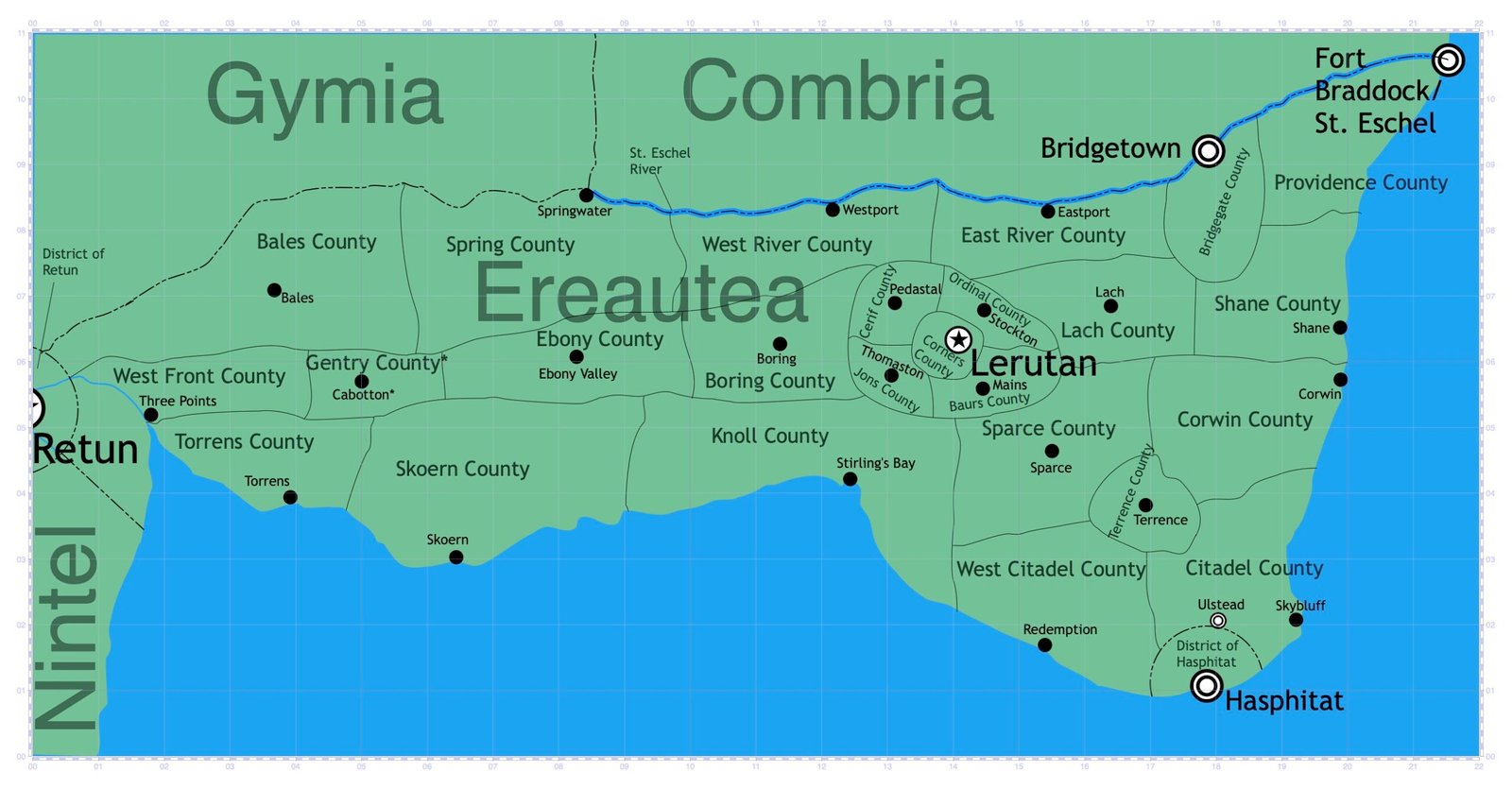
Bridgetown is located over the St. Eschel River, straddling the border between the provinces of Combria and Ereautea and serving as a midpoint between the cities of Jestopole and Hasphitat. The Bridge, itself, consists of two Towers, with the North Tower being on the Combria side and serving as the Bridgetown Center of Commerce, and the South Tower being on the Ereautean side and serving as Bridgetown College. Each Tower consists of two trestles intersected by three levels of Archways, with each Archway dotted on each side with landing pads for gyroplane POD vehicles. Historically, fly-up moors for small airships stood in the place of the landing pads today. The Crossway spanning the length of the Bridge consists of four Levels plus a section below lining the Supports. The Top Level of the Crossway is home to a VacTrain line in the center, a freeway on either side, and a side street spanning each edge with intersecting cross-streets. Along the latter stands shops, parking lots, and living spaces. The Second Level (going down) consists of a network of city streets lined with more businesses, parking lots, and apartments. Below that lies the Third Level, consisting of the People-Mover Network. And on the Fourth Level, pedestrian walkways line shops, apartments, and offices. Below the Fourth Level are the Supports, which hold up the Bridge on the Combrian side, the Ereautean side, and the Midpoint. Lining each of these Supports are numerous offices; and at the bottom of each, along the River, lies a network of Docks servicing boats.
Founding Days:
The design of Bridgetown was originally conceived and initiated by chief founder and first Combrian President, William Jeson, who aimed to promote trade and strengthen ties with the neighboring then-nation of Jurango, which occupied present-day Ereautea. However, President Jeson died in 1132 and was succeeded by the next President of Combria, Arthur Chadwick, who had an attitude of prejudice toward the Jurangan people. Chadwick continued Jeson's idea of the Bridge project, but aimed to use it in order to gain dominance over Jurango in a prospective trade agreement. Chadwick hired for work on the Bridge to be carried out by Jurangan laborers, who endured harsh working conditions. By 1135, the skeletal structure of the Bridge was completed and had a single conventional railroad track crossing its length through the center and had parallel concrete highway lanes on either side of it. Paved streets along the sides and the level below were initially lined with vacant spaces, but already businesses began to emerge. The Third Level had for its People-Mover network a system of trolley cabs hanging off of conventional rails over the Fourth Level, which was initially a network of open-air catwalks lining living spaces for the Bridge workers. Catwalk staircases ran up and down the Supports, which already had offices for shipping entrepreneurs doing business with boats making contact with the Docks below.
Since assuming the Presidency of Combria, Chadwick had initiated tariffs against the Jurangans, provoking popular grievances. Chadwick had initially hired Jurangan laborers, as mentioned above, to temporarily dispel these complaints. However, in January 1135, Chadwick also issued a series of letters to Jurangan leadership claiming that the Island of Skye further West on the River belonged to the nation of Combria. This Island had been considered by Jurangan society to be a sacred place, and the nation claimed this in opposition to Chadwick. Chadwick responded by withholding Jurangan Bridge worker paychecks. In February, Jurangan laborers carried out protests and began "deconstructing" the Bridge in the process. Chadwick issued an order of evacuation for the Bridge, but the workers refused and stayed to protest, this time obstructing highway and rail traffic. The Bridge Guard, loyal to Chadwick, hit the protestors with water from firehoses, to which the workers responded with makeshift cannons shooting the Guards with soil "grits." On 2 March, Chadwick deployed the Fifth Infantry of the Combrian Armed Forces, who shot shells into the crowd of protestors, killing 53 of them. The nation of Jurango considered this a provocation and declared war on Combria.
Jurango's armed forces were well-built. They arrived to the Bridge on 12 March and, with surprising strength against Combrian forces, captured it. Jurango then communicated to Chadwick with the promise to return the Bridge to Combria if Chadwick paid Jurangan workers' paychecks and reparations to compensate for the tariffs. Instead of negotiating, Chadwick responded on 18 March with reinforcements, which took back the Northern half of the Bridge. However, Jurangan forces held their ground so that the Southern half remained under their control, bringing the conflict to a stalemate. Chadwick contacted the Wannonian Emperor Clastye I for assistance. Chadwick had previously built a Wall running North to South along the Wannonian border near present-day Gymia, but, at this point, was now alleging that the Remikran Union of Nations had coerced him into doing so. He furthermore promised to demolish the Wall and turn half of Jurango over to Wannonia if Wannonia joined forces with Combria to defeat Jurango. Emperor Clastye I agreed to the deal; and on 3 September 1135, Wannonian forces attacked Jurango from the West. Meanwhile, Chadwick delivered propaganda to the Jurangan people alleging that Wannonia was attacking both Jurango and Combria, and that they needed to join forces and fight the "common enemy." Jurango agreed to a cease-fire with Combria and moved troops from the Bridge to the Western front, expecting Chadwick to follow through with a plan to launch a counter-attack on Wannonia. However, Chadwick joined forces with Wannonia, instead, and massacred the newly-arrived Jurangan soldiers and deployed other Combrian units to join Wannonian forces in a planned assault on Jurango proper. Meanwhile, Combrian forces retook the Bridge and territory to its immediate South. Having not anticipated Chadwick's mutual manipulative tactic with Wannonia and having experienced major losses on all fronts, Jurango formally surrendered on 13 September 1135.
Afterward, Chadwick employed Combrian workers who finished the Bridge in the form of its early structure by the end of the year.
In October 1136, Chadwick instructed that Wannonia was required to appoint a sponsor from Combria to testify and gain approval from the Remikran Union of Nations Parliament in Cotts (in the Great North) in order to attain the Jurangan territory promised by him. As Wannonia followed through with this, however, Chadwick appointed a sponsor of his own, who alleged that Wannonia was attempting to "thwart the system" to leverage territorial gains not negotiated with Combria. So the Parliament voted down all of Wannonia's land requests. Needless to say, this led to friction between Combria and Wannonia, as Wannonia called out Chadwick for his dishonesty and began to build and fortify bases near its border with former Jurango. Upon hearing news of Wannonia's fortification efforts, Chadwick began fortifying Combrian bases. During this time, between 1137 and 1151, the Bridge was fortified, being converted into a stronghold with ramparts as well as barracks and turrets every few hundred feet. The single rail line was converted into a double-track to increase the traffic of military supplies as the Bridge was governed by a commanding General from each of the two Towers, taking direct orders from Chadwick. Airship Moors were then added to the Towers and Supports. Although the Bridge would not be on the front line in the event of a conflict between Wannonia and Combria, the purpose of these renovations was to have the Bridge stand as a reserve and also to serve as another line of defense against Wannonia-allied sea guilds.
Wannonia responded by constructing a Wall of its own in present-day Gymia running parallel to Chadwick's Wall, to which Chadwick responded by fortifying his Wall. In 1151, Wannonia responded to this by building a base between the two Walls on the Wannonian side. Here, they carried out active shooting range drills. Chadwick demanded that the Wannonians cease their activities at this new base. Wannonia ignored Chadwick's demands, and Chadwick launched an attack, beginning the Wannonian-Combrian War.
The War ended up being a stalemate for both sides, as Chadwick was forced to retreat from an offensive deep into Wannonian territory and no changes were made to the initial borders between the two nations; although that meant Combria had kept all of the former Jurangan territories, and furthermore, Combria moved its official government seat to Hasphitat. Nonetheless, with regard to the failures in the conflict with Wannonia, contempt in the higher ranks for him forced Chadwick to abandon his post as President, leading to a rivalry-succession of Interim Presidents that led the reformed nation into civil conflict. During this time, rival militant groups fought and held their ground between the North and South Towers as constant fighting took place in the streets, Levels, and Supports below.
Combria:
In 1184, Jacob Thomas Henry became President of Combria, bringing peace and order to the war-torn nation. In the years that followed, he converted the Bridge from a military reserve to a commercial hub, establishing it formally as the city of Bridgetown in 1185. Bridgetown established a new method of government as, between 1185 and 1187, it constructed a City Hall in the interior Levels of the Midpoint. Bridgetown became a municipality free of either of the neighboring Districts but with its residents still living as residents of each District of their respective side. The municipality was led by a Mayer and a democratically-elected Council. This system was different from what would come in the Early Republic, however, in that Council Members were chosen by a certain electorate fitting certain criteria, primarily those who were business owners and others approved by the government. The Mayor would be chosen by the said Council, voted in every five years. The Council, itself, had two bodies: the North Chamber consisting of representatives from the Northern half of Bridgetown, and the South Chamber consisting of representatives from the Southern half of Bridgetown. The two Towers also began serving specific roles for Bridgetown. The North Tower saw the establishment of the Center of Commerce, which consisted of a bank on the bottom two sections, executive living quarters in the mid section, and a hotel in the upper section. Later in 1185, a large grant received from the nation of Notulfa financed the establishment of Bridgetown College in the South Tower.
The double-track remained in place on the Crossing as the rail line while the concrete highway on either side was marked with definitive automobile lanes. The city streets on either side of that as well as on the level below began to see a significant increase in businesses, shops, and living spaces. The trolley network on the level below remained in place but saw the building of more platforms, especially around the City Hall. On the Fourth Level, the network of open-air catwalks was converted to an indoor network of pedestrian corridors as living spaces here saw improvements in living standards and other living spaces were converted into office spaces. At the Midpoint, a train station was constructed extending a half-mile North and a half-mile South and was named Midway Station. From each end of the Bridge, the tracks diverted about a mile away from the the beginning of the Bridge so that the tracks on the bottom went across the Bridge without stopping at the station, going instead through tunnels on the same level as the automobile highway, while the tracks on top stopped at the Station. For the top level of this, each station track split into two lines each for three platforms, so that there were six platforms for each track and twelve for the whole station. Atop Midway Station was constructed Midway Stadium, used primarily by Bridgetown College. Below Midway Station was the City Hall, itself, consisting of the Mayor's Office on the topmost level, the Council Chamber on the level below, and the Municipal Court on the bottommost level. In the early 1200s, cable rail was increasing in popularity, leading to the installment of two cable rails through the Bridge. Platforms for these were eventually installed on each side of the Midway Station while, in 1203, a cable rail cab system took the place of trolleys for the People-Mover network on the Third Level.
During the Retunian Revolution, the Bridge, once again, became the focal point of a critical conflict, this time between the East Wannonians, who occupied the Northern half, and the Retunians, who occupied the Southern half.
Early Republic:
East Wannonia was defeated in 1242 as the Federal Estates established its Constitution and Provinces. Bridgetown would straddle the border between the Province of Ereautea and the Province of Combria. The jurisdictional hierarchy of Bridgetown was very similar to what it was during the years of the Chartered State of Combria, with residents on the Combria side having "Bridgetown, Combria" as their addresses, paying taxes as Bridgetown and Combrian residents, and voting as Bridgetown and Combrian residents. Meanwhile, those on the Ereautean side had "Bridgetown, Ereautea" as their addresses, paid taxes as Bridgetown and Ereautean residents, and voted as Bridgetown and Ereautean residents.
Significant renovations took place during this era. In 1250, the cable rail system on the People-Mover level was upgraded to implement the no-contact technology that long-distance cable rails were beginning to use. In 1262, Bridgetown City Council passed a budget proposal for a major renovation project for the Midpoint. In accordance to this, the conventional rail lines and platforms for Midway Station were shut down in 1263 and converted into market districts, the existing Midway Stadium was demolished and replaced by a new Midway Station for long-distance cable rail lines in 1265, and a new Midway Stadium was built atop that, opening in 1268.
The Independent Commonwealth:
The economic crash of the early 1300s rendered the cable rail industry obsolete and, in the wake of the 1309 Revolution and the establishment of the Independent Commonwealth State of Retun, platform trains became the new norm. With these factors in place, Bridgetown City Council passed yet another renovation project in which, between 1311 and 1316, the cable rail Midway Station was shut down and replaced with market districts and an indoor concert hall. Meanwhile, the market district on the level that was once the old Midway Station was converted back into the Midway Station, this time with boarding platforms for platform trains. Mesh trains eventually began to replace platform trains as the transit norm, and so Midway Station, between 1333 and 1334, was upgraded accordingly. And then in 1348, it was renovated, once again, to service VacTrain lines.
Airship moors, having been in place since the Chadwick era and providing essential business to the municipality, continued to see airship traffic despite the rise in carrier planes in the early years of the Commonwealth. Carrier planes, though, along with platform trains and ships, provided competition for the airship industry. And such pressures on the airship industry worsened with the arrival of a significant expansion in the gyroplane industry in 1320. In 1322, Middle Ereautea Airship Moor, located on the Supports Level, was the first airship moor to close. This was followed by the closure of the Ereautean End Airship Moor and the Middle Combria Moor in 1323. The National Airship Heritage Foundation saved the Combrian End Airship Moor, however, later that year. The Foundation also saved South Tower One (the Airship Moor on top of Bridgetown College). From the 1320s onward, gyroplanes continued to improve, providing more and more competition for the skies. In the 1330s, as mentioned before, mesh trains came to the scene, giving better services than platform trains. By the 1340s, South Tower One, North Tower One through Five, and Combria End Moors were the only airship moors remaining open. By the 1350s, VacTrains replaced mesh trains, leading to the closure of North Tower Moors Four and Five. Then-Prime-Minister Robinson's policies led to an economic boom between 1347 and 1349, and with that came a growing trend for "airship tourism," inspired by the newly-emerged Library of Circlaria. Airship moors reopened around the Commonwealth, and by 1356, all eighteen Airship Moors had reopened in Bridgetown.
However, airship tourism lost its trend when the Esurchian War of the 1360s led people to fear traveling by airship across the Magnumarian. Bridgetown was not directly affected by this initially, as they only dealt with smaller airships that did not travel overseas. However, in 1367, the Esurchians launched a direct attack on the Commonwealth. Their agenda saw immediate defeat but the turn of events led people to fear traveling within the Commonwealth as well. Hardship from the lightfire industry fallout in 1369 dealt yet another blow to the airship industry, leaving only the Airship Moors along the Supports and Moor One (the top Moor) on each Tower open. All of the other moors closed down. Between 1369 and 1380, "airship hobbyists" dominated the scene. They managed to keep the airship industry afloat, although they did not generate the same amount of revenue as airship tourists. As a result, the Airship Moors that had closed were converted into landing pads for gyroplane POD vehicles starting in the mid-1370s. In 1380, another economic shakeup caused the "airship hobbyists" to dash, leaving all of the Airship Moors in Bridgetown to close except for the two held by the National Airship Heritage Foundation: South Tower One and Combria End Airship Moor. The Foundation planned to lay out a more regular schedule of federally-funded specialty tours between Bridgetown and North Kempton. However, in June 1380, the Commonwealth Council voted to eliminate federal funding to the Foundation with regard to the tours. In October 1381, the last commercially-flying airship departed Bridgetown from South Tower One to land in North Kempton. The two remaining Airship Moors in Bridgetown subsequently closed and were converted into POD vehicle landing pads, bringing an end to the airship industry in Bridgetown and the world.
Today, POD landing pads still exist in place of the Airship Moors that once stood in the past. Additional landing pads exist on the rooftops of almost every structure on the outdoor levels of Bridgetown. The People-Mover network now consists of a modern "soft-rail" transit system, the result of a renovation made in 1427. And Bridgetown College, having been part of the Global Academy of Ancondria between 1304 and 1368, still stands but is now, since the 1380s, part of the National Institute of Research and Development. Midway Stadium stands over the level consisting of the indoor market district and concert hall. Also on this middle level now stands a museum. And on the first level, Midway Station still exists with its VacTrain platforms; although VacTrains have not been in use in the Commonwealth since the beginning of the Great Circlarian Pandemic of 1431.