
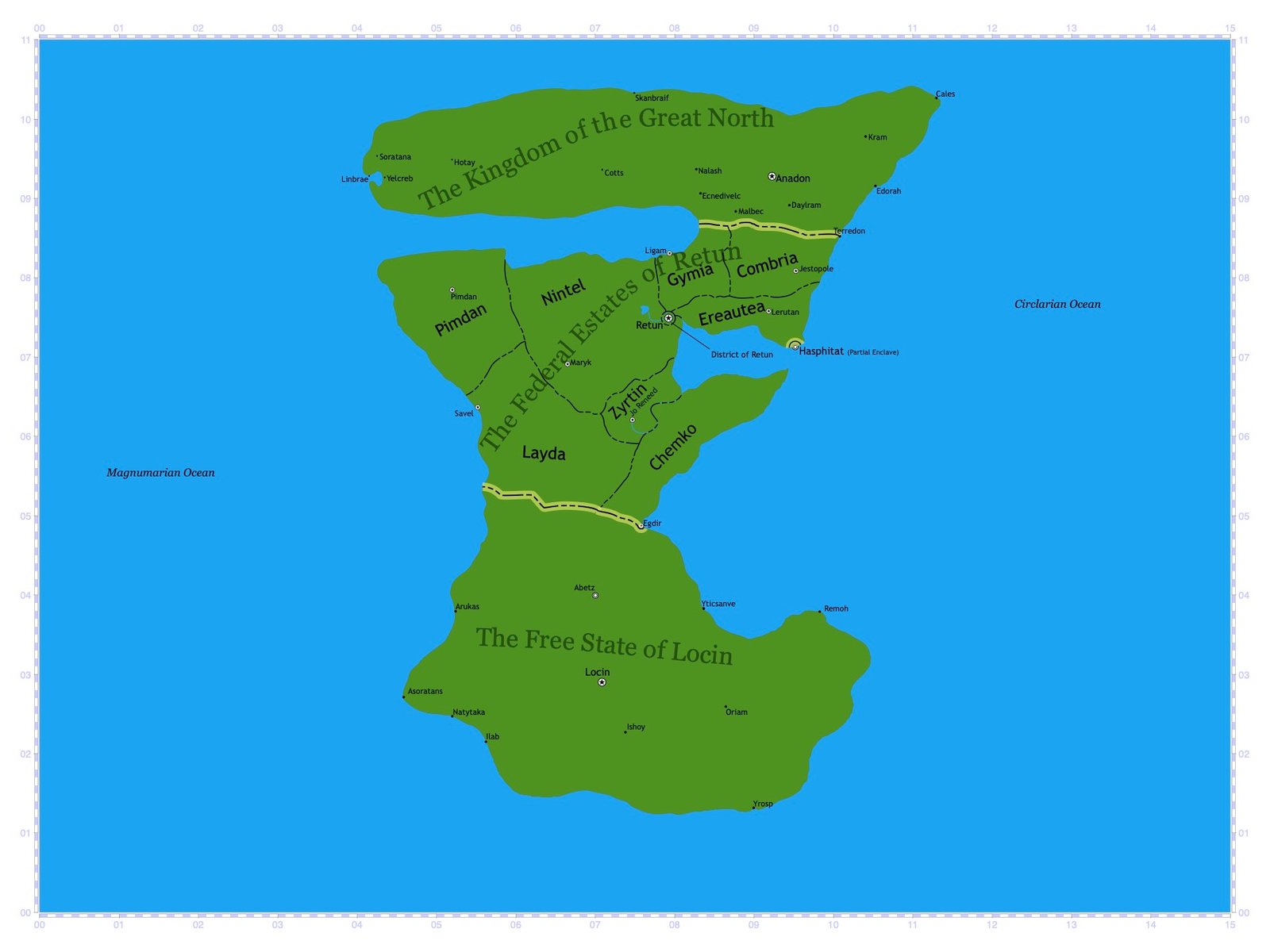
Map of Remikra, 1108
Locinian Establishment and Brief History
Locin was initially established as the protectorate state of Mikant in 1108 in a similar fashion to its partner, Combria, in the North twenty-two years previously. Likewise, its founding was carried out by the Kingdom of the Great North while its government came into existence in the form of an incumbent-appointed presidential council structure. Later that year, Mikant, Combria, and the Great North joined to form the multi-national organization named the Remikran Union, led by a Parliament of elected representatives from each of the three nations. Mikant grew its territory Southward with the peaceful and diplomatic acquisition of Southern Remikran territories, and had a large swath of territory in its jurisdiction by the mid-1100s. Later on, the Mikanian government seat would move to the oasis-city of Abetz, located in the center of the Interior Desert.
In 1192, the Mikanian Plague struck and decimated the Mikanian population. Although the Remikran Union gave important recovery provisions to the nation, Mikant's weakened state was exploited by the invasion carried out by Combria in 1194. And though the Remikran Union levied repercussions against Combria for invading a fellow nation-member, the Parliament voted in consolation measures which allowed the invaders to keep the gained Mikanian territory. This outraged the Mikanian population, which rebelled and ousted the Mikanian government. The government seat was moved from the city of Abetz to the city of Locin, after which the entire nation was named, while a new government took form. This new government preserved the presidential council structure but required that the Presidency, as well as every Council seat, was elected. The new nation of Locin was thus a Republic.
Locin vs. Linbrae
The Great Northern Regiondom of Linbrae had benefitted economically from the old nation of Mikant, which had complied with economic agreements to surrender partial ownerships of assets and economic profits to the Linbraean Royal Trust. The new nation of Locin, however, voted to repeal such measures, earning contempt from the Linbraeans. Over the course of a century, the Linbraeans would launch various measures to regain economic leverage with Southern Remikra. Some measures were civil while others were by force, with the Linbraeans construing Remikran Union principles to dispatch Remikran Union task forces to the region. Such gameplay would prove partially successful for the Linbraeans, but the Locinians were relentless in their struggle for economic and political freedom. With equally successful attempts by the Locinians to fend off Linbraean advances, the tension between the two political entities would continue to remain heated.
Map of Remikra, 1300
1300 to 1412
Of the many issues sparred over by the two starkly different entities, education was the most controversial. The Linbraeans favored a rigid, traditional approach to teaching, as is reflected in even their present-day education system, while the Locinians had begun by the 1290s to implement a democratic and research-based school system. In 1299, the Locinian Council enacted a sweeping piece of legislation entitled the Educational Reformation Act, which the Linbraean government decried as being in violation of Remikran Union education standards. On 2 March 1300, they issued a warning letter to the Locinian Department of Education, ordering them to suspend the new law and resume a traditional education system. When the Locinian government refused to comply, the Linbraean government filed a complaint to the Remikran Union.
On 3 May 1300, the Remikran Union Parliament issued a verdict in favor of the Linbraean accusation and passed a measure giving authority to the Linbraean government to dispatch a Remikran Union law enforcement squad to seize Locinian schools and conduct mass-arrests. On 6 May, this was carried out, and was met by Locinians who peacefully resisted the Remikran Union officers by refusing them entry into the schools. On the premise of one of the schools in Locin proper, law enforcement officials and protestors staged a confrontation which sparked an exchange of gunfire, killing 10 protestors and 3 law enforcement officials. The Remikran Union declared this a provocation and invoked a special measure which gave an expansion in authority to the Linbraean government to employ military forces from both the Great North and Retun to form a peacekeeping task force and place the nation of Locin under martial order. Such a massive measure was carried out on 12 May 1300 and, although was considered by the Remikran Union and international law not to be so, was effectively an invasion and occupation of the nation of Locin.
Owing to the 1309 Revolution, the nation of Retun withdrew from the peacekeeping measure. However, Linbraean forces remained in the region and continued to enforce its measure. Accordingly, such a peacekeeping measure was allowed to continue under Remikran Union law as long as there was determined to be "an emergency," and Linbrae would continue to assert its presence until 1412. During this time, every aspect of Locinian life was governed by Linbraean martial law, from the movement of its people, to education, to the economy, and to even the democratic political process. Numerous uprisings emerged over the years, but were effectively suppressed by Linbraean forces. As discovered in a recent testimony, the Linbraeans even employed aggressive traveling entities, some of them sea pirates, to carry out crimes such as burglaries, robberies, and even murders. With Linbraeans at the helm of Locinian law, Locinian victims saw a failing justice system that failed to levy punishments upon wrongdoers, sometimes even favoring them while placing blame on the victims, themselves.
In 1400, a Locinian figure by the name of Janis Odo came to popular attention with a calling for Locinian freedom delivered by the complete severance of Locin from the Remikran Union. This gave birth to the Odon Movement, which led to a general strike by Locinian workers in 1402. This was quickly brought to an end by Linbraean forces. However, the Linbraeans, at this point, were under economic strain resulting from an economic fallout in 1400; and the Odon Movement saw an opportunity. Movement leaders joined forces with the Sea Council of Retacaern, and invoked another provision under the Remikran Union peacekeeping task force measure which legally called for the Linbraeans to withdraw all of its forces from Locin between 1403 and 1404. Eight years later, on 12 May 1412, the population of Locin voted in favor to secede from the Remikran Union.