Westerhill Mines
In 1204, construction was completed for an airstrip near the Westerhill Mines and workers' town in order to facilitate the importation of new workers. This airstrip would become Gentry County Airfield in the years to come.
Starting between 1205 and 1206, however, a boom in ebony mining from nearby Ebony Valley lowered ebony prices. Dave Morriston, the owner of Westerhill Mines, committed to preserving Westerhill profit margins by freezing pay raises as well as forcing workers to work longer hours for the same pay. In 1211, the mine workers, led by Merlin Kent Ogden, united and carried out a strike. Not wishing to negotiate, Dave Morriston resigned from his position and was replaced by George Cabot, a close in-law and family friend to Ogden. Thus, negotiations succeeded in improving pay, hours, and working conditions for the miners. Furthermore, housing in the town was refurbished to facilitate middle-class living standards; and Ogden was rewarded for his efforts with an especially large residence that would become the address: 124 West Mason Street.
In 1217, the dominance of Ebony Valley over the industry forced the Westerhill Mines to close. This led the economy in the former miners' town to shift to that of trading shops, predominantly those of the spellcrafter trade. While this provided stability, Combrian leadership in Hasphitat desired for more of a purpose to be served by this town. They were soon approached by Robert Barrington, who proposed to purchase the preserved lands owned by the Emoran Heritage Foundation and build a special academy to provide a second chance to those Combrians who failed out of the Combrian education system.
Combrian law required all Combrian citizens to attend school through the level of a University bachelor degree. Any person in the University system receiving failing grades would be expelled from said University system and made to take a civil service job with the option of going through military service first in order to be considered for better promotions and pay raises. The issue here was that beginning around the 1210s and 1220s, a growing number of Combrian citizens believed this doctrine to be unfair and furthermore believed that Combrian students should be given second chances.
And thus Barrington rose to the occasion by proposing a new alternative curriculum vested in the construction of the Westerhill Institute of Academic Rehabilitation.
Westerhill Institute for Academic Rehabilitation
A few groups of collective youth working as spellcrafter traders in the former miner town attempted to speak on behalf of the Emorans against the idea of converting the preserved consecrated land to the miner town's immediate South into property developed for this new Institute. However, the Combrian government utterly ignored them and approved Barrington's proposal. Construction began in 1228 and would be completed in the spring of 1231.
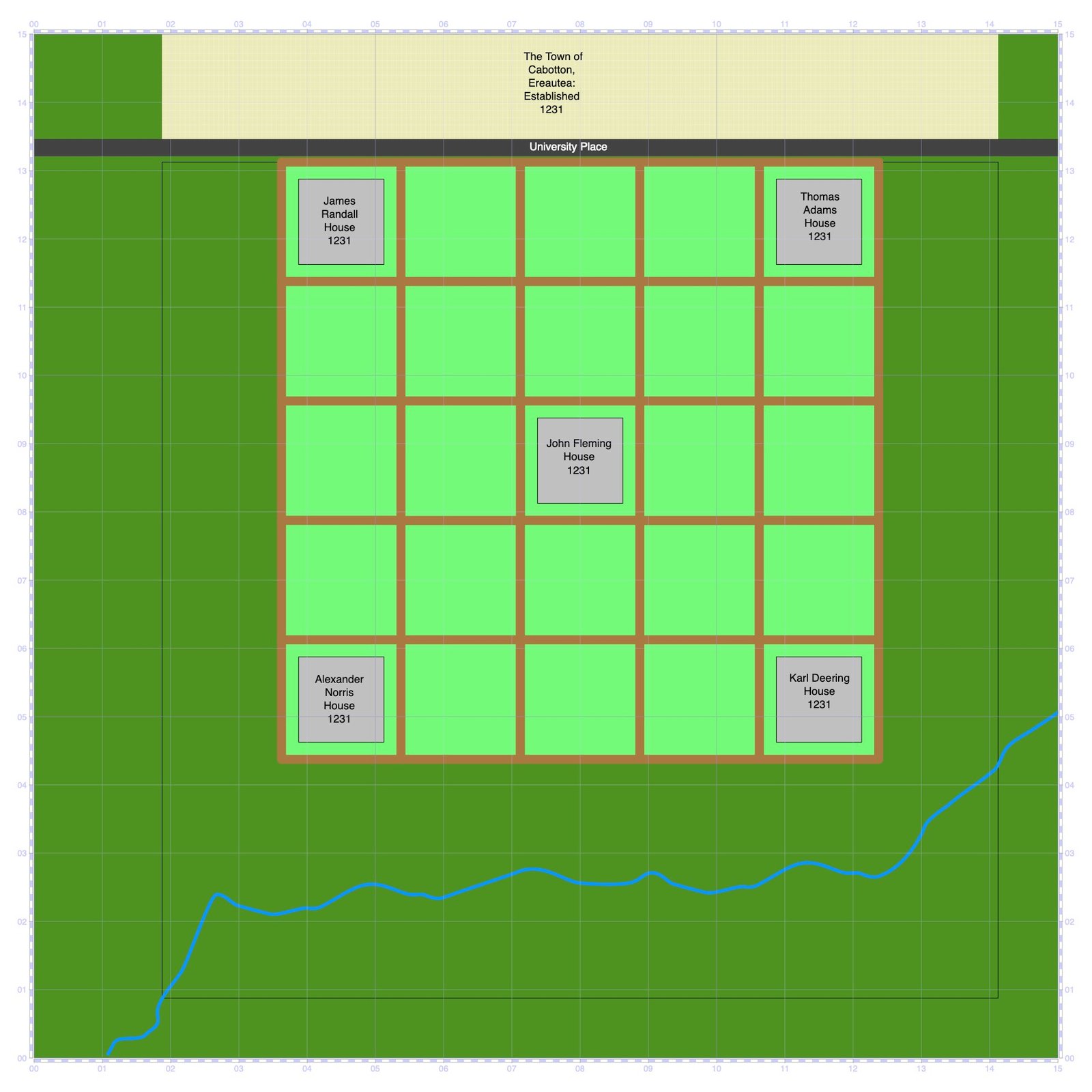
The Westerhill Institute of Academic Rehabilitation was "simple-oriented" in its structure, consisting of a vast grid of criss-crossing sidewalks over vast lawns. In each corner square, and in the center square, stood a large structure with a square base. Each structure had a center pillar-wing of rooms, and a pillar-wing in each of its five corners. And each structure was five floors tall. These structures were the Five Schools of the Institute, with the one in the Northwest Corner named the William Peck School of Grammar, the one in the Northeast Corner named the John Arthur School of Science and Spellfire, the one in the Southeast Corner named the John Cracker School of Mathematics, the one in the Southwest Corner named the Michael Kelvin School of History and Law, and the one in the Center Square named the Mack Schrader School of Citizenship. Each School consisted of classrooms on its First Floor and student dormitories on the remaining Floors. The overall design of the Schools and the grounds was designed to be cut-and-dry, as well as large and intimidating in order to incentivize student focus and discipline.
Every student enrolled in the Westerhill Institute was subject to the same basic curriculum: to present what one did to cause academic failure, to receive feedback from the assigned Schoolmaster (mostly shaming), and to complete an assignment schedule given by the said Schoolmaster, with said schedule involving "fundamentals" courses on the affected subject, courses that imposed intense lecture-and-drill. The assignment schedule also required each student to complete a sophisticated project which also involved writing long essays explaining how the student thought to complete each step. This would also be subject to harsh feedback from the Schoolmaster.
Robert Barrington served as the Headmaster of Westerhill Institute from 2 through 23 May 1231, after which he resigned and was replaced by Arnold Stone.
John Fleming, University Establishment
John Fleming was born in December 1208 and grew up in Bridgetown in the District of Ereautea, and pursued a career agenda to become a trade accountant. In 1227, Fleming graduated high school with good grades and enrolled in the local branch of the University of Ereautea. Fleming completed his college freshman year in 1228 with academic distinction, and was recommended to enroll into Bridgetown College, a school independent of the University system and reserved for honors students. Fleming excelled in Bridgetown College for his sophomore year, at the end of which he was accepted into their Upper Division program and assigned a field internship for his junior year. However, Fleming had a political falling-out with one of his peers during this internship, and was made to look as if he was academically incompetent. Fleming as a result was expelled from Bridgetown College and would later have his re-application rejected by the University of Ereautea.
Fleming would work a year as a groundskeeper for the Bridge but then accepted an opportunity he received by letter to enroll in the Westerhill Institute.
Martin Cross was born in 1211, and grew up in Jestopole, where he would pursue a career agenda to be a contract scriptfire planecrafter for the Edoran Kingdom. Cross graduated high school in 1229 and, like Fleming, did so with good grades. That year, Cross enrolled in the University of Combria where he, like Fleming, passed with distinction and was moreover recommended for Upper Division that same school year. For his sophomore year, Cross was tasked with completing a dymensional plane project and presenting it as a proposition to enter the Terredon Royal College in the neighboring Kingdom of the Great North. The project involved creating an imitation of the land and territory of the Duchy of Daylram set in the tenth century. And though it was deemed impressive by Cross' peers, it was utterly rejected by the Royal College, who wrote a scathing complaint to the University of Combria on this. Though the University of Combria did not discipline him over the complaint, Cross had a mental break from the outcome and largely stopped attending classes. The University of Combria would expel him for his resulting attendance issues.
Cross then received a letter to enroll in the Westerhill Institute.
Thomas Snow was born in 1212 and grew up in Ebony Valley in the District of Ereautea to pursue a career as an engineer in ebony and related hardware construction. Like Cross and Fleming, Snow graduated high school in 1230 with good grades, but decided to work one year for one of the Ebony Valley construction companies. In the summer of 1230, before he started his job, Snow trained for and attained his Spellcaster License, an achievement which he made known to his co-workers later that year. This led to abrasion with some of them, including the high manager's son, who set him up to take on an assignment that appeared to simply involve surveying territory to the immediate Northwest for ebony deposits. This turned out to be a set-up, a discovery that Snow and his fellow surveyors only made when they, during the trip out into the wilderness, encountered dangerous wysps kept and then released by the manager's son. One of Snow's surveying crew people ran off and went missing, while Snow saved the other two, discharging spells and killing two wysps in the process. They and the person that ran off were rescued, but the incident did not pass without consequence for Snow. He would later be charged with endangerment for not realizing the area surveyed was prone to wysps, and also be penalized for the killing of the wysps themselves as they were considered by the Remikran Union to be an endangered species. Snow had a lawyer who managed to reduce the sentence for the incident to simply a fine, but this would also result in academic implications later on.
Snow received good grades during his freshman year, 1230-31. However, the University of Ereautea received documentation regarding the wysp incident and the legal proceedings. Though they did not consider this a criminal disqualification, the University leadership cited Snow's apparent lack of knowledge for biology and geography to be grounds for requiring a "remedial exam" in those subjects. Though Snow knew the material, the wording of this exam led him to failing it. Snow was then made to reconsider his career path through an "aptitude exam." And while this exam was open-ended, it was possible for a student to fail it if they did not demonstrate measurable strength for any particular career path. Like the first exam, the wording of this second exam led Snow to receiving a failing score; and so as a consequence, Snow was destined to be expelled from the University system.
Westerhill Institute enrollment was selective in nature and was done by invitation. However, Snow, in the course of working in the ebony mining industry, had befriended Merlin Kent Ogden, who worked closely with the Institute and leveraged them into enrolling Snow.
And so in the summer of 1231, John Fleming, Martin Cross, and Thomas Snow became acquainted with one another.
Such a mutual acquaintance began with Cross and Snow, who were assigned roommates and were quarreling with one another over menial logistical matters. Fleming overheard the arguments and summoned Cross and Snow to his room, where the three of them shared their backgrounds and their common hatred toward the oppressive Combrian education system. Fleming was inspired by Cross' dymensional plane project and suggested that he and Snow build one here at Westerhill. Cross initially dismissed the idea as unfeasible, but Snow voiced disagreement, stating that Merlin Kent Ogden had the hardware and venue to build such an apparatus. Cross surrendered to the idea; and several days later, they met with Ogden, who agreed to the arrangement.
On 13 June 1231, Arnold Stone arrived at the Westerhill Institute to start his tenure as the new Headmaster. The next evening, he was visited by Cross and Snow, who were sent to him by the Master of the Kelvin School for poor academic performance; both students had failed an exam due to not being able to form words for answers quickly enough due to lack of sleep. Upon further investigation, Stone learned that the two students had stayed up late into the night working on the dymensional plane with Merlin Kent Ogden. In response, Stone asked to travel to 124 West Mason Street to see this dymensional plane project.
On 19 June, Stone made the visit to the venue, where instead of moving to shut down the project, Stone was impressed with it and requested to have it moved to the Library located in the Mack Schrader School. The next day, this move was made. And on 21 June, Cross and Snow presented this dymensional plane to the other Westerhill students, who took great interest. The following day, Headmaster Stone made an announcement to all Westerhill students and faculty that this dymensional plane project, now known as simply the Project, would serve as a central part of a new curriculum. Stone furthermore declared that all students and faculty would be termed equally as "Scholars" and that faculty were required to pose research questions and provide resourceful information. Stone also banned the oppressive grading system for academic performance and declared the Library open to all Scholars.
However, George Kormell, Master of the Mack Schrader School, reported Stone to the Combria Department of Education for "significant and detrimental educational curriculum deviations." The Education Department accepted the request to press this charge, and subsequently sent a letter to Stone on 13 September, dismissing him from the Headmaster position. Kormell was assigned as the next Headmaster, prompting waves of protests from the students.
As the new Headmaster, on 17 September 1231, Kormell announced his intent to re-instill the old lecture-and-drill curriculum. However, the students staged a mass-walkout and began forming human chains around each of the Five Schools, chanting "Bring back Stone!"
On 18 September, protests escalated, as students began throwing rocks and destroying property. The Masters of the John Arthur, Michael Kelvin, and William Peck Schools resigned, as Headmaster Kormell called in martial law, who, on that day, shot dead John Fleming during a heated confrontation in front of the Mack Schrader School.
This further enraged the student protestors, who, that evening, stormed the Schools under the Masters who resigned. They overtook the John Arthur School and renamed it the House of Thomas Adams, one of their still-living protest leaders. They also seized the Michael Kelvin School, renaming it the House of Alexander Norris, and the William Peck School, renaming it the House of James Randall.
On 19 September, the student protestors were joined by the former-miner town shopkeepers and the former-miners, both of whom held sympathy for the students and a common hatred toward the old Combrian system. The protestors that day stormed the John Cracker School and beat its Master to death; they would later rename this building the House of Karl Deering. In response, Kormell barricaded himself in his Office and refused calls to leave, and on 21 September, called in more reinforcements. This was countered with even more protestors, consisting of students and a growing number of allies. On 22 September, Kormell sent a ticker-text message to the Combrian government for a significant boost in money and resources to deal with this crisis, to which the government responded with a promise to do so.
Nevertheless, gridlock continued between both sides of the crisis, until 2 October, when Kormell was approached by George Cabot with a proposition to purchase the Institute as private property for a large sum of money. Kormell relented and signed a joint proposition with Cabot for approval from the Combrian government on this. The Combrian government approved the transaction, and, on 12 October, sent Kormell a letter granting him an honorable dismissal from the Headmaster position and a rewarding retirement.
George Cabot, on 13 October, transferred ownership of the Institute to Arnold Stone, who waived ownership to the Scholars. That day, they voted to rename the Institute to Cabotton University and also to rename Mack Schrader School as John Fleming House. On 2 November, the Cabotton University student body voted in a University Constitution, which mandated the University to be run democratically. And on 6 June 1232, Cabotton University began classes with its first Summer Semester.
Cabotton University would then begin its first official school year with a Fall Semester commencing on 2 September 1232.