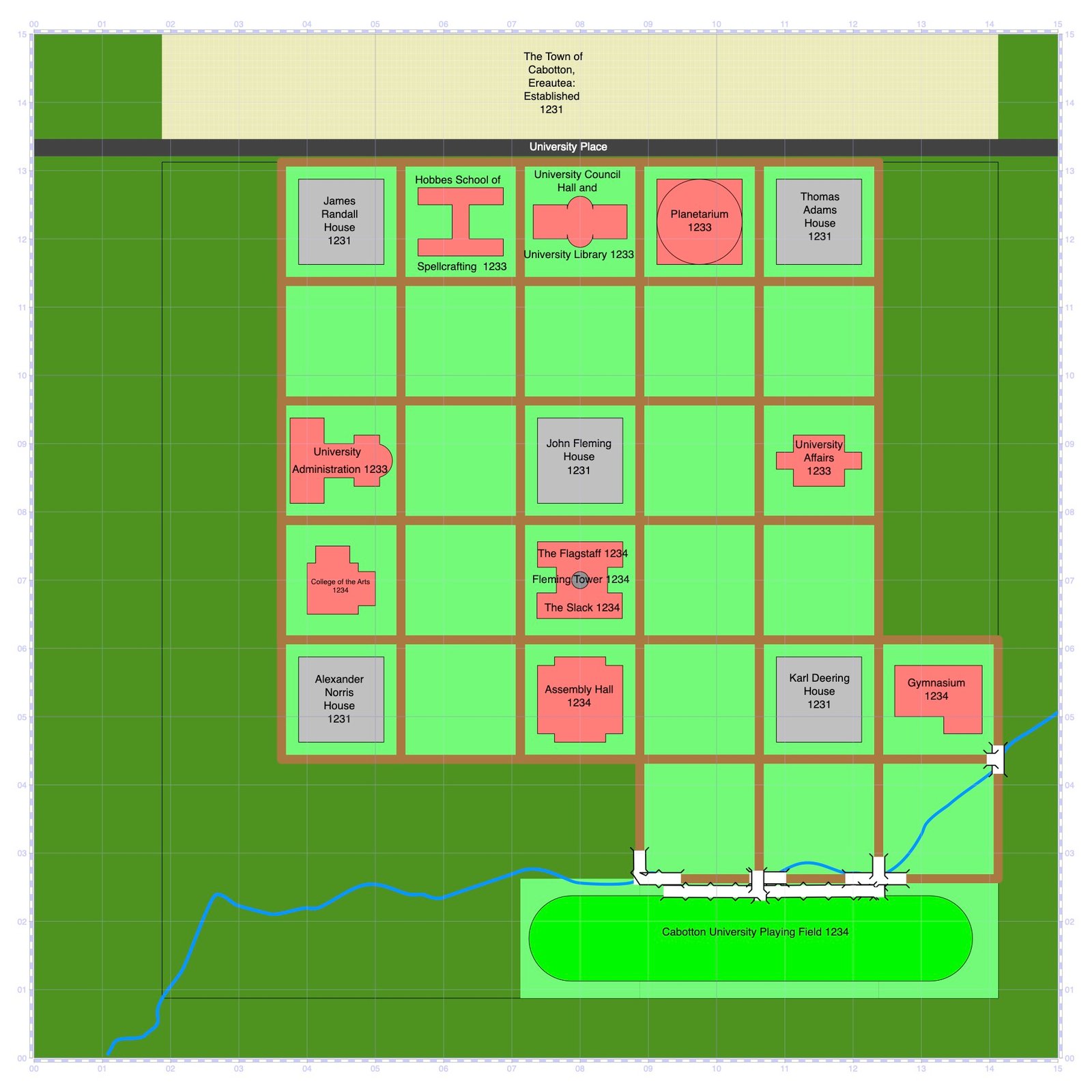
Cabotton University: 1232-33 School Year
Construction was not yet complete for the Hobbes School. However, by the beginning of Cabotton University's first Spring Semester in January 1233, there were enough rooms and corridors inside capable of housing classes, meaning that the school opened for its first unofficial semester. This was aided by the sealed pavilions around the premise providing venues to the classes whose rooms were not yet completed. And a chamber larger than the other classrooms, situated in the Southeast Corner of the school, served as a venue for spellfire practice and testing.
However, there was concern over this practice venue, with it being too small to handle the growing number of enrolled students. There was a long wait list by the month of May; so many began calling for a larger facility. Furthermore, Jon Fortin, one of the students, began voicing concern over the spellfire discharges being able to "influence" each other as they were cast in close proximity. Though this was a myth, Jon had a lot of supporters capable of swaying the University Council accordingly.
Meanwhile, Norris House and the University Administration Hall began to increasingly serve as a venue to the arts, primarily music, literature, theatre, and visual arts. Like with the Hobbes School, there were issues with overcrowding and difficulty scheduling class sessions in the limited availability of classrooms, despite the availability of the sealed pavilions. Overcrowding was also an issue for Fleming House, which had been the primary venue for assemblies and gatherings.
There was also the issue with the Yards. Certain sports, especially the game of handball, played informally between University Houses on a bet-and-schedule basis, were becoming more popular as the students and teams involved reserved certain vacant squares for set tournaments. The Yards would become muddy, or even flooded, in wet weather, while such scheduling and reservations began growing evermore chaotic.
Vested in the University Constitution was a provision for the freedom of student expression. As a result, there emerged a few student-run pamphlets and journals circulating through the student body. Of note was a platform headed by Bryan Cards, who advocated for Cabotton University to establish a University handball team mascot and compete against other schools in the Circlarian hierarchy; and this platform was countered by one run by Coleton McKennan, who advocated against such a thing. Kenzie Stakes had a platform of her own, advocating that the University should focus on other priorities other than sports, and voiced, furthermore, a call to stand with Sedryth Grey and return the vacant Yards back to the Emoran Community. Dorian Glockett was against such attention given to sports as well, but opposed Stakes, calling for an expansion in University real estate to provide a better venue for future students. All of this led to certain groups of students gravitating to certain platforms, a matter which members of University Council grew concerned would threaten the integrity of the student body with biases and misinformation.
The Second Construction Project
On 2 February 1233, even before construction was completed on the First Renovation Project, George Cabot and his donors came forward with a proposition for a Second Renovation Project to take place between June 1233 and June 1234. This new project called for the construction of a new Spellcrafter Gymnasium, a separate College of the Arts, a John Fleming Memorial Complex, a new Assembly Hall, and a new designated Playing Field.
The next day, University Council commenced debates, first on the construction of the Spellcrafter Gymnasium, which was originally going to be built in the Yard square South of the Hobbes School. However, as mentioned above, Jon Fortin pushed the myth that numerous spellfire-casting sessions in close proximity with one another would have unpredictable influences. Though scientific studies have consistently proven this false, Fortin swayed the Council with fear, alongside financial lobbying from his family members, to have the Gymnasium constructed, instead, on a new Yard square on the Southeast end of the University Campus. Sedryth Grey objected to this, citing that this would force more trees to be cut down, breaking the promises made before to the Emoran Community. With this the University Council High Scholars Delegation was, once again, at a tie and impasse. Thomas Snow broke the tie by voting in favor of the University Constitution being amended to allow for the building development. Furthermore, the same amendment allowed all wooded areas on the University property to be subject to the same. James Randall, Thomas Adams, Alexander Norris, and Karl Deering added to this by leading the Council to approve more wooded areas cleared for the construction of the Playing Field. They had chosen that specific location with the intent that future athletic events would not disrupt the academic functions of the University. And thus on 5 February, Council approved construction of the Gymnasium and Playing Field to take place starting that June.
The College of the Arts, intent to house the music, literature, theatre, and visual art programs, was originally proposed for the 1232-33 Renovation Project. However, Kirk Morris, the Head Scholar of the Cabotton New Music Society, had advocated to have added to the building a larger ensemble room as well as an indoor congregation area to encourage the mingling of students between the multiple programs. The involved architects intended to implement these changes as requested by the majority vote of University Council, and thus construction of said College of the Arts was pushed until the Second Renovation Project. Only Sedryth Grey and a handful of Council members were opposed, so the College of the Arts plan passed University Council the same day, 6 February.
Debates began on 7 February regarding the construction of the John Fleming Memorial Complex and the new Assembly Hall. However, Sedryth Grey, that day, asserted herself and demanded a hold on these debates so that she could take the floor and speak on behalf of the Emorans whose land on the University grounds was being impacted. Thomas Snow explained to her that he was aware of her stance and that the Council would not support her, thus justifying that Grey would have to wait until after the voting rounds were concluded on the Renovation Project. Grey, in response, made a call to the Council chamber to vote to override Snow's argument, but the Council Chamber Mitigator stopped the override vote from happening. As a resolve, Grey, starting 11 February, led numerous supporters in the Council to stage a walkout, preventing the High Scholar Delegation from being able to carry a quorum to continue the Renovation debates.
However, Meodra Caemo, leader of the local Emoran Community, opposed Grey's initiative on the walkout, insisting on more gentle means to make their voice heard. Grey insisted that the walkout occur as the more gentle approach would be ignored, but Caemo refused to negotiate further. Grey, in response, opted to have herself and the other protestors dress up in Emoran clothing and make-up and carry out acts of vandalism on University property, with the supposed intent of creating incentive for those in the Emoran Community to join. This, of course, would lead to a falling-out with the Emoran Community in time to come. Regardless, Grey responded to Thomas Snow's calls to cease the walkout with the argument that she and her allies would return to the Council meetings as soon as Snow voiced his intent to have the Council hear her arguments regarding the Renovation and the Emoran Community.
The walkout continued to derail University Council debates until 19 February, when George Cabot intervened and paid Grey's opponents, both those from Thomas Snow's circle and those from the Emoran Community, to circulate negative publicity against Grey. Cabot also paid some of Grey's supporters in Council to resign, prompting the University Affairs Office to call for special elections held 24 February, resulting in the vacancies being filled by those loyal to Snow. Thus, the High Scholar Delegation was now able to carry a quorum once again. On 2 March, they convened and passed the remaining provisions of the Second Renovation Project despite Grey and her remaining supporters not being in attendance. Grey's walkout concluded on 7 March to no avail.
Cabotton University Mascot, Sedryth Grey's Downfall, and Completion of the Second Renovation Project
Sport tournaments, early on at the University, were carried out on an incidental bet-and-schedule basis between Houses. Usually, an assembled team from one House would make a bet against that of another House. They both would then approach the Head Mediator of University Affairs, who would schedule a time and a place in the University Yards for the tournament to take place. This followed no hierarchy or set schedule, and the University did not have any teams at the time to play other schools in Remikra or Circlaria. However, some Cabotton University handball athletes began calling for the University to have a proper team. They argued that this would encourage student unity, and would be appropriate since now there was an actual Playing Field being built.
On 5 May 1233, an official proposal was made by Thomas Adams to the University Council for the funding and establishment of the Cabotton University Stags as the official handball mascot. Sedryth Grey opposed this, stating that the stag was a symbolic animal of the Emoran Community and that having such as a mascot risked expressing an insult to them. In response, University Council voted down the measure and called instead for the establishment of a new University mascot: the Wrayth-Hunters. Grey decried that as a derogatory term against the Darkfire Community, though it would be years before mainstream Middle Remikran society considered the term as such. Like before, Grey was denied floor time. And on 11 May, Grey and her remaining colleagues in Council staged another walkout.
However, the University Council was still able to carry a quorum, and passed the measure to establish the Wrayth-Hunter mascot on 15 May.
Grey campaigned for re-election to her seat in the University Council, expected to take place on 8 October 1233. However, her perceived "disorderly conduct" during the walkouts made her rather unpopular with the Cabotton University student body. Furthermore, she had lost the respect of Meodra Caemo and the Emoran Community, who viewed her dressing-up in Emoran make-up and clothes while carrying out such of vandalism as racist and misrepresenting of the Emorans and serving only Grey's personal interests. George Cabot and Thomas Snow reached out to Caemo for a conference excluding Grey. Such a conference would lead to concessions between both the University and the Emoran Community. Caemo, furthermore, endorsed Dorian Glockett, who was running against Grey in the seat election but had taken part in the concessional agreements with the Emorans.
And thus, on 8 October 1233, Sedryth Grey lost re-election to her Council seat to Dorian Glockett. Seeing no allies or supporters any longer, Grey relocated to the Basin District.
Construction on the Second Renovation Project began on 1 June 1233 and was completed 1 June 1234.