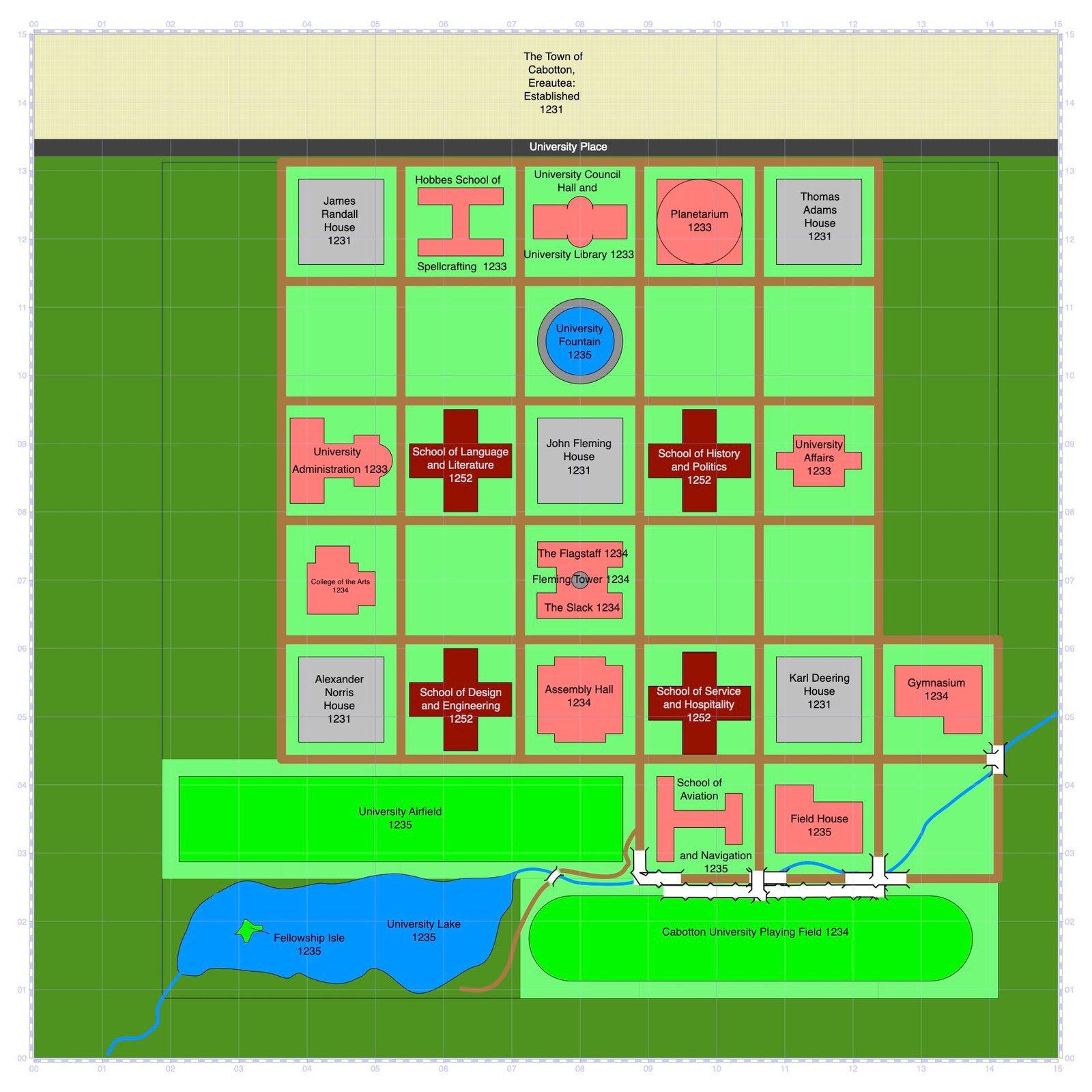
1235-37
As mentioned before, the curriculum at Cabotton University during the 1230s was very much similar to the structure of the present-day National Institute of Research and Development. Every semester, each Department would publish a "big question," open for two-sided debates among students or student groups. Such a curriculum took on enlightening ideas spurred by an international lightfire conference held on the Campus in February 1236. Meanwhile, students of the School of Aviation and Navigation as well as the Hobbes School of Spellfire-Crafting took on projects involved in the establishment of New Hasphitat to design buildings, roads, boats, watercraft, aircraft, and numerous pieces of infrastructure. Such projects in the end would be either approved or rejected by the majority vote of their particular class before being subject to the same kind of vote in University Council.
Also during this time, resentment in the Cabotton University Scholar Body against the establishment of the Chartered State of Combria had been mounting, especially around the issues of taxation, long-distance wars, and treatment of the working class. There was also concern, as lack of knowledge on the matter lead to fears, about the discovery under the University Grounds of a darkfire quarry branch leading to the main quarry hub under Mount Carris. In March 1237, Arthur Dickens, Head Arbitrator of University Affairs, cited these concerns, along with concerns over the lack of unity and integrity in the "piecemeal" academic programs, in a call for the Scholarly Body to elect a first-ever University Headmaster. That same evening, Thomas Snow stepped forward and announced his candidacy.
However, Snow was not alone. Outspoken Council Members James Randall, Thomas Adams, Alexander Norris, and Karl Deering, after whom four of the Five University Houses were named, stepped forward with Headmaster candidacy announcements as well. Shortly thereafter, Randall withdrew his announcement to throw his support behind Norris while Deering withdrew to support Adams. After pre-election polls showed Adams being the most popular opposition candidate against Snow, Randall shifted to throw his support behind Adams while encouraging Norris to withdraw and do the same. However, Norris refused. This, of course, led to there being three candidates running for the Headmaster role; and in accordance with the Cabotton University Constitution, if a student body election failed to yield a majority vote for any one particular candidate, the candidate with the most votes would become the nominee. Despite being rivals still, Norris and Adams formed a coalition to call upon University Council to amend said Constitution so that in the event of no candidate winning a majority, the University Affairs Arbitrators would instead make judgements accordingly based on a meticulously-crafted process of elimination. Meanwhile, Norris and Adams worked together to ensure that of the three candidates, Snow would get the least amount of votes. However, Norris and Adams struggled to get pledges from the student body.
While the Planetarium housed mostly astronomy and astrophysics classes, it also began increasingly to serve as the home to a growing number of geography classes. A popular research group from there had been approved to venture to Lake Maern National Park to study its terrain as well as its weather patterns. However, in the summer of 1237, the Combrian government closed the National Park due to high numbers of darkfire floans reported there as well as concerns over a figure named Holz Finzi having recently fled institutionalization and established effective residency on Mount Carris. Specializing in Finzi and darkfire, however, was a first-year student named Ivella Ogden, who was granted an exception from both University Affairs and the Combrian government to visit the area. In September 1237, Mount Carris discharged a large volume of darkfire floans, triggering a moment of panic across the University as well as all of Combria. Ogden had afterward returned to the University with insight suggesting that darkfire was not as harmful to the human mind as may be believed by the authorities. Thomas Snow backed Ogden's claims. However, both Ogden's class and the University Council rejected Ogden's findings, leading Ogden to drop out of the University and pursue other career interests.
Despite the controversy over Ogden, Thomas Snow won with 75 percent of the vote on 16 September 1237 as the first Headmaster of Cabotton University.
The Retunian Revolution, The Campus Watch, and The Reserve Corps
In the wake of the Mount Carris incident, two labor rights figures, Thomas Reyshack and James Shawtun, were falsely deemed responsible for "darkfire cartel conspiracy" and were shot on-site in New Hasphitat by the Combrian National Guard, sparking outrage in the region. On 23 February 1238, the population united and overthrew the local Combrian authorities, declaring the region to be the independent Retunian Republic.
Headmaster Thomas Snow wrote an open letter to the leaders of this Revolution, applauding their actions. Those of the Cabotton Scholarly Body once opposed to Snow stood with him on this sentiment, a move of political consolidation that would help Snow to win re-election in 1243. Cabotton students in celebration of the formation of the Retunian Republic held a rally on 02 March 1238 in front of the Fleming Memorial, where Snow attended and gave an inspirational speech. The Combrian Department of Education deemed this response "disorderly in nature" and Snow a demagogue in a letter of their own. Headmaster Snow then got a letter from the Combrian Department of Justice asking that he withdraw the statements he made thus far regarding the Revolution, which the Justice Department considered acts of sedition, and otherwise threatened to place the University Grounds under martial law as soon as Combria re-gained control of the region. Snow responded by saying that he was an elected individual speaking on behalf of the student body, and furthermore emphasized that the Retunian Republic was an independent nation over which Combria no longer had jurisdiction.
However, as the year 1238 wore on, the Retunian Republic struggled to hold onto its territory against the relentless Combrian forces. Though no attacks were made against the University itself, Snow was concerned with the threats made by the Combrian Justice Department as well as rumors of loyalist insiders on Campus. So on 17 April 1238, he signed an order to establish the Campus Watch, intended initially as a temporary task force to defend the Campus against hostile entities as well as detain and expel insiders within the Campus perimeter. A coordinated Retunian offensive later that year pushed Combrian forces further East, though; and in March 1239, the Chartered State of Combria surrendered nearly all Ereautean territory as it formally recognized the Retunian Republic.
This left for the Retunian Republic only one other threat: East Wannonia. East Wannonia had taken over Provincial Combria and was seeking to reclaim former Wannonian territories, which included Gentry County. In response, Headmaster Snow ordered the establishment of the Cabotton University Reserve Training Corps, who would later be dispatched in 1242 to defeat the last of the Wannonians in the city of Ligam.
Both the Watch and the Corps were scheduled to terminate on 23 May 1243. However, an incident involving a darkfire cartel having occurred less than a mile from the Campus prompted fears leading Snow to authorize both organizations to continue functioning till the end of the calendar year. And then came the incident of 124 West Mason Street during which Ivella Ogden went missing. Independent investigator Daniel Carter hunted down the culprit, who was yet another darkfire cartel leader, and had him captured. This led Snow to authorize yet again for the Watch and the Corps to continue functioning till the end of May 1244. On 18 January 1244, Cabotton Scholar Peter Bryer brought a formal complaint against Headmaster Snow to the University Affairs Office, alleging that Snow was effectively turning the University into a police state. After two days of discussion, the Arbitrator Board concluded that not only was Snow within his rights to extend the timeline for the Corps and Watch, but also that the University Council had a right to vote both organizations in as permanent institutions of the University apparatus.
On 16 March 1244, the University Council did just that, and Headmaster Snow signed the policy into effect. Two days later, the Peter Bryer camp staged Campus-wide protests, which were ultimately broken up by the Watch.
Martin Cross: 1249 Election and Early Tenure
Peter Bryer's camp made up only half of the Cabotton Scholarly Body, however. The other half supported the idea of the Campus Watch and Corps, and even called for the Campus Watch to expand its duties following the Daniel Carter and Ivella Ogden incident of 1243.
Another controversial issue was Cabotton University's research-based curriculum. Though democratic in nature, the curriculum had its naysayers who alleged that some classes played favorites to certain students. This gave birth to a calling within the student body for a more traditional education curriculum, one involving lecture, examination, and a grade scale, all in the name of educational stability. And there was also a growing call for new buildings to be constructed to house the increasing number of new classes in more diversified subjects, primarily those in writing, history, engineering, and hospitality. This latter issue was especially opposed by Thomas Snow and his faction, who voiced concern over the financial costs of such construction.
In late 1248 emerged Martin Cross, once Thomas Snow's close friend but now political rival, announcing his candidacy for the Headmaster election of 1249. Cross promised to either eliminate or reduce the power of the Campus Watch, establish the aforementioned traditional curriculum model, and initiate construction of four new schools: the School of Language and Literature, the School of History and Politics, the School of Design and Engineering, and the School of Service and Hospitality.
With the majority of the Cabotton Scholarly Body believing that his agenda would lead to academic excellence, Martin Cross defeated Thomas Snow and was elected the second Headmaster of the University on 16 September 1249.
Shortly after beginning his tenure in January 1250, Headmaster Cross received communication from Retun that grants would be awarded to the University for having a functioning Campus Watch and Reserve Corps. Cross decided, in that case, not to pursue termination of either program, but did sign policies clarifying their power limitations. Under Cross' leadership, policy establishing a traditional education curriculum was passed and signed, and went into effect in the Fall Semester of 1250. Cross also followed through with his promise to build the aforementioned four new Schools on the Campus, with each building four levels tall. Construction on the four Schools started in Fall 1251 and was completed in the Spring 1252, with classes starting that fall.