Influential Events
A growing number of Members in the Third Level Society began, in the 1260s, calling for the creation of a medieval version of the Arturian Realm. This was supported by Meona Bell but such support never resonated with Society leadership or the majority of its Members. However, interest was voiced by Marcus Terrings and Jon Beyon, who invited Meona Bell and her supporting colleagues to travel to Cenofan in Canticula to discuss implementation of the agenda. The city of Cenofan would serve as the Headquarters for the leadership of this new project while dymensional plane servers were established in all the trading ports of the Midland River States. However, such an agenda would be short-lived, as the Lykian Republic overtook the Midland River States as well as the neighboring Chokian Republic, forcing Bell and her colleagues to disband the project. While a few of her colleagues left, a few remained and joined Bell in relocating to West Terredon, Combria. Here, the dymensional plane initiative evolved into an agenda of building a 10th-century version of Remikra. Meanwhile, Meona's colleagues informed both Cabotton University and the Basin District of the turn of events having taken place in South Canticula; however, the response was surprisingly indifferent. Combrian and Retunian society had largely sided with the alliance in North Canticula during the First Continental War from 1221 to 1226, a conflict won by the alliance of South Canticula. With North Canticula and its allies made to respect South Canticulan nations' call for independence and self-determination, Combria, the Retunian Republic, and their allies left South Canticulan nations to their own affairs, both good and bad. The Retunian Department of State voiced the same attitude regarding the Lykian takeovers; and even the press did not give South Canticula any attention. Cabotton University leadership voiced the same attitude and turned down funding for a group of Cabotton students friends with those working with Meona Bell to travel to the region to give aid.
***
Meanwhile, the Airship Cardian, a First-Generation Traditional Airship, left its base in Clareon, territorial capital of the Mid-Westerlies, to carry out a map survey expedition to the West, scheduled to occur between 5 and 8 June 1263. The vessel was piloted by Captain George Connin and was accompanied by Cabotton student, Jerris Brown, who was leading the survey project. On 6 June, they reached their survey area but, with a slightly-off prediction made by the National Weather Bureau, got caught in a cluster of thunderstorms. The airship navigated its way out of this weather system without major incident but had to make course corrections in order to return to Clareon. Brown, during this time, took an opportunity to salvage what he could from the failed mission, and took pictures of a cluster of isles he spotted out of the starboard side window.
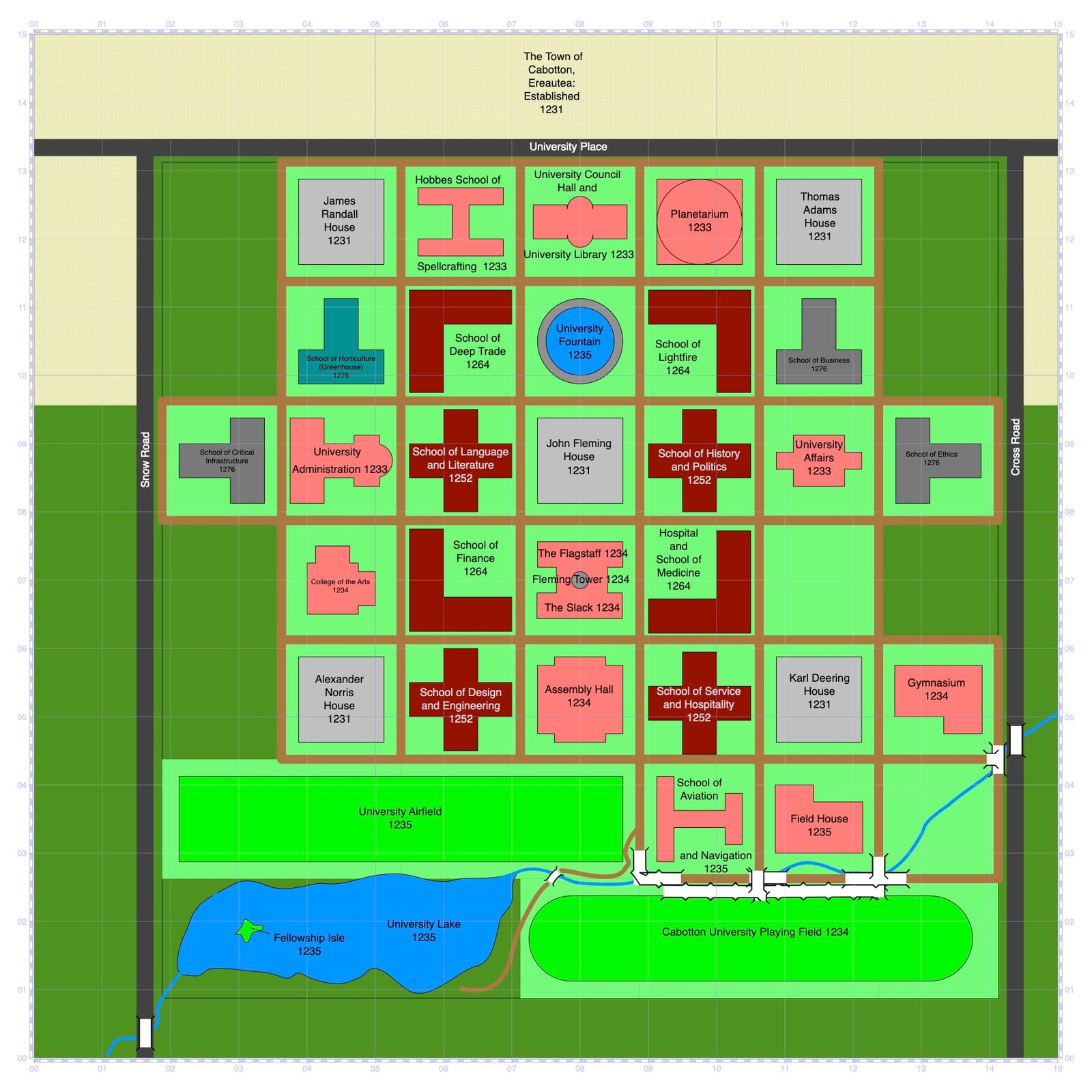
The Cabotton University Planetarium was home to the Astronomy Department, which included the Planetary Curriculum, which, at the time, was divided into the Juno Minor Geographical Studies and the Extraterrestrial Geographical Studies. Dr. Dorian Linder was the head of the Juno Minor Geographical Studies and was known for having a constructive education approach as well as a relatively lax approach to grading. Jerris Brown was Linder's doctoral student, and therefore, in September 1263, submitted the Airship Cardian mission photographs to Linder for evaluation. Both Brown and Linder determined that the isle cluster photographed was already on standard Circlarian maps but that the shape and placement of each isle needed to be re-evaluated in terms of accuracy. Brown and Linder would submit such a proposal to the Retunian National Geographical Survey Program, or the RNGSP. The RNGSP, in turn, rejected the proposal due to inconclusive attributes with the photos. Linder and Brown determined to work on a re-submission, but other priorities led the ordeal to being effectively shelved.
Dr. Linder retired in the Spring of 1267, and was succeeded, that Fall, by Dr. Henry Roh, who was said to have a personality exactly the opposite of Dr. Linder. According to colleagues, Roh was short in stature, had a high-pitched voice, and also had a long beard. His curriculum focused on holding his students accountable toward high standards of academic excellence, as Dr. Roh assigned his students more projects and assignments, all of which were significantly more ambitious than those of Dr. Linder. Dr. Roh was also more intense on grading, as he also imposed strict evaluations on students for demonstrated passion in their studies and their willingness to go above and beyond what was expected of them. Needless to say, some students in this department, especially those who had grown close to the now-retired Dr. Linder, had grown to resent Dr. Roh.
Dr. Roh also focused on "cleaning up some of the loose ends" present during Linder's tenure. In doing so, he pulled the photos taken by Jerris Brown of the isles from Airship Cardian mission of 1263, and, after further study, made a realization based on the time of day, angle of the sun, and the reported position of the Airship, that the isles had not yet been charted. He also noted in the photograph a range of cliffs and mountains faintly on the horizon in the background. Dr. Roh contacted Jerris Brown, who agreed to join him in making a case to the RNGSP, who, in November 1267, gave Roh and Brown funding to lead a joint survey trip to chart the new lands. The survey would take place in March 1268 during which 150 miles of new continental coastline were photographed and mapped. The resulting maps and photographs were submitted to the RNGSP, who called for a Conference with Roh and Brown. Said Conference would take place in the Great Hall of Cabotton University on 5-8 June 1268, where it was decided that the new continent would be named Ancondria, meaning "eternal land" in Indigenous Remikran Vernacular. This garnered international attention, and between 3 and 19 October 1268, Cabotton University would join numerous other Circlarian schools and national governments on a mass survey mission to map Northeast Ancondria, the ruins of Edom, and the perimeter of the remainder of Ancondria, which was found to be a larger landmass than all of the other Circlarian landmasses combined.
***
According to Alconist religious doctrine, Braeus Alconus died, was resurrected, and gathered the "good spirits" to travel with him on a thousand ships to the Holy City of Edom to be with the Almighty One for eternal life. Numerous other religions also mentioned a fabled "Holy City of Edom" from where came the divine, as the said place was the source of enlightenment and salvation for humanity. The existence of Edom was, over the years, debated among scholars and religious figures alike, for there was no known location for the aforementioned "Holy City."
However, on 18 October 1268, another survey airship discovered the ruins of Edom in Ancondria. Initially, the team figured that the site was like that of the other Ancondrian city ruins found, but that this site was the largest. It was during the return trip that Sandra John, a Cabotton University student, made a leap, saying that the layout quite possibly bore a resemblance to the fabled Holy City of Edom. Dr. Roh and Jerris Brown studied the findings and confirmed John's theory, leading the RNGSP to provide funding for an on-ground survey, which would start on 19 March 1269. Over the years and decades that followed, countless maps and photographs would match up with consistencies spanning past myths.
The fact that Edom was found abandoned and ruined, however, did not resonate well with religious figures, primarily Alconist-Evangelists, who publicly denounced the findings as blasphemy.
Stipulated in the Homestead Act of 1231, a document signed in Cotts to bring an end to the Great Unrest in the Kingdom of the Great North, was the establishment of the Remikran National Debate Committee, or RNDC, in 1232. The first debate held by that organization was held that year, and debates would be held every four years going forward. The RNDC Debate of 1-8 November 1268 was held at the University of Daylram and focused on the question: "Should those individuals under the legal age be permitted to train in 'mock spellcasting' in order to help prepare for proper spellcaster talisman training when they reach legal age?" To note, the settlement on the debate was that such was permissible so long as there was a national standard in place. Though a controversy, the heat of this debate paled in comparison to the RNDC debate of 1-8 November 1272, which took place in the Great Hall of Cabotton University and centered around the question: "Were the ruins and artifacts surveyed in Ancondria between 1268 and 1269 those of the fabled Holy City of Edom?" Thousands of people from outside of the Retunian Republic, representing both sides of the debate, had makeshift tented encampments on and near the University campus during this time, despite directions from University Administration. And in the Great Hall, there carried out an orderly exchange of arguments, counter-arguments, and rebuttals, all of which were closely moderated by a Dialogue Control Board. As per protocol, at the end of the debate, all registered audience members were called to cast a vote on which side held more sound arguments. Said vote occurred as scheduled on 8 November, and the argument supporting the secular scientific studies was voted by the majority to be true. This angered those who had sided with the religious arguments, particularly the Alconist-Evangelists from Linbrae, who lashed out and sparked a riot that overtook both the Campus and the town of Cabotton proper. This forced town and University leaders to call on the federal government for martial law, who did not quell the uprisings completely until 10 November. The groups responsible were publicly condemned by Headmaster Cross, Prime Minister Jackson, Great Northern and Remikran Union leadership, and even lead clergy figures of the Linbraean Church.
***
A deep-trade agreement established in 1272 between the Retunian Republic and the Acrean Kingdom led to numerous economic benefits. However, revolutionary groups, between 1272 and 1273, overthrew the Acrean Crown and established the Acrean Republic. And in doing so, the new Acrean government terminated the deep-trade agreement, triggering a decline in the Retunian tradestone markets. North Kempton was especially hit hard by this, and had a resulting collapse in its economy as well as its financial institute: WestMar Bank. In 1272, Cabotton University had signed a contract with WestMar Bank to have a portion of its tradestone dividends go toward a Non-Profit Academic Trust Bond. The Acrean Fallout between 1273 and 1274, and the resulting economic collapse of North Kempton led said Trust Bond to actually cost the University financially in a significant way.
Meanwhile, Prime Minister Jackson publicly refused to recognize the Acrean Republic and considered the Acrean Kingdom the victim of a coup as well as the Crown a "government in hiding." He invoked a Congress of Circlaria stipulation to declare war on the Acrean Republic in order to protect and preserve the now-deposed Crown. However, the war effort proved fruitless for the Retunian Republic, compounded by the fact that the Crown, itself, submitted surrender to the Acrean Republic on 4 June 1275. That day, Jackson conceded and signed a treaty with the revolutionaries, thus ending the Acrean War and leading the Retunian Republic to formally recognize the Acrean Republic. This would, of course, leave the economy of the Retunian Republic, as well as the financial situation of Cabotton University, under strain.
University Policy Stagnation
Martin Cross would be re-elected as the Headmaster of Cabotton University in 1267 and then again in 1273. In 1269, he signed policy to establish the Academic Standard Committee, which was designed to hold students academically accountable in order to prepare them for the lightfire market trade standards that the Retunian Republic shared with Furthing and the Circlarian Maritime Councils. This Committee garnered a mixed reaction from the student body, with half of the population supporting it and the other half voicing resentment over Cross overreaching in terms of academic standards. Disapproval also became prevalent with significant portions of both halves over Cross' handling of the 1272 Scholarly Debate Riots, with the half who opposed him decrying his decision as excessive in terms of imposing a police state and the other half decrying him for not doing enough. There was also resentment against Cross' decision with WestMar Bank in 1272, which had led to financial strain on the University in the wake of the Acrean fallout. Up to this point, the University Constitution had a principle against engaging in for-profit business; however, the same provision allowed for such behaviors if they would go toward a non-profit effort, which had been the deal with WestMar Bank. However, in 1274, in an act of embarrassing consolation, Cross signed a policy to not allow such non-profit engagements if they involved tradestones.
Said fallout and growing resentment did not begin, however, until shortly after Cross' Headmaster re-election in 1273, meaning that he would be leading as a University Headmaster to deliver on a call made by a large portion of the student body to expand the University. The 1276 Resolution signed by Prime Minister Jackson promised a federal financial package to the University to help more solidly establish education programs to help prepare students for the growing Circlarian lightfire trade market.
This provided a financial boost considering the situation with the new and emerging programs at the University. Numerous training classes emerged for the speciality of Critical Infrastructure over the years and were held initially in the wings of the University Administration Building. This proved to be an issue due to the growing number of recruits making scheduling and venue availability progressively difficult. Meanwhile, in the Juno Minor Studies program in the University Planetarium emerged a growing number of students and classes on the subject of Horticulture, which presented a similar issue. Furthermore, as part of the requirements involving the Academic Standard Committee, every School on the campus housed classrooms for business and ethics courses; although the subjects those covered were not always in the same building as the subject study they addressed, leading to erratic schedules particularly for upper-division students.
Student Tuition
These issues grew especially important during the Fall Semester of 1274. At that point, there was a call to build new Schools to house the new classes, and Prime Minister Jackson, though still a while off from the 1276 Resolution, had promised a federal package to help pay for such an expansion. All of the combined funding was outpaced by the mounting expenses and mounting economic losses of the time, forcing Cabotton University into financial strain as to endanger its ability to operate without loans. To this point, there had been an unwritten principle against the University taking out loans, and an explicitly written University Constitution principle against charging students tuition. However, latter had an exception which allowed the Administration to impose said tuition on students should financial matters leave no other option; however, said exemption dictated that this must be temporary and only for the duration of the financial emergency.
A proposition to invoke the tuition exemption was brought to University Council in October 1274, during which took place long-winded and intense debate over the matter owing to its intense controversy. On 6 November 1274, the University Council passed a measure to invoke the exception clause and impose a per-student-per-semester tuition of 483.84 credits, a measure signed by Headmaster Cross later that evening. On 7 November, Cross made a public statement on the matter, assuring the student population that this would only last through the Spring Semester of 1276. Later on, in the face of growing criticisms, Cross made a private remark that he would retire at the end of his ongoing term in December 1279.
Construction began in June 1275 on a new School of Horticulture (the Greenhouse) on the Northwest end of Campus, a new School of Critical Infrastructure on the West end of Campus, a new School of Business on the Northeast end of Campus, and a new School of Ethics on the East end of Campus. Said construction would be completed in May 1276.