Jon Den: Further Actions
A Cabotton University student named Heather Walker declared, through underground communication networks to the Cabotton student body, that the decision by Jon Den to downsize the University Council was the beginning of a policy to end democracy for the University. In response to this, a large of students on Campus held conferences during which they made a plan to accompany those elected Council Members deemed illegitimate by Den to sit in the Council Chambers alongside their colleagues beginning 2 January 1360. This plan, in other words, was "to enforce the University Constitution by force of the masses." Also according to the plan, Arbitrators would be elected and accompanied by the protesting students to occupy Arbitrator seats in the University Affairs Office, an act done through the same means.
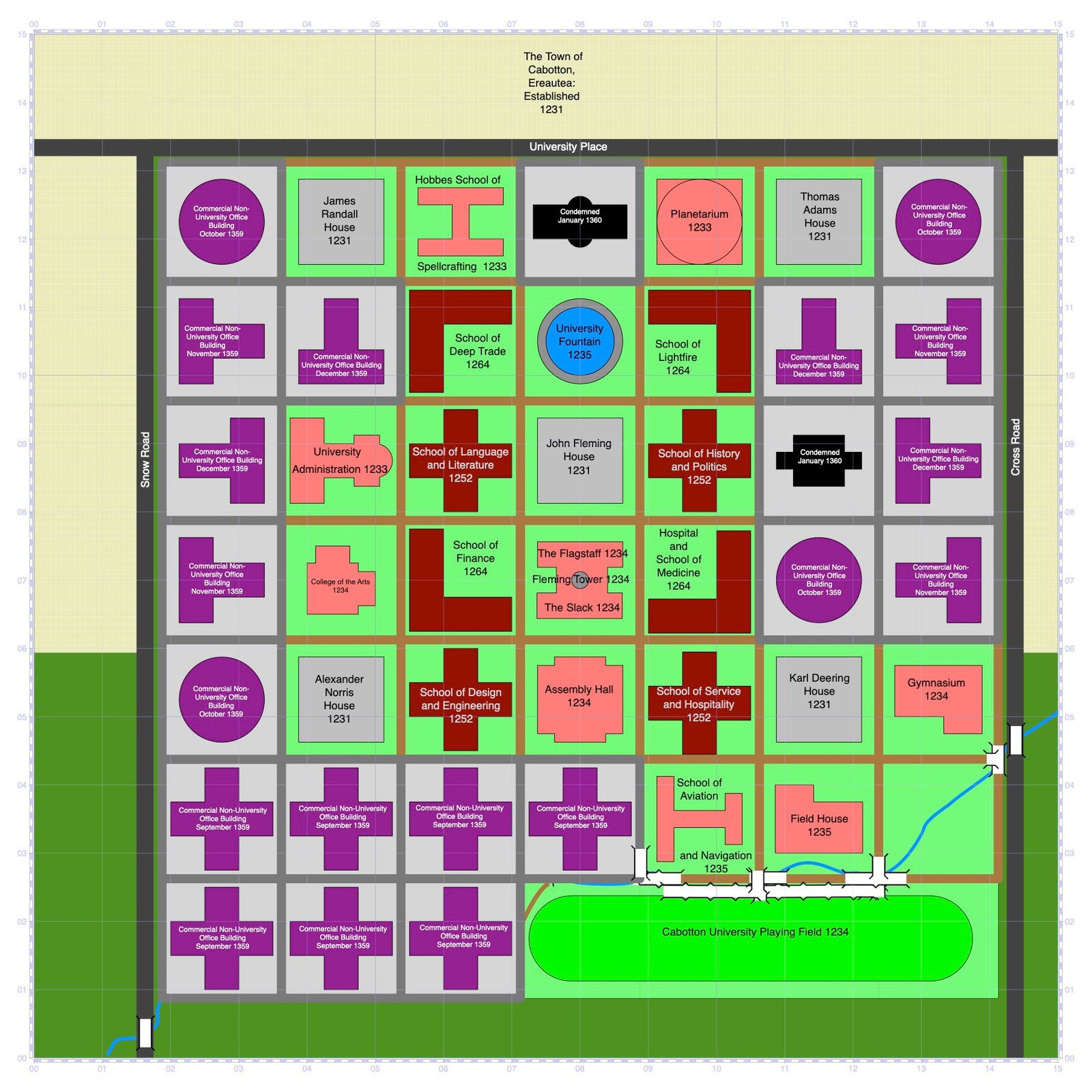
The University Administration received news of this effort and, in response, declared that the University Library, Council Chambers, and University Affairs Office would be placed under "condemned" status; that all of its assets, including library books and high-value University relics, would be sold; that the buildings would be demolished; and that the property on which the buildings sat would be leased to non-University businesses, who would have permission to construct new buildings.
Student Resistance: January 1360
On 2 January 1360, the protesting students, led by Heather Walker, forced their way through entrance barriers into the University Council and University Affairs Buildings. In the Council Building, protestors were confronted by a squad of Esurchian Scouts, who drew out their guns and opened fire. The incident led to the deaths of three Cabotton students: Charles Armstrong, aged 21 years; Karya Marlen, aged 19 years; and Robert Craine, aged 20 years.
The Esurchians paid Retunian media platforms to focus their broadcasts on Esurchian propaganda, primarily on the push for the Esurchian State in Ancondria to "liberate themselves from the oppressive rulers of Onitalep." Thus, Cabotton University and its affairs never came to public knowledge at this time. Numerous underground communities, however, spread the news regarding the alarming developments.
The Cabotton Scholar Exodus
Before the tenures of Arnold Stamp and Jon Den, Cabotton University was a school of repute, known for its quality education programs. However, in the wake of Den's policies, and most especially the January 2 incident, many Cabotton students began to feel that the damage done to the University was hardly reversible. Many resolved to continue their education elsewhere.
Some students transferred to other schools within the Retunian Commonwealth. The University of Combria, for example, had an underground academic curriculum independent of Esurchian influence who accepted Cabotton students and provided them with equivalent education credentials. Most notably, however, there was an unofficial, underground school run by the Cabotton Scholar Foundation. Located in North Kempton, this school would, in the future, form into the National Institute of Research and Development.
Other students would move to schools abroad like the Global Academy in Silba, the university network in the Acrean Republic, and Kindol University in Furthing.
The Cabotton Scholar Foundation
The Cabotton Scholar Foundation erected, in North Kempton, the Three Columns to commemorate the students killed in the January 2 massacre.
Also beginning in January 1360, the Foundation commenced negotiations with the Cabotton University Administration in order to save the University Council and University Affairs venues from demolition. This had partial success, as the Foundation convinced the Esurchians to forgo demolition and the leasing of said properties. However, the University Administration continued to deny students access to the two buildings as they remained under "condemned" status.
Meanwhile, the Cabotton Scholar Foundation dispatched a secret network of "burglars" to slip into the "condemned" buildings in order to retrieve library books and important University items. This had partial success, as many books were saved. Sadly, other items, like the University Marching Band uniforms and University Sceptre, would be liquidated by the Esurchians.
It is important to note, however, that one of the most important items saved by the "burglary effort" was the original copy of the Cabotton University Constitution, which exists to this day.