Lora Kotimer: Continuation of Policies
Waltmann School Expansion Project VI, Phase II, approved officially by the University Council in June 1357, would begin in June 1359 and finish construction in May 1360 to provide one Waltmann School for every State in Tandeiyah. Cabotton University also continued to make contributions to Ultima Porta as well as other missions to be carried out by the Retunian Aerospace Program.
The agenda to have Cabotton University become a Global Academy continued to be pursued, with support from both Cabotton Liberals and Cabotton Conservatives. However, there was opposition to the agenda, particularly from those "fringe-Conservatives" and "fringe-Liberals," both of whom were opposed to the idea of "turning Cabotton University into a franchise."
Meanwhile, the University Council approved a measure in October 1354 for student tuition to increase again, effective June 1356. And in June 1355, an increase approved back in October 1353 took effect, raising tuition to 3875.86 credits per semester.
Lora Kotimer: New Policies
The month of June 1355 saw a wave of students protesting against the tuition increases, voicing how, during the "Foundation Years," Cabotton University did not charge tuition at all. The protestors drew upon how tuition was started in 1275, intended initially as a temporary measure, and that the promise to repeal it had been broken all these years. Headmaster Kotimer responded with the distribution of a brochure to all students, listing advice on how to finance tuition payments, and even giving advice on being financially responsible altogether. A vast majority of the Cabotton student body was outraged over this and, in September 1355, staged a mass walkout.
This prompted an emergency University Council meeting on 15 September 1355, during which a measure was passed to establish the Honor Student Scholarship Program to waive tuition for those students demonstrating academic excellence. The Program also included a stipulation for favorable job placement. This new policy would lead to a decrease in the number of student protestors, as many had qualified for the scholarships and therefore had their tuitions waived. However, there were students who felt "left behind" by the Program and began protesting more intensely. The University Administration, in response, dispatched the Campus Watch, members of whom Kotimer included in the new Program. Leadership, furthermore, threatened to call in Ereautean Provincial authorities to impose martial law.
Arnold Stamp
Born in 1301, Arnold Stamp enrolled in Cabotton University in September 1319, but was discharged that December from the University after receiving failing grades. Afterward, he enrolled in the Lerutan University of Ereautea, where he would graduate in the May 1324 with a degree in business. Between 1324 and 1355, Stamp pursued a large number of business interests with varying degrees of success, but with a lot of instances where a business venture would fail while Stamp, himself, settled with a great deal amount of money personally. In 1355, shortly after a rather large business failure in one of the Gyrosakian Territories, Stamp visited Cabotton University once again, where in September of that year, he was witnessed to have accidentally driven his car onto one of the University walkways, mistaking it for a street and getting fined by the Campus Watch.
Despite this, Stamp gained a favorable reputation, particularly among those students who had felt "left behind" by the Honors Student Scholarship Program. Stamp had begun offering these students alternative classes in the subject of business, at very affordable tuitions. Stamp's reputation would draw him into the University political dialogue, during which he shared his account of the car-on-sidewalk incident and used it to blame the apparent lackluster University infrastructure and lack of clear traffic signs. He also began talking about how no one in University leadership seemed to care about the concerns of the "left-behind" students, decrying Kotimer's establishment-conforming "scholarship privilege" policies, and voicing resentment toward the tuition increases. A complaint was filed against Stamp for being a disturber of the peace; and on 17 October 1355, the University Administration had him trespassed from the Main Campus.
Many of those opposed to Stamp's conduct believed that Stamp would never return. However, Stamp had many student supporters, by this point, who united and filed a complaint to University Affairs against the actions of the incumbent Administration. On 9 January 1356, University Affairs ruled that the trespass against Stamp was invalid due to it violating basic freedoms of speech. As a result, Stamp, on 12 January, returned to Campus, presenting such an event in a very dramatic fashion. Student supporters, in that moment, called on Stamp to run for the Headmaster position. Stamp answered the call with a pledge to run, initially as a Cabotton Conservative. Now as a candidate, Stamp voiced his detestation for the Cabotton Liberal backing of Kotimer's Scholarship Program, and furthermore promised to walk-back "scholarship privilege" policies, as well as repeal student tuition and eliminate debt the University owed to the banks.
Mainstream Cabotton Conservatives pushed back against Stamp, declaring him too radical and having their platform refuse campaign donations toward him in the case that he would win the primary. In response to this, Stamp resolved to run as a write-in independent candidate, as the Headmaster Primary Elections of 16 September 1356 yielded incumbent Headmaster Lora Kotimer as the Cabotton Liberal candidate and David Keener as the Conservative candidate.
The 1357 Elections
For the two mainstream candidates, Lora Kotimer and David Keener, the top issues for the 1357 electoral cycle included the tuition hikes, the Scholarship Program, and the controversy over Cabotton University's Global Academy agenda. Such issues became all the more apparent in June 1357 with the University Council approval of the Waltmann School Expansion Project VI, Phase II, and an increase of tuition to 6070.91 credits per semester.
During this election cycle, Lora Kotimer argued that the tuition increases were necessary to keep Cabotton University functioning but that the Decision Committee would do their due diligence to ensure such increases were affordable for students. She also promised to expand the Honor Student Scholarship Program to include more students and that priority would be given equally to the lightfire, darkfire, and dymensional planecrafting studies. Kotimer also voiced her full support of the agenda to have Cabotton University officially become a Global Academy in order to expand education opportunities to more and more Circlarians abroad. Meanwhile, David Keener, the Conservative challenger, also supported the tuition hikes in order to keep the University functioning and the Decision Committee in fulfilling their role in keeping tuition affordable, but differed from Kotimer by arguing that the Decision Committee should be appointed directly by University Affairs rather than by the Headmaster and approved by University Council. Keener argued against the expansion of the Honors Student Scholarship Program and advocated, instead, to shift all scholarship funds to favor those students in the lightfire curriculum. Keener also supported the Global Academy agenda, but advocated for more achievement standards to be implemented in the process.
Unlike Lora Kotimer and David Keener, Arnold Stamp stressed the importance of putting an end to the "University debt crisis," highlighting how over the previous ten years the debt that the University owed to the banks had been steadily increasing and doing so at a higher rate than during this time than over the previous years. While that fact was true, Liberals and Conservatives alike were alarmed when Stamp vowed to resolve the issue by "eliminating the costs associated with the Waltmann School Program" and "taking extraordinary measures to pay off the debt once and for all." Stamp was unclear how he would achieve these objectives, an uncertainty made all the more discomforting by his other promise: to wholly eliminate student tuition "come day one." Stamp also vowed to eliminate the entire Honors Student Scholarship Program, including its job placement provision, and vowed to terminate Cabotton University's Global Academy agenda as well as terminate its membership in association with the Global Academy of Ancondria.
More alarmingly, Stamp claimed that "establishment figures" were "working their ropes to push off the ballot those candidates who actually care" thus making it more difficult for said candidates to be elected. Stamp recalled David Keener's agenda to keep him off the Conservative space of the ballots, claiming that mainstream Conservatives had, up to this point, been brainwashed by "Team Kotimer." During his campaign, Stamp and his colleagues pushed an agenda to persuade voters up until election day to "overcome the brainwashing and vote away the corruption while there still is a chance to save the University." Stamp also alleged that "media infiltration" was present throughout the University, claiming that the Flagstaff was "controlled by the establishment to change the narrative" and vowing to carry out a "grand replacement" strategy for the journalist platform if elected.
It is important to note that the year 1357, for Cabotton University, was the highest enrollment year on record for University freshmen. Stamp pursued an opportunity with this by, in June 1357, establishing the Voter Freedom Advocates Team, which sought to reach out to as many students as possible, particularly freshmen, in order to have them cast early ballots in his favor. The first agenda of this mission, Agenda I, was to get as many leader figures as possible with each of the Five Houses to advertise as publicly as possible the points stressed by Stamp with as many advertising locations as possible to include ballot boxes for early ballots. Agenda II involved Voter Freedom Advocates approaching as many as students as possible, particularly freshmen, between classes, preaching to them Stamp's campaign vows and giving them early ballots to cast. Agenda III was the most notorious one, in which Voter Freedom Advocates approached students in their Houses, near their dormitory rooms, in order to stress the crises talked about by Stamp, and threaten certain consequences, like expulsion or trespassing, if students did not support Stamp and if Stamp later won.
The Flagstaff, at the urging of those donors supporting Kotimer and Keener, reported on the stances of both mainstream candidates on the issues of the day and gave no attention to Arnold Stamp. Stamp refused to donate or coordinate donations to the Flagstaff, citing a "corrupt donation model" of which he did not want to be a part. Instead, he and his supporters started an unofficial pamphlet called "The Newsletter," intentionally named simplistically. Those identifying as far-left of the Cabotton Liberals voiced concern over the Flagstaff not making the student body aware of Stamp's alarming campaign tactics; however, the Flagstaff would not report on these concerns due to the lack of financial incentive unlike that from Kotimer and Keener's donors.
On 16 September 1357, the Headmaster election was carried out. Despite the lack of attention that the Flagstaff gave him, Stamp got a surprisingly high number of votes, thanks to his aggressive agendas. The three candidates, Kotimer, Keener, and Stamp, had each almost equally a third of the vote in terms of ballots cast. It was, however, according to the University Constitution, the House Elector votes that counted. There was a dispute in the numbers here, which turned the election over to University Affairs. On 20 September, after round-the-clock counting and recounts, Arnold Stamp was determined the winner by a margin of one Elector vote. Stamp made his first appointment that day: Greg Torus for Chief Administrator of the Main Campus. And Stamp, by University Constitution protocol, was set to begin his tenure as Headmaster on 1 January 1358.
Despite such an act being part of what triggered the outrage fueling Stamp's popularity, University Council voted, in October 1357, to instill another tuition increase to be effective in June 1359. Headmaster-elect Stamp decried this and vowed, once again, to repeal student tuition.
Headmaster Arnold Stamp: 1358 to 1359
While a Headmaster's term officially began on 1 January of the first year, the new Headmaster usually carried out his or her first day of business on Monday January 2. Such was the case for Headmaster Arnold Stamp, who, on 2 January 1358, signed officially for the withdrawal of Cabotton University as an Associate from the Global Academy of Silba, and also signed officially for the complete termination of Cabotton University's Global Academy agenda. Under Stamp's instructions, Chief Administrator Greg Torus, that same day, terminated the employment of all writers of the Flagstaff except for those first-year students who demonstrated loyalty and support for Stamp's agenda. And thus the "grand replacement" began.
The Members of the University Council of 1358 was comprised of one third identifying with the Cabotton Liberal Party, one third identifying with the Cabotton Conservative Party, and the remaining third identifying with "Team Stamp." On 14 January 1358, Hen Manna, the University Council Leader of the Cabotton Conservatives, called for the Conservative Party to form a coalition with "Team Stamp." On 19 January 1358, with this new coalition formed, the University Council approved a major budget reconciliation measure, termed Stamp Out Corruption, which Headmaster Stamp signed the same day. Stamp Out Corruption ordered for the complete termination of the Honors Student Scholarship Program effective 2 June. And it also terminated the Waltmann School Program in the following phases: the closure of all Project VI, Phase II properties effective immediately; the closure of all Project VI, Phase I Schools effective 23 May 1358; the closure of all Project V Waltmann Schools effective 23 December 1358; the closure of all Project IV Waltmann Schools effective 23 May 1359; the closure of all Project III Waltmann Schools effective 23 December 1359; the closure of all Project II Waltmann Schools effective 23 May 1360; and finally the closure of all Project I Waltmann Schools effective 23 December 1360.
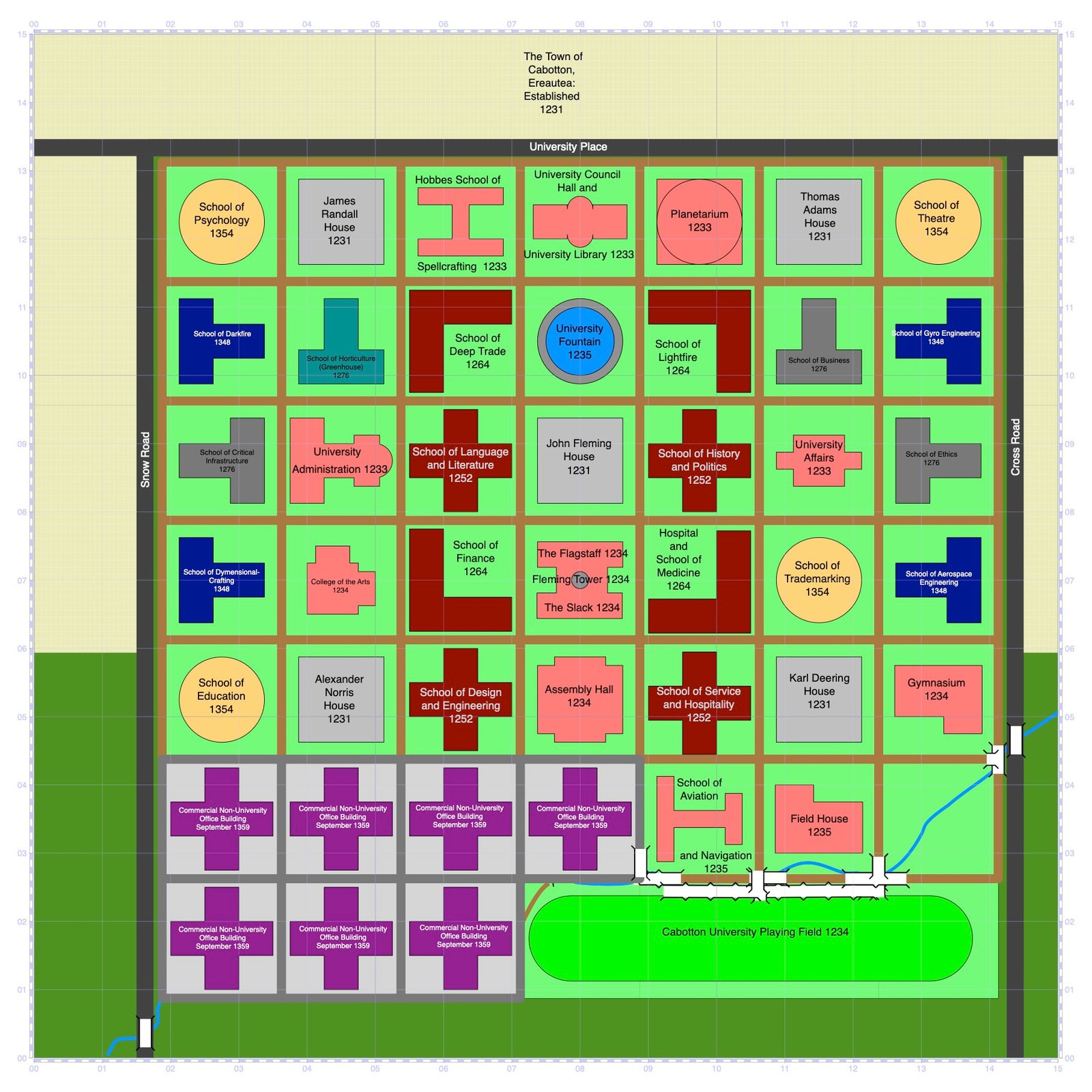
Also a stipulation in Stamp Out Corruption was the final sale of the University Lake and University Airfield to a group Gyrosakian real estate developers who, with permission from the University, drained the lake and began building over both the Lake and Airfield a series of commercial buildings. This construction project would be completed by May 1359.
University Council and Headmaster Stamp then granted authority to Chief Administrator Torus to lease out the sidewalks across Campus to various businesses for advertising and selling venues.
Stamp Out Corruption also ordered for debates to begin in University Council in January 1361 for an evaluation of finances and the possible elimination of student tuition. Until that point, the tuition and its increases would remain in place.
While the University Council was still debating the Stamp Out Corruption policy, before the final vote, henshale industry advocates saw the dramatic change in Cabotton University leadership as an opportunity to approach and negotiate the prospect of leasing land for henshale drilling, a practice banned by the Independent Commonwealth Federal Government but protected from federal legal intervention by a stipulation of property rights under the Cabotton University Deed. To the surprise of many, however, Stamp voiced adamant refusal to allow for henshale drilling and stated that he would refuse to sign any policy that included such a permission. Thus, a henshale-industry-favoring clause was never considered.
Regardless, those Liberals and Conservatives opposed to Stamp filed, under University Affairs between February and March 1358, a formal complaint against the Stamp Out Corruption policy, alleging that this had violated the provision under the Cabotton University Constitution against engaging in for-profit business interests. University Affairs, however, concluded that Stamp and his Administration were within their rights under the notion that the policy aimed to resolve University debt to the banks, and that such an objective was not considered a for-profit one.
As scheduled, on 23 May 1358, all Project VI, Phase I Waltmann Schools closed with their properties sold to commercial bidders.
Per the University Council measure approved and signed in October 1356, student tuition, in June 1358, increased to 7882.06 credits per semester.
On 22 June 1358, the University Council approved a measure for the establishment of the Voter Freedom Advocates Team, now named the Voter Freedom Committee, as an official University Administration department.
And on 12 September 1358, the University Council approved, signed by Stamp the same day, the Educational Quality Improvement Program. Scheduled to take effect in January 1359, this Program authorized for all University classrooms to be leased out to privately-owned charter schools whereas instructors from said charter schools would teach in the relevant subjects of those taught in the University classrooms before the charter transition. The conditions here were that said charter schools sold their own textbooks and charged their own tuition rates; though Stamp publicly and informally called upon them to keep their fees affordable. Those students and staff opposed to Stamp began to protest; and Torus responded to such protests with by dispatching the Campus Watch, while Stamp blamed Flagstaff "propaganda."
Stamp also enacted a program to increase retirement packages for himself and his loyal colleagues in University leadership while promising the same for those Arbitrators in University Affairs if they either side with him or retire early. This led to an explosive increase in University debt and expenses, despite Stamp's policies and promises. And in October 1358, the University Council, at the urging of Stamp, voted to increase tuition, once again, for the effective date of June 1360. Stamp assured the public that this was temporary and promised "better times around the corner."
All Project V Waltmann Schools would close on 23 December 1358.
Jon Den
By the end of December 1358, it had become apparent that Headmaster Stamp's policy of allowing private businesses to utilize Campus sidewalks had become an issue. There were a large number of sidewalk spaces being used, making navigation difficult for students between classes. Most notoriously, Gyrosakian credit card companies were dominating this landscape, and had begun using aggressive salesperson tactics on passerby. Numerous student and faculty groups petitioned for Stamp's Administration and University Council to have a policy in place to at least regulate this, but both Stamp and the Council voiced explicit refusal to act accordingly.
On 2 January 1359, the Education Quality Improvement Program took effect, thus allowing charter schools who had signed classroom leases to begin their curriculum. Average tuition costs charged by these organizations came to 1000.00 credits per class per semester while textbooks costs averaged 600.00 credits per book. This triggered further student resentment against University Council and the Stamp Administration both of whom, once again, voiced refusal to enact regulatory policies accordingly. Furthermore, Stamp, once again, blamed Flagstaff "propaganda" for evoking said student resentment.
On 4 March 1359, students and staff organized and carried out a mass strike against University leaders, demanding Stamp's policies thus far to be reversed or otherwise changed. Chief Administrator Torus responded by dispatching the Campus Watch, who imposed martial law across the Main Campus by imposing curfews and setting up checkpoints between every entrance to every building. Torus further authorized the Watch to monitor ballot boxes for the upcoming University elections while Stamp claimed that there existed "propaganda electoral infiltration." On 18 April 1359, Cabotton University student, Maxima Tangreen, filed a formal complaint to University Affairs against University leadership for overstepping their bounds and possibly interfering in the electoral process.
Jon Den, an "education advocate" representing the Esurchian State, arrived to the University on 19 April 1359 and began publicly giving scathing feedback against the Stamp Administration. Among many other things, Den condemned Stamp and Torus for overstepping Campus Watch powers, and condemned Stamp for breaking his promises on student tuition, failing to keep control of the "sidewalk vendors," allowing charter schools to financially exploit students, and destroying the University Lake and University Airfield for real estate development. This would lead Den to gaining a favorable reputation with a large majority of Cabotton students and staff.
The hearings against Stamp began at University Affairs on 20 April 1359. On that same day, at the urging of popular demand led by Den, Greg Torus resigned from his Chief Administrator position, while Stamp appointed Jon Den, himself, to fill the role. The University Council approved the appointment; and Jon Den's tenure as the new Chief Administrator began 21 April.
On 2 May, University Affairs concluded that Stamp and Torus were, indeed, overstepping their limitations of power, and ordered that Campus Watch scale back the additional measures, especially those involving interference with the ballot boxes. They did, however, allow Stamp to remain the Headmaster for the remainder of his term and to seek re-election for additional terms.
Despite the latter, Arnold Stamp, owing to popular demand led by Den, announced his resignation from the Headmaster position on 3 May, to take effect on 15 May 1359. Between those two dates, Stamp and Den held private talks during which Stamp had the University Council approve a motion to grant Chief Administration Den direct powers over the University Treasury while Den promised Stamp a handsome retirement package. It is important to note, at this point, that neither of these two arrangements received public attention.
Shortly after Stamp's departure, Jon Den publicly refused to accept his appointment as an Interim Headmaster, despite constitutional protocol allowing for such. Instead, Den stated that Headmaster elections would occur as scheduled on 16 September 1363, and that the University, till the beginning of the next term on 2 January 1364, would function without one.
However, it was after 15 May that Jon Den's attitude regarding the University began to change drastically.
On 18 May 1359, Chief Administrator Den declared those Members of the Third Level Society to be practicers of oathcrafting, and, on that same day, gave the Society until 2 September to move itself and all of its assets off of University Campus. Den stressed that any assets left behind would be seized and sold to bidders. The Society had been planning to relocate anyway, but Den's decision forced them to expedite the process.
Den then went after the University Library, labeling certain books owned by the University as apparently containing oathcrafting and others forms of "bad influences." He authorized to have these books sold and removed off campus, to be replaced by books either from the charter schools or those approved by the Esurchian State.
On 23 May 1359, per policy previous signed by Arnold Stamp, all Project IV Waltmann Schools closed. Up to this point, Den had remained intentionally silent on his stance regarding the Waltmann School Program. But then on 26 May 1359, he ordered the closures to continue on an expedited schedule, with all Project III Waltmann Schools now set to close on 23 June 1359, all Project II Schools to close on 23 September 1359, and all Project I Schools to close on 23 October 1359. On 3 June, students and staff organized and carried out another mass strike, but Den responded by stepping up Campus Watch measures, very much like Torus had done in the past, but now with the Watch authorized to use potentially lethal force. The crackdown of June 1359 was not fatal, but there were serious injuries reported. Furthermore, over 300 Cabotton students were expelled and trespassed from Campus.
Chief Administrator Jon Den then turned his attention toward University Affairs, which he accused of being corrupt based on their decision to not completely dismiss former Headmaster Stamp from his position. Den called on the incumbent Arbitrators to resign in order to be replaced by "new Arbitrators better fit for the role." Privately, Den gave handsome retirement packages to those who followed through, further increasing University debt and expenses. One Arbitrator, Tyler Cunningham, resisted and held onto his role. However, Cunningham was later invited to a retirement party for one of the other Arbitrators, during which he was unknowingly given belwine by the Esurchians, and became incapacitated due to strong addiction urges. Per the urging of Den, Cunningham was voted out of his role by University Council on 27 May 1359, while Den carried out numerous infiltration measures to sow discord among University Council Members over approving replacement Arbitrators, leading to a forever-impasse. Thus, University Affair Arbitrator roles became, and would remain, vacant.
On 2 June 1359, student tuition, per University Council approval in October 1357, increased to 10703.01 credits per semester. Chief Administrator Den stated publicly that he did not have direct power to eliminate student tuition or reverse the increase, and called upon University Council to vote in these desired measures with two-thirds majority. Den, meanwhile, implemented infiltration measures to sow further discord within the Council chambers over this, thus leading to another forever-impasse.
Chief Administrator Den allowed for the "sidewalk vendors" to carry out their business unregulated until "the University debt was paid off," allowed for the continuance of real estate development at the former University Lake and University Airfield sites, and allowed for the charter schools to continue their business unimpeded.
On 18 June 1359, Den ordered the Campus Watch to seize all student ballot boxes, citing alleged potential "electoral sabotage" being carried out by the opposition. He initially promised for the ballot boxes to be returned before the 16 September elections. However, on 14 September, Den changed his stance and stated that the elections would have to be re-scheduled. Despite this, students and staff resisted and carried out elections on 16 September, utilizing copies of ballots made before the seizures. However, Den declared these ballots invalid and called on University Council to "get serious" about appointing new University Affairs Arbitrators to facilitate the overdue elections, which Den assured the public would occur "sometime in December." Again, Den worked infiltration measures to cause a forever-impasse in Council.