Preface
By the 1100s BCE, the Circlarian Empire, spanning the Circlarian Realm between Canticula and Remikra, had nearly achieved global status, the first to do so since the ancient Ancondrian State of Edom of the distant past.
Southwest Canticula, at that time, extended to the present-day Meredythian Islands of Vantacula, Mikropouli, Megalopouli, Terasy, Forsy, and Arnaki. In fact, the aforementioned Isles were part of Canticula, itself, as the land between it and present-day Gyrosak was raised above the waves of the mighty Circlarian Ocean due to a growing magma chamber under the super-volcano: Magnum Plagam Collis. In fact, the six aforementioned Isles were actually summits lining the volcanic crater. At the foot of the main summit, along the Circlarian Coast, sat the Imperial Seat, located under present-day Akropolis.
In 1025 BCE, Magnum Plagam Collis erupted, destroying and burying the Imperial Seat. The magma chamber collapsed in the process, leading the land between the Isles and present-day Gyrosak to fall beneath the waves. Coastlines around the Circlarian Realm were destroyed by tsunamis; and a volcanic winter covered the globe for approximately five years, a period referred to by historians as the Ashen Years. This event wiped out nearly all of Circlarian civilizations, while the nomadic peoples fared slightly better than the settled civilizations. Those who survived did so by practical means.
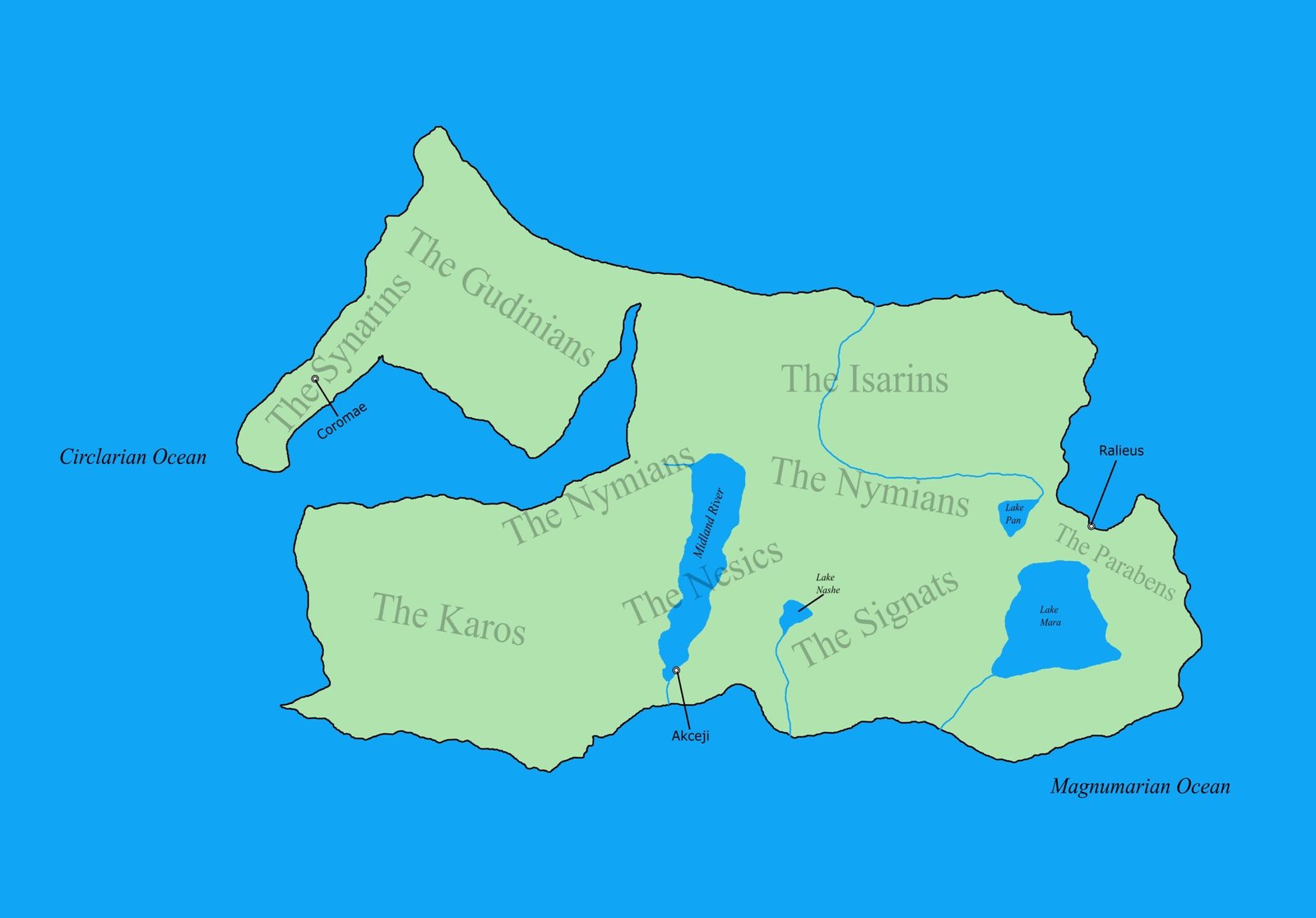
Before the cataclysm, the Circlarian Empire established three Seed Vaults in what were termed "Citadel Cities." One was located in Coromae, present-day Cenofan; another was located in the city of Akceji near the mouth of the Midland River; and a third was, at the time, a mystery in its location, though was later discovered in Ralieus, present-day Ralyn, Yarol.
An important factor helping in the survival of the Citadel Cities was the use of kelwick oil as a fuel. Meanwhile, the nomadic groups who survived were those who knew where to travel for food and had the means to do so.
The Regions of Canticula
The West Peninsula was home to the Citadel City of Coromae as well as the Synarin nomad peoples, who lived along the many rivers and lakes, and traveled mainly by boat. Northwest Canticula was home to the Gudinian nomadic peoples, who were known for making religious pilgrimages to the sacred Lake-and-Pillar, located in the present-day city of Gudina. Northeast Canticula was home to the Isarin nomadic peoples, known for traveling mainly by horseback, while the region was known for its plains and the Great Isarin River. The region of the Chokian Mountains, the longest mountain range in the world, which stretched from present-day Chok to the East Coast of Canticula, was home to the Nymian nomadic peoples as well as territorial wysps and the Belleshian Plateau. Southwest Canticula was home to the Karo nomadic peoples, and was known, as is today, for the Diveo River, the rolling grasslands to the North, and the rolling grasslands to the South, all atop the Chokian Plateau which stood at an elevation of 2500 feet above sea level. The Midland River region was home to the Nesic nomadic peoples and the Citadel City of Akceji; and the Midland River was known as it is today for its current flowing in counter-clockwise fashion owing to gyro-forces, as well as being the widest river in the world. The Red Desert region was home to the Signat nomadic peoples while the name, Red Desert, derives from the bright red color given off by the sands and rock during the winter solstice. And finally, Southwest Canticula was home to the Paraben peoples and the hidden Citadel City of Ralieus.
Geography
The terrain of the West Peninsula is dominated by two river basins: the Galan in the North and the Marish in the South, with the latter flowing through a network of lakes. And all throughout were low rolling hills covered by forests and grasslands. Both pines and deciduous trees dominated here, while the grasses and flowers here were of temperate species variety. The native animals of the West Peninsula included deer, elk, horses, black and brown bears, snakes, and hill cats.
Meanwhile, Northwest Canticula had steeper and higher hills, sometimes even low mountains. The region also had smaller but more numerous lakes as well as a large number of short rivers. More pine trees and Northern flower species grew here while the grassland areas were sparser. Like the West Peninsula, Northwest Canticula was dominated by deer, elk, and bears; however, they also had wolves, mountain cats, rams, mountain goats, sheep, and eagles. It is important to note, though, that the eagles in this region were much smaller than their counterparts in Remikra.
In contrast to the Northwest, Northeast Canticula was dominated by flat plains and grasslands, all of which were crossed by river basins including the Great Isarin River network. Very few trees grew here except for the area lining the Chokian Mountains. However, Northeast Canticula had quite a large variety of flowers. Northeast Canticula was home to deer, elk, horses, wolves, bears, moor cats, rodents, a variety of insects both non-venomous and mildly venomous, and a variety of birds.
As in its name, the Chokian Mountain region was home to towering, snow-capped mountains. There existed also numerous short-distance rivers, deep lakes, and, most notably, the Belleshian Plateau. Pine trees were very frequent and grasslands occasional. However, the higher elevations were dominated by barren rock with snow. Over all this region roamed mountain bears, mountain cats, rams, goats, elk, and deer, as well as a variety of rodents. There were also formed and formless wysps. Usually, in other parts of the world, it was the formless wysps deemed dangerous; but both types here, both territorial, gained notoriety.
From Northwest to Southwest of the Southwest Canticula region runs the Diveo River, to the North of which stand rolling grasslands and to the South of which stand forests. All terrain here sits atop the Chokian Plateau, 2500 feet above sea level. Mostly deciduous trees, as well as some pines, dominate the region. To note, there are also palms and ferns in present-day Gyrosak. Warm-temperate grasses and a variety of flowers also live here. And roaming along through this region are numerous kinds of rodents, deer, elk, moor cats, and bears.
As aforementioned, the Midland River flows counter-clockwise owing to naturally-occurring gyro forces and stands as the widest river in the world. This river is fed by ten tributaries, five on each side, and is lined by low-level plains on either side. The lands in the West slope up to the Chokian Plateau while the lands to the East slope up to the Red Desert Plateau. In the Southern portion of the Midland River region grow tropical trees, grasses, and plants while temperate trees, grasses, and plants grow throughout most of the region. Pines and other cold-weather flora grow in the land area between the North end of the River and the Chokian Mountains. Meanwhile, warm-weather fauna inhabit the Southern portion, while temperate-weather fauna inhabit the temperate zone and cold-weather fauna inhabit the North.
The terrain atop the Red Desert Plateau is mostly flat, towered by the Belleshian Plateau to the Northeast. Meanwhile, there stands the Great Canyon of Lepowe Southwest of Lake Mara, lined by the River of Geljer, while the Lake itself sits atop its own elevation surrounded by the Lake Mara Slopes. Plant life in the Red Desert Region is quite sparse barring the oases and lands surrounding the lakes, with the majority of the Red Desert consisting of sparse dried grass and brambles. Animal life here consists of sand-worms, desert ants, the Great Desert Hawk, and a variety of insects and reptiles.
The terrain in Southeast Canticula is the most varied of the continent, with the Chokian Mountains to the North, the rolling hills in present-day Yarol, the smaller-elevation Raisekan Mountains lining Lake Mara and the Eastern extension of the Red Desert, and the rolling hills along the East Coast. Here the grow numerous varieties of tropical and warm-temperate trees, grasses, and plants. Meanwhile, the region is inhabited by Marran Hillcats, deer, elk, rodents, and a variety of insects and reptilian species.
Climate
Like in the present, Canticula had differing climates from region-to-region.
The West Peninsula had what was considered a marine-temperate climate. In other words, it was very rainy year round, with exception to a moderate dry season that occasionally passed between January and February. During the spring months, temperatures ran cold to mild with precipitation falling four to six days per week; during the summer, temperatures ran mild to warm with precipitation falling six to seven days per week; during autumn, temperatures ran mild to cold with precipitation falling two to four days per week; and in winter, temperatures ran cold to freezing with precipitation falling one to two days per week.
Northwest Canticula had a cold-temperate climate pattern, with temperatures running cold to mild with precipitation falling three to five days per week in spring; temperatures running mild to warm with precipitation falling five to six days per week in summer; temperatures running mild to cold with precipitation falling two to four days per week in autumn; and temperatures running cold to freezing with precipitation falling one to two days per week in winter.
Northeast Canticula had a contrasting continental climate. Here, temperatures ran cold to mild with precipitation falling two to four days per week in spring; temperatures ran mild to warm with precipitation falling four to five days per week in summer; temperatures ran mild to cold with precipitation falling one to three days per week in autumn; and temperatures ran cold to freezing with precipitation falling one to two days per week in winter. To note, once every few years, the region would get a significant blizzard.
The Chokian Mountain region had what was called a mountain-temperate climate, where, during spring, temperatures ran cold to mild with precipitation falling three to six days per week; during summer, temperatures ran mild with precipitation falling six to eight days per week; during autumn, temperatures ran mild to cold with precipitation falling three to six days per week; and during winter, temperatures ran cold to freezing with precipitation falling five to six days per week.
The Southwest Canticula region had four climate zones: the North Chokian Zone, the South Chokian Zone, the Gyrosakian Zone, and the aforementioned Chokian Mountain Zone. In the North Chokian Zone, spring temperatures ran cold to mild while precipitation fell five to six days per week; summer temperatures ran mild to warm while precipitation fell six to seven days per week; autumn temperatures ran mild to cold while precipitation fell four to five days per week; and winter temperatures ran cold to freezing while precipitation fell three to four days per week. In the South Chokian Zone, spring temperatures ran mild with precipitation falling six to seven days per week; summer temperatures ran warm with precipitation falling seven to eight days per week; autumn temperatures ran mild with precipitation falling five to six days per week; and winter temperatures ran cold with precipitation falling four to five days per week. The Gyrosakian Zone boasted warm temperatures and six to seven days of precipitation per week in the spring; warm to hot temperatures with seven to eight days of precipitation per week in the summer; warm temperatures with five to six days of precipitation per week in the autumn; and mild temperatures with four to five days of precipitation per week in winter.
The Midland River region had a wet and subtropical climate along its South Coast, a warm-temperate climate in its Interior, and a temperate-mountain climate in its North.
The Red Desert Region had a North Red Desert Climate Zone and a South Red Desert Climate Zone, both very arid in terms of precipitation. In the North Zone, spring temperatures ran mild with an average of one day of precipitation per week; summer temperatures ran warm to hot with only one day of precipitation per week; autumn temperatures ran mild with no precipitation; and winter temperatures ran cold with no precipitation. In the South Zone, spring temperatures ran warm with one day of precipitation per week; summer temperatures ran hot with one day of precipitation per week; autumn temperatures ran warm with no precipitation; and winter temperatures ran mild with no precipitation.
Southwest Canticula, in contrast, had a wet and warm-temperate to sub-tropical climate, with precipitation falling nearly every day during the spring and summer, and about five to six days during autumn and winter. The region had warm spring temperatures, hot summer temperatures, warm autumn temperatures, and mild winter temperatures.
Languages
The main language spoken in the Citadel Cities of Coromae, Akceji, and Ralieus was Aerdn. However, dialects in those places, owing to the passing years of separation, began to vary considerably by the 850s BCE.
Meanwhile, the nomadic Synarins in the West Peninsula region spoke a variety of native tongues. The Gudinians of Northwest Canticula spoke a mixture of Aerdn and their native tongues. Isarin Vernacular was spoken in Northeast Canticula while Nymian Vernacular was spoken in the Chokian Mountains, and a mix of Karosian Vernacular and Aerdn was spoken in Southwest Canticula. Outside of Akceji was spoken the Nesic Vernacular in the Midland River region; the Signat Vernacular was spoken in the Red Desert region; and a mix of Aerdn and Parabenian Vernacular was spoken in Southeast Canticula.
Religions
Religious belief in the Citadel Cities followed an Imperial Circlarian Pantheon containing a mix of human and elemental deities, which included a Chief Creator and his descendant deities, a Deity of Ocean and Waters, a Deity of the Earth, a Deity of Weather, a Deity of the Underworld, a Deity of the Cosmos, and a Deity of the Afterlife. A small percentage of the population of Coromae also believed in Alphaesianism, but that would not become mainstream until much later. Also, the Nesic peoples of the the Midland River region had been converted to follow the Imperial Pantheon; thus no records exists of their previous religious beliefs.
The Synarin Pantheon of the West Peninsula was quite like the Imperial Circlarian Pantheon in many ways except that there were no deity familial lines involved; only elemental deities, such as that of the Earth, of the Sky, of the Oceans, and of the Streams and Lakes.
The Gudinian Pantheon of the Northwest Canticula region was quite similar to Totian beliefs, in that they believed that the Sun, planets, and Juno Major were divine beings who created the world out of fire and chaos and controlled all that happened within, while the stars were those ancestors living as divine beings in the afterlife in the Cosmos. Though a nomadic group, the Gudinians would gather at the Lake-and-Pillar, located under present-day Gudina, and perform religious rites based on this Pantheon to mark the summer and winter solstices.
The Isarin nomadic peoples of Northeast Canticula, meanwhile, worshipped gods and goddesses of fire. This was partially inspired by the presence of a burning natural gas pit located near present-day Foten, Rellihan, whose source of ignition remains a mystery to this day. The Isarins, like the Totians of Remikra, believed that the world was birthed from fire and chaos. In contrast, however, they believed that all deities were of the Underworld and that the world would, one day, return to the fire and chaos. Also according to this belief, the deities controlled what happened in the world through the writing of a "Story of Life." Isarin priests sought to intercede with the divine in order to help answer the prayers of the Isarin people through the writing of said Story.
The nomadic Nymians of the Chokian Mountains believed that each Mountain was a deity, god or goddess, and that every Nymian would ascend to live atop the loft summits in the afterlife.
Meanwhile, the nomadic Karos peoples of Southwest Canticula believed also in the Imperial Circlarian Pantheon, but also that there was a deity for every stream and river.
The Signat peoples of the Red Desert region followed a Pantheon including a Goddess of the Sun, God of the Sand, and Goddess of the Wind. And the nomadic Paraben peoples of Southeast Canticula worshipped the Imperial Circlarian Pantheon as well as local deities of the mountains and the Ocean.
Arts and Music
Visual art, in the Citadel Cities of Coromae, Akceji, and Ralieus, consisted of tile mosaics, very much like the mosaics of the Imperial past, depicting mostly secular, everyday life. Stone and cave paintings were drawn by the Synarins of the West Peninsula, the Gudinians (who also created pebble mosaics) of Northwest Canticula, the Nymians of the Chokian Mountains, the Karosians of Southwest Canticula, the Nesic peoples of the Midland River region, and the Paraben peoples of Southeast Canticula. Clay reliefs, some surprisingly realistic, were created by the Synarins, Gudinians, Isarins, and Parabens. To note, the Signats of the Red Desert region were known for their sand mosaics during this time.
Music in this time period was believed to have been done vocally, though some played lutes, stringed-lutes, and primitive percussive instruments. Imperial standard instruments were used in the Citadel Cities while each nomadic group had its own local versions of said instruments.
Theatrical works from Imperial times were performed in the Citadel Cities. Meanwhile, the nomadic groups had their oral stories which they would sometimes act out, especially during religious rituals.
Education
For the Citadel Cities, education was taught in primary, secondary, and advanced stages, very much like for modern Circlarian education standards. During the primary stage, students would learn basic reading, writing, and arithmetic in the Aerdn script. During the secondary stage, students would use such skills to accomplish complicated assignments in problem-solving and critical-thinking. And during the advanced stage, students would pursue military training, depending on qualifications, and then on to apprenticeships for guilds or other vocations as appropriate for given social classes.
For most nomadic societies, the youth first learned oral stories as well as common chores to be done around one's dwelling. Afterward, they would take part in expeditions to hunt and gather while learning combat skills. Aand after the coming-of-age, some would lead such expeditions while serving as warriors in combat if needed while others would join the ranks of the seers and priests.
Government Structures
Each Citadel City in the past was governed by a Consul appointed by the Imperial Seat. With such an Imperial Seat no longer in existence, Consuls remained to rule, with such positions succeeded through an incumbent-appointing process. Each Consul wrote laws and orders, as well as collected taxes, and appointed Wardens to carry out such orders throughout the City. Consul succession was by merit on paper, but in practice, largely hereditary by the 850s BCE. Each Consul did not have absolute power, however, as their power was kept in check by the City's Five Keepers of Council. Usually, the Five Keepers would simply advise the Consul on decisions to be made. But in rare circumstances, they were able to unanimously vote to either reverse an order made by the Consul or to enact one refused by him. It is important to note, however, that such decisions could be made with or without popular backing. The power of both bodies was checked by a Tribune of Clerics who made moral determinations on decisions and could stop a decision through a unanimous vote when needed.
The nomadic groups of the time functioned as Clans who traveled in Caravans. Each Clan was headed by an Elder, male or female depending on either family lines or local tradition. Each Elder governed over every Head of Household for the Clan. The Heads of Household made many important decisions but the Elders had a final say on such matters if needed. However, it was the Elder's responsibility to preserve approval from the majority of the Clan traveling, with the said Elder being cast out otherwise. For each nomadic group, every Clan had either a Priest or Seer who would intercede with the divine they worshipped for moral determination on decisions being made.
Economy
Every Citadel City adhered to the gold-silver-copper standard of the Imperial Age, and conducted trade accordingly in the Great Forum of each City as well as in the Lesser Forums. Traders here also engaged in straight-trade, or trade between goods and services that did not involve currency.
Nomadic groups occasionally interacted with the Citadel Cities but, on the most part, engaged in straight-trade between Clans, and sometimes with other nomadic groups.
Trade and Diplomacy
On most occasions, the Clans of each nomadic group fared well with one another. However, there were occasionally rivalries leading to sporadic outbreaks of conflict. Most conflicts and rivalries, however, occurred between groups or regions. Most noteworthy during this period was the tension between the Isarins and Nymians, tensions between the Nesic and Karo peoples, tensions between the Nesic and Signat peoples, and tensions between a majority of Signat Clans and their fellow Signats in the Geljer River and Lepowe Canyon regions.
Social Structures
Most members of nomadic groups were in equal standing with one another in terms of wealth and power, with exception to the Elders and leadership, who were tasked with making the final decisions. In contrast, the social structure of the Citadel Cities was very stratified, with laborers, builders, servants, slaves, and farmers in the lower class; merchants, guild members, artisans, and soldiers in the middle class; guild owners and military commanders in the upper class; and Consuls and Wardens in the ruling class.
Fuel and Resources
The Citadel Cities relied on wood and kelwick oil for burning fuel while the nomads used only wood. Both the West Peninsula and Chokian Mountain regions carried out the ancient practice of mining, which yielded gold, silver, copper, gems, and salt. Fresh water was available in ample quantity throughout most regions of Canticula wherever there were lakes and streams. However, water could also be obtained from the occasional oasis in the Red Desert. Aside from the Red Desert, where the nomads got food from raids and desert animals, all other areas had cereal crops, fruits, berries, and game as reliable food sources. Most places used either clay, grass, or wood to build their dwellings, while the Citadel Cities used concrete. And many places, including the oases of the Red Desert, had herbs that could be used for healing.
News and Communication
Each Citadel City had Forums and Courtyards, each including a podium upon which could stand orators to give daily news statements, and a wall where there could be posted bulletin scrolls stuck with a special adhesive paste. Communication during this time was spread by couriers on foot who delivered scrolls between parties within the city. For messages to places like nomadic encampments far away, couriers would occasionally ride on horseback.
For the nomadic clans, such announcements were made by Elders or other leading figures at either campfire meetings or common meeting places in the region. These groups used mostly runners who delivered messages by spoken word between the two parties; and they did occasionally spread messages on horseback, especially in Northeast Canticula. Speculation also stands that some groups used special "seer stones" to communicate with one another, though the evidence is inconclusive.
Transportation
For both the nomads and Citadel Cities, the most common mode of transit during this time was by foot. Those of the upper social classes of the Citadel Cities used horses and boats, especially for long-distance travel. Meanwhile, the nomads used these same modes of transit, especially those scouting ahead of a caravan.
Brick streets were present within Citadel City limits. And old Imperial roads outside were occasionally used. However, most transit outside the Cities was done along dirt paths. There were landing places, though, along the lakes and rivers that served the boats both from nomadic clans and from the Citadel Cities.
Defense and Warfare
Every Citadel City mandated for every able-bodied man of the middle and upper classes, between the ages 18 and 35, to enlist and train in the military, even in peacetime. Every Citadel City military structure included an infantry, consisting of archers, spearmen, and swordsmen; a cavalry, consisting of the same type of fighters; and a navy, consisting of rafts holding infantry fighters. In every division was a subdivision of those trained through the Citadel Library to use their weapons with spellfire enhancements.
Nomadic warriors consisted of archers, spear-wielders, and blade-wielders, all recruited as men and women fit for combat between around the same age range. There was no conscription officially with these societies but there was moral and honor-bound incentive. The Isarins fought mostly as cavalry while the other groups fought as infantry. However, nearly every nomadic group had a team of archers would occasionally fight from rafts or canoes as needed.
Spellfire-Crafting
The Citadel Cities kept their spellfire scripts upon scrolls, copied from the Imperial Days and stored securely in Citadel Libraries. Keepers here would only grant access to such scrolls to those specially trained to use them in accordance to the Congress of Circlaria standards.
Some trusted nomadic groups had access, like the Synarins to Coromae. However, most nomads resorted to runes and conjuration methods from before the founding of the Circlarian Congress. Some spellfire practices of note during this era were of darkfire by the Synarins and of "fire runes" by the Isarins.