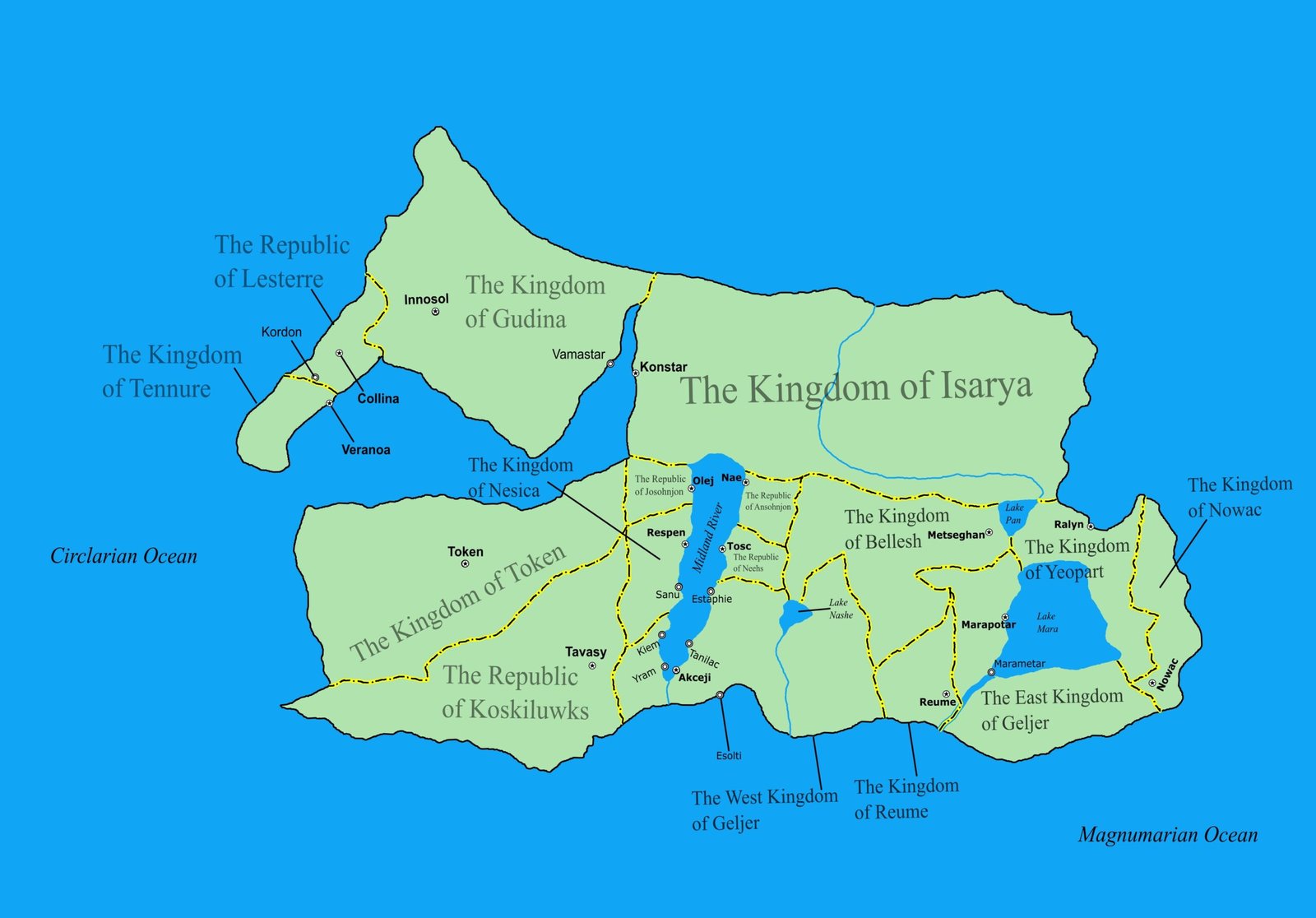
East and West Kingdoms of Geljer: Diplomacy
In September 751 BCE, King Merus of the West Kingdom of Geljer died peacefully and was succeeded by Queen Noria. In April 750 BCE, after discussions between envoys, Noria signed numerous treaties of peace and trade with Queen Erea of the East Kingdom of Geljer. This established a fragile peace between the two Kingdoms, allowing trade to flourish.
Karosia: Rule of King Henmor
Since the gaining of independence in April 766 BCE from the Cantician Empire, the Kingdom of Karosia was ruled by King Henmor. Henmor established his Throne in the city of Token, despite promising to "return the city of Token to nature." The breaking of his promise, Henmor reasoned, was due to a "divine calling" he received to claim the city instead. In consolation to his followers, the King ordered the planting of the Outer Gardens of Token.
Under Henmore's rule, the Kingdom enjoyed relative peace and prosperity as it brokered neutral diplomacy with its Canticulan neighbors and allowed for free trade with them. The Kingdom was also one of the first in this region and age to establish an ancient equivalent of a citizens' welfare program. And in June 750 BCE, in accordance with Congress of Circlaria standards, a School of Spellcrafting was established in Token.
Rise of Gendor
The existence of the Kingdom of Karosia was not without its issues, however. King Henmor was challenged by a rival named Gendor. Considered a best friend to Henmor since childhood, Gendor demonstrated an exceptional degree of talent in spellcasting and spellcrafting during the war against the Cantician Empire. In 750 BCE, Gendor became one of the first students to enroll at the Token School of Spellcrafting and graduated with honors and certification shortly thereafter. Following the graduation, Gendor became determined to establish a standard spellcrafting school of his own in the Southern regions of the Kingdom. However, such would require large funds. King Henmor declined to raise taxes for this effort, so Gendor opted to raise funds through an independent fundraising campaign in the South.
Gendor Versus Henmor
Before long, a rumor arose that Gendor was using oathcrafting among the population to achieve this, an act deemed unlawful by the Congress of Circlaria. King Henmor ordered Gendor to stop his campaign and return to Token. However, Gendor refused the order, insisting that the oathcrafting accusations were false. To this, King Henmor responded with a threat to use military force. Upon receiving this threat, Gendor recruited a militia of spellcasters and fighters, all sympathetic to him, and began overtaking large swaths of territory in the Southern regions.
This prompted King Henmor to dispatch his armies in order to put down the uprisings. However, Karosian subjects were less than willing to pay the resulting tax increases, as taxes were already high to fund campaigns against chronic raids along the coasts by hostile sea guilds that had emerged in recent years.
Rise of the Kingdom of Token
In October 748 BCE, King Henmor dispatched his army to put down the uprising of Gendor. This proved costly to the Royal Treasury, however, leading to the hated tax increases. With such resentment as fuel, Greyma, an elder daughter of one of the rival families against King Henmor, led a militia that seized the Treasury in March 747 BCE. In the following month, Greyma proclaimed herself Queen and the Northern half of Karosia to be the Kingdom of Token.
Rise of the Republic of Koskiluwks
Henmor's agenda in the Southern regions of the Kingdom of Karosia had been costly. Widespread ensued as battles included exchanges of spellfire discharges. Fighters on both sides resorted to plundering the countryside for resources following the cutting of the supply chains by Queen Greyma in the newly formed Kingdom of Token. Henmor had the upper hand in the ensuing war before the usurping of his Throne in Token. But now he was forced to send a large number of his forces back to Token, giving Gendor the upper hand. Meanwhile, Greyma's forces in Token proved to be too strong to overcome.
Then, among the local inhabitants in the South, arose a leading figure named Renma, who recruited spellcasters and fighters to resist both Henmor and Gendor. Renma drove Henmor to the sea in February 746 BCE, after which Henmor agreed to surrender and be handed over to an unknown sea guild as a hostage for Renma. In March 746 BCE, Renma cornered Gendor, who yielded and accepted an offer to live as a spellcaster in Renma's employ.
In the summer of 746 BCE, Renma was called upon by her closest advisors to crown herself Queen of a new Kingdom carved from the Southerly regions of Karosia. Renma, however, rejected this and called for these lands to be established as the Republic of Koskiluwks. Furthermore, she endorsed her wife, Ophrena, to run as an elected Consul over this Republic, an office with a term limit of five years.
Thus ended the Kingdom of Karosia.