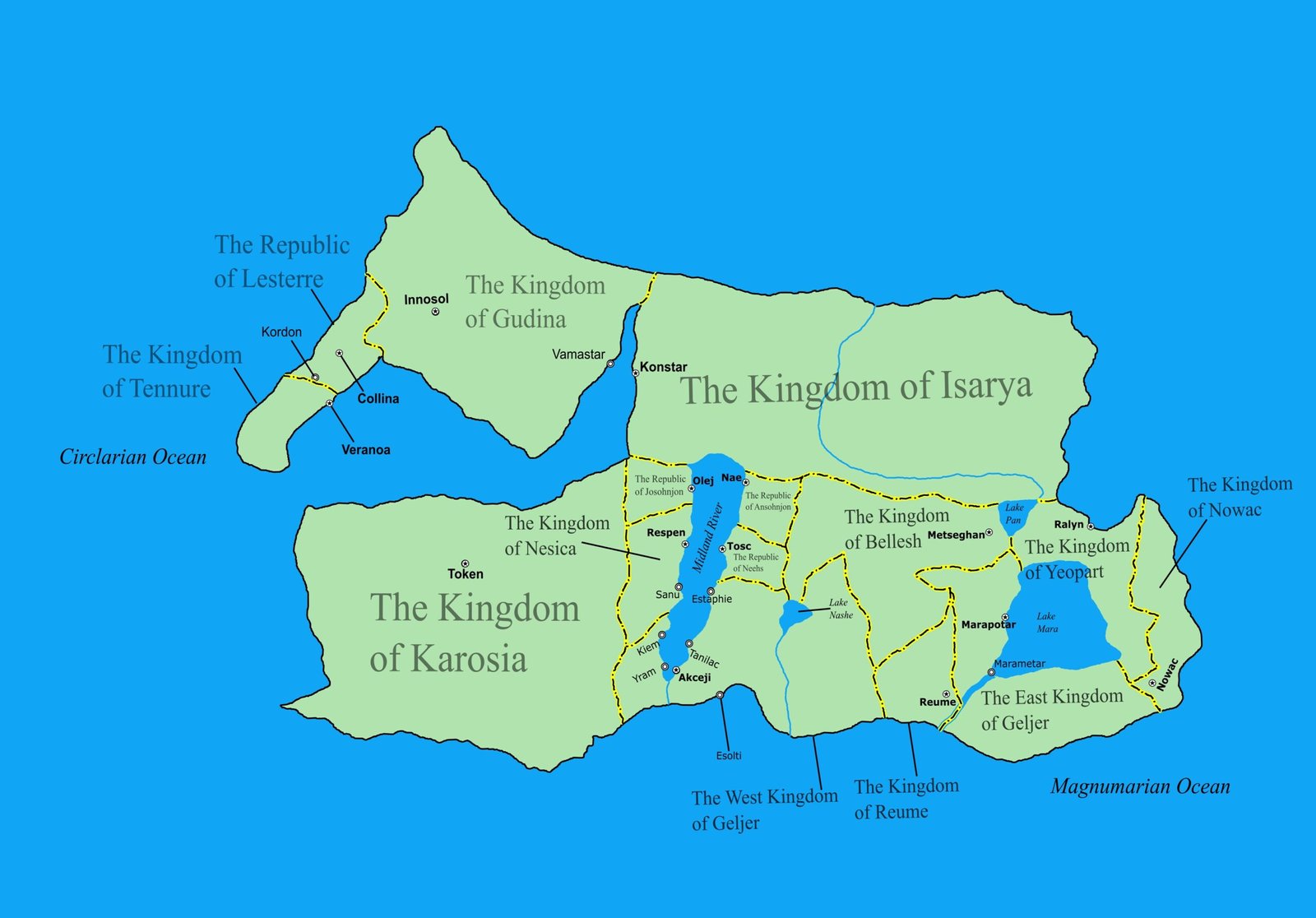
Fall of the Synarian Republic, Rise of the Republic of Lesterre and Kingdom of Tennure
Until the latter days of the 800s BCE, much of the land home to the Synarin peoples had been governed as clans by Elders. The Enra Clan, a strong maternal line, remembered this and, after the fall of the Empire, saw an opportunity to regain territorial dominion. Many looked to the Elder Daughter of this Clan, Veranoa, to run for Consul. However, she refused and instead proclaimed herself Queen of Synaria. As Queen, Veranoa defied orders from Consul Mordraya and began campaigning for such territorial dominions by force. Thus far, Mordraya was able to keep Veranoa in check.
As a Commander, Collina condemned Veranoa for disturbing the peace, and also condemned Mordraya for her hesitancy to address Veranoa. Collina then announced her run for the Consul position to unseat Mordraya, then to use her power as Consul to capture and execute Veranoa. Many voters were set to re-elect Mordraya as they saw her as the only force preventing the extreme figures of Collina and Veranoa from causing civil conflict.
Such circumstances changed shortly before the election, however, when Indroh, a friend to the late Canticius II, assassinated Mordraya on 17 March 763 BCE. Thus, civil conflict erupted between Collina and Veranoa.
Upon Mordraya's death, Collina declared herself Interim Consul to serve until elections could be organized. Queen Veranoa, in response, launched a campaign to capture the city of Kordon, where the government seat of the Synarian Republic was located, and establish her Throne there. In the meantime, her Throne stood in the recently constructed Fortress of Veranoa.
To counter the agenda of Queen Mordraya, Interim Consul Collina launched a counter-campaign locate the whereabouts of Queen Veranoa, draw her forces to a battlefield of choice, then, while the battle ensued, send assassins to sneak around the front line and execute Queen Veranoa. This, Collina launched in September 764 BCE. When battle was given in a field near the Fortress, Collina discovered the Queen and the location of the Fortress, and dispatched her team of assassins accordingly. However, unknown to her, Queen Veranoa was long aware of the assassination plot and, instead, drew 60 percent of her forces, those not already on the battlefield, to sneak around the front line and capture Kordon, now left undefended.
Upon receiving news of this, Collina immediately retreated her forces to double back and recapture Kordon. However, en route, Collina was killed by archers hidden in trees along the road. A new leader named Maione took her place and marched her forces toward Kordon, but was soon caught between Queen Veranoa's forces stationed in Kordon and Veranoa's forces pursuing them from the battlefield. Even with Collina dead and Queen Veranoa's forces having better ground and numbers, the clever tactics and leadership protocols of the Maione's forces brought the conflict outside the gates of Kordon to a stalemate.
In October 764 BCE, the two sides signed the Treaty of Veranoa and Collina. Provisioned in this agreement were terms for Queen Veranoa to retain her crown and rule over the lands surrounding her Fortress, while the northern portions of the former Synarian Republic would continue as a democracy.
With Queen Veranoa keeping her Throne in the Fortress, now named Veranoa in her name, the surrounding lands would be established as the Kingdom of Tennure. Meanwhile, to the North, a city was built atop a slight plateau rounding a river bend; this city was named Collina after the late Commander, while its surrounding lands became the Republic of Lesterre.
The nations of Tennure and Lesterre would maintain a relation of non-aggression but followed no obligation for mutual defense unless both sides consented to do so.
Formation of Josohnjon, the Kingdom of Reume, West Kingdom of Geljer, and East Kingdom of Geljer
Shortly after the sacking of Akceji, King Dylator of the Kingdom of Geljer named his daughter, Erea, heir to become Queen. This sparked contempt from many who believed that the next heir should have been male; they believed, therefore, that the Crown should have passed to Dylator's nephew, Merus, who shared the same paternal sentiment. At the time, Merus was a General. And in the wake of the announcement that Erea was to be heir, Merus attempted to raise a usurper Army. This, however, was discovered by Dylator, who banished Merus. As General, Erea took Merus' place, to which many people responded that it was a violation of principle to have a female General. Meanwhile, Merus began to secretly gather an army of outcasts and hire a group of assassins.
Since the early 700s BCE, the people of the Josohnjonian territories began wanting independence. In April 763 BCE, Merus consolidated such sentiment and sparked a united insurgency here. Upon receiving news of this, King Dylator led an army to put down the uprising. While the King rode out, Merus took a small group of guards and traveled back, concealed, back to the city of Marapotar, where sat the Geljerrian Throne. On 08 May 763 BCE, an assassin dispatched by Merus on his way back ended the life of King Dylator. In the wake of this, Dylator's forces, on May 14, surrendered to the insurgents and agreed to respect Joshnjon as an independent Republic. This would be formally acknowledged by Merus, who crowned himself King of the Kingdom of Geljer on May 20 after he arrived in Marapotar. Erea condemned Merus as a traitor for this and, on May 24, crowned herself Queen. Merus responded to this with a declaration of war, mustering enough forces to succeed in driving Erea out of the city of Marapotar.
Five years before these events, a veteran Commander named Gordrian was promised by King Dylator to be promoted to General upon the incumbent's retirement. During this period, however, Gordrian was assigned to mentor a recruit named Kemdrayon, who turned out to be unconventional but practical in his fighting skills. To Gordrian's frustration, Kemdrayon would frequently bypass Gordrian's authority, calling Gordrian incompetent in the process. However, Kemdrayon's unorthodox tactics went a long way to helping King Dylator succeed in not only capturing Akceji but also defeating Canticius III. As a reward, King Dylator passed over Gordrian to appoint Kemdrayon as the next General. This left Gordrian stewing in jealousy and contempt; however, Gordrian was able to project his sentiments in a way to draw a strong and loyal following from a group of indigenous outcasts named the Emilon Clan, who hated King Dylator and worshipped Reumor, a fire-god of war.
In June 763 BCE, Gordrian announced that Reumor divined to him that Merus and Erea were morally corrupt beings seeking to drain the land home to the Emilons of its life and light. Thus, they answered a calling by Gordrian to defend the lands of Reumor and to keep the enemy at bay. In September 763 BCE, they elected Gordrian King of the Kingdom of Reume. King Merus attempted to put down this uprising, but, after two to three weeks, it became apparent that Gordrian and Emilons had the upper hand.
While Merus was distracted by the uprising led by Gordrian, Erea, in October 763 BCE, led her forces in re-capturing the city of Marapotar. In March 762 BCE, Merus dispatched his forces in an attempt to take back Marapotar, but Erea's forces proved too strong.
In September 762 BCE, Merus and Gordrian agreed to a truce while Merus was forced to flee Marapotar to establish his Throne in Akceji, which he anticipated to be a temporary location.
Formation of Neehs and Ansohnjon
In March 761 BCE, Merus tried again to retake Marapotar, this time by laying the city under siege. However, like in the past, Erea's forces, proving too strong, broke the siege after only three days and all but vanquished Merus' forces. By the end of that month, they called an end to the conflict and signed the Treaty of Akceji and Marapotar, which gave Erea the East Kingdom of Geljer to be ruled from Marapotar and Merus the West Kingdom of Geljer to be ruled from Akceji. They, furthermore, agreed to aid each other in the event of an outside threat.
Meanwhile, King Merus, during the recent conflict with Erea, had taxed the crops grown on the farmland of the territories of Arydrome. Merus had previously promised to lift such taxes after the conflicts, but when peace finally prevailed, Merus went back on such a promise. In response, the local people rose and declared the lands of Arydrome to be the independent Republic of Neehs, to be governed from the city of Tosc. King Merus sent an army to put down this uprising, but with the local forces stronger than expected, there would be a stalemate here.
During the war in Neehs, Merus drew increasing amounts of resources, primarily for weapon-making, out of the Chokian Mountains in the Ansohnjonian territories. In September 760 BCE, the local people here rose and formed the independent Republic of Ansohnjon to be governed from the city of Nae. King Merus, in response, declared war on this land.
Queen Erea of the East Kingdom of Geljer refused to provide aid to King Verus, reasoning that neither Neehs nor Ansohnjon was considered an outside threat due to both conflicts being provoked by Merus. In October 760 BCE, seeing no other alternatives, King Verus grudgingly signed a truce with the Republics of Neehs and Ansohnjon, respecting their sovereignties.
Merus took no action against Erea for her refusal to aid him. However, it is said that he told his inner circle, in private, that he would vow a renewed war against her in the future.